How to use social listening to find the right health influencers
TL;DR
People look for health advice on social media, but the loudest health voices are not always the most credible. Use social listening to find health influencers by starting with the conversation, separating clinicians, patients and wellness creators, and checking credentials, claims and misinformation before you sign.
Key Takeaways
- ▸Start with the conversation about conditions, treatments and symptoms, rather than with a list of health influencers.
- ▸Separate the voices: healthcare professionals, patients, caregivers and wellness creators each shape the conversation differently.
- ▸Weigh expertise against reach. The most-shared health voices are sometimes the most qualified, but often they are not.
- ▸Check credentials, past claims and links to misinformation before you sign someone up.
- ▸Build compliance in from the start, including adverse event monitoring and claim checks.
In This Article
- Why is it hard to find the right health influencers?
- Step 1: Start with the conversation, not the creator
- Step 2: Separate clinicians, patients and wellness creators
- Step 3: Weigh expertise against reach
- Step 4: Check credentials and listen to what they actually say
- Step 5: Check for links to misinformation
- Step 6: Build compliance in from the start
- Step 7: Measure the shift in trust
- How Pulsar helps you find the right health influencers
- FAQ
People now look for health advice where they spend their time: on social media. eMarketer reports that 70.4% of social users who look up health information follow or engage with health influencers when doing so.
That creates a problem for health and pharma brands. The loudest voices are not always the most credible, with expertise and certification often difficult to either prove or discredit, and a single unverified claim can become a compliance issue.
This guide shows how to use social listening to find the right health influencers: start from the conversation, separate clinicians, patients and wellness creators, weigh expertise against reach, and check credentials, claims and risk before you sign.
Why is it hard to find the right health influencers?
Credentials are hard to read. Researchers at Virginia Commonwealth University studied 330 short-form social videos from doctors with more than 100,000 followers and found viewers trust them partly for “looking the part of the doctor”. As Tubefilter’s Sam Gutelle put it: “Just because someone’s wearing a labcoat, it doesn’t mean they are automatically trustworthy.”
Trust has moved away from institutions. “People don’t have the faith in the industry or the advice they are getting from the experts,” said Vishal Khapane, senior director of external expert engagement services at AstraZeneca. So patients turn to social media, especially in disease areas where reliable information is scarce.
Pulsar’s own data shows the same shift. Our Narrative Report Spring/Summer 2025 tracked 102,365 health and pharma narratives. One of the leading themes was health influencers gaining more trust than traditional doctors, as people turn to social media for peer-to-peer recommendations and personalized wellness advice.
Popular claims can run ahead of the evidence. Wellness creators have helped drive interest in peptides for recovery and anti-aging. Northeastern University professor Mansoor Amiji told Newsweek: “There are no preclinical or clinical studies showing safety and effectiveness of these ‘hyped’ peptides.”
Consequently, a health influencer with a big audience can carry real risk for a brand. Rather than looking only at what they’re saying now, you need to be across their audience, their history, and the broader cultural flows they feed into.
Step 1: Start with the conversation, not the creator
Set up searches around the conditions, treatments, symptoms and wellness trends your brand touches. This shows how people actually talk about them, which narratives are growing, and who is driving them.
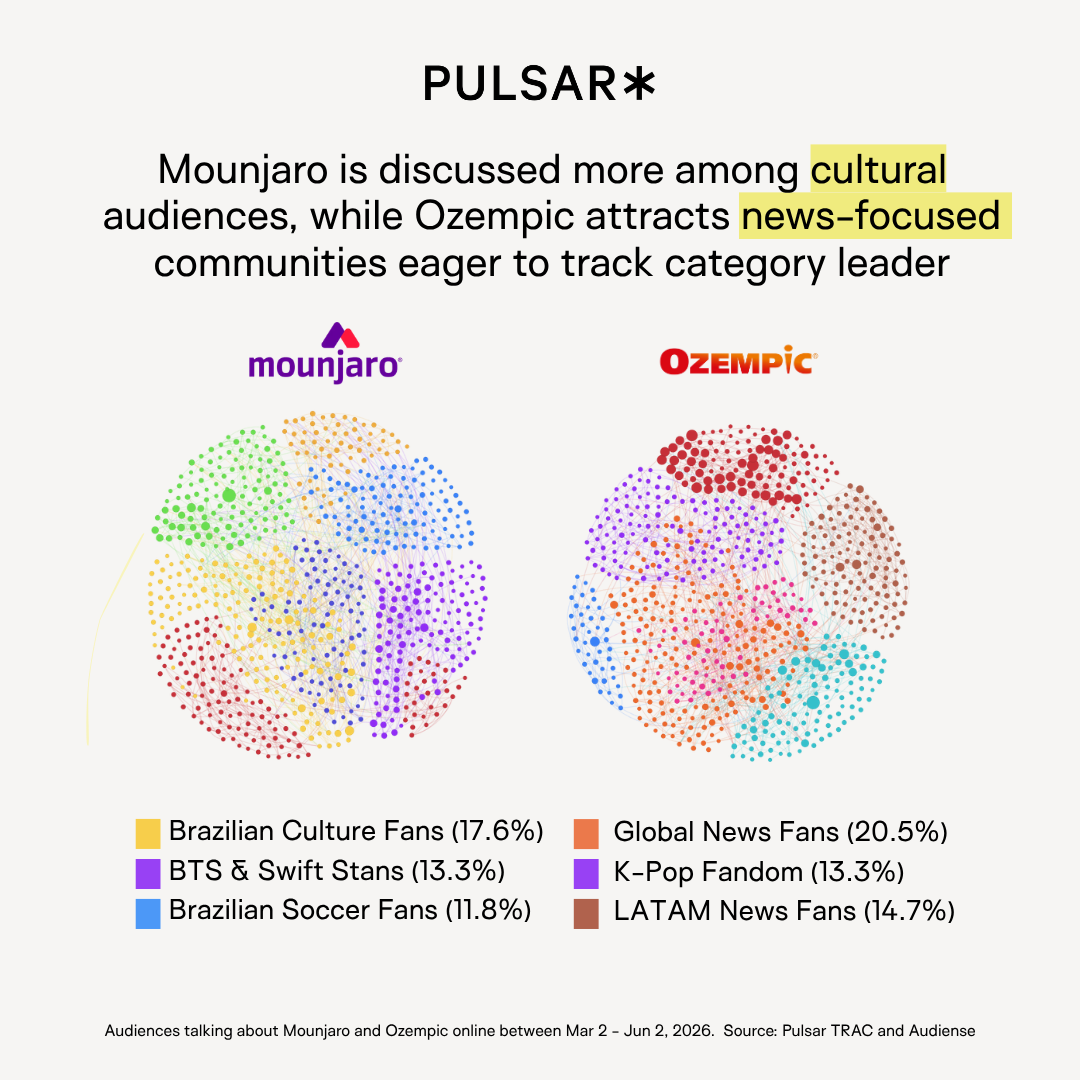
Pulsar example: in our Mounjaro vs Ozempic analysis, the two GLP-1 brands drew very different audiences. Mounjaro’s conversation was fandom-led, with Brazilian culture fans (17.6%) and BTS and Taylor Swift fans (13.3%) among its top communities. Ozempic’s was news-led, led by global news fans (20.5%).
There were myriad reasons for this, which ranged from aspirational content, to confessional content, to ‘gotcha’ celebrity moments. And that meant that the two brands, while ostensibly selling a very similar product, would need to source quite different influencers, as they are already building from different places within the culture.
Step 2: Separate clinicians, patients and wellness creators
Health conversations mix very different voices: doctors and nurses, key opinion leaders (KOLs) and digital opinion leaders (DOLs), patients sharing lived experience, caregivers, and wellness creators. Each carries different trust and different risk.
Audience segmentation groups people by who they are and who they follow, so you can see each group separately. Our guide to social listening tools for pharma brands shows that the traditional split between healthcare professionals and patients misses much of the picture. There are different gradations within each group, and perspectives beyond it, from different kinds of caregivers to recovered patients, family members and voices from non-traditional medicine.
Pulsar example: our eczema and atopic dermatitis research, built on more than 1.7 million posts, found communities trusted very different treatments. Young Black Instagram users leaned towards home remedies such as hemp, CBD and bathing, while young queer nerd culture communities favored JAK inhibitors and oral steroids. Each group is receptive to different products, different language, and different voices.
Pulsar example: in our women’s health and femtech analysis, each platform carried a different part of the conversation: fertility and wellness on Pinterest, menopause and sexual health on Instagram, periods and fertility on forums. Each of these communities was distinct. Even where the same community appeared to be present on multiple platforms, the logic and incentives of each platform meant that they expressed themselves in different ways, to different people.
Step 3: Weigh expertise against reach
In health, the most-shared voices are often not the most qualified. Rank creators by their impact on the topic, then look at who they are.
Pulsar example: in research for our social listening guide on health and pharma, influencers without medical credentials dominated the volume of the sugar and health conversation, often contributing to an inflammatory tone, while healthcare professionals posted less but more educationally.
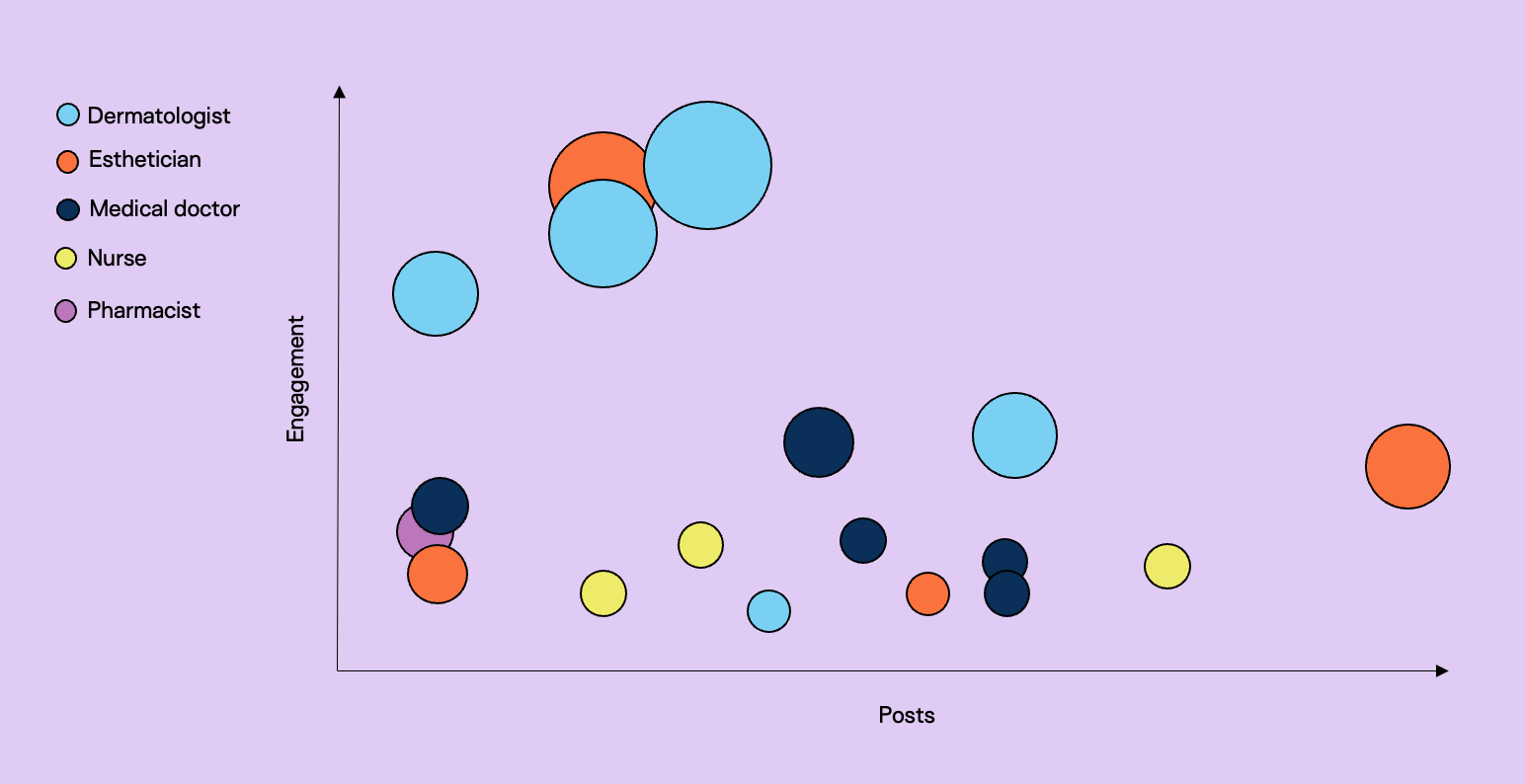
In a separate eczema study, the dial swung back in favor of expertise: dermatologists drove the most engagement, while other doctors posted more but traveled less.
Similarly, in our gut health and microbiome research, covering more than half a million posts, gatekeepers with scientific or medical credentials led engagement on every platform, with Dr. Mark Hyman driving the most engagement on Facebook and X. So there is no hard and fast rule for which voices will dominate a conversation. The extent to which the topic being studied is an emergent behavior or category, or the degree to which it can be monetized by bad actors, will all impact how likely HCPs are to set the tone, but that can easily be thrown off kilter.
For reference, we might refer back to our COVID vaccine sentiment analysis, in which a mention of Moderna by Dolly Parton was one of the drivers of more positive sentiment towards the vaccine. In this instance, HCPs were delighted to see their message travel further and faster than any they might have engineered. But it’s easy to see how an outsized voice can turn a public conversation on its head, for good or for ill.
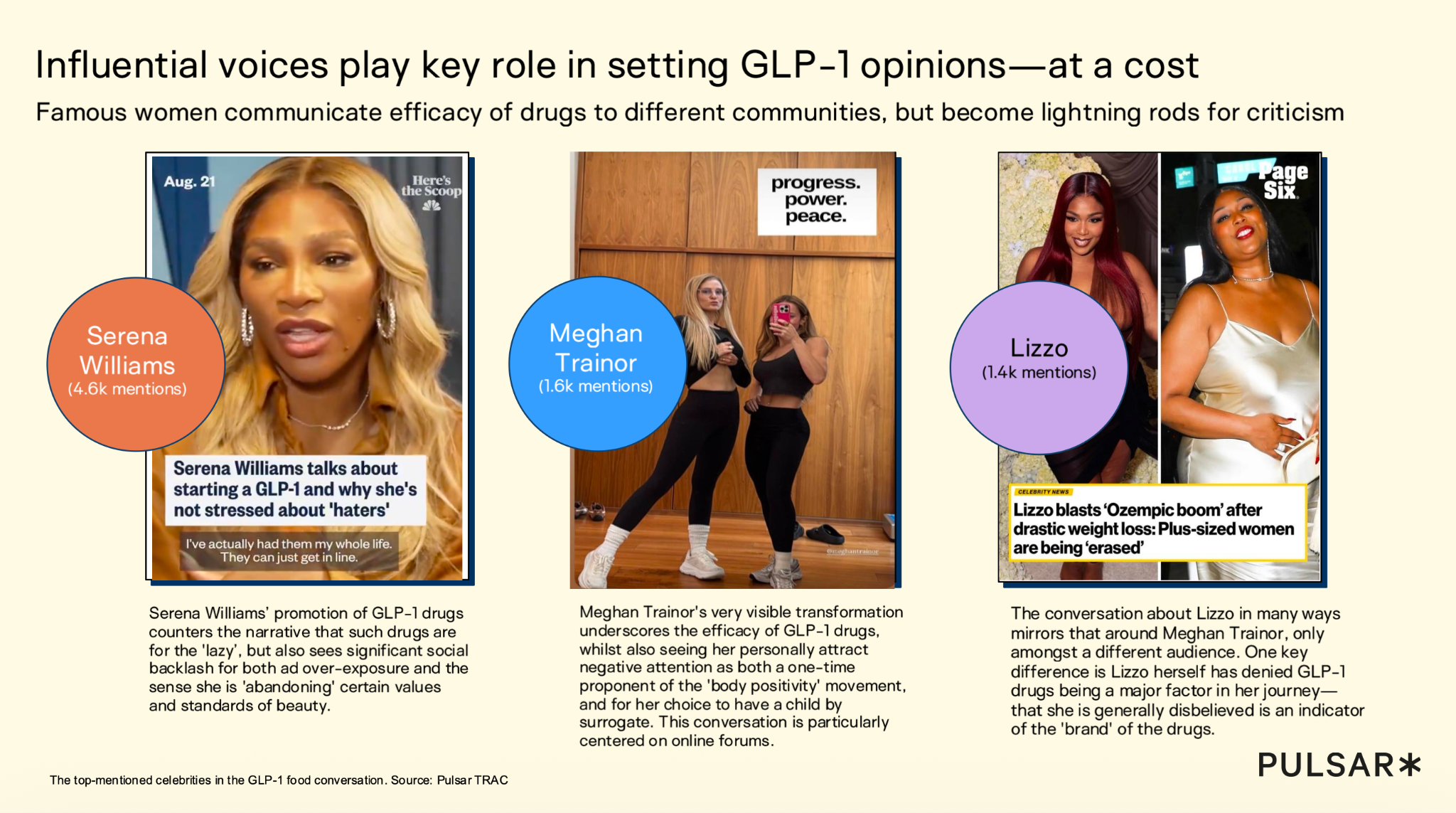
Pulsar example: big names carry reach, and risk with it. In our research on how GLP-1 drugs are reshaping food behavior, the most-mentioned celebrities each carried the conversation to a different community, and each became a lightning rod for criticism.
Serena Williams (4.6k mentions) challenged the idea that the drugs are for the “lazy”, yet drew backlash for ad over-exposure and for seeming to abandon certain beauty standards. Meghan Trainor (1.6k), once a body-positivity voice, became both proof of the drugs’ efficacy and a target for criticism, mostly on forums.
Lizzo (1.4k) drew a similar conversation among a different audience, and her denial that GLP-1s played a major part in her weight loss was widely disbelieved, a sign of how strong the drugs’ “brand” has become. For any healthcare organization, a famous voice can move a message into new communities, but it brings that voice’s controversies along too. Even when it lands the message the brand wants, it can have a negative impact on the influencer carrying the message.
Step 4: Check credentials and listen to what they actually say
Bio keywords such as “Dr” or “MD” are a starting point, not final proof. Check professional registration with the relevant body, such as the GMC or NMC in the UK or state medical boards in the US.
Then listen to their content. Much health advice is spoken in videos, not written in captions. Video transcription lets you check what a creator has said about conditions, treatments and competitors, and whether their claims match the evidence.
Step 5: Check for links to misinformation
Before you sign, check whether a creator has shared or amplified misleading health narratives. Look at the hashtags, communities and sources around their posts. This flags risky associations early.
Pulsar example: our health guide tracked more than 4,600 “Big Pharma” narratives since late 2024. Digital epidemiologist Dr Sam Martin, who advises the NHS and NIHR, used Pulsar to trace how US-origin vaccine misinformation spread into UK conversation through hashtags such as #InformedConsent, #LearnTheRisk and #Nuremberg2. Credentials alone are not a safeguard either. In our gut health research, one health community was led by a doctor whose content the report describes as anti-vaccine, so check each creator’s narratives as well as their title.
Step 6: Build compliance in from the start
Health and pharma partnerships come with rules: adverse event reporting, branded vs unbranded content, fair market value for healthcare professionals, and regional codes such as the ABPI Code in the UK and FDA guidance in the US. AstraZeneca’s Vishal Khapane suggests that for branded partnerships, posts “should be closed for comments” so adverse event reports are not left unmanaged. Agree claims, review processes and monitoring before the first post.
Step 7: Measure the shift in trust
The right health influencer changes what people trust and believe, which matters more than how many people saw a post. Set a baseline before the campaign, then track sentiment, trust and narratives afterwards.
Pulsar example: in our GLP-1 analysis, the widest gap between Mounjaro and Ozempic was on trust, 79.7 against 63.2, tied to conversations about diabetes remission and lasting weight loss. That is the kind of shift a health influencer campaign should aim to move.
How Pulsar helps you find the right health influencers
| Step | Pulsar feature |
|---|---|
| Start with the conversation | Pulsar TRAC tracks conditions, treatments and wellness trends across social, video, news, forums and reviews |
| Separate the voices | TRAC Communities and archetypes split clinicians, patients, caregivers and wellness creators. Archetypes can be set up around medical subspecialties |
| Weigh expertise against reach | The Visibility Score ranks creators by impact on a topic. Industry AI models for pharma add health-specific context |
| Check what they say | Video transcription turns spoken health advice into searchable text |
| Check for misinformation | Narratives AI shows which narratives a creator’s posts sit within, including misinformation clusters |
| Build in compliance | Pulsar CLEAR checks content against advertising rules. The Custodians agent supports influencer approval. STORY “creator check” vets a creator and keeps watching after signing |
| Measure trust | Narratives AI and Pulsar CORE track sentiment, trust and narrative shift after the campaign |
FAQ
+How do I find credible health influencers?
Start with the conversation about the conditions and treatments you care about. Separate clinicians, patients and wellness creators, then check each shortlisted creator’s credentials, past claims and links to misinformation.
+Why is it hard to find the right health influencers?
Credentials are hard to read, trust has moved away from institutions toward social media, and popular claims can run ahead of the evidence. A health influencer with a big audience can carry real risk for a brand.
+What is the difference between a KOL and a DOL?
Key opinion leaders are established experts, often clinicians or researchers. Digital opinion leaders build their influence online, and may or may not have medical training.
+Can pharma brands work with patient influencers?
Yes, within the rules. Patient influencers bring lived experience and trust, but partnerships need clear disclosure, claim review and adverse event monitoring.
+How do I check a doctor influencer’s credentials?
Treat “Dr” or “MD” in a bio as a starting point. Confirm registration with the relevant professional body and review what they have said publicly.
+Which platforms matter most for health influencers?
Short-form social video, Instagram and YouTube lead for patients and wellness audiences. LinkedIn and X matter more for clinicians and healthcare professionals.
Related reading
- How to use social listening to find influencers
- How to use social listening to find the right beauty influencers
- Social listening and audience intelligence guide for health and pharma
- Best Social Listening Tools for Pharma Brands 2026: Compliance-Aware Comparison
- Mounjaro vs Ozempic: Who is winning the GLP-1 brand narrative battle?
If you're interested in how Pulsar Tools can support your brand and strategy, simply fill out the form below and one of our specialists will contact you!