What does AI social listening for the enterprise look like?

TL;DR
At enterprise scale, social listening is a source of insight that feeds into mission-critical, cross-team workstreams around risk, brand equity, research, compliance, product, customer experience and beyond. That’s the broadest of remits, and it’s why off-the-shelf solutions tend to fail when they come up against complex team and business structures, regulated industries, and brands with enormous value. In this article, we lay out the framework by which enterprise buyers evaluate and choose social listening tools, and how artificial intelligence is emerging as a key element in the framework for enterprise-level social listening.
Key Takeaways
- ▸Data. This is the most fundamental layer; shortcomings here limit what you can hope to achieve. Shortcomings here limit what you can achieve, especially when trying to decipher complex global audiences across fragmented platforms. But it also brings opportunities for understanding new audiences and opening up new channels; AI can help enrich and parse this data at the scale enterprise brands require.
- ▸Intelligence. Enterprise brands are constantly under scrutiny, and have to make decisions that can impact multi-million dollar campaigns. An intelligence toolkit that helps teams understand, predict and plan ahead is crucial—AI allows activities on this layer to happen faster, more effecitvely and with a greater degree of specificity, than before.
- ▸Execution & Publishing. One challenge many enterprise brands face is that the intelligence function and the publishing function can operate under different time horizons and priorities; the right tool bridges the gap between insight and activation and closes the loop between idea and execution
- ▸Enterprise Deployment. Social listening tools are never rolled out into a void, but rather have to be embedded and tailored tothe processes a company already has in place, from permissioned sharing to incorporation of first-party data, to existing ways of working with artificial intelligence. That is particularly true for large enterprise players where distributed, often international teams need to handle….
- ▸Security & Readiness. Social listening involves ingesting massive volumes of global data alongside sensitive company context. Platforms must meet strict SOC 2, ISO, and AI governance standards. Without proven data privacy, auditability, and source-level traceability, a tool creates regulatory liability rather than value
Enterprise brands generate large digital footprints. They also tend to deal with massive global audiences, are subject to increased scrutiny, and compete with other enterprise brands for consumer demand and cultural dominance.
All of which means that enterprise brands have a different checklist to a mid-sized brand, or a governmental body, when it comes to choosing and purchasing social listening tools.
It also means that AI is not simply a nice-to-have when it comes to choosing the right tool for an enterprise brand. Because artificial intelligence is an essential part of making sense of the volume and complexity of data an enterprise brand realistically has to deal with.
The important questions are further down the stack: where the data comes from, how it is enriched, how intelligence is layered on, and how that intelligence connects to the systems and people responsible for acting on it.
The five considerations
This framework evaluates social listening platforms across five considerations:
| Tier | What it evaluates |
|---|---|
| Data | what the platform can ingest and retain. |
| Intelligence | how it turns data into usable signals. |
| Execution & Publishing | how those signals connect to action and reach an audience. |
| Enterprise Deployment | how the platform operates within the systems and processes a company already has. |
| Security & Readiness | whether the vendor can meet security, governance, and operational requirements. |
The first three tiers form a sequence, with data underpinning intelligence which, in turn, underpins action. The latter two considerations determine whether those capabilities can operate reliably across the enterprise.
In this article
Tier 1: Data
Everything downstream depends on the quality and scope of the underlying data. Shortcomings at this layer put a constraint. The reverse is also true: broader data is what opens up new channels and brings new audiences into view.
For enterprise use, three requirements matter most.
Direct licensed access
Web scraping introduces operational and regulatory risk, including IP blocking, telemetry gaps, and uncertainty around data rights. Direct, licensed feeds provide a more stable foundation, particularly in restricted markets.
You do not, as a brand, need to have a presence on a platform to make it worth monitoring for crises, or for opportunity. But, global coverage also requires a comprehensive list of non-western platforms. Evaluators should establish which regional platforms are actually covered, including Weibo, WeChat, Xiaohongshu, Naver, and Douyin.
Given that all the applications of AI subsequently discussed are going to take place on this body of data, it’s absolutely vital that this remains as high fidelity as possible.
Multimodal extraction
Important signals increasingly appear in images and video rather than in text alone. This is where AI first emerges as a key consideration. A useful ingestion layer needs to handle OCR, logo identification, visual scene recognition, and automated video transcription at scale; this is only made possible by employing models that are specifically engineered to apply approaches used by social intelligence practitioners. The idea is not to displace their part in shaping and ideating research, but too offload the incredibly time-consuming work of tagging and sorting data.
Longitudinal depth
Historical continuity matters for trend analysis and predictive modeling. A platform should be able to demonstrate how much historical data it retains and how that history is maintained as source platforms and their terms change.
Pulsar TRAC processes 40B+ documents annually across 45+ source types and 200+ languages, with an un-sampled 24-month operational window. Its sources include global social networks, APAC platforms, alternative social networks such as Bluesky and Telegram, broadcast media, and specialist review ecosystems.
Tier 2: Intelligence
Enterprise brands operate under scrutiny, across multiple geographies and markets, and make decisions that can commit multi-million dollar campaigns. The requirement at this tier is twofold: unpack what a team can already see, and reveal what it missed.
Once data is available, the next question is what the platform can determine from it. There are three distinct problems to solve, each underpinned by correct application of AI: understanding audiences, identifying narratives, and detecting anomalies.
Audience intelligence
Audience intelligence is predicated on the simple, but fundamental, idea that different audiences talk about the same topic differently.
Network analysis can map accounts through their interactions, identify communities, and find bridge nodes connecting otherwise separate groups. These nodes are better identified through network centrality than through follower counts alone.
The important distinction comes from treating an audience as a demographic segment and representing it as a network of relationships.
Narrative intelligence
Narrative intelligence addresses a different problem.
Keyword queries work well when the language of interest is already known. They are less useful when a new narrative is forming and the vocabulary has not yet been defined. This is where a platform either reveals what you missed or leaves you to find it later.
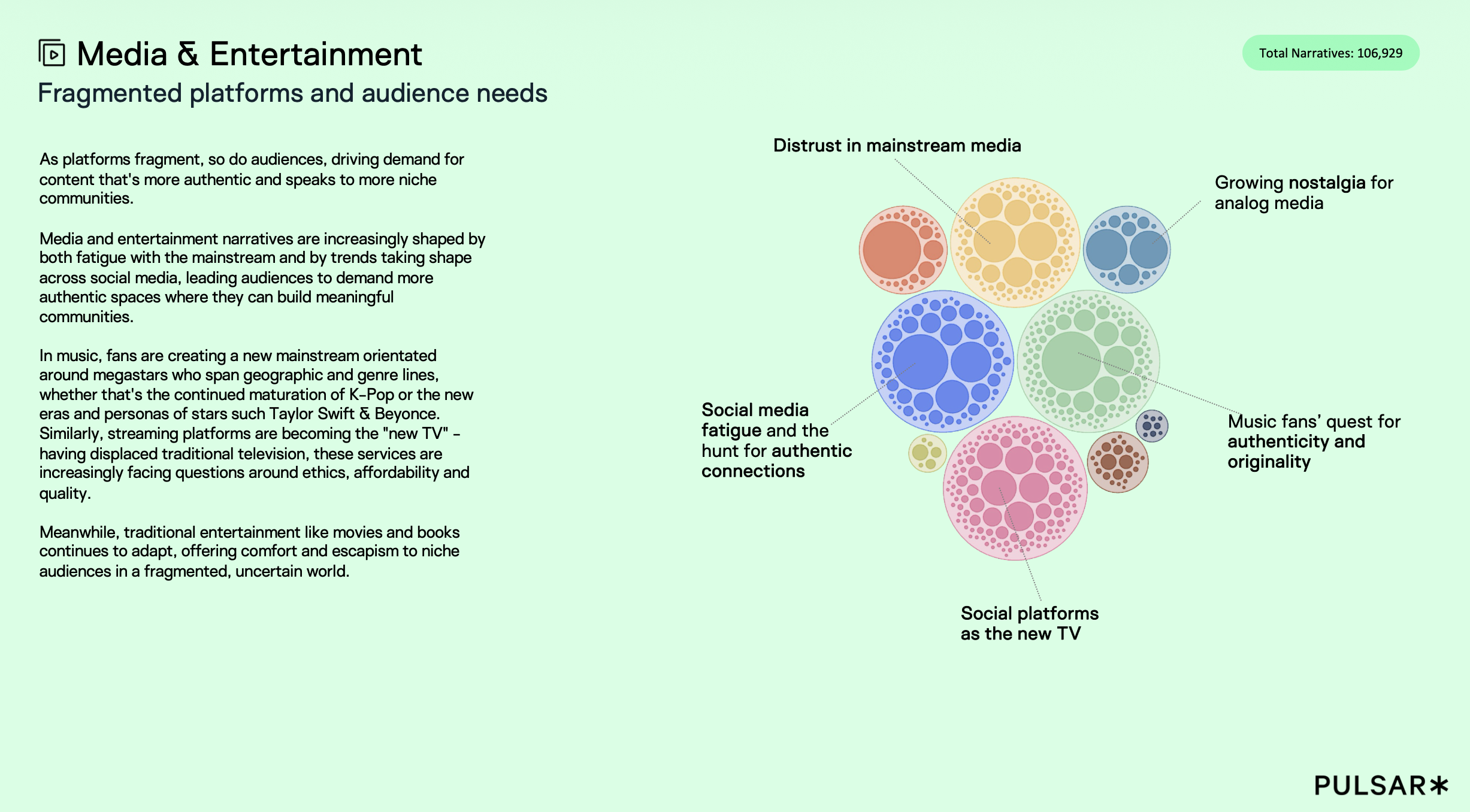
Media & Entertainment Narratives captured by Narratives AI
Unsupervised semantic clustering can group posts into emerging narratives without requiring a predefined taxonomy. Narratives AI clusters approximately 500M documents per day in real time and uses narrative velocity to identify structural changes rather than relying only on mention volume.
This distinction matters because volume often follows the change rather than preceding it. A narrative can become more coherent, coordinated, or widely connected before it produces a large increase in mentions.
Anomaly and crisis detection
Crisis detection is not particularly difficult to do after the fact. The key challenge that undoes many providers is quantifying and communicating crises while still in the window of time where something can be meaningfully done about them.
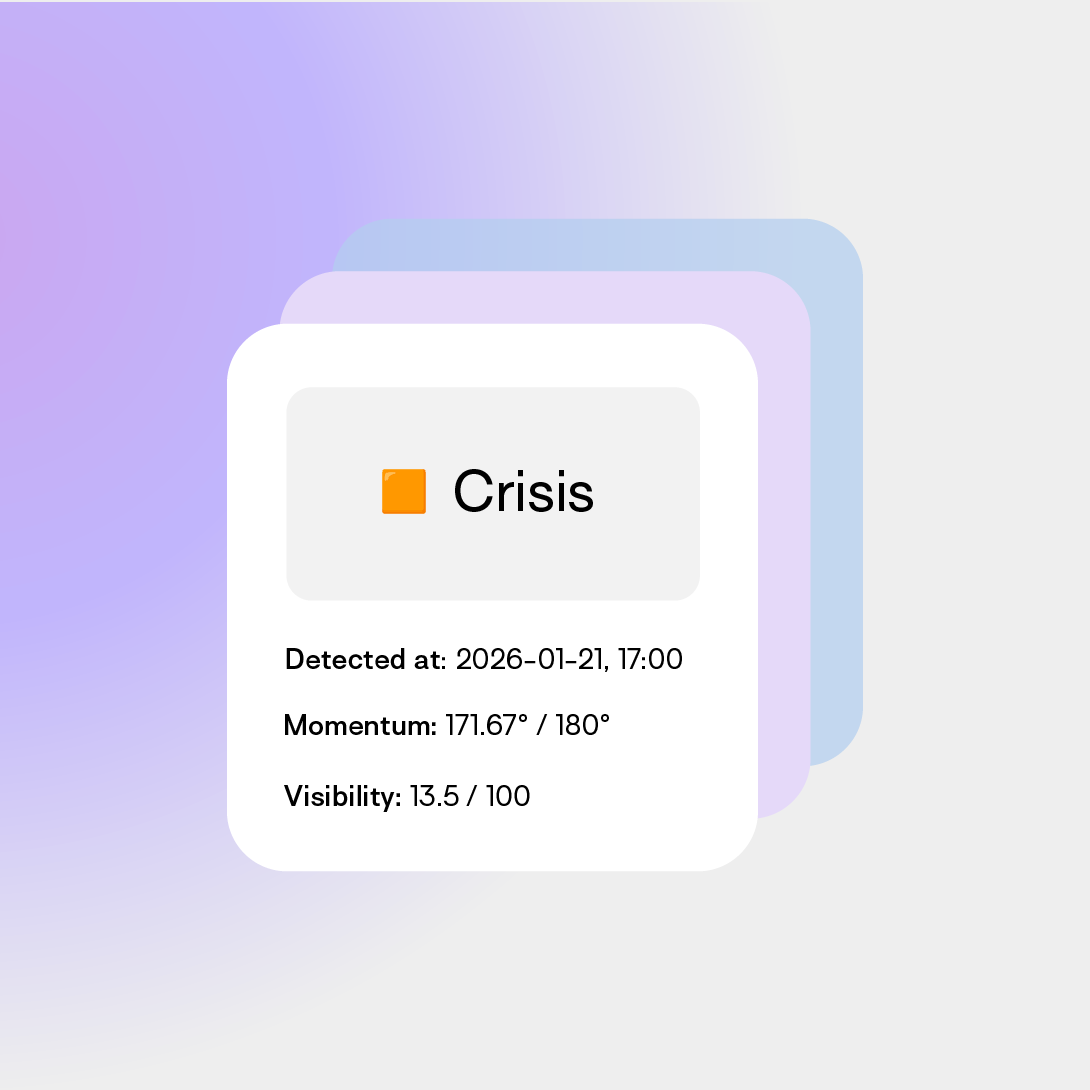
A volume threshold can identify that something has already become large. It is less useful for identifying an emerging event while it is still small.
Narrative momentum provides another signal: how quickly a narrative is forming, how it is spreading, and how its structure is changing.
Crisis Oracle uses narrative velocity to forecast reputational shock, while Sentinels agents within Pulsar TeamMates provide continuous background anomaly detection. The objective is to identify a potentially significant cluster when it contains hundreds of posts, rather than waiting until it contains tens of thousands.
Where does enrichment happen?
One of the most important architectural questions is whether enrichment happens during ingestion or when a user runs a query.
If sentiment, entities, and narrative classifications are attached when a document enters the system, those attributes can be retained and used for retrospective analysis. If enrichment happens only at query time, historical data cannot necessarily be reconstructed using the same classifications.
The same principle applies to domain-specific models. Generic classifiers are not sufficient for every use case. In regulated sectors, the distinction between a positive, negative, or neutral statement may be less important than what the statement is about and whether it creates an obligation to act.
Pulsar uses a three-tier model structure: standard core enrichment, pre-trained vertical models, and client-specific models.
Tier 3: Execution & publishing
In many organizations the intelligence function and the publishing function run on different time horizons and different priorities. One is looking at what is forming, while the other is working to a calendar that was set weeks ago, in a different cultural and business context. The next generation of platforms serves to meaningfully bridge that gap.
Intelligence also has a shelf life. If an insight has to move from a listening platform into a presentation, meeting, content calendar, or separate workflow before anyone can act on it, the value of the signal decreases with time.
1. Insight to execution
Narrative intelligence should connect directly to content and workflow systems. The objective is not simply to place an LLM interface on top of listening data. Content generation should have access to live conversation data and the enterprise context required to determine an appropriate response.
2. Predictive simulation
Content can be tested before it is distributed. Pulsar Creative Studio uses simulated audience personas to assess expected reach, sentiment, and viral dynamics before deployment. This allows teams to test an asset without committing real media spend or exposing the brand to unnecessary risk.
3. Compliance before publication
Compliance checks should happen before an asset reaches the public. After all, if the cost of finding an issue before publication is a revision then finding it after publication can mean regulatory exposure and damage to the brand.
That includes platform requirements, regional advertising rules, and internal brand guidelines. Pulsar CLEAR applies automated risk scoring against regulatory frameworks including UK ASA standards.
4. Feedback
The system should learn from what happens after deployment, essentially closing the loop on the intelligence to activation workflow. Except ‘closing the loop’ is perhaps an inaccurate description, when what is actually happening is that the process is being extended indefinitely, with insight running into publishing and campaigns, which in turn lead to more insight, and to tweaked or improved campaigns, and so forth.
Performance data should flow back into the listening and prediction layers so that future recommendations are based on observed outcomes rather than the assumptions that dominated when the process was started.
Tier 4: Enterprise deployment
A listening platform is never rolled out into an empty space. It has to work productively with the systems and processes a company already has, and it cannot create much value if it remains isolated from the rest of the organization.
Enterprise deployment therefore requires the platform to connect to existing data, AI, security, and workflow systems.
Data and application interfaces
Three interfaces are particularly important:
- REST and GraphQL APIs for moving data into enterprise warehouses and applications.
- Model Context Protocol (MCP) for connecting social telemetry with enterprise AI systems.
- Agent outputs such as STORY for delivering automated, scheduled intelligence to decision-makers.
Some of these interfaces should work in both directions, so that first-party data such as CRM records, survey responses, and support logs can be brought alongside social signals rather than analysed separately.
Access control
Multi-brand and multi-jurisdiction environments require clear separation between business units.
Role-based access control should prevent users or agents from crossing those boundaries, and permissioned sharing should govern what moves between them.
In plain language, this means different workspaces for different teams and territories, with individuals possessing access in accordance with their expertise and seniority, not to mention the sensitivity of a given project.
Operational alerting
An alert is only useful if it reaches the person who can act on it.
Crisis alerts should therefore route to the relevant operational teams, such as Product, Legal, and CX, with defined latency requirements, escalation rules, permissions, and mobile delivery.
An agent such as the Brand Crisis Oracle can even deliver intelligence to the Slack channel of the brand in question, ensuring that the information is coming to them, in spaces and on tools that are already a part of their workflow.
Tier 5: Security & readiness
Social listening involves processing very high volumes of information. And when you start introducing artificial intelligence into the equation, the need for careful governance only becomes more pronounced. A vendor that cannot show it handles that volume securely should be disqualified at this stage, whatever the interface looks like.
Technical capability is only one part of an enterprise procurement decision. The vendor must also satisfy security, governance, auditability, and commercial requirements.
Security
Enterprise shortlists should establish the vendor’s current position on SOC 2 Type II, ISO 27001, and GDPR DPA requirements.
AI governance
ISO/IEC 42001 provides a framework for AI management and governance. Organizations operating in or serving European markets should understand the vendor’s position against the standard and its broader AI governance requirements.
Source attribution
An intelligence output should be traceable to its underlying evidence.
For regulated or high-risk decisions, teams need to know which sources produced an output and, where relevant, which regulatory requirements informed the recommendation. An unsupported model output is difficult to defend in a legal, regulatory, or operational review.
Vendor viability
The platform itself becomes part of the organization’s infrastructure. That creates migration risk.
Vendor evaluation should therefore include corporate backing, financial position, product roadmap, and the likelihood that the platform will remain supported over the required operating horizon.
Pulsar operates under Pulsar Group Plc, which is LSE-listed, with $90M in revenue, 95% recurring revenue, and 750 employees across 12 offices.
Evaluation checklist
| Tier | What to evaluate | Red flag |
|---|---|---|
| Data | Direct API licenses, regional platform coverage, and historical depth. | Source counts are provided without a licensing or coverage breakdown. |
| Intelligence | Whether enrichment occurs during ingestion and whether narratives are discovered bottom-up. | The ingestion model is unclear or intelligence depends on fixed taxonomies. |
| Intelligence | How crisis triggers are calculated. | Volume thresholds are presented as advanced crisis detection. |
| Execution & Publishing | Whether simulation and compliance checks happen before distribution. | A basic publishing calendar is paired with a generic LLM copy generator. |
| Deployment | How data reaches enterprise warehouses and AI systems, and how first-party data comes in. | “API available” is stated without schema, permissions, or MCP governance. |
| Security & Readiness | ISO/IEC 42001 roadmap, SOC 2 Type II status, and source-level citation. | Security credentials are presented without corresponding AI governance or explainability. |
| Deployment | Whether features are generally available, in beta, or on the roadmap. | Demonstrations combine production features with unreleased capabilities. |
Frequently asked questions
+How does social listening fit into enterprise data architecture?
Social listening can act as a signal layer across risk, regulatory, product, market intelligence, and other functions. To support those use cases, data needs to move through direct API connections into corporate data environments and AI orchestration layers.
+What is the difference between audience intelligence and narrative intelligence?
Audience intelligence starts with a known population and maps its network: communities, relationships, and influential bridge nodes.
Narrative intelligence starts with the data and looks for structures that were not specified in advance. It uses semantic clustering to identify emerging narratives, changes in language, and developing threats before they necessarily become high-volume keyword events.
+Why do generic sentiment classifiers fail in complex environments?
Positive, negative, and neutral are often insufficient categories.
In pharmaceuticals, for example, a side-effect mention can trigger a reporting obligation regardless of the tone of the post. In corporate banking, operational friction may matter more than general sentiment.
Enterprise systems therefore need domain-specific models and a clear distinction between sentiment, subject, and target.
+How does narrative momentum improve crisis detection?
Volume generally tells you how large a conversation has become.
Momentum provides information about how quickly a narrative is forming and spreading. Monitoring the acceleration and structural development of a cluster can therefore surface an emerging issue before it reaches broad distribution.
+What compliance standards apply to enterprise social intelligence?
There are several overlapping requirements.
Marketing and advertising teams need pre-publication controls. Data processing requires appropriate privacy controls, including GDPR and CCPA considerations. AI systems increasingly require governance around auditability, source lineage, model behavior, and explainability under frameworks such as ISO/IEC 42001 and the EU AI Act.
Sources
- Pulsar first-party product documentation: TRAC, Audience Insights, Narratives AI, Crisis Oracle, Creative Studio, Pulsar CLEAR, STORY, TeamMates, coverage and compliance figures.
- Model Context Protocol specification and 2026 roadmap documentation.
- ISO/IEC 42001 (AI management systems) and EU AI Act conformity guidance.