How to Use Social Listening to Find Influencers

TL;DR
Follower counts and likes don’t tell the full story of who truly influences an audience. Social listening helps brands identify creators who shape conversations, earn community trust, and drive recommendations by tracking how ideas spread, which communities amplify them, and how audience sentiment changes over time. This approach helps marketers uncover credible, high-impact influencers before they become widely recognized.
Key Takeaways
- ▸Look beyond vanity metrics. Follower counts, likes, and comments don’t necessarily reflect real influence. Track how often a creator’s ideas, opinions, and recommendations are repeated and trusted within their community.
- ▸Uncover influence beyond public engagement. Social listening helps reveal how conversations spread across communities, how audiences share ideas, and where creators build credibility beyond visible likes and comments.
- ▸Use a four-step discovery framework. Map relevant conversations, identify audience communities based on shared interests and behaviors, trace the creators driving emerging narratives, and monitor audience sentiment over time.
- ▸Prioritize relevance and momentum over popularity. Creators who spark conversations and shape opinions within niche communities can have more meaningful influence than those with larger but less engaged audiences.
- ▸Continuously validate creator influence. Audience trust, sentiment, and content relevance can change quickly. Ongoing social listening helps brands spot emerging opportunities, identify audience fatigue, and make more informed influencer partnership decisions.
In This Article
- The Death of the Follower Count: Why Legacy Metrics Mislead
- Evaluating Influence: Static Vetting vs. Dynamic Social Listening
- A 4-Step Framework for Social Listening-Driven Influencer Discovery
- Why Pulsar Provides the Definitive Engine for Modern Influencer Discovery
- Time for a Strategic Shift: Influence as Community Infrastructure
- Frequently Asked Questions
The creator economy has reached an inflection point where conventional influencer discovery models no longer function. For years, brands tended to view things according to a linear equation: aggregate audience size multiplied by public engagement rates equaled influence. Today, that framework is fundamentally broken.
The digital ecosystem is undergoing three structural shifts:
- The transition from active participation to passive consumption: Across major platforms—from TikTok and Instagram Reels to YouTube—the traditional 90-9-1 participatory rule has skewed even further toward silent consumption. Audiences increasingly lurk, consume via algorithmic feeds, and share content in private spaces (such as group chats and direct messages) rather than commenting or posting publicly.
- The degradation of surface-level engagement metrics: Follower counts, likes, and generic comments have become highly susceptible to manipulation, bot farms, and algorithmic distortions.
- Extreme narrative dynamism: Cultural and algorithmic cycles now turn over on a weekly basis. An influencer who commands cultural authority on a topic this week may see their audience relationship mutate or dissipate the next, depending on conversational drift, algorithmic re-indexing, or platform fatigue.
To identify voices that can actually move brand sentiment and drive commercial outcomes, marketing leaders are going to have to pivot from static influencer catalogs to dynamic social listening and audience intelligence.
The Death of the Follower Count: Why Legacy Metrics Mislead
Leading industry publications, from Adweek to Digiday and Harvard Business Review, have repeatedly documented the growing disconnect between influencer scale and brand advocacy. When platforms prioritize algorithmic recommendations over chronological social graphs, follower counts become something closer to a vanity metric, rather than an accurate predictor of reach.
A creator with two million followers might generate millions of impressions through passive short-form video loops, yet fail to influence a single purchasing decision. Conversely, a niche specialist with 15,000 followers may serve as the foundational trust node for an entire micro-community (a manifestation of the old 1000 true fans thesis).
When brands rely strictly on the previous generation of influencer discovery tools—which merely index biographical data, total follower tallies, and average likes per post—they inherit blind spots:
- Inability to measure “Dark Social” resonance: When public posting drops, content sharing moves to closed channels. True influence is marked by how frequently an influencer’s ideas, phrasing, and recommendations are repeated across organic conversations elsewhere.
- No context on community fragmentation: Audiences do not behave as monoliths. An influencer might command credibility within an urban design cohort while being dismissed by enterprise architects, despite both groups occupying the broader “design” vertical.
- Failure to detect shifts in the very things you’re optimizing for: Static metrics cannot track sudden changes in audience sentiment, narrative dilution, or audience fatigue until long after an engagement campaign has concluded.
Evaluating Influence: Static Vetting vs. Dynamic Social Listening
Transforming influencer discovery requires contrasting traditional metrics with conversational listening signals:
| Evaluation Dimension | Influencer detection rooted in legacy metrics | Detection rooted in dynamic social intelligence | What the difference means for marketers |
|---|---|---|---|
| Primary Metric | Follower count, like count, comment volume. | Conversational share of voice, affinity clustering, community centrality. | Eliminates bot inflation; surfaces actual behavioral impact. |
| Audience Relationship | Assumed static based on historical subscriber counts. | Tracked dynamically week-by-week via sentiment and interaction shifts. | Mitigates brand safety risks and capitalizes on peak momentum. |
| Behavioral Context | Focuses on public broadcast posts and broadcast reach. | Analyzes conversational adoption, peer-to-peer quotation, and shared language. | Identifies genuine brand advocacy rather than passive viewing. |
| Audience Mapping | Basic demographic proxies (age brackets, gender, declared location). | Graph-based community segmentation based on interconnected affinities. | Enables targeted engagement within tightly knit subcultures. |
| Discovery Pathway | Database search based on bio keywords and hashtags. | Origin tracing: identifying who sparks the themes that later gain traction. | Uncovers emerging micro-authorities before commercial market saturation. |
A 4-Step Framework for Social Listening-Driven Influencer Discovery
Finding the right creator through conversational intelligence involves tracking how narratives form, propagate, and take root across distinct social communities.
1. Map the Conversational Landscape
Begin by monitoring the organic conversations that matter to your category, rather than hunting for personalities. Use conversational topic modeling to isolate:
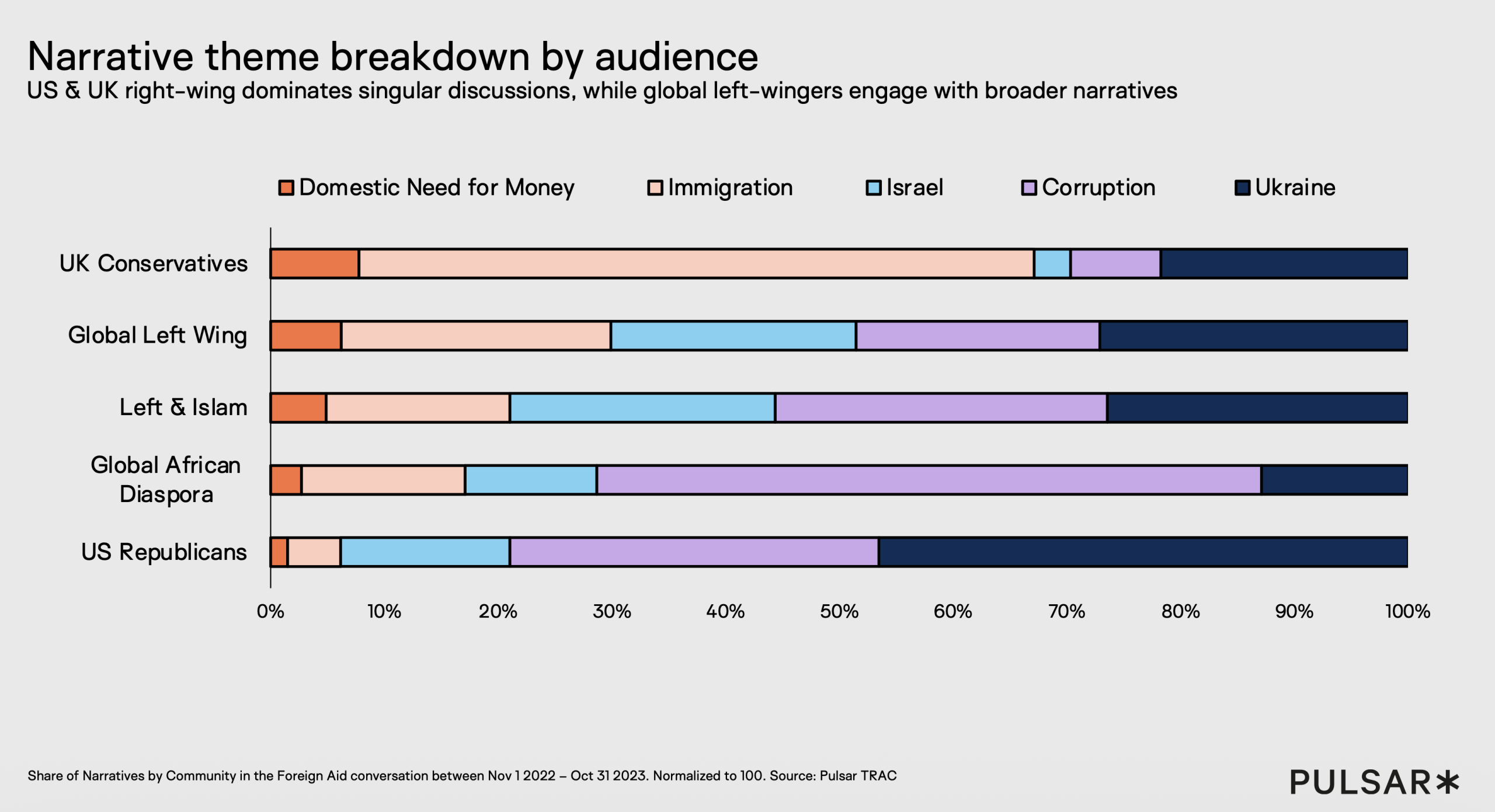
(Narrative theme breakdown by audience in the Foreign Aid conversation)
- Recurring audience pain points.
- Emerging vocabulary, slang, and cultural touchpoints.
- The specific discussion spaces where high-intent brand consideration takes place.
Narrative Intelligence can be invaluable here, as it focuses on surfacing insights ‘bottom-up’: clustering conversations by shared semantic and contextual similarity.
2. Segment Audiences by Network Affinity, Not Bio Keywords
Relying on self-reported user bios (e.g., “Tech Enthusiast” or “Sustainability Advocate”) results in generic targeting. Instead, map the relational ties within the audience.
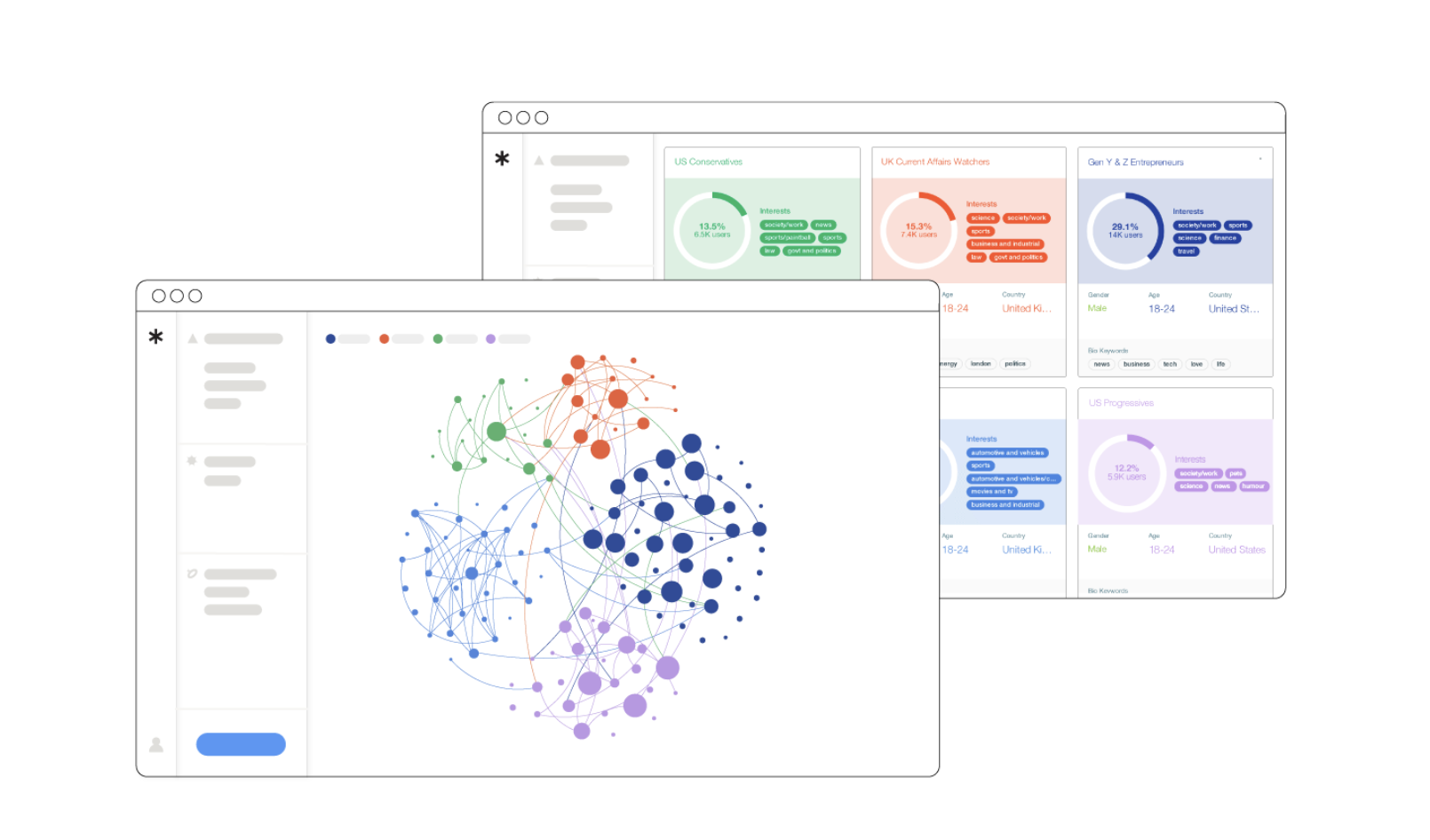
Network affinity analysis analyzes who engaged users follow, cite, and read. By grouping audiences into clusters based on shared behavioral connections, you reveal discrete communities (e.g., “Enterprise Cloud Architects,” “Minimalist Designers,” “Clean Beauty Obsessives”).
3. Isolate the “Origin Nodes” (Narrative Velocity)
Once a conversation cluster is mapped, analyze the flow of information. True influencers act as origin nodes—voices whose points of view, phrases, or media assets are organically repeated and amplified by community participants hours or days later.
Prioritize creators who exhibit high narrative velocity (the speed and depth with which their perspectives travel through a subculture) over those who merely command large, passive audiences.
4. Audit Sentiment Volatility and Temporal Context
Because modern social relationships fluctuate rapidly, audit potential partners across a rolling multi-week timeline:
- Is community engagement trending positive, skeptical, or indifferent?
- Has the creator's core audience grown fatigued by excessive commercial endorsements?
- Does the creator’s current content match their historical niche, or are they pivoting into new areas where their authority has not yet been validated?
Why Pulsar Provides the Definitive Engine for Modern Influencer Discovery
Navigating this fluid environment requires an audience intelligence engine that moves beyond simple mention counts into structural network analysis. Pulsar’s Platform is purpose-built to address this transition, offering an integrated suite designed to spot authentic influence as it emerges, backed by 15 years of permissioned, audience-grade data.
Pulsar TRAC: Uncovering True Conversational Influence
While standard listening tools restrict themselves to keyword tallies, Pulsar TRAC brings together data from social media, news, search, and vertical-specific platforms using advanced AI models.
- Community-First Clustering: TRAC segments audiences based on shared network affinities and conversational behaviors, allowing marketers to identify who commands respect inside a specific subculture, rather than across the internet at large.
- Visual & Textual AI: Pulsar’s natural language processing and visual analysis tools detect how an influencer's content travels—tracking whether creative assets and talking points are genuinely driving brand conversations or fading in the feed.
STORY: The Autonomous AI Analyst That Never Clocks Out
Most AI copilots wait for you to ask a question and merely summarize pre-aggregated dashboards. STORY operates directly on Pulsar’s raw data lake as an autonomous agent that runs indefinitely on a standing brief.
- Proactive Intelligence: Instead of requiring teams to constantly log in and search for emerging creators, you brief STORY once (e.g., “Track brand sentiment shifts and emergent creator communities in Gen Z segments across four markets, weekly”). STORY watches the raw corpus 24/7, escalating alerts when an audience shift crosses a statistical threshold or when a novel affinity cluster forms outside pre-existing taxonomies.
- Finished Deliverables: STORY skips intermediate dashboard summaries to produce finalized work—such as multi-market scans highlighting the top 200 high-signal mentions—delivered straight to your inbox before weekly planning calls. It ensures you spot and vet high-momentum micro-authorities before competitors notice them.
Pulsar CORE: Dynamic Partner Benchmarking and Verification
Identifying an influencer is only half the battle; brands must also understand their operational trajectory and audience retention. Pulsar CORE enables marketing teams to track and benchmark owned and partner channels with granular precision.
- Performance Tracking Across Dynamic Cycles: By analyzing how an influencer's audience engages over rolling intervals, brands can evaluate whether a creator's momentum is accelerating or decaying.
- Contextual Content Scoring: CORE isolates which formats, themes, and emotional tones resonate most effectively across distinct platforms, ensuring creator partnerships are grounded in empirical engagement patterns rather than vanity metrics.
Time for a Strategic Shift: Influence as Community Infrastructure
Influence can no longer be evaluated as a static media buy calculated in gross ratings points or surface-level likes. In an age characterized by passive content consumption and algorithmic unpredictability, real influence operates as community infrastructure: built on sustained trust, shared identity, and conversational authority.
Marketers who rely on traditional influencer registries risk spending significant budgets targeting passive, disengaged audiences. By deploying conversational listening, autonomous AI analysis, and deep audience intelligence through Pulsar, brands gain the continuous clarity needed to identify true cultural catalysts, build lasting community partnerships, and drive measurable commercial impact.
Frequently Asked Questions
+Why is follower count a poor measure of influence?
When platforms prioritize algorithmic recommendations over chronological social graphs, follower counts become something closer to a vanity metric than an accurate predictor of reach. Follower counts, likes, and generic comments are also highly susceptible to manipulation, bot farms, and algorithmic distortions.
+How do you use social listening to find influencers?
Use a four-step framework: map the conversational landscape and its themes, segment audiences by network affinity rather than bio keywords, isolate the origin nodes whose ideas travel fastest through a community, and audit sentiment and context over a rolling multi-week timeline.
+What is an origin node in influencer discovery?
An origin node is a voice whose points of view, phrases, or media assets are organically repeated and amplified by community participants hours or days later. Origin nodes are the true influencers inside a conversation cluster.
+What is narrative velocity?
Narrative velocity is the speed and depth with which a creator's perspectives travel through a subculture. Brands should prioritize creators with high narrative velocity over those who merely command large, passive audiences.
+What is network affinity analysis?
Network affinity analysis looks at who engaged users follow, cite, and read. Grouping audiences into clusters based on these shared behavioral connections reveals discrete communities, which is more precise than targeting by self-reported bios.
+How should brands vet an influencer before partnering?
Audit potential partners across a rolling multi-week timeline. Check whether community engagement is trending positive, skeptical, or indifferent; whether the creator's core audience has grown fatigued by commercial endorsements; and whether their current content matches their historical niche.
+How does Pulsar help brands find influencers?
Pulsar TRAC segments audiences by shared network affinities and conversational behaviors and tracks how an influencer's content travels across social media, news, search, and vertical platforms. Pulsar CORE benchmarks owned and partner channels over rolling intervals to show whether a creator's momentum is accelerating or decaying.
Related reading
Last updated: October 2026.