How AI actually works in social listening: what it does at every stage


TL;DR
Under the hood, social listening tools use AI at almost every stage of their pipelines, but it’s not always the same kind of AI, and not always to the same effect: AI helps classify, deduplicate, interpret, contextualize data, and allows users to find and access insights and outputs. But while claims of “AI-powered” and “AI-native” flood the industry, the best way to understand how—and whether—AI is adding value in your solution is to look at each layer (and job) separately.
Key Takeaways
- ▸AI supports social listening in 3 ways: Data, Intelligence and Access. Separating these layers helps you see what a platform has actually built versus what has been bolted on. Conversational interfaces, AI summaries and autonomous research agents all sit at the end of this pipeline.
- ▸Data: this sets the ceiling for everything above it. Without deduplication, four hundred syndicated copies of one story register as a genuine volume spike. Without coordination detection, forty linked accounts will look like a true groundswell. And on video-first platforms most of the message is never written down: spoken audio, on-screen text and unbranded logo appearances carry meaning that text-only collection cannot see.
- ▸Intelligence: Narrative intelligence serves as a genuine upgrade on sentiment or topic detection, although both of those have also been massively boosted by artificial intelligence. Audience networks, meanwhile, are more sophisticated, and take place at a greater scale than was previously imaginable; researchers can track how an idea or message cascades through society and base their strategy on these insights.
- ▸Access: Agents are not Copilots. Copilots answer session-bound chat queries; agentic pipelines and MCP move listening data into the model’s own workflow, running briefs against raw data and handing back completed work.
“AI-powered” now appears on the homepage of every social listening platform on the market.
It can all lead to a sense of satisfaction. Two platforms describe themselves in nearly identical language, a buyer picks on price or interface, and eighteen months later the insights team discovers that the thing they most needed, whether that is an audit trail back to evidence or a corpus that counts syndicated copy correctly, was never in the product after all. ‘Ai-powered’ can disguise more than it reveals as a phrase.
The only way to understand how—and whether—AI is adding value is to take each layer, and each job, separately.
There are three layers to focus on: Data, Intelligence and Access. Understanding and separating them is what tells you what a platform was built for, as against what has been added after the fact. It also flags something about sequence, which is the part most buyers miss. Conversational interfaces, AI summaries and the more sophisticated end of the category—autonomous research agents—all sit at the end of the pipeline. They inherit whatever the layers beneath them produced.
Misunderstanding where AI supports different kind of activities can help avoid procurement and user headaches. Two platforms describe themselves in nearly identical language, a buyer picks on price or interface, and eighteen months later the insights team discovers that the thing they most needed—whether that’s an audit trail, or a consistently applied analysis of audience behavior—was never in the product. The gap that was always there was flattened by using an expansive term like ‘AI-powered’. We need to ask what the AI is powering, and where.
Below we expand on these three different layers, and what is contained within each.
The three layers of AI in social listening
| Layer | What the AI does | Typical techniques | Good for |
|---|---|---|---|
| 1. Data | Ingestion hygiene, relevance filtering, visual and video AI ingestion & processing | Relevance filtering, image and logo detection, video intelligence, deduplication, bot and coordination detection | Making datasets trustworthy and searchable |
| 2. Intelligence | Structures the corpus, segments networks, interprets arguments, forecasts trajectory | Community clustering, narrative analysis, stance modelling, zero-shot LLMs pre-trained on use cases, momentum and velocity scoring, network diffusion modelling | Understanding how different audiences drive or communicate trends, behaviors and crises, across social and media platforms |
| 3. Access | How clients can access and work with the data & intelligence, in what form, and what is taken care for them | Conversational interfaces, AI summaries, agentic pipelines, MCP, scheduled autonomous workflows, APIs | Moving finished intelligence to where the work already happens |
The rest of this piece takes each layer in turn.
In this article
- The three layers of AI in social listening
- Layer 1: Data—what does AI do before anyone runs a search?
- Layer 2: Intelligence—what does AI do to the data once it is collected?
- Layer 3: Access—how does the intelligence reach the work?
- The questions to ask at each layer
- Frequently asked questions
- About Pulsar
- Sources
Layer 1: Data
The different ways in which AI can impact datasets prior to analysis is all-too-often overlooked.
Before a query is ever typed, machine learning is resolving whether three different account names refer to one entity, deduplicating syndicated news copy, detecting the language of every post, flagging bot accounts and coordinated inauthentic behavior, running image and video recognition so that visual content is findable at all rather than sitting in the archive as an unsearchable blob, and scoring how relevant each piece of content is to what your organization actually asked about.
None of this tends to show up in flashy demos. All of it resides upstream of where most day-to-day work takes place. This means cleaning, tagging, sorting and transcribing the information at hand. On video-first platforms, for instance, most of the message is never written down at all: spoken audio, on-screen text and unbranded logo appearances all carry meaning that text-only collection cannot see what’s actually happening.
Hygiene failures are invisible by their nature
Every other layer is visible when it fails, not so here. Because while you might spot the irrelevant post that got through, what you won’t spot is the all-too-relevant one that was filtered out.
A false negative in a relevance model looks exactly like an absence of conversation—just a somewhat smaller number that looks entirely plausible and that nobody has any real reason to question.
So the question to put to a vendor is not how accurate the filter is. It is: what does your relevance filter discard, can you show me the discard pile, and how would I ever know if it were wrong?
Enrichment at ingestion, not at query time
In Pulsar TRAC, every piece of content is enriched as it’s brought through onto the platform: sentiment and emotion extraction, entity recognition, topic classification, image and video AI, and relevance scoring. A search then filters against attributes that already exist.
The alternative, analyzing on demand when a user runs a query, sounds equivalent but it is not. Query-time analysis means the depth of your answer is bounded by how long you are willing to wait, historical re-analysis is expensive enough that it rarely happens, and two analysts running the same search a week apart can get different enrichment. Ask any vendor whether enrichment happens at ingestion or at query time. It is a single question that tells you a lot about what the rest of the platform can support.
Video intelligence: the difference between captions and speech
On video-first platforms, the caption is at best a supporting piece of content. Two emoji and a vague tag sit on top of ninety seconds of spoken dialogue in which a brand is named, compared, recommended or written off. Text-only collection will simply return the two emoji.
Automatic speech recognition is what closes that gap: spoken audio transcribed into searchable, multilingual text across TikTok, Reels and YouTube, then treated as text so the rest of the enrichment stack runs over it. As consumer conversation has shifted toward unscripted short-form video, text-only tools have gone blind to a growing share of exactly the content brands most need to see—viral reviews, creator feedback, product recommendations where the name was spoken aloud and never typed.
That’s where AI is vital in providing a fuller picture, at a massive scale.
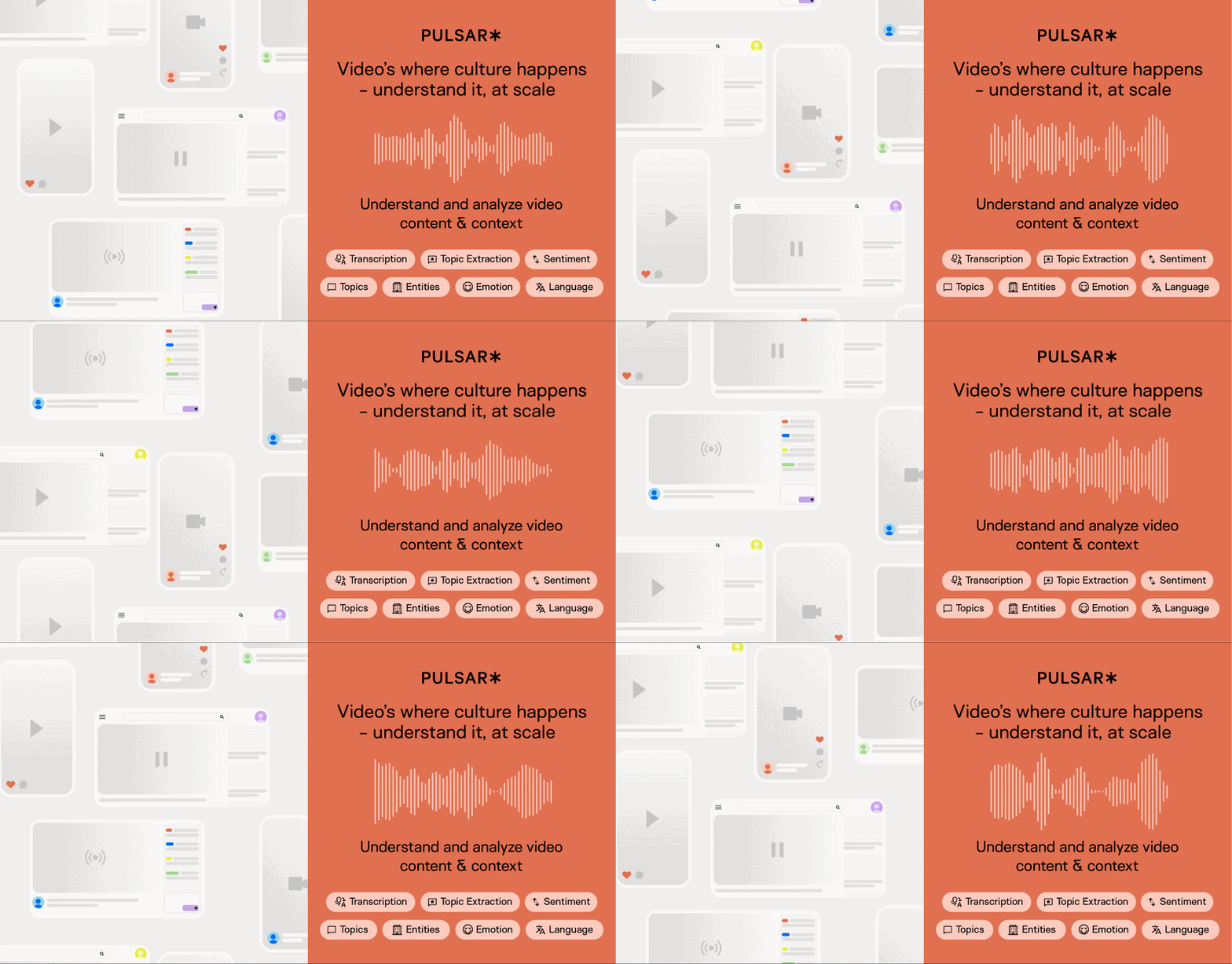
Pulsar’s Video Intelligence transcribes video from X, Instagram, YouTube and Facebook into searchable text in 16 languages, then treats the transcript as text so the full enrichment stack runs on it: sentiment, emotion, entity recognition, topic analysis and language analysis.
On-Demand handles up to 120 manually selected videos at a time, which suits a defined research question where an analyst already knows which content matters. Automatic transcribes every compatible video ingested by a search with no manual submission, which is the mode that matters for monitoring, because the most valuable transcript is usually of a video nobody thought to select.
For the wider category view, see the comparison of social video analysis tools.
Image and logo detection: brand presence with no text at all
Logo and image detection answer the other half of the same problem. Millions of posts a day show a product without naming it: in shot, in use, in a setting, with no text tag anywhere. Computer vision and OCR are what make that visible. In the broader market this serves two needs at once: a precise way to measure sponsorship ROI and earned media exposure across sports events and influencer content, and a way to see how consumers organically use products in real life—an unexpected usage occasion or demographic setting that keyword alerts would have missed entirely.
Two distinct models reflect two distinct needs. Logo detection asks whether a specific trained brand mark appears in an image, which is what sponsorship valuation and counterfeit surveillance need. Image captioning asks what is in the image at all, attaching scene, object and activity labels that answer context questions about where a brand appears rather than only how often. In Pulsar TRAC both must be enabled at search setup rather than applied retroactively, which is worth knowing before a retrospective analysis is commissioned.
Relevance: filtering noise without maintaining Boolean forever
Booleans have long been the means by which analysts direct tools. Every experienced analyst will know, however, the time-consuming nature of building an exclusions list, maintaining that list, and then still finding out that your most recent explosion in mentions was actually that new stablecoin, or kid’s TV character, who happened to share a name with the brand you’re tracking.
Pulsar’s Relevance model takes the other route: a brand-specific model using semantic affinity, configured around an organization’s brief and context, then applied consistently across every search that team runs on that domain.
It filters at ingestion rather than after the fact, and, most importantly, retains non-relevant content rather than deleting it, so what the model excluded can be inspected. That last property is the one to insist on from any vendor, for the reason set out at the top of this layer.
This is also why the Data layer gets more important as the layers above it get more autonomous, not less.
Layer 2: Intelligence
Once the corpus exists, the Intelligence layer decides what it means: who is talking, how they divide, what is actually being argued, and where it is heading.
Sentiment measures tone, not position
Tone does not adequately describe someone’s position—least of all in a world so vested with irony and added context. Stance detection asks what someone is arguing for, whereas sentiment only asks how they sound.
The two come apart constantly, and expensively. “This is completely insane” is negative in tone and, depending on what it is replying to, strongly positive in stance. A brand post can generate overwhelmingly negative-sentiment conversation that is entirely hostile toward a competitor.
So put it to the vendor as a specific question rather than a general one: what does your sentiment model do with negative phrasing aimed at a competitor, in a post that mentions us? Platforms that score tone alone will answer it with the wrong conclusion and total confidence.
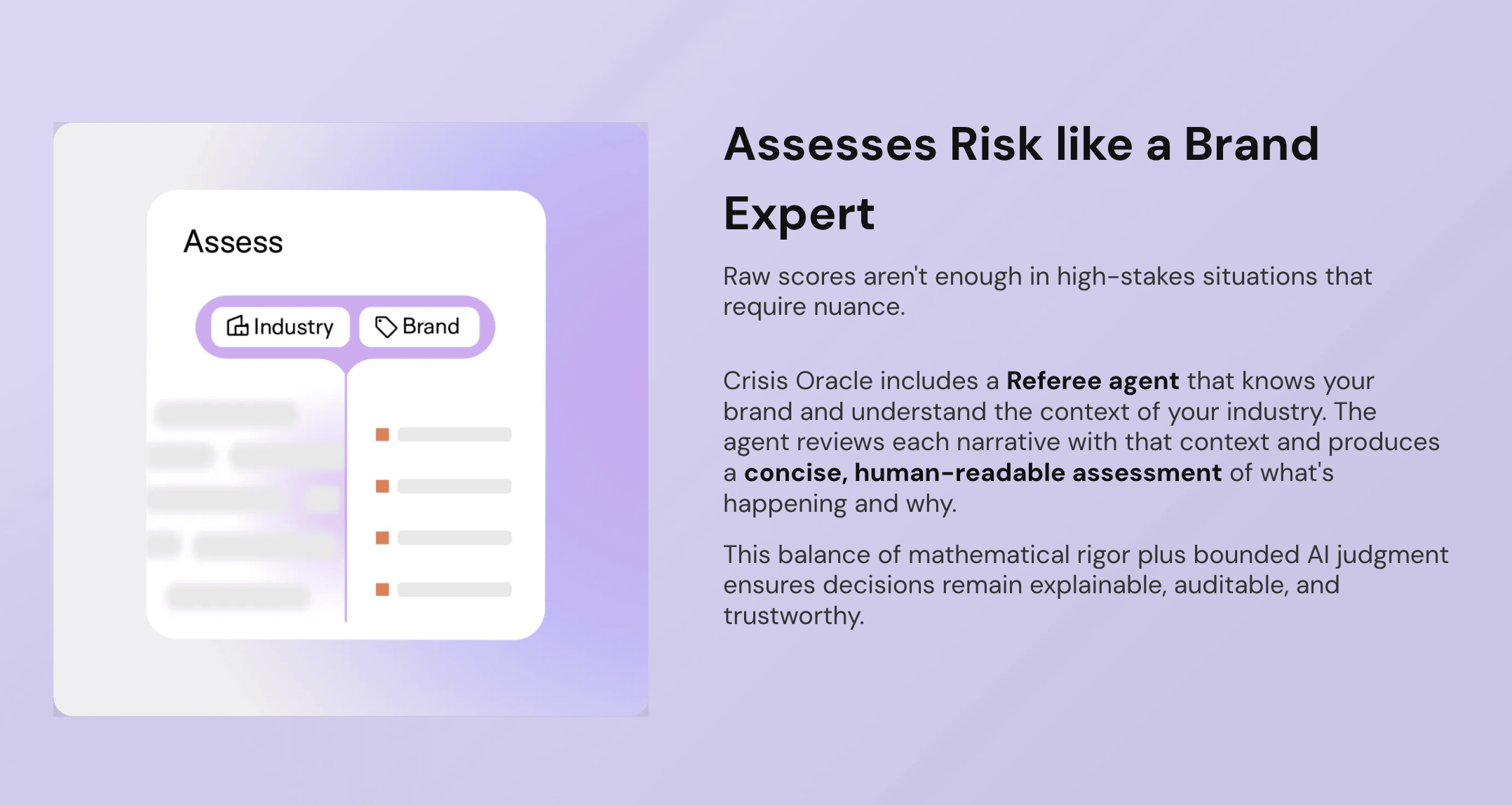
Pulsar’s Crisis Oracle handles this utilising artificial intelligence: an NLP classifier that first establishes whether a post is genuinely about the brand, then assesses whether the position is hostile, critical, neutral or positive, and with what intensity. Whether or not you use Pulsar, that two-step structure is the gold standard for this form of analysis. The related mechanic worth asking about is whether sentiment attaches per entity or only per post, because a single article can be positive about your brand and negative about your competitor, and a post-level score averages those into a meaningless neutral.
The network tells the story
Different people talk about the same topic differently. And simply counting mentions flattens who said what:a network view on the other hand shows you how a story developed.
An audience network of a topic conversation shows you who is talking, how the conversation splits into sub-communities, and which bridge accounts are carrying a narrative out of one community and into the next. That is a different order of information from a ranked list of topics, and it is the single most consequential difference between listening tools.
The same conversation looks entirely different depending on which you run. A category conversation that appears uniformly enthusiastic at post level often resolves, at network level, into three groups with incompatible reasons for engaging and one small cluster driving most of the visible volume.
In Pulsar TRAC, cluster analysis groups a dataset by shared characteristics using a PageRank-based algorithm over nodes that can be keywords, topics, hashtags, entities, image tags or bio keywords, producing up to ten distinct clusters each named after its most central terms. Separately, influencer network analysis builds a live engagement graph where nodes are authors and edges are engagements such as replies, comments and reposts, with automatic color-coded clustering separating distinct communities. The 3D version, included with a TRAC license at no additional cost, adds spatial depth specifically to disentangle overlapping communities and surface bridge accounts. Graphs export to Gephi for independent analysis, which matters whenever a finding is going to drive a real decision and should be reproducible outside the vendor’s own interface.
Notice what the unit of analysis is here. It is the community, built from network structure—who follows and shares with whom—rather than a demographic slice of individuals. That is also the practical test. Ask a vendor to show you not the top ten topics in a conversation, but the communities within the audience and how each one discusses the same topic differently. Many platforms cannot do this at all, because they never built the audience graph. They built a very good search engine over posts. The distinction is worked through in more depth in audience intelligence versus social listening.
It’s worth mentioning, however, that every classifier in this layer has a boundary and vendors rarely publish it. Sentiment and topic taxonomies are several orders of magnitude more intelligent than they were even a few short years ago, But clearly training data remains a sticking point: if a new taxonomy of means of communication flares up, there might be a brief lag before artificial intelligence can truly understand if this or that reference is entirely ironic.
At the same time, clustering algorithms will always return clusters (given it’s what they’re designed to return), including from data that doesn’t have an especially defined community structure. This specifically trap when a search is narrow or a market is small. In these instances, they may simply default to broad communities: entirely correct (and sometimes useful) but often not offering the degree of specificity you need to anchor a campaign or strategy.
Narratives and topics are not the same
Topics are more useful than keywords when it comes to analysing conversations. Like keywords, however, they’re essentially static. Narratives represent beliefs—claims held by identifiable actors, with a stance and a direction of travel.
The consequence is measurable, which is what stops this being a purely semantic argument. A volume chart often stays completely flat while the argument underneath it inverts. Six months of stable sustainability mentions can run from consumers praising a commitment to consumers accusing the brand of missing it. Many of the keyword counters will stay the same; the sentiment will have shifted, but then it becomes a case of reverse engineering what changed, and when. And this type of retrospective analysis is not only time-consuming but tactically disastrous. A brand health programme running on volume and average sentiment alone will miss precisely the change it existed to catch.
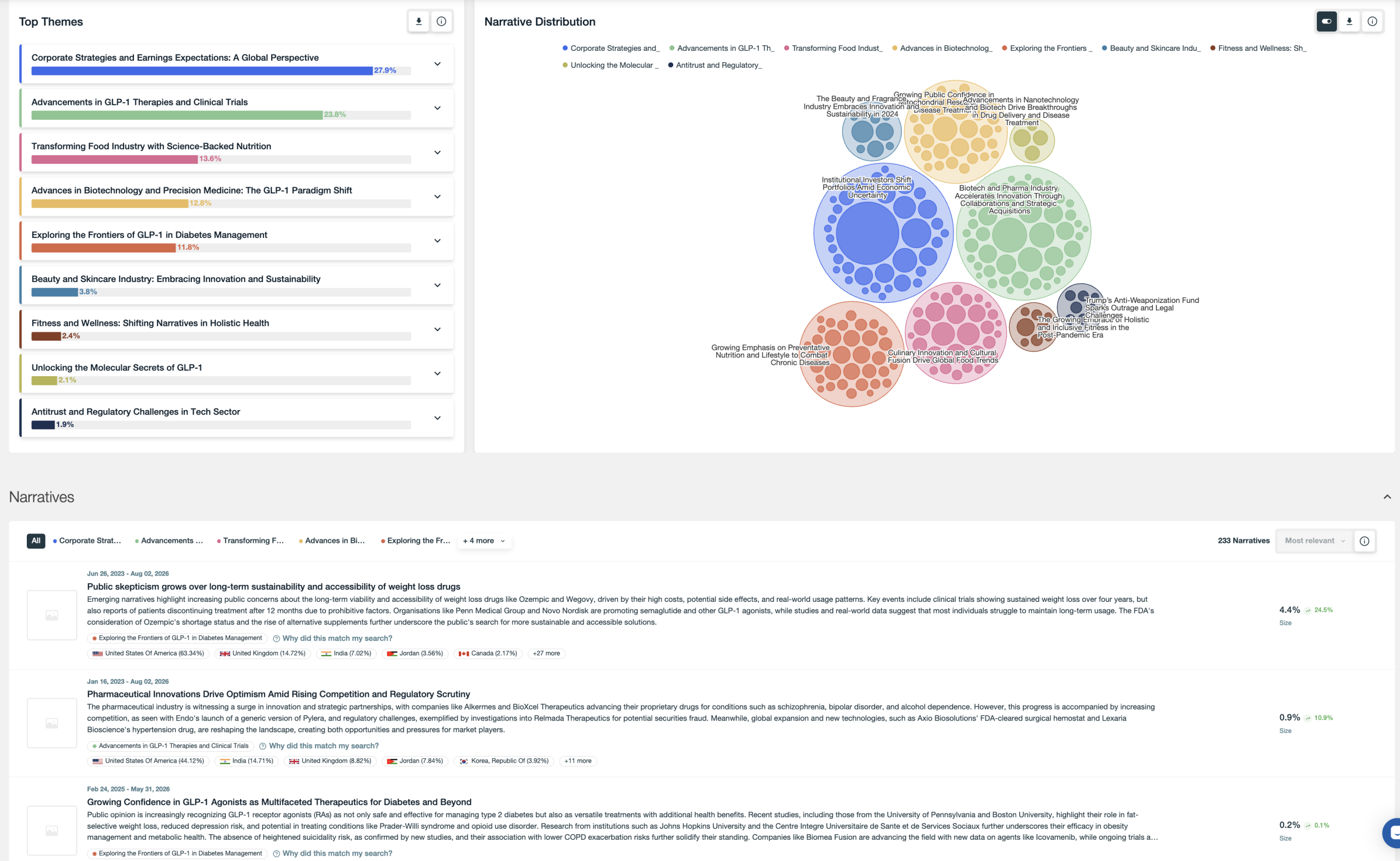
Pulsar built this layer around narratives rather than topics for exactly that reason. Narratives on TRAC extracts the dominant narratives in any topic search, then reports the scale of each, the audience behind it, how it travels across platforms, and who is driving it, with Narratives AI making the same analysis available as a search interface over social and news data, operating at roughly 500 million posts a day clustered into hierarchical narratives in real time.
The architectural point is more general than the product, though, and it is the thing to take into any vendor conversation: a synthesis capability built on top of an audience graph can tell you whose narrative it is. The same capability built on top of a keyword index can only tell you that the narrative exists. The dependency runs the other way too, since narrative extraction over a corpus with weak deduplication will confidently report a narrative that is one wire story. Narrative intelligence covers the discipline in full.
Layer 3: Access
Everything covered thus far captures the pre-conditions and mechanics by which intelligence is produced. This layer decides who can reach it, in what form, and whether they have to go and ask for it. It is also where the language is most confused, because two very different things are being sold under the same word.
Agents: access as delegated work
The oldest access model in the category is a dashboard—the platform holds the data, and the client carries out the work on top.
Query construction, sampling decisions, chart selection, deciding what counts as a signal worth escalating: all of it sits with the user, constrained by their fluency with the tool. Agentic access inverts that dynamic. Rather than a dashboard, the interface becomes a brief. Users describe the investigation in prose, against a defined dataset and timeframe, and the agent plans the research itself, queries the raw corpus, detects the narratives, pulls the relevant charts and returns an evidence-based report. That is precisely how Pulsar’s own Saga agent works, and what keeps it at the forefront of industry innovation in this area.
Templates handle the blank page—brand health, competitive gap, audience deep dive, campaign debrief, crisis signals, trend detection—and the approach is proposed back to you before anything runs, so you can widen the market set or swap the comparison first. After delivery the conversation continues: break it down by platform, add a period comparison, surface the influential authors, explain why the shift happened.
There’s another factor at play here, however, which elevates this approach from a simple timesaver and convenience to something that materially changes the way social listening happens.
Briefed once, an agent can keep on going: the Monday briefing that lands before standup, the reputation pulse held to a single methodology across every market, the emerging cluster escalated at two hundred mentions rather than twenty thousand, the signed creator whose drift you hear about within the hour.
That’s the future of user access in social listening—a true research assistant, or even partner, rather than a dashboard with pretensions of being something else.
MCP: access as a protocol
Programmatic access is not in itself new. A GraphQL API already exposes both metadata and results: create and edit searches, preview and launch historics, start and stop real-time collection, and pull enriched data into a warehouse, a BI environment like Power BI, or a client-built front end with no interface involved.
But that route has a threshold—it assumes development resource and a connector someone has to build and maintain.
MCP lowers that threshold; instead of a bespoke integration, the dataset and its analytical tools are exposed as callable resources that any compliant AI client can discover and use. The intelligence therefore becomes available inside whatever system the client is already reasoning in.
As a consequence, social and media intelligence can participate in workflows it was previously siloed from. An internal assistant answering a question about category sentiment queries live listening data rather than a spreadsheet someone pulled a fortnight ago. An analysis can combine audience data with CRM records, sales figures and first-party research in a single reasoning step, without three exports and a reconciliation. Increasingly, organisations are designing their own bespoke systems for their business models and categories; audience data that feeds into that can ensure that marketing, communications, and genuine human behavior are integrated across strategies and processes.
Intelligence-led social publishing: access as input to creation
Almost every model of how intelligence gets consumed assumes the output is a report. The underserved case has tended to be creation.
Social, content and creative teams sometimes need a document explaining last quarter—but far more often, what they need is something to produce the next post, or the next platform decision. And they need it at the tempo publishing actually runs at.
Access for that audience means intelligence arriving in a form that can be acted on directly: what’s genuinely shifting in a given culture this quarter, the tensions inside it, the communities carrying it, real audience language rather than paraphrase, which creators are safe to sign and which carry history, and what a competitor is doing that’s working—while it’s still able to be acted on.
There are a couple of examples of intelligence-led social publishing. One is for advertising compliance that sits at the point of publication rather than after it, checking creative before it goes out instead of explaining what went wrong afterwards.
The other centres on creative ideation, and tight audience feedback loops. So tight, in fact, that they can be used before the audience has had a chance to even see the content in question.
Before anything goes live, a piece of content can be simulated against a synthetic representation of the brand’s real social audience—modelled on the communities, affinities and language patterns the listening data already describes—returning a read on likely performance and probable audience response while the work is still editable. That relocates the feedback loop to before publication rather than after it. The question stops being how a post is performed and becomes how it is likely to perform, at a point where the answer can still change the work. For teams currently learning what resonates by publishing and waiting, it collapses a cycle measured in days into one measured in minutes, and removes most of the cost of finding out.
The questions to ask for each AI layer
If you are evaluating social listening platforms, these ten questions can help you understand what AI is doing and helping with.
| Layer | The questions |
|---|---|
| Data |
|
| Intelligence |
|
| Access |
|
Whichever platform you end up with, the three layers are the useful frame. Not because the boundaries are perfect, but because “AI-powered” and “AI-native” as single claims are now unfalsifiable, and these ten questions are not. If you are turning this into a formal procurement document, the enterprise RFP checklist for social listening software converts questions of this kind into scored, testable requirements. For how the same shift is reshaping measurement programs, see the future of brand tracking and what brand tracking means in the AI era.
Frequently asked questions
+What is AI-powered social listening?
AI-powered social listening is the use of machine learning and language models to collect, classify, interpret and act on public conversation at a scale no human team could read. In practice the phrase covers three distinct layers, each doing a different job. Data collects, cleans and resolves the raw corpus, and sets the ceiling for everything above it. Intelligence structures that corpus, segments the networks inside it, works out what is being argued, and forecasts where it is heading. Access decides who can reach the result and in what form, from chat interfaces through to autonomous agents. Most vendors are strong at one layer and thin at the others, which is why “AI-powered” and “AI-native” as single claims no longer distinguish between products.
+What is the difference between sentiment and stance?
Sentiment measures the tone of a piece of content, independent of what it is directed at. Stance measures position relative to a target, expressed as hostile, critical, neutral or positive. Stance asks what someone is arguing for; sentiment only asks how they sound. The difference is expensive because the two can point in opposite directions: “this is completely insane” is negative in tone and can be strongly positive in stance depending on what it is replying to, and a brand post can generate overwhelmingly negative-sentiment conversation that is entirely hostile toward a competitor. The structure to look for is two-step—an NLP classifier that first establishes whether a post is genuinely about the brand, then assesses the position and its intensity, which is how Pulsar’s Crisis Oracle handles it.
+What is the difference between a topic and a narrative?
Topics count keywords. Narratives represent beliefs: claims held by identifiable actors, with a stance and a direction of travel. The consequence is measurable rather than semantic, because topic volume can be perfectly flat while the narrative underneath it inverts—which is why a brand health programme running on volume and average sentiment alone will miss the change it most needed to catch.
+What is the difference between an AI copilot and an AI agent?
A copilot is a chat interface on top of a dashboard: you ask a question about what is on screen, read the answer, and close the tab, and the context dies with the session. An agent is given a job rather than a prompt, runs on its own schedule against the underlying data, decides what is worth surfacing, and delivers finished work whether or not anyone is logged in. The difference is pull versus push. Four practical tests separate them: is it brief-driven or prompt-driven, does it run on the raw data lake or on pre-aggregated dashboard data, does it produce finished deliverables or summaries, and does your team’s methodology accumulate as versioned libraries or vanish with each session.
+Can social listening tools analyze video and images?
Some can, and the distinction is which part they analyze. Most platforms read only the caption, description, hashtags and comments around a video, which misses brand mentions that occur in speech—and on video-first platforms most of the message is never written down. Pulsar’s Video Intelligence transcribes video from X, Instagram, YouTube and Facebook in 16 languages and runs the full enrichment stack on the transcript, with an On-Demand mode for up to 120 manually selected videos and an Automatic mode covering every compatible video in a search. For images, two separate models do different jobs: logo detection asks whether a specific trained brand mark appears, and image captioning labels the scene, objects and activity so you can ask where a brand appears rather than only how often. Logo models only recognize the catalogs they were trained on, so absence of detection is not evidence that the brand was absent.
+Which AI layer should we prioritize when choosing a platform?
Data, because it caps everything above it and is the only layer you cannot fix later. A weak corpus makes every higher layer confidently wrong rather than visibly broken, and the failure has no error state. After that, prioritize by the decision you actually need to make: Intelligence if you need reliable measurement, community segmentation, an account of what is being argued, or early warning on where it is heading; Access if the constraint is analyst capacity and the problem is that finished intelligence never reaches the people who need it. Treat any claim at the Access layer as a claim about the next twelve months rather than the current state, because the whole category is immature there.
About Pulsar
Pulsar is an enterprise social and audience intelligence platform used by global brands, agencies, and public sector organizations. Part of Pulsar Group Plc alongside media intelligence specialists Vuelio in EMEA and Isentia in APAC, Pulsar combines licensed data access across 45+ source types and 200+ languages, ingestion-time AI enrichment including video transcription and image analysis, community-level audience segmentation, narrative analysis, and agentic AI. The products referenced here—Pulsar TRAC, SAGA, Narratives AI, Crisis Oracle, CLEAR and Creative Studio—are described in more detail in the Pulsar Library. Pulsar operates under SOC 2 Type II, ISO 27001, ISO 9001, and GDPR, and is Cyber Essentials certified.
Sources
- Forrester, The Social Suites Landscape, Q1 2026: 81% of B2C marketing decision-makers use a social listening or consumer intelligence tool.
- Gartner 2026 CMO Spend Survey (May 2026, 401 CMOs): CMOs allocate 15.3% of marketing budget to AI, but only 30% report the maturity to scale it.
- X (Twitter) developer API, 2026: X moved to consumption-based pricing on February 6, 2026 and restructured access again in April 2026, with full-archive search moving to enterprise tier. Meta shut down CrowdTangle in August 2024, replaced by the more limited Meta Content Library (TechCrunch). Pricing and access terms change frequently and are vendor-reported; verify at time of purchase.
- Pulsar first-party platform documentation: coverage across 195 countries including territory-specific sources; 45+ aggregated source types, 200+ languages, 40B+ documents processed annually, 24-month rolling retention; ingestion-time AI enrichment through parallel microservices covering sentiment and emotion, entity recognition, topic analysis, image and video AI, narrative clustering, and relevance scoring. Compliance: SOC 2 Type II, ISO 27001, ISO 9001, GDPR, and Cyber Essentials.
- Pulsar TRAC product documentation: entity analysis with per-entity sentiment and emotion, migrated to a large language model architecture from July 2025 adding products, brands and events as entity categories with universal language handling; clusters analysis using a PageRank-based grouping algorithm producing up to ten named clusters from keyword, topic, hashtag, entity, image tag and bio keyword nodes; influencer network analysis with authors as nodes and engagements as edges, 2D and 3D views included with a TRAC license, and Gephi export.
- Pulsar Video Intelligence documentation: transcription across X, Instagram, YouTube and Facebook in 16 languages; On-Demand mode handling up to 120 videos at a time and Automatic mode covering all compatible videos in a search; full enrichment applied to transcripts.
- Pulsar Image AI: two models, logo detection (bounded by trained company and industry catalogs) and image captioning (scene and concept labeling), both enabled at search setup, with image tags available as cluster nodes.
- Pulsar Relevance: brand-specific AI vertical model using semantic affinity, configured to an organization’s brief and deployed consistently across searches on that domain; filters at ingestion rather than after the fact; retains non-relevant content for auditing rather than deleting it.
- Pulsar Narratives AI: Narratives on TRAC and Narratives AI, operating at approximately 500 million posts a day clustered into hierarchical narratives in real time, reporting narrative scale, the audience behind each, cross-platform travel, and who is driving it.
- Pulsar Crisis Oracle and P.U.L.S.E.: brand-target stance gate as an NLP classifier establishing brand relevance before assessing hostile, critical, neutral or positive position and intensity; momentum score combining volume, visibility and velocity, mapped to four escalation states (calm, concern, incident, crisis) with hysteresis at thresholds.
- Pulsar TeamMates and Saga: agent classes of Sentinels, Oracles, Analysts and Custodians; Saga introduced June 2026 by Francesco D’Orazio, Founder and CEO, currently in private beta with access by request; CLEAR running eleven specialized agents over a hybrid NLP and LLM pipeline with conclusions linked to specific regulatory clauses, starting with ASA advertising standards in the UK. Founder quote on AI judgment from the Pulsar TeamMates announcement.
- Pulsar Creative Studio: social media publishing platform with beta targeted for Q2 2026 and general availability in early Q3 2026, combining intelligent publishing, pre-publication audience simulation via the Artificial Societies partnership predicting reach, engagement, sentiment and viral potential with A/B testing, and compliance assurance surfaced during creation. Forthcoming rather than generally available; timelines subject to change.
If you're interested in how Pulsar Tools can support your brand and strategy, simply fill out the form below and one of our specialists will contact you!