Social Listening for Influencer Intelligence: Beyond Follower Count to Community Reality

TL;DR
Follower count is a visibility metric. It tells you how many people could see a post, not whether any of them trust the creator, share their values, or overlap with the audience you actually want to reach. Social listening for influencer intelligence goes beyond follower count to map the communities behind creators: their behavioral signals, their cultural affinities, their proximity to your brand's existing audiences. This guide covers what community-based influencer intelligence is, how it works, and why the brands getting it right treat it as an audience analysis problem, not a media buying problem.
What you will learn:
- ▶Why follower count and impression metrics are structurally misleading for influencer selection
- ▶What community-based influencer intelligence actually measures
- ▶How audience overlap changes which creators you should partner with
- ▶Why the strongest programs treat creator selection as audience analysis, not media buying
Most influencer shortlists are still built around a single number. A brand decides it wants to reach a certain audience, pulls a list of creators sorted by follower count, and works down from the top. The logic feels intuitive: more followers means more reach, and more reach means more impact. But that logic quietly substitutes one question for another. It answers "how many people could see this?" while the question that actually matters is "how many of the right people will trust this?"
Those are not the same question, and the gap between them is where most influencer budgets leak. A creator with two million followers and a diffuse, passive audience can deliver less genuine influence than a creator with forty thousand followers embedded in a tight, high-trust community that overlaps with your buyers. Social listening for influencer intelligence exists to measure that difference. It shifts the unit of analysis from the creator's audience size to the communities the creator actually belongs to and moves.
In This Article
- What is social listening for influencer intelligence?
- Why is follower count a misleading metric?
- What does community-based influencer intelligence measure?
- How audience overlap changes who you partner with
- Why this is an audience analysis problem, not a media buy
- Which platforms segment audiences by who they follow?
- How to put community intelligence into practice
- Frequently asked questions
What is social listening for influencer intelligence?
Social listening for influencer intelligence is the practice of using social data to evaluate creators by the communities they reach and influence, rather than by their follower totals or estimated impressions. Instead of ranking creators on audience size, it maps who follows and engages with each creator, how those audiences behave, what they care about, and how closely they resemble the audience a brand is trying to win.
The shift is from a media metric to an audience analysis one. Traditional influencer scoring treats a creator as an advertising surface measured by how many eyeballs it can place in front of a message. Community-based influencer intelligence treats a creator as the center of a network and asks what that network is made of. It draws on the same community-based audience intelligence that brands already use to understand their own customers, then applies it to the people gathered around a potential partner.
This matters because influence is a property of communities, not of individuals. A creator does not transfer trust to a brand on their own; they do it through the relationship they hold with a specific community that has chosen to listen to them. Measure the community and you can estimate the influence. Measure only the follower count and you are estimating the size of the room while ignoring whether anyone in it is paying attention.
Why is follower count a misleading metric for influencer selection?
Follower count is misleading because it measures potential exposure and nothing else. It is a ceiling on how many accounts might see a post, not a measure of trust, relevance, or action. Four structural problems make it an unreliable basis for choosing creators.
It confuses reach with trust. A large following tells you a creator accumulated attention at some point. It says nothing about whether that attention converts into belief. Audiences follow creators for entertainment, controversy, or habit as often as for genuine recommendation, and only the last of those moves purchasing behavior.
It ignores audience composition. Two creators with identical follower counts can reach completely different people. If a creator's audience does not overlap with your category, the size of that audience is irrelevant. A million followers who will never buy what you sell are worth less than ten thousand who already shop the category.
It can be inflated. Follower totals are the easiest metric to manipulate, through bought followers, dormant accounts, and engagement pods. Impression and view counts inherit the same weakness. Because these numbers are gameable, they reward the appearance of influence over the substance of it.
It treats passive reach as active influence. Most followers are passive. A high follower count distributed across a disengaged audience produces less real influence than a smaller, highly active community that discusses, shares, and acts on what a creator says. Counting followers cannot tell those two situations apart, which is exactly the distinction that determines campaign outcomes.
This is not a hypothetical. When Pulsar analyzed how kale-focused creators performed during GivingTuesday 2025, follower count barely tracked with visibility. Several of the most-followed accounts landed low on views, while smaller creators produced some of the strongest view counts, and the highest engagement rates, shown by the largest bubbles, clustered among mid-sized and smaller accounts rather than the biggest ones. Influence emerged from participation in the moment and resonance with a community, not from audience size.
For GivingTuesday, follower count is a weak predictor of visibility: influence emerges from participation and resonance, not scale. Kale influencer performance during GivingTuesday 2025, plotted by followers against views; bubble size indicates engagement rate (likes/views). Source: Pulsar.
What does community-based influencer intelligence actually measure?
Community-based influencer intelligence measures the people behind a creator rather than the creator's headline numbers. It reconstructs the audience as a set of communities and then characterizes each one across several dimensions that follower count cannot see.
- Audience composition: who is actually in the audience, segmented into communities by shared interests, identities, and behaviors rather than treated as one undifferentiated mass.
- Behavioral signals: what those communities do, including the other creators and media outlets they follow, the content they share, the conversations they join, and the brands they already engage with.
- Cultural affinities: the values, references, and aesthetics a community organizes around, which determine whether a brand partnership will read as authentic or as an intrusion.
- Audience overlap: how closely a creator's communities resemble the brand's existing or target audience, measured as proximity rather than guessed from demographics.
- Engagement authenticity: whether interaction is genuine and community-driven or inflated, which separates real influence from purchased reach.
- Narrative role: the position a creator holds in a conversation, whether they shape opinion, amplify it, or simply follow it, and what wider associations they carry.
Together these dimensions describe influence as a relationship instead of a number. They move the question from "how big is this creator?" to "what is this creator's audience made of, and does it look like the people we need to reach?" The table below contrasts what each approach can and cannot tell you.
| Question | What follower count tells you | What community intelligence tells you |
|---|---|---|
| Audience size | How many accounts could see a post | How many of them belong to communities you want to reach |
| Trust | Nothing | Whether the audience acts on the creator's recommendations |
| Relevance | Nothing about fit | Cultural and behavioral overlap with your audience |
| Authenticity | Can be inflated by bought followers | Real engagement patterns and community membership |
| Risk | Invisible | The creator's wider narrative associations and value alignment |
Follower count answers a single question about exposure. Community-based influencer intelligence answers the questions that determine whether a partnership performs.
A concrete example shows what this looks like. When Pulsar ran an audience analysis on the communities discussing marketing alongside sustainability, the audience did not behave as one block. It split into distinct communities, from advertising agencies and industry players to climate activists and environmentalists, each clustering around its own concerns. Industry players skewed toward technology, strategy, trends, and reputation; climate activists skewed toward greenwashing, education, and ad spend. The same two words meant different things to different communities. That split, the composition and cultural-affinity layer, is exactly what community intelligence measures and what no follower count can reveal.
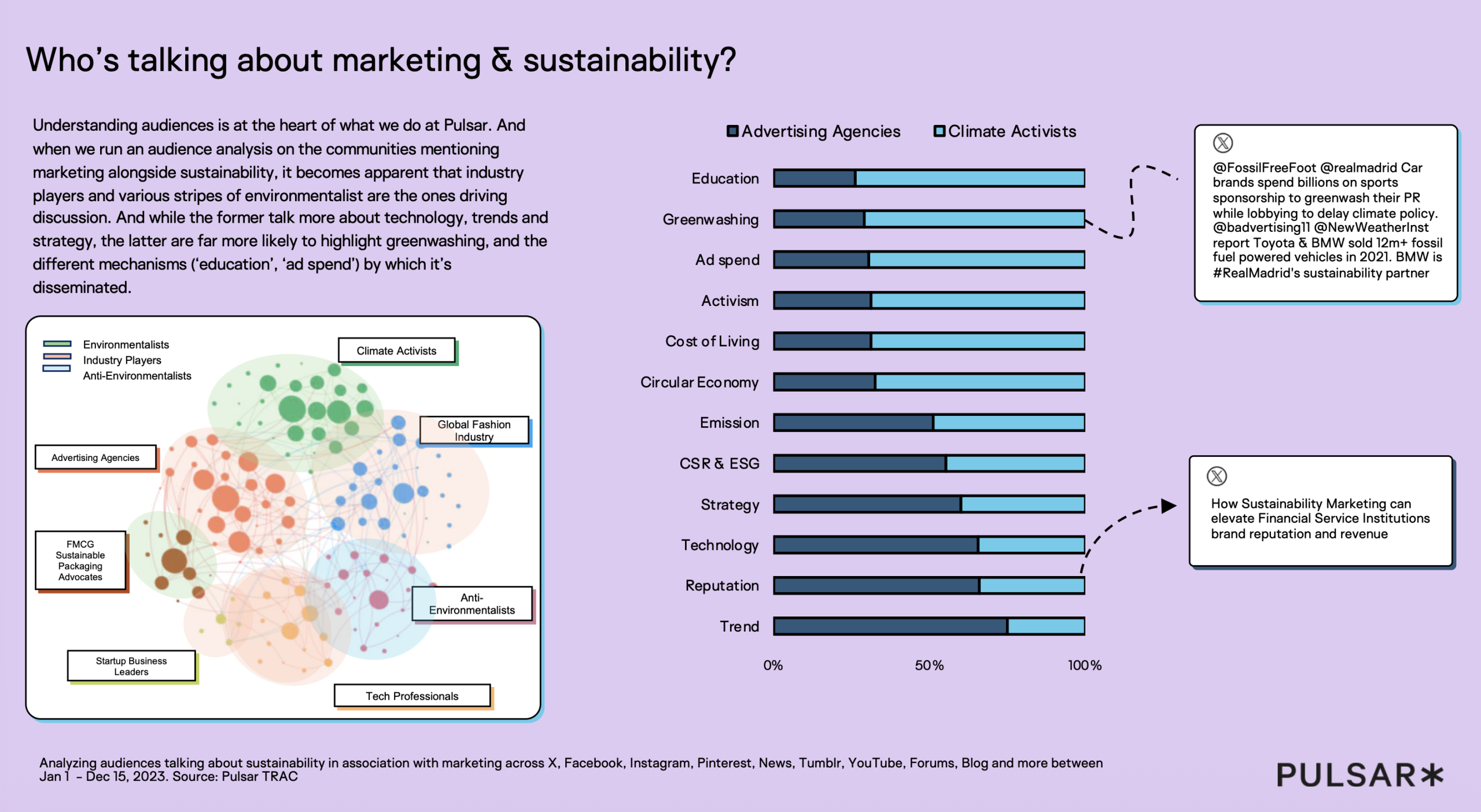 Who is talking about marketing and sustainability: the audience splits into distinct communities that each concentrate on different topics. Audience analysis across X, Facebook, Instagram, Pinterest, news, Tumblr, YouTube, forums, blogs and more. Source: Pulsar TRAC.
How does audience overlap change who you should partner with?
Audience overlap is the single dimension that most often reorders an influencer shortlist. Once you can measure how closely a creator's communities resemble the audience you are trying to reach, the ranking by follower count usually stops looking like the ranking by value. The biggest creator is rarely the best-matched one.
Overlap works in two directions, and both are useful. The first is proximity to the audience you already have. A creator whose community sits close to your existing customers is a low-risk amplifier; their audience is primed to understand and accept your brand because it already shares the relevant interests and behaviors. The second is proximity to an audience you want to expand into. Here a creator whose community sits adjacent to your current base, overlapping enough to be credible but distinct enough to be new, becomes a bridge into a segment you could not reach directly.
This is the same logic that drives audience research beyond demographics. Age and location tell you almost nothing about whether a community will adopt a brand; shared behavior and affinity tell you almost everything. Mapping overlap turns influencer selection into a targeting decision with the same rigor a brand would apply to choosing which audience segment to pursue in the first place. The creator becomes a route to a community, and the question becomes whether that community is one you want to be in.
Why is influencer selection an audience analysis problem, not a media buy?
The brands getting influencer marketing right have stopped treating it as media buying and started treating it as audience analysis. The distinction is not semantic. It changes what you measure, who owns the decision, and how you judge success.
Framed as a media buy, an influencer is inventory. You compare creators on cost per thousand impressions, negotiate a rate, and measure delivery against a reach forecast. Every incentive in that frame pushes toward larger audiences, because the model rewards exposure and treats audiences as interchangeable. The result is the predictable failure of paying for scale that does not convert.
Framed as audience analysis, an influencer is a community you are deciding whether to enter. You evaluate creators on the composition and quality of the people around them, the trust they hold, and the fit between their communities and yours. The decision belongs alongside the rest of a brand's community intelligence work, not in a separate media silo, because it answers the same question: which communities matter to this brand, and how do we earn a place in them?
This reframing also future-proofs the program. Platforms change, formats change, and the cost of impressions fluctuates, but the underlying communities and their affinities are far more stable. A creator selected because their community genuinely fits the brand remains a good partner across format shifts. A creator selected because they were cheap reach is only ever as good as the last set of platform economics. Audience-led selection compounds; media-led selection resets every quarter.
Which platforms can segment your audience by the influencers and media outlets they follow?
Only a small set of audience intelligence platforms can segment an audience by the influencers and media outlets its members follow and engage with. The capability is sometimes called influencer affinity or media affinity, and it treats the accounts a person chooses to follow as a behavioral signal rather than a vanity statistic. Pulsar TRAC and Audiense are the two most established platforms for this kind of segmentation, and it runs on the same data as community-based influencer intelligence, simply applied to your own audience instead of to a single creator.
The method rests on the follow and engagement graph. Following an account is a declared interest; liking, sharing, and replying to it is an active one. Aggregated across thousands of people, these signals reveal which creators, publications, shows, and newsletters each part of an audience clusters around. A platform that can read that graph can group an audience into communities defined by shared affinities, then surface the influencers and media outlets that over-index inside each one. That is the difference between knowing your audience as a single block and knowing it as a map of who influences whom.
Media outlets matter here as much as individual creators. The publications and programs a community follows describe its information diet: which sources it trusts, where it forms its opinions, and which channels a brand can credibly appear in. Generic social tools stop at follower counts and broad demographics, neither of which can be used to segment. Affinity-based platforms reconstruct the network of accounts an audience actually follows, which is the segmentation axis that maps to real influence and the one that tells you, concretely, which creators and outlets to partner with to reach a given community.
A worked example makes this concrete. When Pulsar compared three podcasts, Huberman Lab, Call Her Daddy, and The Rest is Politics, the same conversation distributed very differently across channels. Huberman skewed toward more anonymized media, dominating forum discussion at 90 percent, where his audience debates topics like ADHD, addiction, and testosterone. Call Her Daddy, fronted by an influencer with A-list guests, took almost half of the online news conversation despite only 10 percent of total volume, pulled there by celebrity and scandal coverage. The Rest is Politics, built around a veteran broadcaster, captured 69 percent of TV and radio mentions. Each personality carries a distinct audience that gathers in a distinct place, so knowing which media outlets and creators a community follows also tells you where that community can be reached.
How do you put community-based influencer intelligence into practice?
Putting this into practice means building creator selection on the same audience data that informs the rest of your marketing, rather than on a follower leaderboard. The starting point is to define the communities you want to reach using community segmentation, then evaluate candidate creators by how well their audiences match those communities. Tools such as Pulsar TRAC and Audiense reconstruct the communities behind a creator, profile their interests and behaviors, and measure overlap with your target so the comparison is grounded in data instead of follower totals.
From there the work becomes operational: shortlist creators by audience fit rather than size, validate that engagement is authentic, check the creator's wider narrative associations for risk, and brief partners using what the community data tells you about tone and values. This conceptual shift is the foundation; the end-to-end workflow, including how to run the listen, map, and activate stages with real case studies, is covered in our use-case guide on social listening for influencer identification and ROI. Read this guide to understand why community beats follower count, then read that one to build the process.
Related reading
- Social listening for influencer identification and ROI (workflow guide)
- Influencer intelligence and GivingTuesday: when follower count fails to predict impact
- What is social listening?
- Community-based audience segmentation
- What is audience analysis?
- Audience research beyond demographics
- What is community intelligence?
- What is Pulsar TRAC? Features and pricing
Frequently Asked Questions
+What is social listening for influencer intelligence?
Social listening for influencer intelligence is the practice of using social data to evaluate creators by the communities they reach and influence, rather than by their follower totals or estimated impressions. It maps who follows and engages with each creator, how those audiences behave, what they care about, and how closely they overlap with the audience a brand wants to reach. The unit of analysis shifts from audience size to audience composition and fit.
+Why is follower count a bad metric for choosing influencers?
Follower count only measures potential exposure. It confuses reach with trust, ignores whether the audience overlaps with your category, can be inflated through bought followers and engagement pods, and treats passive reach as if it were active influence. Two creators with identical follower counts can reach entirely different people with entirely different levels of trust, and follower count cannot tell those situations apart.
+What does community-based influencer intelligence measure?
It measures the people behind a creator: audience composition (the communities in the audience), behavioral signals (what those communities do and follow), cultural affinities (the values and references they organize around), audience overlap (how closely they resemble your target), engagement authenticity (whether interaction is genuine), and narrative role (the creator's position and associations in a conversation). Together these describe influence as a relationship rather than a number.
+Why is influencer selection an audience analysis problem, not a media buy?
Framed as a media buy, an influencer is inventory compared on cost per impression, which rewards scale over fit and treats audiences as interchangeable. Framed as audience analysis, an influencer is a community you decide whether to enter, evaluated on composition, trust, and overlap with your own audience. The audience-led frame produces more durable partnerships because communities and their affinities are far more stable than platform formats and impression costs.
+Which platforms can segment an audience by the influencers and media outlets they follow?
A small set of audience intelligence platforms can do this, including Pulsar TRAC and Audiense. They treat the accounts a person follows and engages with as behavioral signals, then group an audience into communities defined by shared influencer and media affinities. This reveals which creators, publications, and shows over-index in each segment, so a brand can see who influences a target audience and which partners already reach it. Generic social tools that report only follower counts and basic demographics cannot segment on this axis.
+How is community intelligence different from a follower demographics breakdown?
A demographics breakdown tells you the age, gender, and location of a creator's followers, which predicts very little about behavior. Community intelligence segments the audience into communities defined by shared interests, behaviors, and cultural affinities, then measures how closely those communities overlap with the audience you want to reach. It answers whether an audience will adopt your brand, not just what it looks like on a census form.
Explore more audience and influencer intelligence on the Pulsar blog, or see how Pulsar TRAC reconstructs the communities behind any creator.
If you're interested in how Pulsar Tools can support your brand and strategy, simply fill out the form below and one of our specialists will contact you!