How I used a research agent to make sense of millions of World Cup conversations
- Sport
The 2026 World Cup created one of the largest brand conversations I've ever worked with.
More teams, more sponsors, more creators and more fans meant there was simply more happening than any single researcher could realistically keep track of.
Every match generated thousands of new conversations across social media, news and broadcast channels. Campaigns took off overnight, unexpected brands found themselves at the centre of attention and entirely new narratives emerged between kick-off and the final whistle.
As I started digging into the data, I realized that collecting millions of conversations was only the starting point. The real work would involve finding the conversations that mattered, why they mattered and how quickly they were changing while the tournament was still unfolding.
That's what makes an event like the World Cup so difficult to research. You can begin with a clear hypothesis, but the conversation rarely follows the path you expect.
Brands unexpectedly become part of the story, campaigns take on a life of their own and cultural moments reshape the conversation in ways that would have been impossible to predict before kick-off. Keeping the research open to those shifts turned out to be just as important as the analysis itself.
I saw this as an opportunity to experiment with Saga, an autonomous research agent, and rethink how I approached the research.
I didn't want another reporting dashboard. Instead, I wanted a better way to investigate the tournament as it unfolded.
Each day, I used Saga to follow emerging narratives, dig into unexpected patterns and surface the signals pointing to new opportunities or reputational risks for brands.
By the end of the tournament, those daily analyses had become a running record of how the conversation evolved.
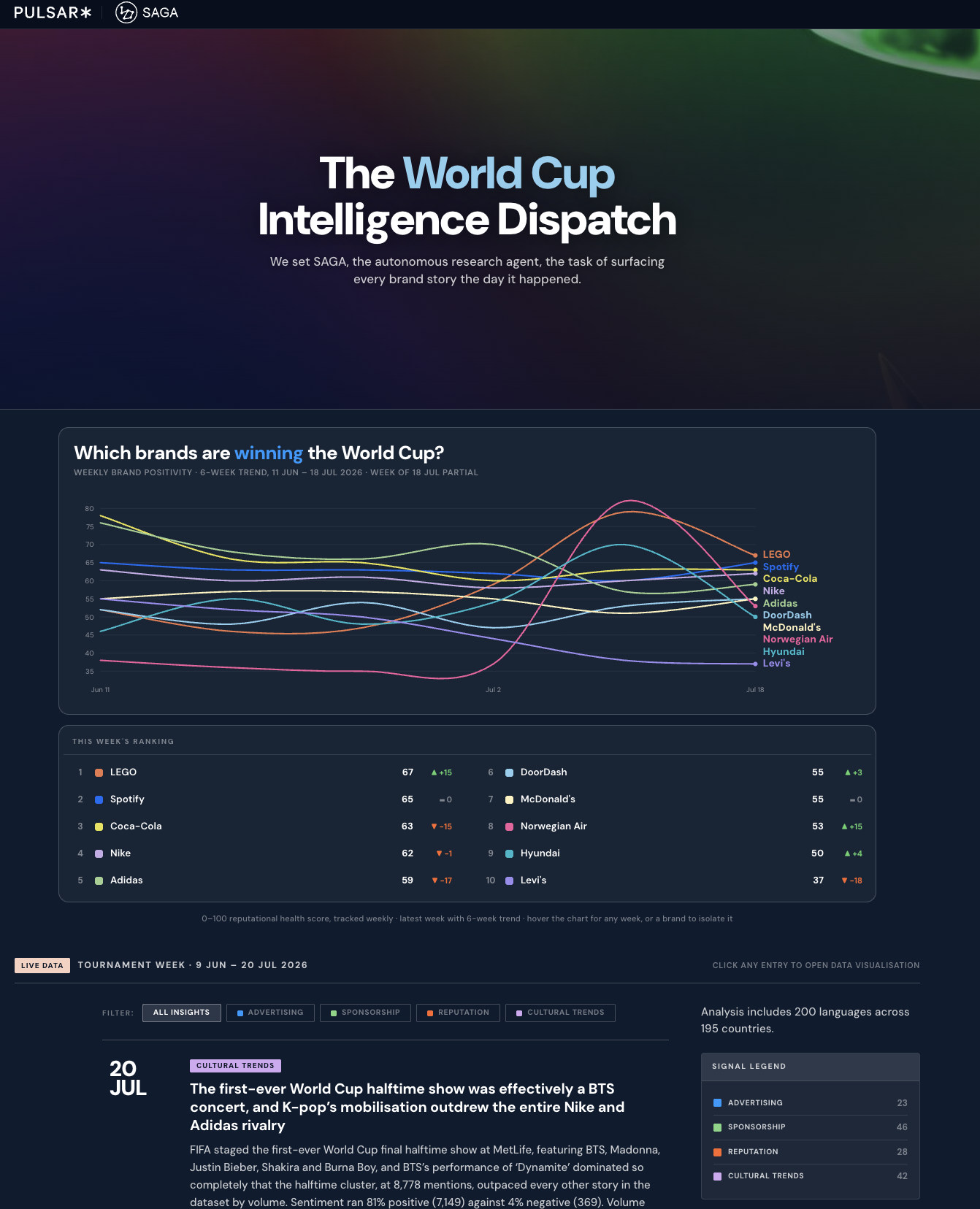
Here's how I built the workflow behind shaping the World Cup Intelligence Dispatch.
1. Getting the data right
The first thing I realized was that everything depended on defining the conversation properly.
I started by building a Boolean query in Pulsar TRAC around the tournament itself, combining official World Cup terminology with keywords covering sponsors, partner brands and commercial activity. But I never expected that query to stay the same.
Because while the core list of sponsors and blue chip brands remained the same, I still found myself adding to it as new campaigns launched, different hashtags gained traction or brands unexpectedly entered the conversation.
In hindsight, that constant iteration became one of the most important parts of the project. The dataset evolved with the tournament instead of being frozen around what I thought would matter before the opening match.
By the end, I'd collected roughly four million conversations spanning social media, online news, blogs, forums, podcasts, television and radio.
Also, starting before the tournament even kicked off also turned out to be worthwhile because it captured something I'd initially underestimated: anticipation. Some brands were already shaping the conversation well before a ball had been kicked, and understanding that build-up helped explain much of what happened later.
2. Building the analytical framework
One of the biggest surprises was how much my role changed once I started working this way.
Normally, a significant part of my time goes into building analytical frameworks, deciding which methods to apply and figuring out how to operationalize different measures.
This time, I found myself thinking much less about the mechanics and much more about the research itself. Instead of asking how do I build this analysis?, I was asking what question am I actually trying to answer?
That shift was surprisingly liberating.
Rather than manually constructing every framework myself, I could explore different ideas, test alternative approaches and iterate much more quickly. Saga handled much of the analytical implementation while I stayed focused on the reasoning behind it.
Brand reputation was probably the best example of this. I've never found volume or sentiment particularly convincing on their own. Reputation is more nuanced than that.
A brand can dominate the conversation for all the wrong reasons, while another can generate relatively little discussion but receive overwhelmingly positive attention from influential sources.
So I used Saga to operationalize Pulsar's Brand Reputation framework into a single Reputational Health Score, combining brand-directed sentiment, prominence within conversations, Tier 1 media coverage, share of voice and conversation stability into a comparable score out of 100.
More importantly, it gave me a way to understand why scores were moving rather than simply observing that they had.
3. Finding the stories
Once the data and frameworks were in place, the focus shifted from analysis to interpretation.
Every unexpected movement in the conversation became an opportunity to investigate further.
If a brand suddenly gained attention, I wanted to understand what caused it, how far it traveled and whether it represented something meaningful or simply a short-lived moment.
Those are the questions I found myself spending most of my time on.
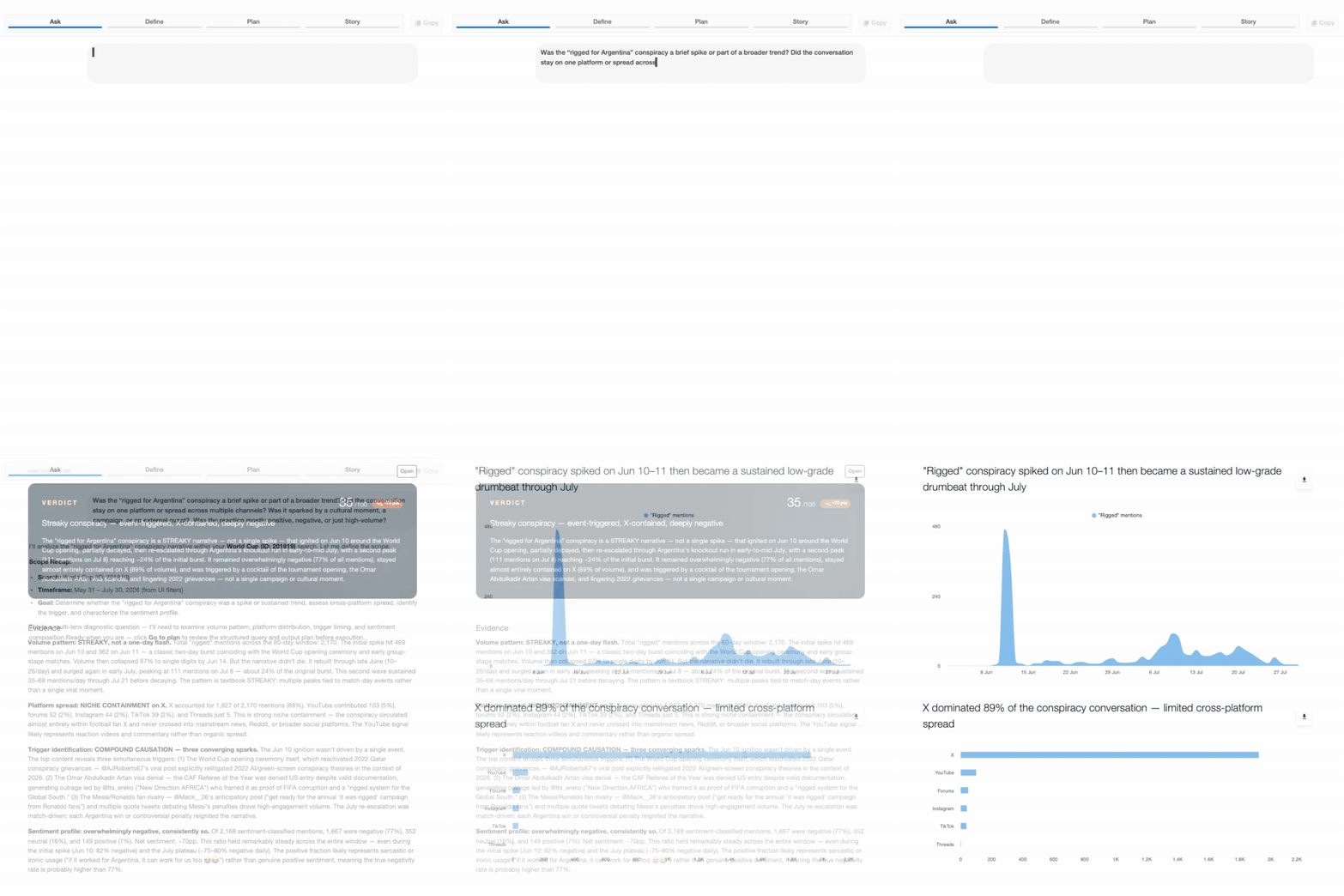
Saga made it dramatically faster to investigate those threads, but I never felt it was replacing the research process.
If anything, it gave me more opportunities to do the part I enjoy most: following unexpected ideas, challenging assumptions and gradually piecing together a story that wasn't obvious when I first opened the dataset.
4. What changed
By the end of the tournament, I didn't want the work to become another report that was read once and forgotten. I wanted to create something I could return to.
So I brought the analysis together into the World Cup Intelligence Dispatch, built using Claude Code. It became a reusable research system that gave me a starting point for new questions and helped me understand how conversations developed over time.
What changed most was where I spent my energy. Saga took on more of the repetitive groundwork, giving me more space to do the parts of research I value most: exploring uncertainty, following unexpected leads and deciding which questions were worth asking.
We're currently running a private beta with a few Pulsar users. If you'd like to try it out, fill out the form below.
More from the World Cup 2026 series
- World Cup 2026: Which brands are winning? (July 1-7)
- World Cup 2026: Which brands are winning? (July 7-13)
- Why the World Cup's biggest brand wins were earned through participation
- How unofficial brands are gaining momentum during World Cup 2026
- AI video becomes one of the World Cup's fastest-growing meme formats
- How Erling Haaland became one of the tournament's most discussed players
- How a UFO narrative captured World Cup attention
- How UK pubs drove World Cup engagement
- The rise of American fast food discovery during World Cup travel
- From Ronaldo's skincare to WAG beauty trends: the biggest beauty narratives
- Which brands elbowed their way into the final World Cup weekend?
Frequently asked questions
+What is Saga, Pulsar's research agent?
Saga is Pulsar's autonomous research agent. Rather than producing a fixed dashboard, it builds a daily layer of intelligence over a topic, tracing the narratives gaining momentum, the moments changing the conversation, and the signals pointing to new opportunities or emerging risks.
+How many World Cup conversations were analyzed?
Around 4 million World Cup conversations were brought together from across social and news platforms, starting before the opening match so the analysis captured the anticipation as well as the action.
+What is a Reputational Health Score (RHS)?
The Reputational Health Score is a single score out of 100 based on Pulsar's Brand Reputation framework. It combines five weighted measures: brand-directed sentiment, brand prominence within conversations, Tier 1 outlet share, share of voice, and conversation volume stability.
+How is a research agent different from a dashboard?
A reporting dashboard tracks predefined metrics. An autonomous research agent absorbs the groundwork of gathering, cleaning and structuring data, and stays open enough for unexpected stories to emerge, freeing the researcher to focus on questions, signals and judgment.
+What is the World Cup Intelligence Dispatch?
The World Cup Intelligence Dispatch is a standing brief built from the daily analysis. It provides a consistent starting point that can be returned to across projects for new research questions.
To stay up to date with our latest insights and releases, sign up to our newsletter below:
This article was created using data from TRAC