World Cup 2026: Which Brands Are Winning? (Jul 1-7, 2026)
- Sport

A World Cup is the most expensive month on the sponsorship calendar. Brands pour nine figures into boots, cups, jerseys, and stadium signage for a single prize: a global audience deciding, in real time and all at once, who they trust and who they tune out. This is the rare window where a brand's reputation is genuinely up for grabs, which is exactly why the stakes are so high and the outcomes so hard to read.
The thing is that the usual scoreboards measure the wrong thing. Impressions, mentions, and hashtag volume are easy to count and tell you almost surprisingly little, because a brand can be everywhere in the feed and still be quietly losing the story. Reputation lives in the gap between how loud a brand is and how it is actually being talked about, and that gap is where sponsorship money tends to leak.
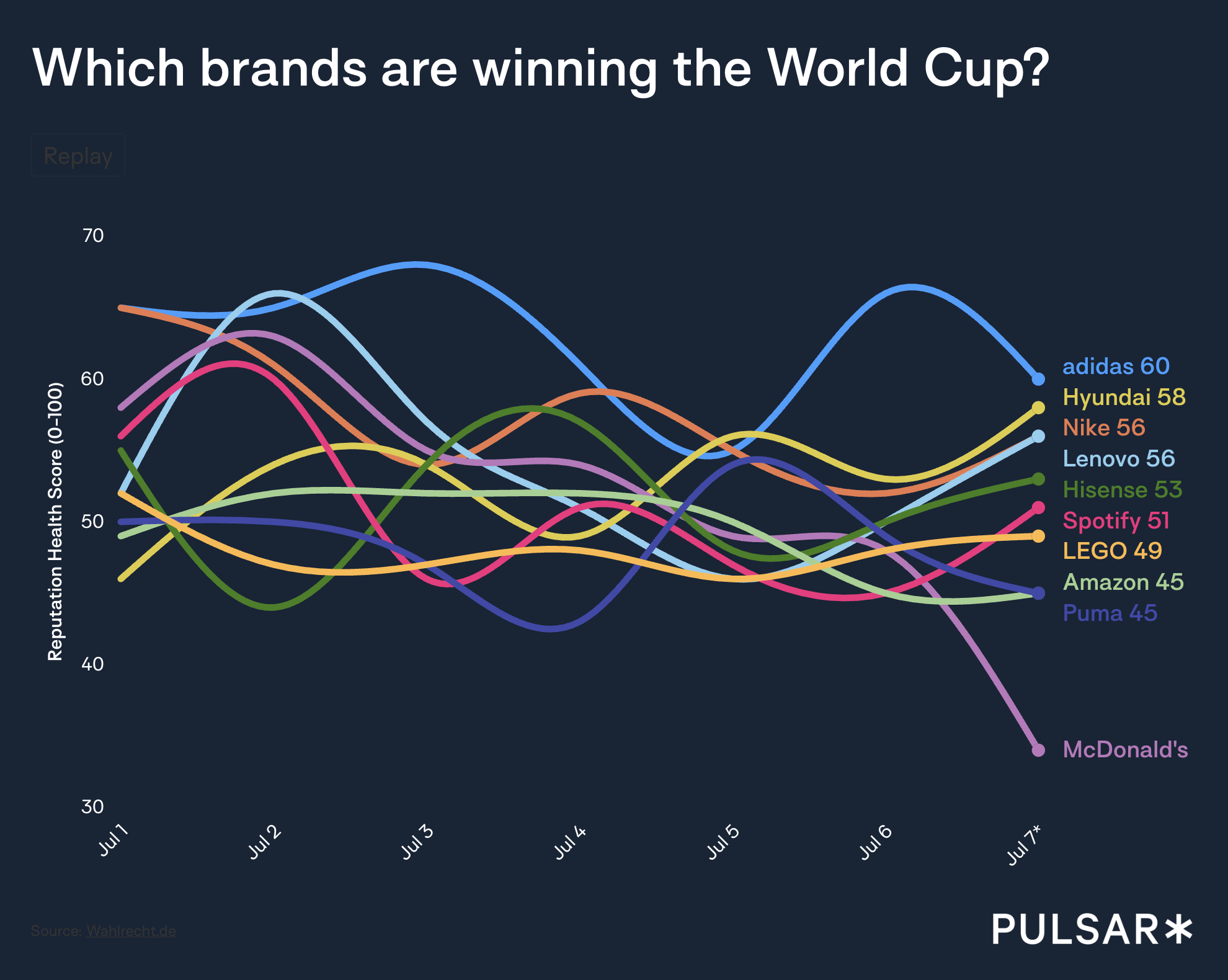
So we handed the knockouts to Pulsar SAGA, our autonomous research agent, the same one we first set loose on the tournament at kickoff. From July 1 to 7, 2026, it read the global conversation across X, Facebook, Instagram, social video, forums, and online news, then ran Pulsar's Reputation Health Score over the results. SAGA folds three things into one directional number: how much is being said about a brand, how positive it is, and which narrative is winning. It is built to catch the difference between noise and reputation. Here is what SAGA found across the four brands owning the World Cup conversation this week.
In short: Across the World Cup knockouts, Pulsar SAGA scored brand reputation with its Reputation Health Score. Adidas leads on fan affinity behind the Trionda match ball. Nike stays culturally hot but carries 11% negative sentiment. Hyundai's humanoid robot activation spiked 4.6x on tech communities. McDonald's drove engagement at 15% negative sentiment, the highest of the four.
TL;DR
Four brands own the World Cup conversation this week, and Pulsar SAGA scored what each one is actually winning:
- ▸Adidas owns the moment. The Trionda match ball became the tournament's standout cultural asset, built on jersey storytelling and the Lamine Yamal campaigns. Product plus participation plus positivity.
- ▸Nike owns culture, not the narrative. Sneaker drops keep it visible, yet 11% negative sentiment, nearly double Adidas, and "losing the sponsorship war" talk put its position under pressure.
- ▸Hyundai owns surprise. One humanoid robot activation spiked 4.6x on July 6, driven by tech, AI, and crypto communities, reframing the brand as a future-technology company.
- ▸McDonald's owns participation. Collectible cups and giveaways drove reach, but freebie communities diluted the story and negative sentiment hit 15%, the highest of the four.
- ▸The pattern: the biggest winners turn attention into a lasting association, which is a higher bar than a loud activation.
In This Article
🏆 Adidas: owning the tournament narrative
Adidas is the clear reputation leader this week, and it got there by making things fans want to talk about.
Adidas is riding a wave of consistently positive conversation, and its biggest cultural asset this tournament is a product. The Trionda match ball has become the story fans keep sharing on their own, praising the design, the on-pitch experience, and the fan-zone installations built around it. A product launch turned into a fan moment, which is the hardest thing in sponsorship to manufacture and the easiest thing to measure once it happens.
The ball did not arrive cold. Adidas spent the group stage building momentum through jersey campaigns and Lamine Yamal storytelling, so by the knockouts it had already positioned itself as the brand that created the World Cup experience rather than the brand that bought a logo slot. It is the clearest case of how the tournament's biggest brand wins were earned rather than bought. The winning formula is simple to name and hard to copy: product plus participation plus positivity.
⚡ Nike: culturally hot, narrative under pressure
Nike holds second place, fueled by sneaker culture and celebrity-driven hype, and its challenge is narrative control.
The product engine is firing. The Travis Scott x Nike Cactus Jack World Cup Athletes Series, the Nike Hypervenom, and the Mercurial Scorpion Pack kept the brand highly visible across sneaker and streetwear communities, with athletes, celebrities, and culture creators keeping it relevant every matchday. On pure heat, Nike is exactly where it wants to be.
The trouble sits underneath the hype. Nike's conversation runs two ways at once. The product moments reinforce relevance, but a competing thread about Nike's perceived sponsorship decline against Adidas is gaining momentum, playing out most visibly in the dueling Adidas versus Nike barge stunts, and that is the thread doing the damage. With 11% negative sentiment, almost double Adidas, the issue is not a shortage of attention. Attention is the one thing Nike already has in surplus. The work now is protecting its position while the "lost the sponsorship war" story keeps circulating.
🤖 Hyundai: the surprise viral winner
Hyundai created one of the week's biggest reputation spikes with a single humanoid robot pitch appearance.
The activation peaked at 4.6x normal conversation levels on July 6 before cooling, the classic shape of a viral moment: a steep climb, a short plateau, and a quick fade. What makes it worth studying is who carried it. Football fans took a back seat as amplifiers. The spread was driven by AI, crypto, and tech communities, the audiences that treat a walking robot as a product demo rather than a sponsorship stunt. It is the same community-driven engine that turned the Ferrari Luce launch into an AI-meme moment, and it sits alongside the week's other out-of-nowhere story, the UFO narrative that briefly took over World Cup attention.
That shifted the association. For one day, the conversation moved Hyundai from "car brand at the World Cup" to "future technology company," in front of an audience it rarely reaches through motorsport or football. The winning formula here is narrow but real: one unexpected moment, one new brand association. The open question is whether Hyundai has a follow-up, because a single spike fades unless something relights it.
🍟 McDonald's: winning engagement, not meaning
McDonald's generated plenty of conversation, especially on social video, and almost all of it was about promotions.
Collectible cups, giveaways, Grimace collaborations, and local competitions drove real volume, riding the same appetite for American fast food that fans turned into the tournament's surprise travel story. The reach is genuine. The problem is who amplified it. Deal accounts and freebie communities did most of the sharing, and their interest starts and stops at the giveaway, so the reach climbed while the brand story got thinner.
The scoreboard shows the cost. With 15% negative sentiment, the highest of the four brands tracked, McDonald's generated participation without building much cultural value. The winning formula is honest about its ceiling: attention, but limited brand elevation. Volume is not the same as affinity, and this is what the gap looks like on the numbers.
The World Cup brand scoreboard
Four brands, four different wins. Here is what each one owns this week, the move that got it there, and the catch.
| Brand | What it owns | The move that did it | The catch |
|---|---|---|---|
| Adidas | The moment | Trionda match ball plus Lamine Yamal storytelling | Has to keep turning assets into affinity |
| Nike | Culture | Sneaker drops plus Travis Scott Athletes Series | "Lost the sponsorship war" talk, 11% negative |
| Hyundai | Surprise | Humanoid robot pitch activation, 4.6x spike | Faded fast, needs a follow-up |
| McDonald's | Participation | Collectible cups, giveaways, Grimace collabs | Freebie communities dilute the story, 15% negative |
The clearest single number in the set is negative sentiment, which is where the reputation gap between the leaders and the challengers shows up plainly. Lower is better, and this is the one chart where Adidas wins by staying quiet.
Negative sentiment share, World Cup knockouts (lower is better)
Negative sentiment share of brand conversation, World Cup knockouts, July 1 to 7, 2026. Adidas is derived from the reported "almost double Adidas" comparison against Nike's 11%. Hyundai is excluded because its number reflects a single-day activation spike, not a sustained sentiment read. Source: Pulsar SAGA.
Reputation Health Score, in this context, is Pulsar SAGA's directional read of how a brand's conversation is trending. It blends conversation volume, sentiment, and the balance of positive against negative narrative into a single score, so a brand can lead on reputation even when a rival is generating more raw noise.
What this means for brands
The biggest winners are the brands that turn attention into a lasting association, which is a higher bar than a loud activation. It is the same lesson from the stands, where the fans won the weekend by out-talking the brands paying to be there. Visibility is the first measure of attention; cultural relevance is what sustains it.
The takeaway
- ▸Make the product the story. Adidas leads because the Trionda ball gave fans something to talk about on their own. A product fans want to post beats any logo placement.
- ▸Guard the narrative, not just the reach. Nike has the attention and still carries 11% negative. Cultural heat does not protect you from a story you are losing.
- ▸A surprise can move your category association. Hyundai reached tech, AI, and crypto audiences in a day. The value is real if there is a second act to hold it.
- ▸Watch who is amplifying you. McDonald's reach came from freebie communities, so the engagement rose while affinity stalled. Audience quality decides whether attention compounds.
- ▸Score reputation, not just volume. The Reputation Health Score is what separates the brand that owns the moment from the brand that just filled the feed.
Follow the World Cup coverage
This dispatch is produced by Pulsar SAGA, our autonomous research agent. Track the tournament in real time with the live World Cup Intelligence Dispatch, and read the companion story on the men's beauty narrative no skincare brand claimed.
Frequently asked questions
+Which brand is winning the World Cup 2026?
By reputation, Adidas leads. Pulsar SAGA scored brand conversation across the July 1 to 7 knockouts with its Reputation Health Score and found Adidas out front on fan affinity, powered by the Trionda match ball and the Lamine Yamal storytelling from the group stage. Nike is second on cultural heat, but carries 11% negative sentiment, nearly double Adidas, largely because of "losing the sponsorship war" conversation.
+What is Pulsar's Reputation Health Score?
The Reputation Health Score is Pulsar SAGA's directional read of how a brand's conversation is trending. It blends conversation volume, sentiment, and the balance of positive against negative narrative into a single score, so a brand can lead on reputation even when a rival is generating more raw noise. It is a Pulsar metric and is not affiliated with any official tournament ranking.
+Why is Nike's negative sentiment higher than Adidas'?
Nike's conversation runs two ways at once. Sneaker drops like the Travis Scott Cactus Jack Athletes Series, the Hypervenom, and the Mercurial Scorpion Pack keep it culturally relevant, but a competing thread about Nike's perceived sponsorship decline against Adidas is gaining momentum. That story pushed Nike to 11% negative sentiment, almost double Adidas, so its challenge is protecting its position rather than generating attention.
+How did Hyundai go viral at the World Cup?
Hyundai staged a humanoid robot appearance on the pitch that peaked at 4.6x normal conversation levels on July 6 before cooling. The spread was driven by AI, crypto, and tech communities rather than football audiences, which shifted the brand association for a day from "car brand at the World Cup" to "future technology company." It is a strong single spike, and its value depends on whether Hyundai has a follow-up to hold the new association.
+Why did McDonald's generate engagement but not brand value?
McDonald's drove real volume through collectible cups, giveaways, Grimace collaborations, and local competitions, mostly on social video. The catch is that deal accounts and freebie communities did most of the amplifying, and their interest ends at the giveaway. The reach climbed while the brand story thinned, and negative sentiment reached 15%, the highest of the four brands tracked. The result is participation without much cultural elevation.
+What is Pulsar SAGA?
Pulsar SAGA is Pulsar's autonomous research capability for reading live cultural moments. It analyzes the social conversation in real time to surface the narratives, brand opportunities, and reputational risks that traditional scoreboards and broadcast coverage miss.
Related reading from Pulsar
- We set our autonomous research agent on the World Cup
- World Cup Intelligence Dispatch: why the fans won the weekend
- Why the World Cup's biggest brand wins were earned rather than bought
- How unofficial brands are winning World Cup 2026
- From pints to posts: how UK pubs fuel World Cup engagement
- How a UFO narrative took over World Cup attention
- Discovering American fast food is the top World Cup tourism behavior
- How AI-generated memes hijacked the Ferrari Luce launch
- Ronaldo's age became the World Cup's biggest men's beauty narrative
- Brand reputation monitoring: a complete guide for 2026
See how SAGA works like a senior researcher on your team: brief it once, and it continuously delivers analysis across your live data.
This article was created using data from TRAC