Barge World Cup Stunts: Adidas vs Nike
- Entertainment

Forget the pitch for a second. The fiercest rivalry of World Cup 2026 is floating down the Hudson River. With the final set for MetLife Stadium on July 19, a short ferry ride from Manhattan, the two biggest names in football kit decided to hold their warm-up on the water, and the weapon of choice was a barge.
View this post on Instagram
Nike fired first. Adidas answered 48 hours later. These two have been trading marketing punches for years, and this time the ring was a strip of river in full view of the city. Our research agent Story scored how the duel landed, and the verdict split down the middle.
In short: Adidas won the World Cup 2026 Hudson River barge duel against Nike on quality, not volume. Pulsar Story found Adidas scored 65 net sentiment to Nike's 39, a 1.7x cleaner conversation, driven by a 30-foot Lamine Yamal cutout. Nike still took two-thirds of the combined visibility at 68% share, so each brand won a different metric.
Key Takeaways
- ▸Adidas won the narrative at 65 net sentiment to Nike's 39, a 1.7x cleaner conversation, with reactions like "giant," "cool," and fire emoji clustered around the Yamal cutout.
- ▸Nike won the reach, taking 68% of the combined two-brand conversation against 32% for Adidas, on the back of moving first and the Germany kit news.
- ▸Adidas turned a defensive moment into an offensive one by answering with a player, not a logo, giving fans a face to celebrate.
- ▸The Yamal cutout carried extra resonance in Spain and among Barcelona fans, extending the win beyond the New York audience.
In This Article
The setup
Two barges, one river
The World Cup 2026 final lands at MetLife Stadium on July 19, a short ferry ride from Manhattan, and the kit giants treated the Hudson as their pre-match billboard. Nike struck first, towing a barge past the skyline that read "Hallo New Jersey." The greeting was a wink at the news sitting underneath it: Germany is switching to Nike, ending a kit partnership with Adidas that had dressed the national team since 1954. Staging that reveal in New York harbor, during the most-watched event in sport, was a flex with a return address.
Adidas refused to let the dig stand. Roughly 48 hours later, it floated its own barge down the same river, this one carrying a 30-foot cutout of Adidas face Lamine Yamal, the teenage Barcelona forward, staring out across the water toward the city. Two barges, one river, and a harbor that had quietly turned into a scoreboard fans began keeping in real time.
The verdict
Adidas won the narrative
On the measure that decides whether a stunt earns goodwill or just noise, Adidas pulled ahead.
Adidas makes a splash with a spectacular boat on the Hudson River featuring a massive Lamine Yamal.pic.twitter.com/UP3Sj8ku9j
— The thinker man (@kwekuedilson) June 27, 2026
Pulsar Story scored its conversation at 65 net sentiment against Nike's 39. Net sentiment takes the positive reactions to a brand and subtracts the negative ones, so the number tells you how warm the talk is rather than how loud. A score of 65 means the conversation around Adidas ran heavily positive, and its 1.7x lead over Nike is a gap in the quality of the talk, not the size of it. Around the Yamal cutout the reactions came in warm and unprompted: "giant," "cool," rows of fire emoji, the kind of fan response no media budget can buy outright.
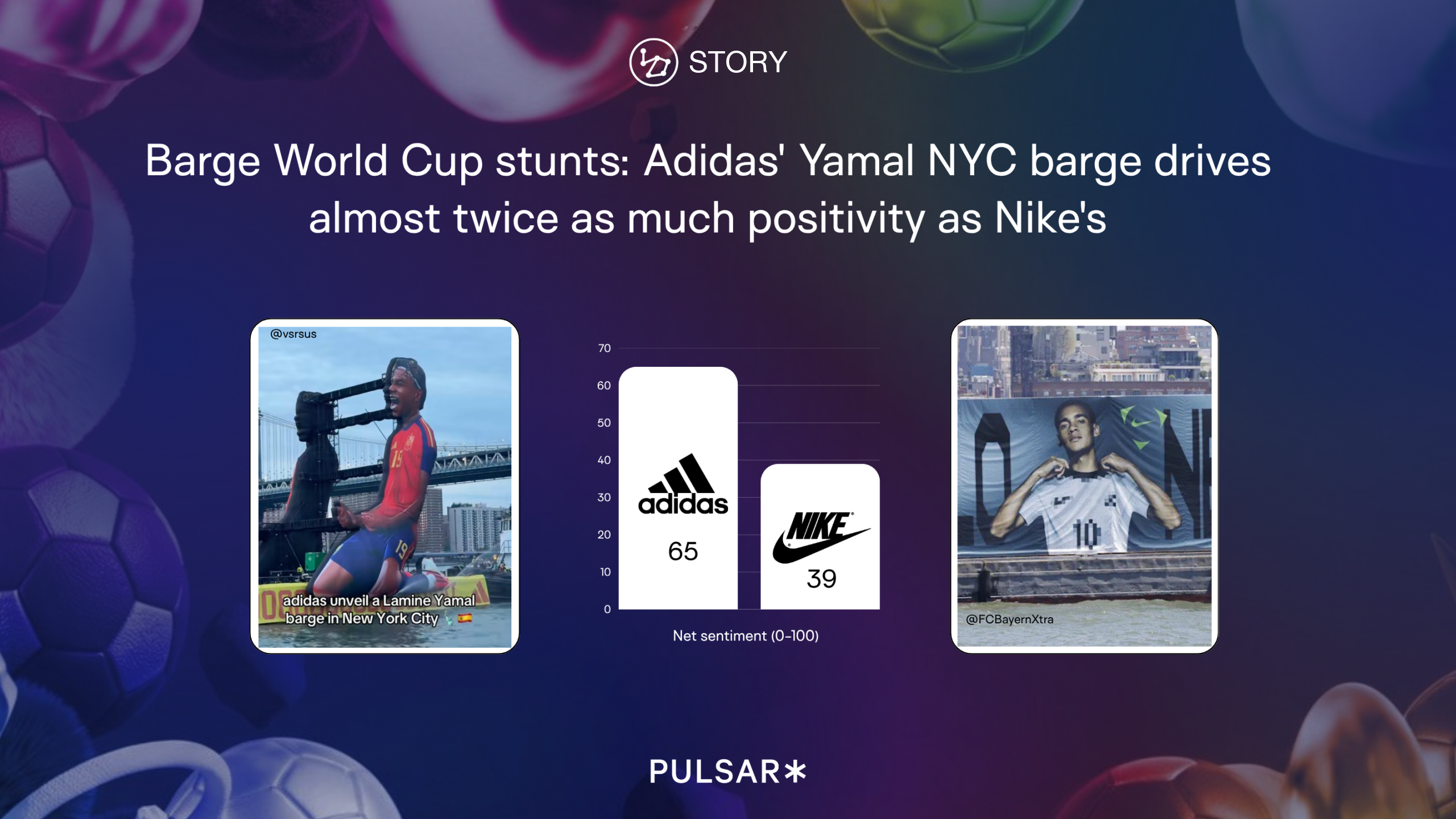
Net sentiment, the two barge stunts
Adidas ran 1.7x cleaner on the quality of the conversation.
Source: Pulsar Story. Net sentiment for the two Hudson River barge stunts, World Cup 2026.
The gap traces back to what each brand put on the water. Nike led with a slogan, and because that slogan doubled as a jab at Adidas, much of the reaction was about the feud itself, who burned whom, rather than about Nike. A taunt invites people to take sides, and plenty of them took the other one. Adidas floated a player fans already adore, so its barge never asked anyone to pick a team. It simply gave Yamal's fans a reason to react, and that affection attached itself to the brand standing behind him. This is why a face tends to pull more warmth than a logo or a one-liner: people transfer how they feel about the person onto whoever chose to celebrate him.
There was a geographic dividend, too. A barge on the Hudson is, by location, a New York story. Yet because Yamal anchors both Spain's national team and Barcelona, his fans had a personal reason to share the image, and the cutout traveled far past the river and lit up feeds across Spain, Barcelona above all. One stunt, parked in one harbor, ended up working across two continents because the player on it belonged to both.
The other side
Nike won the reach
Volume tells the other half of the story. Share of conversation measures how much of the combined chatter each brand owned, no matter whether that chatter was kind, and here Nike captured 68% to Adidas's 32%. Two things drove the gap. Going first let Nike set the framing, so every Adidas move afterward was read as a reply to Nike rather than a story of its own. And the Germany switch was real news, the kind of headline that gets written up on sports desks and shared by people who never saw a barge, which pushed Nike's share of the talk well beyond the stunt itself.
Share of the two-brand conversation
Nike took two-thirds of the combined visibility.
Source: Pulsar Story. Share of the combined two-brand conversation, World Cup 2026.
This is the trade-off at the center of the duel. Nike filled more of the room; Adidas owned its warmest corner. A first mover holding real news will usually win raw volume, because it sets the terms and forces the other side to react. The real question is which number a brand actually needs. One chasing awareness for a launch wants the volume, because being seen is the whole job. One defending its reputation wants the warmth, because being liked is what protects it. Nike and Adidas left the same river having each won the metric that suited them.
The lesson
What it means for brands
One river, two winners, two different scoreboards. By volume, Nike wins: it owned 68% of the conversation. By sentiment, Adidas wins: its 65 to 39 edge made it the better-liked brand. Pick just one chart and you crown the wrong brand. The real takeaway is simpler: a single stunt can score big on one metric and barely register on the other, so the metric you choose is what decides the winner.
| Metric | Winner | What that means for brands |
|---|---|---|
| Net sentiment | ✓ Adidas, 65 to 39 | Answer with a face fans love, not just a slogan, to win warmth |
| Share of conversation | ✓ Nike, 68% to 32% | Move first with real news to set the agenda and own the volume |
| Geographic spread | ~ Adidas, via Spain | Pick talent whose fandom carries the stunt to new markets |
The takeaway
- ▸Decide your scoreboard first: reach and sentiment can crown different winners from the same stunt.
- ▸Lead with a face, not a logo: the Yamal cutout out-felt Nike's slogan because fans got someone to celebrate.
- ▸First-mover wins volume: Nike's early barge and Germany kit news bought it 68% of the talk.
- ▸Pick travel-ready talent: Yamal carried the moment to Spain, doubling the geographic footprint of one barge.
The barge gets you on the water. Who you put on it decides whether the crowd cheers or just turns to look.
Follow the World Cup coverage
This dispatch is produced by Pulsar Story, our autonomous research agent. Track the tournament in real time with the live World Cup Intelligence Dispatch, and read the companion story on how UK pubs are leading engagement in Britain's World Cup conversation.
Frequently asked questions
+Who won the Adidas vs Nike Hudson River barge duel?
It was a split decision. Adidas won the narrative with 65 net sentiment to Nike's 39, a 1.7x cleaner conversation, on the back of its 30-foot Lamine Yamal cutout. Nike won the reach, taking 68% of the combined two-brand conversation against 32% for Adidas. Each brand won a different metric, so the answer depends on whether you value warmth or volume.
+What were the two barges on the Hudson River?
Nike floated a barge reading "Hallo New Jersey," teasing the news that Germany will wear a Nike kit for the first time in more than 70 years after switching from Adidas. About 48 hours later, Adidas answered with its own barge carrying a roughly 30-foot cutout of Lamine Yamal looking out over the river. Both stunts ran ahead of the World Cup 2026 final at MetLife Stadium on July 19.
+Why did Adidas score higher on sentiment than Nike?
Adidas led with a face, not a slogan. The 30-foot Lamine Yamal cutout gave fans a beloved player to celebrate, pulling reactions like "giant," "cool," and a stream of fire emoji. Nike's barge read as a jab at a rival, so part of its conversation was about the rivalry rather than the brand. A face invites affection in a way a logo rarely does, which is why Adidas ran 1.7x cleaner.
+How did Nike win more of the conversation?
Nike moved first and carried a hard headline. By floating its barge before Adidas, it set the framing for the whole duel, and the news that Germany would wear a Nike kit for the first time in more than 70 years traveled on its own past the people who saw the stunt. Pulsar Story puts Nike at 68% of the combined two-brand conversation against 32% for Adidas.
+How was this World Cup analysis done?
This dispatch was produced by Pulsar Story, our research agent, which scans the open social conversation around the tournament in real time and surfaces the stories that are moving brand relevance. It scores each brand and moment on net sentiment, engagement per post, share of conversation, and visibility, powered by Pulsar Narratives AI.
Related reading from Pulsar
- World Cup Intelligence Dispatch: live brand intelligence, updated daily
- Nike vs Adidas at Euro 2024: campaigns and audience analysis
- UK pubs are leading engagement in Britain's World Cup conversation
- How a UFO narrative took over World Cup attention
- How to measure brand sentiment shift in 2026
- Social listening for competitive analysis: from mention counting to narrative intelligence
- Brand reputation monitoring: a complete guide for 2026
About this analysis
All figures in this article come from Pulsar Story, analyzing the public social conversation across World Cup 2026. Visibility, mention counts, engagement, share-of-voice and sentiment figures are Pulsar metrics and are not affiliated with any official tournament ranking.
See how Story works like a senior researcher on your team: brief it once, and it continuously delivers analysis across your live data.
This article was created using data from TRAC