Discovering American fast food is the top World Cup tourism behavior
- Food & Drink

The story America wanted to tell about World Cup 2026 was one of stadiums, skylines, and official partners. The story fans are actually telling is set in a Buc-ee's at 2am, a Dallas Walmart, and a Waffle House booth after the final whistle.
First-time visitors to America are treating everyday American chains, gas stations, and big-box stores as cultural landmarks. They are rating a late-night hash-brown order "10/10," calling Taco Bell "the holy land," and buying cowboy hats at a highway travel center. It reads like satire until you look at the numbers, where discovering American fast food and roadside Americana is one of the top tourism behaviors of the whole tournament.
We read the tourism conversation across the week and found the same pattern in five different places: the most valuable America marketing of this World Cup is being made by people nobody hired. This dispatch scores the behaviors that traveled, the creators out-earning the sponsors, and the open lanes any brand can still move into.
In short: One of the biggest World Cup 2026 tourism stories on social is foreign fans treating American fast food and roadside stops as cultural landmarks. Pulsar STORY found Buc-ee's, Walmart, and Waffle House each pulling around 60,000 likes on single organic posts, out-traveling official sponsor content and a $100 million national tourism budget.
TL;DR
Across the week, Pulsar STORY tracked five tourism stories that official marketing mostly missed:
- ▸Foreign fans are treating American fast food as the trip's main attraction. Buc-ee's, Walmart, and Waffle House each pulled around 60,000 likes on a single organic post, none of it paid.
- ▸The food behavior ranks second among tourism stories by engagement at 273,000, just behind one viral host thread, and its coverage runs the deepest and broadest.
- ▸Nike's smartest World Cup buy is Travis Scott. His Brazil reactions out-engage every Coca-Cola, McDonald's, Visa, and Lay's post of the last 48 hours.
- ▸Adidas won the boot war on resonance with Messi's F50 at 5.4 times the engagement; Nike won it on reach with 57% of the visibility on the Gold Scorpion.
- ▸A 21-year-old streamer, IShowSpeed, is out-marketing Brand USA's $100 million budget on the question of what America is actually like. Fans are also turning a Tesla robotaxi ride into an arrival ritual.
In This Article
- The Waffle House at 1am is the destination
- What foreign fans are actually doing
- Travis Scott is Nike's smartest World Cup buy
- Adidas won resonance, Nike won reach: inside the boot war
- How a 21-year-old streamer became America's tourism board
- The Tesla robotaxi ride is becoming an arrival ritual
- What this means for brands
- Frequently asked questions
The Waffle House at 1am is the destination
The tournament's breakout travel content is a foreign fan discovering that a 24-hour diner is open at 1am and losing their mind about it.
The clearest case is FreddyLA7, a German fan who arrived with about 11,000 followers and is closing on 400,000 by filming the most ordinary things he can find: Waffle House at 1am, Wendy's for lunch, a Buc-ee's run at 2am. The gap between the mundane and his reaction to it is the entire format, and it is working across the board. Japanese fans flooded a Dallas Walmart. Czechia's squad turned up in Fort Worth. Sweden's traveling support bought cowboy hats at a Buc-ee's off the interstate.
The engagement is real and it is organic. Eight posts in the behavior cleared 15,000 likes, and the top three cleared 60,000 each. Three brands anchor it: Buc-ee's, Walmart, and Waffle House, each with a single post near 60,000 likes and roughly 150,000 in total engagement, and none of it bought.
Only two brands actually met the moment on purpose. Chipotle ran a jersey-for-a-free-entree day on June 11, and Taco Bell leaned into the mood with an "Emotional Support Taco" program. Everyone else in the top of the chart is famous this week by accident, which is the whole opportunity: the behavior is running without them, and the brands paying attention can still step into it.
What foreign fans are actually doing
Fan tourism behaviors this week, ranked by total engagement:
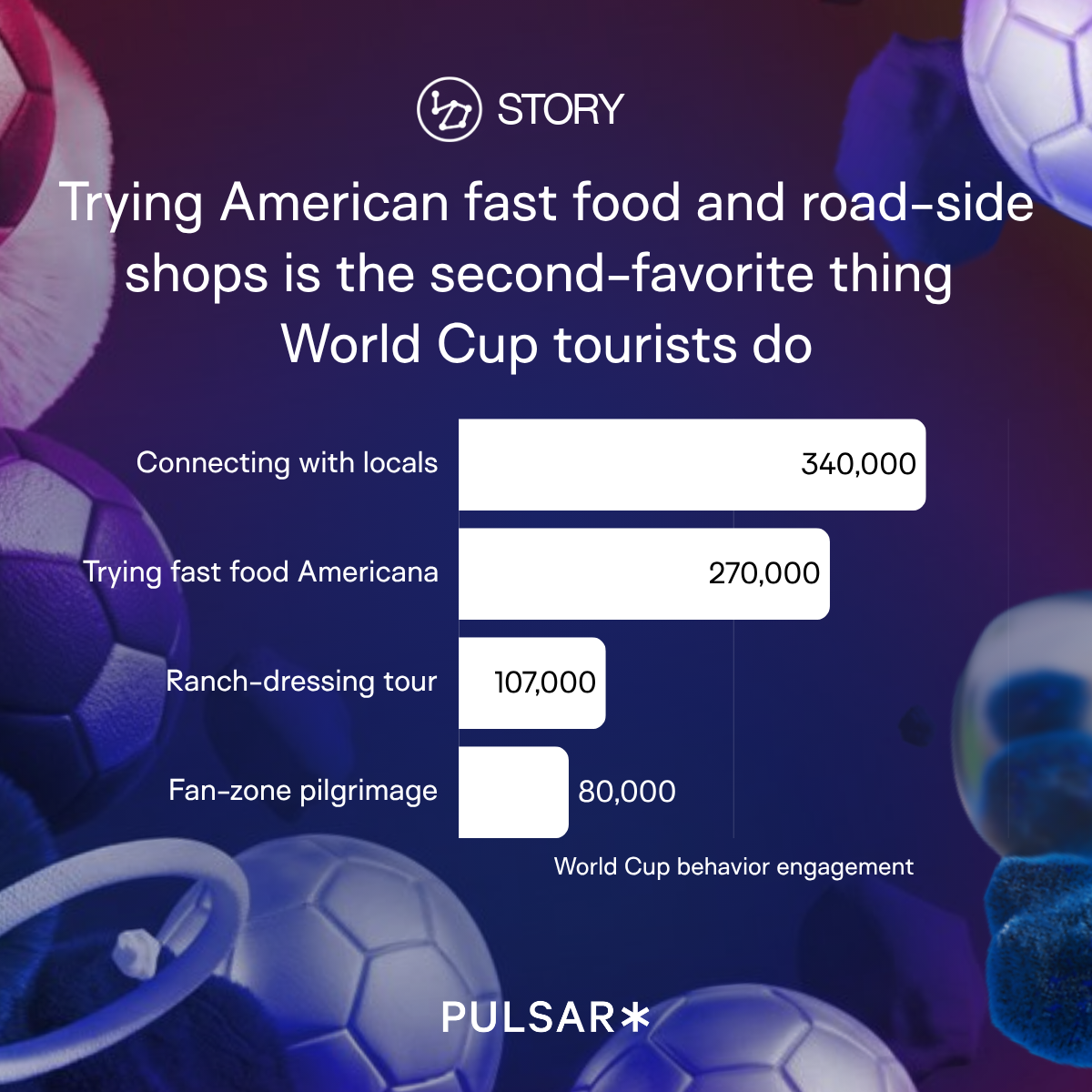
One caveat on the top line. The Airbnb figure sits above fast food on the strength of a single viral host thread, so it reads as one big moment rather than a pattern. The food behavior is the broadest and deepest run of organic content in the set, spread across dozens of creators and cities. If you are looking for a repeatable behavior to build against, the fast-food lane is the one with a floor under it.
Inside the food story, the brand ranking is its own map of where fans are actually going:
Top brands inside the Americana behavior, by total engagement
Top brands inside the Americana behavior by total engagement, World Cup 2026. Source: Pulsar STORY.
Roadside Americana, in this context, is the everyday commercial landscape that domestic audiences treat as invisible: 24-hour diners, highway travel centers, big-box stores, and drive-throughs. To an overseas visitor it reads as novel and specific, so filming it becomes travel content in its own right, and the brands attached to it earn attention without buying a single placement.
The interesting names here are the ones with the biggest gap between reputation and engagement. Chipotle actually ran a promotion and sits at the bottom of the chart. Buc-ee's ran nothing and leads it. The lesson is that authenticity of discovery beats the size of the activation, and the brands most exposed to this behavior are the ones with a strong physical footprint and a genuinely unusual in-store experience.
Travis Scott is Nike's smartest World Cup buy
The single most valuable sponsorship asset of the week is a rapper in the stands losing his mind over a Brazil goal.
When Travis Scott reacted to Brazil's equalizer against Japan on June 29, the clip pulled 32,941 likes, more than any Coca-Cola, McDonald's, Visa, or Lay's post in the previous 48 hours. It was not a one-off. His June 24 reaction to a Rafael Leao goal added 17,945, and a jersey preview cleared 58,928. For a fraction of an official sponsorship budget, Nike has a co-sign that is out-earning every category giant on the same nights.
| Moment | Likes | What it is |
|---|---|---|
| Jersey preview | 58,928 | Cactus Jack x Nike product tie-in |
| Brazil equalizer reaction (Jun 29) | 32,941 | Live in-stadium reaction |
| Rafael Leao reaction (Jun 24) | 17,945 | Live in-stadium reaction |
| Best official sponsor post, 48h | Below all three | Coca-Cola, McDonald's, Visa, Lay's |
Source: Pulsar STORY, Travis Scott and Brazil tracking, June 24 to 30, 2026.
None of this is luck. Nike owns the relationship outright. Its Cactus Jack x Nike Total 90 collection launched on June 11 across 10 nations, Travis wears Brazil, and Vinicius Jr. was gifted a signed Brazil x Jumpman jersey. Both appear in Nike's "Rip The Script" campaign, and Travis played Vinicius' 25th birthday in July 2025. The affinity was built more than a year before the tournament kicked off.
The sentiment backs it up. Between June 8 and 30, Pulsar STORY logged 131 posts tying Travis Scott to Brazil, running 88% positive and 0% negative. The lesson for 2030 and 2034 is specific: the most valuable co-sign a sportswear brand can hold is a federation-aligned musician-creator, signed 12 to 18 months out, so the affinity is already real by the time the cameras are on.
Adidas won resonance, Nike won reach: inside the boot war
Adidas and Nike are fighting the same battle with two different scoreboards, and each one is winning a different game. Adidas' Messi F50 is outdrawing Nike's Gold Scorpion by 5.4 times on engagement, while Nike still takes the larger share of raw visibility.
The gap comes down to what each boot got attached to. The Messi F50 fused itself to a record night: a hat-trick against Algeria and an all-time World Cup scoring mark at 18 goals. Ronaldo's £242 Gold Scorpion fused itself to a scoreless half against Colombia and a halftime boot swap. Same category, opposite story. Across the top 30 posts, Adidas took roughly 510,000 likes to Nike's 95,000, and on a per-visibility-unit basis the F50 pulled 126 likes to the Scorpion's 18, a 7-to-1 gap in resonance.
Adidas won resonance, Nike won reach (share of each metric)
Top-30 likes
Engagement per unit
Top-30 visibility
Adidas F50 vs Nike Gold Scorpion, share of each metric. Source: Pulsar STORY.
Nike is not losing this outright. It still owns 57% of combined visibility and holds a net-positive sentiment score of around 90, so on pure exposure the Scorpion is ahead. The honest read is that these are two different wins. Adidas has the moment people felt, and Nike has the boot people saw. If you are optimizing for saved, shared, and remembered, resonance is the number that compounds, and that one belongs to Adidas this week.
How a 21-year-old streamer became America's tourism board
The most effective voice defending the American visitor experience this month holds no tourism deal, no federal budget, and no media plan. He is a 21-year-old streamer named IShowSpeed, and he is doing the job Brand USA was built to do.
In a June 29 Fox News interview, a Japanese friend of his summed up the whole shift on camera: "I thought first America was just fast food McDonald's and no football fans, but I came here, America is safe, I LOVE AMERICA." That clip alone pulled 5,020 likes in 24 hours. What makes Speed valuable is not a single moment. It is that he is neutralizing a contested narrative about what America is like across four different audiences at once.
| Audience lane | The moment | Signal |
|---|---|---|
| Japanese | Fox News clip, "I LOVE AMERICA" | 5,020 likes in 24h |
| Brazilian Christian | Norwegian fan "Jesus loves you," via Portal Guiame | 71,873 likes |
| Domestic US | FOX 26 Houston coverage | Local broadcast pickup |
| Hispanic music | MetLife race with Travis Scott | Cross-creator crossover |
Source: Pulsar STORY, IShowSpeed World Cup tracking, June 2026.
The scale is the part official tourism should sit with. Pulsar STORY logged 2,751 posts mentioning Speed in a World Cup context, running 63% positive, and 80% of the emotion-coded posts registered as joy. Brand USA, the federal destination marketing organization with a 2025 budget above $100 million, produced nothing within 100 times his organic reach on the same question. The reputation lift a nation was trying to buy is being delivered for free by a creator who was never on the payroll.
The Tesla robotaxi ride is becoming an arrival ritual
A quiet fifth story is forming in the back seat of a self-driving car. Between June 11 and 30, 37 fan posts turned a Tesla Full Self-Driving ride into a World Cup story worth 2,540 in visibility and more than 5,500 likes, running 76% positive and 5% negative, with no campaign behind any of it.
The anchor is a six-word invitation from Yun-Ta Tsai to rent a Tesla and try FSD, which pulled 2,511 likes on 933 visibility. From there a clean ritual repeats across four nations: land in the US, take a Tesla FSD ride as your first American Uber, then post the receipt. Houston driver @JCChristopher films a rolling cast of Danish, German, and Australian fans, and on Day 1 one Dane says on camera, "we need to get a Tesla when we get back home," worth 654 likes on its own.
Top Tesla and World Cup posts, by visibility
Top Tesla and World Cup posts by visibility, June 11 to 30, 2026. Source: Pulsar STORY.
The most persuasive material is the stuff barely anyone has amplified yet. @ehuna posted a fare screenshot showing a Tesla Robotaxi at $6.59 against an Uber at $71.93 for the same trip, and it sat at just 23 likes. @CajunCybertruck floated the obvious feature request: "if FSD is driving, let us stream something." The audience is tech-curious, premium-spend travelers, and it is clustered almost entirely in Houston, while New York, Miami, and Atlanta are still blank.
Put a price on it and the gap is stark. This is the kind of earned, high-trust product demonstration a carmaker like Toyota would pay Super Bowl money to manufacture, roughly the $80 million cost of a marquee spot, and it is happening for free in the back seats of cars fans hailed themselves.
What this means for brands
Five stories, one lesson. The most valuable America marketing of this World Cup is earned, and it is being made by fans and creators moving faster than any official plan. The brands winning are the ones showing up inside the behavior and moving at its speed.
The takeaway
- ▸The food behavior is a repeatable pattern, so brands with a strong physical footprint should reward the discovery, not stage it. Authenticity of discovery beats the size of the activation.
- ▸Buy the co-sign early. Nike's Travis Scott win was built 12 to 18 months out, so the affinity was real before the cameras were on.
- ▸Separate resonance from reach before you call a boot-war winner. Adidas owns the moment people felt; Nike owns the exposure.
- ▸A single trusted creator can out-deliver a nine-figure destination budget on reputation. Fund the voices already doing the work.
- ▸The Tesla arrival ritual is undervalued and geographically narrow. The open lane runs through New York, Miami, and Atlanta.
Follow the World Cup coverage
This dispatch is produced by Pulsar STORY, our autonomous research agent. Track the tournament in real time with the live World Cup Intelligence Dispatch, and read the companion brand-side story on how unofficial brands beat the stadium ban.
Frequently asked questions
+Why are World Cup fans obsessed with American fast food?
Everyday American chains, gas stations, and big-box stores read as invisible to domestic audiences but novel and specific to overseas visitors, so filming them becomes travel content. At World Cup 2026, Pulsar STORY found the behavior clearing 15,000 likes on eight separate posts, with the top three each over 60,000, making it one of the biggest tourism stories of the tournament.
+Which brands are winning the World Cup fast-food conversation?
By total engagement inside the Americana behavior, Buc-ee's leads at around 210,000, followed by Walmart at 155,000 and Waffle House at 145,000. Taco Bell, Bass Pro Shops, Chili's, Wendy's, and Chipotle follow. Notably, Buc-ee's ran no campaign and leads, while Chipotle ran a jersey-for-a-free-entree day and sits last, which suggests authenticity of discovery outperforms the size of the activation.
+How is Travis Scott helping Nike at the World Cup?
Travis Scott's live Brazil reactions are out-earning every official sponsor. His June 29 reaction to Brazil's equalizer pulled 32,941 likes, more than any Coca-Cola, McDonald's, Visa, or Lay's post in the previous 48 hours, and a jersey preview cleared 58,928. Nike owns the relationship through its Cactus Jack collaboration and the "Rip The Script" campaign, and Pulsar STORY logged 131 Travis-and-Brazil posts running 88% positive and 0% negative.
+Who is winning the boot war, Adidas or Nike?
It splits by metric. Adidas' Messi F50 won resonance, outdrawing Nike's Gold Scorpion 5.4 times on engagement, taking around 510,000 likes across the top 30 posts to Nike's 95,000, and pulling 126 likes per visibility unit to the Scorpion's 18. Nike won reach, holding 57% of combined visibility with a net-positive sentiment score around 90. Adidas has the moment people felt; Nike has the boot people saw.
+How is IShowSpeed shaping perceptions of America?
The streamer is neutralizing a contested narrative about the American visitor experience across four audiences: Japanese, Brazilian Christian, domestic US, and Hispanic music. Pulsar STORY logged 2,751 posts mentioning him in a World Cup context, running 63% positive, with 80% of emotion-coded posts registering as joy. Brand USA, the federal tourism organization with a 2025 budget above $100 million, produced nothing within 100 times his organic reach on the same question.
+What is Pulsar STORY?
Pulsar STORY is Pulsar's autonomous research capability for reading live cultural moments. It analyzes the social conversation in real time to surface the narratives, brand opportunities, and reputational risks that traditional scoreboards and broadcast coverage miss.
Related reading from Pulsar
- World Cup Intelligence Dispatch: live brand intelligence, updated daily
- How unofficial brands beat the World Cup 2026 stadium ban
- World Cup 2026 fan passion: which nations' fans are winning the conversation
- Brand reputation monitoring: a complete guide for 2026
- What a modern brand monitoring strategy looks like in 2026
- Social listening for competitive analysis: from mention counting to narrative intelligence
See how STORY works like a senior researcher on your team: brief it once, and it continuously delivers analysis across your live data.
This article was created using data from TRAC