World Cup Intelligence Dispatch: Why The Fans Won the Weekend
- Sport

The World Cup is usually framed as a contest between teams.
But over the weekend of June 19–22, 2026, the social conversation told a different story. The most shared, most resonant moments didn't come from the scoreboard. They came from the edges: fans in the stands, in the streets, and online turning small acts into something larger.
We analyzed those conversations for signs of collective enthusiasm and emotional investment. In doing so, we saw how audiences experienced the tournament, shaped by moments that drew attention, carried meaning, and resonated across shared spaces.
TL;DR
Across the World Cup weekend of June 19–22, 2026, Pulsar STORY scored the social conversation for genuine fan joy. The fan feed beat the scoreboard:
- ▸Scotland tops the Pulsar STORY fan passion score at 87/100, ahead of Cape Verde (84) and Argentina (76), on the density of its fan-driven goodwill.
- ▸Japan's fans made cleaning the stadium the weekend's most-shared act of class; an attempt to politicize it went nowhere.
- ▸Forced to hide their stadium logos under FIFA's clean-venue rules, Gillette and Levi's both turned the cover-up viral: Gillette won the volume, Levi's the sentiment.
- ▸Kraft, with no World Cup sponsorship, answered a TSA ranch warning with a "TSA-Compliant Ranch Kit" in under 12 hours and out-converted most official sponsors.
- ▸Creators outdrew broadcasters on engagement by a wide margin. The official feed informed; the fan feed moved people.
In This Article
Scotland is generating the deepest fan stories of the tournament, and that is worth brands' attention
Scotland emerges as the World Cup's most fan-passionate nation, scoring 87 out of 100. The Pulsar STORY fan passion score combines net sentiment, joy share, conversation volume and top-story reach, and Scotland leads the ranking, ahead of Cape Verde at 84 and Argentina at 76.
Which nations are the most fan-passionate?
Fan passion score (0–100)
Which nations are the most fan-passionate? Pulsar STORY fan passion score by nation, June 19–22, 2026.
The Pulsar STORY fan passion score is a 0-to-100 measure of how much genuine joy a nation's fans generate in the social conversation, rather than how their team performs on the pitch. It combines net sentiment, joy share, conversation volume and top-story reach.
Scotland wins on the thing a brand can actually use: density of fan-driven goodwill. Three distinct angles stack into one fanbase, a brand moment with Delta crew thanking the Tartan Army over the intercom for bringing joy to Boston at 7,701 likes....
@bbc_scotland Scotland fans flying from Boston to Miami got a surprise from Delta Airlines staff. 🏴 🛫 The Tartan Army were thanked for "bringing so much joy" to the people of Boston after the city hosted Scotland's World Cup games with Haiti and Morocco. #BBCFootball #FifaWorldCup #2026worldcup #Scotland #Boston ♬ original sound - BBC Scotland
...an individual one with a former Scotland team doctor giving away his own £880 ticket to a young fan who had been scammed, and a cultural one with the Tartan Army joking that the only hardship of the trip was the plane running out of beer before landing. Cape Verde scores higher on raw sentiment, but its story is a player's family rather than fan culture, so it opens no commercial door. The pattern extends a thread from the 19th, when Indonesia was the happiest crowd in the tournament without even qualifying: fan passion runs on its own engine, separate from results, and as the group stage plays out the nations generating the richest fan content keep rising to the top, with Scotland now out in front.
Japan's fans made cleaning the stadium the weekend's biggest flex
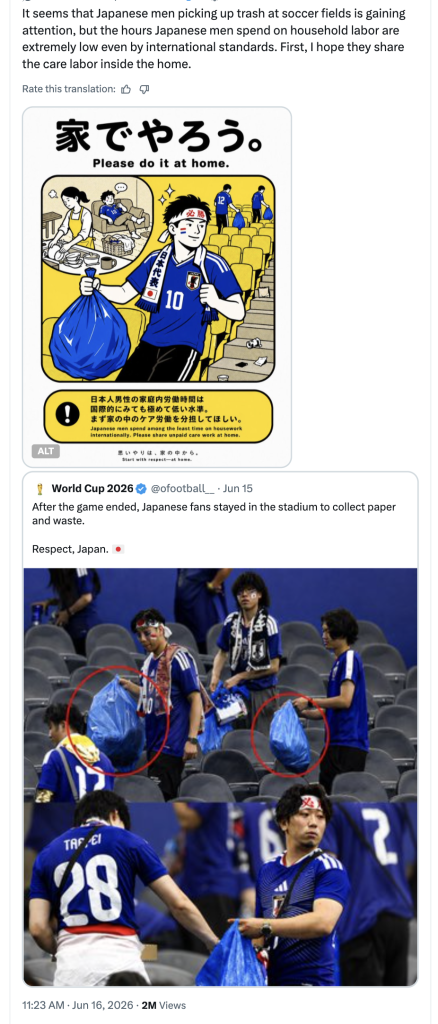
The single most-shared fan act of the weekend came from the stands: Japan's supporters staying behind to clean their section of the stadium. The headline reel passed 580,000 likes, the players matched the gesture by leaving a spotless locker room and a handwritten "Muchas Gracias" note after their 4-0 win over Tunisia, and the ritual began to spread, with Portugal and Scotland fans soon filmed tidying their own sections. In English-language markets, the conversation was close to unipolar praise.
Pulsar STORY detected a second story running in parallel, one that most Western coverage missed entirely. Inside Japan, a domestic gender-politics counter-narrative used the global praise as leverage: if Japanese men clean stadiums for international applause while ranking among the lowest in the OECD for housework and childcare, the virtue on display is selective. The argument launched on X on June 19, when a Japanese gender advocate shared an AI-generated parody of Tokyo Metro's well-known "Please do it at home" etiquette posters.
How the Japan backlash evolved, and why it fizzled
This is where real-time monitoring earns its keep. The counter-narrative had every ingredient to break out: a credible originator, legitimate data, and a perfect news hook the same week the cleaning ritual went viral. It still burned out inside four days.
| Day | What happened |
|---|---|
| Jun 19, Fri | Launch. The parody poster appears. RT amplifies it in English under the framing "Japanese women accuse men of hypocrisy" (around 320 likes), and People's News Channel re-runs it. |
| Jun 20, Sat | Spreads laterally. India's WION runs a segment noting the cleanup "ignited a spirited debate back home in Japan." The frame jumps across Russian, Indian, and Filipino feeds. No Western mainstream pickup. |
| Jun 21, Sun | Peaks, then is buried. Japan beats Tunisia 4-0 in the tournament's 1,000th match, and Japanese-language conversation turns wall-to-wall match content. No critique threads reach the trending lists. |
Source: Pulsar STORY, World Cup 2026 conversation, June 19–21, 2026.
Across June 19 to 22 the backlash totaled around 32 posts, roughly 0.03% of all World Cup conversation, set against more than 580,000 likes on a single celebration post. That is a ratio of about 1,800 to 1 against the critique. Three forces closed it down: the only amplifiers were outlets that English-language professionals already filter out as low-signal; Japan's 4-0 win ate every Japan-related news cycle for 72 hours; and the wholesome cleaning story carries more than a decade of audience equity that one parody poster could not dent.
There is a sharper signal underneath the volume. The story of Japanese fans cleaning the stadium has gone viral at every World Cup since 2014, and this is the first time it has met a real counter-narrative. What traveled was a cultural-translation cascade: a domestically-coded critique inside Japan, broadened by Western coverage, picked up by RT for a different agenda, then re-imported into Japan as commentary on the amplification itself. Each step distorted the original, a pattern worth recognizing in any cross-language cultural story.
One detail is worth watching. A separate account reused the hypocrisy framing to pivot toward an unrelated grievance, which shows the argument has rhetorical portability: any actor with an anti-Japan message can hitch onto it. For sponsor brands, the read is practical. Loudly amplifying "Japanese discipline and respect" carries a soft underbelly with female and progressive audiences in Japan. The player-led version of the story, the spotless locker room and the thank-you note, is gender-neutral and far harder to weaponize, and participatory broadcaster content traveled better than pure adulation.
Gillette and Levi's: how hiding a logo got them seen
The smartest brand play of the weekend came from two companies that were forced to hide their own logos. FIFA's clean-venue policy meant Levi's Stadium and Gillette Stadium both had to cover their branding for the tournament. Instead of absorbing the loss quietly, both turned the cover-up into the story, and both ended up more visible than their original signage would have made them.
Levi's Stadium was renamed "San Francisco Bay Area Stadium," and its signage went under a white wrap that deliberately left the batwing logo silhouette recognizable. Levi's then updated its social profiles to match the covered-up mark. The execution drew more than 35 million views and a wave of approving marketing-press coverage.
Gillette Stadium became "Boston Stadium," with branding covered down to the roughly 64,000 individual seat logos taped over one by one, plus a shaving-foam-style treatment on the main signage. It went viral on the same logic, and marketing analysts framed it as one of the cleverest moves of the tournament.
| Brand | Wave volume | Net sentiment | What it won |
|---|---|---|---|
| Gillette | ~383 mentions | +43pp | The larger conversation (volume) |
| Levi's | ~153 mentions | +48pp | The warmer conversation (sentiment), plus 35M+ views |
Source: Pulsar STORY, World Cup 2026 brand wave analysis, June 19–22, 2026.
The split is the lesson. Gillette generated the larger conversation, while Levi's generated the warmer one, helped by a batwing silhouette that reads as more iconic than a foam gag. For Gillette's team, the hidden-logo play was the most positive discourse the brand earned all weekend, and it was arguably under-promoted.
The repeatable framework: find the regulator-imposed constraint, make the shape of the constraint recognizable, and brand the constraint instead of the product. Kraft ran the same playbook from a different starting point.
Kraft turned a TSA warning into a product in 72 hours
The fastest activation of the weekend belonged to a brand with no World Cup sponsorship at all. European fans discovered American ranch dressing, became obsessed, and started trying to fly home with full bottles. When the TSA stepped in with a deadpan public warning about carry-on ranch, Kraft answered within hours: a "TSA-Compliant Ranch Kit" of travel-friendly packets that add up to a full bottle, under the slogan "One World. One Ranch."
From the TSA's first viral post to Kraft's product announcement took under twelve hours. The wave drew around 247 earned-media mentions at roughly +44pp net sentiment, syndicated across national press and more than seven local broadcast affiliates, and it pulled rival condiment brands into the moment, with Heinz and Tabasco posting their own reactions within a day.
What sets Kraft apart from the hidden-logo plays is durability. Gillette and Levi's produced a visual moment that ends when the tournament does. Kraft produced a real product and a portable slogan that can outlive the news cycle. It is the clearest argument of the weekend for shifting budget from rights fees toward fast reactive creative: a non-sponsor generated more conversation about itself than most official sponsors managed.
Creators outdrew the broadcasters
On engagement, independent creators beat the official broadcast feeds by a wide margin across the weekend. The broadcasters informed; they delivered scores, highlights, and analysis. The creators moved people, turning the same moments into the clips that fans actually shared into their group chats.
Two names anchor the split. On the creator side, iShowSpeed-style distribution turned a single personality into an official-scale channel, outrunning traditional feeds on reach. On the broadcaster side, DAZN was the quiet accelerator, posting some of the warmest sentiment of any rights holder in the window, at around +75pp.
For rights holders and sponsors, the implication is direct: the official feed sets the record, but the creator layer sets the mood. The full per-channel breakdown, along with the rest of the weekend's tracked stories, lives in the World Cup Intelligence Dispatch.
What this means for brands watching the tournament
The weekend proved that the most valuable World Cup moments happen off the pitch and off the schedule. They surface in the fan conversation, in real time, and they are gone within hours. The brands that win them are the ones watching the conversation as it moves and acting before it passes.
The takeaway
- ▸Score culture alongside coverage: fan joy is a leading indicator that the scoreboard misses.
- ▸Separate reach from resonance before you declare a winner.
- ▸Watch the creator layer alongside the official feed to read the real mood.
- ▸Speed beats spend: the brands that won earned media moved at hour-scale, while most approval cycles still run for weeks.
Follow the World Cup coverage
This dispatch is produced by Pulsar STORY, our autonomous research agent. Track the tournament in real time with the live World Cup Intelligence Dispatch, and read how we set the agent loose on the tournament in our launch story.
Frequently asked questions
+What is the Pulsar STORY fan passion score?
The Pulsar STORY fan passion score is a 0-to-100 measure of how much genuine joy a nation's fans generate in the social conversation, rather than how their team performs. It combines net sentiment, joy share, conversation volume and top-story reach.
+Which nation topped the Pulsar STORY fan passion score over the World Cup weekend?
Scotland topped the Pulsar STORY fan passion score across June 19 to 22, 2026, scoring 87 out of 100, ahead of Cape Verde at 84 and Argentina at 76. Scotland led on the density of its fan-driven goodwill rather than results on the pitch.
+What was the most-shared fan moment of the weekend?
Japan's supporters staying behind to clean their section of the stadium was the most-shared fan act of the weekend. The clips spread well beyond football, and a small attempt to politicize the moment failed to gain traction.
+Was there a backlash to Japan's stadium cleaning?
Yes, but it stayed small and faded within days. Pulsar STORY tracked a domestic gender-politics counter-narrative in Japan that used the global praise to highlight the gap between stadium cleaning and Japanese men's low ranking for housework in OECD data. It launched on June 19, was amplified mainly by RT, WION and People's News Channel, peaked on June 21, and was extinguished by June 23 after Japan's 4-0 win dominated the news cycle. At its peak it was about 0.03% of World Cup conversation.
+Did Gillette or Levi's win the World Cup branding moment?
Both were forced to cover their stadium branding under FIFA's clean-venue rules, and both turned the cover-up into a viral campaign. Gillette Stadium, renamed Boston Stadium, generated the larger conversation at around 383 mentions, while Levi's Stadium, renamed San Francisco Bay Area Stadium, generated warmer sentiment at about +48pp and more than 35 million views for its batwing-silhouette wrap. Gillette won on volume, Levi's on positivity.
+How did Kraft go viral at the World Cup without being a sponsor?
European fans' obsession with American ranch led the TSA to post a warning about carrying bottles through airport security. Within twelve hours, Kraft launched a TSA-Compliant Ranch Kit of travel-sized packets under the slogan One World. One Ranch. The activation drew around 247 earned-media mentions at roughly +44pp net sentiment and was the only brand play of the weekend to turn the moment into a real product.
+What is Pulsar STORY?
Pulsar STORY is Pulsar's autonomous research capability for reading live cultural moments. It analyzes the social conversation in real time to surface the narratives, fan moments, and brand opportunities that traditional scoreboards and broadcast coverage miss.
Related reading from Pulsar
- Consumer trends 2026: how to spot cultural shifts before they peak
- Consumer trend detection: from signal to strategy
- What is narrative intelligence? Definition and use cases
- AI narrative analysis: how AI reads public opinion at scale
- Social listening for influencer intelligence: beyond follower count to community reality
- Best tools for spotting consumer trends in 2026
About this analysis
All figures in this article come from Pulsar STORY, analyzing the public social conversation across the World Cup weekend, June 19 to 22, 2026. The fan passion score is a Pulsar metric and is not affiliated with any official tournament ranking.
See how STORY works like a senior researcher on your team: brief it once, and it continuously delivers analysis across your live data.