
How Erling Haaland became the World Cup’s most talked-about player
- Entertainment

Norway's quarterfinal exit should have been the final chapter of their World Cup story. Instead, it marked the beginning of another one.
When Norway left the 2026 World Cup after a 2-1 defeat to England, Erling Haaland had already become one of the tournament's defining figures. His seven goals made him the competition's leading striker, but his influence reached far beyond what happened during 90 minutes of football.
Across music, social platforms, internet culture and audiencee behavior, Haaland became the player people continued talking about long after the final whistle. His tournament was shaped by moments that travelled beyond football and became part of a wider cultural conversation.
Throughout the tournament, unexpected moments helped build the Haaland phenomenon. A teenage rap track returned to the spotlight and reached number one in Norway. The Viking Row celebration developed into a global meme. Google created an interactive Easter egg around his name. Norway shirts sold out as Haaland gained millions of new followers across social platforms.
These moments were spontaneous, but together they created a clear picture of Haaland's growing cultural influence. So we dig deeper into this with Pulsar research agent Story.
In short: Norway's tournament ended in the quarterfinal, yet Erling Haaland finished it as the most talked-about player of World Cup 2026. Pulsar Story traces the phenomenon across music, internet culture and consumer behaviour: a teenage rap restored to number one in Norway, the Viking Row celebration and its Google Easter egg, and a commercial surge in shirts and followers.
Key Takeaways
- ▸A losing side, the most talked-about player. Norway went out to England in the quarterfinal, yet Haaland, the tournament's seven-goal leading striker, became the player people kept talking about.
- ▸Music: Kygo Jo, a rap Haaland recorded as a teenager, reached number one on Spotify Norway and drew 12,955 engagements, around ten times the next World Cup song.
- ▸Internet culture: the Viking Row celebration developed into a global meme and earned a Google search Easter egg of seven rowing Vikings, one for each of Haaland's seven goals.
- ▸Commerce: Norway shirts sold out internationally and Haaland gained around 20 million Instagram followers during the tournament.
In This Article
The phenomenon
A footballer who became a cultural event
The most striking part of Haaland's World Cup was how quickly fans turned individual moments into shared experiences. The story began with music.
Years before becoming one of football's biggest names, Haaland recorded a playful rap track called "Kygo Jo" with two Norway youth teammates, Erik Botheim and Erik Tobias Sandberg. The song, created in 2016 under the group name Flow Kingz, was never expected to become part of a major sporting moment.
The World Cup changed that.
After Haaland scored twice against Brazil in the round of 16, Norwegian producer Kygo released a remix of the track.
As promised, Kygo Jo (Kygo Remix) @ErlingHaaland 🇳🇴 - out now! https://t.co/DR4mkvXhW9 pic.twitter.com/7SPpRJUWFK
— Kygo (@KygoMusic) July 7, 2026
It immediately climbed to number one on Spotify Norway, while the original video attracted millions of views as fans discovered the teenage recording behind the unexpected hit.
Poca gente sabe que Haaland tiene una canción de rap que hizo con sus amigos
Este tío saber hacer de todo, estoy llorando pic.twitter.com/vrZprVMke0 https://t.co/6t144lIWcq
— Padronso (@TitoPadronso) July 5, 2026
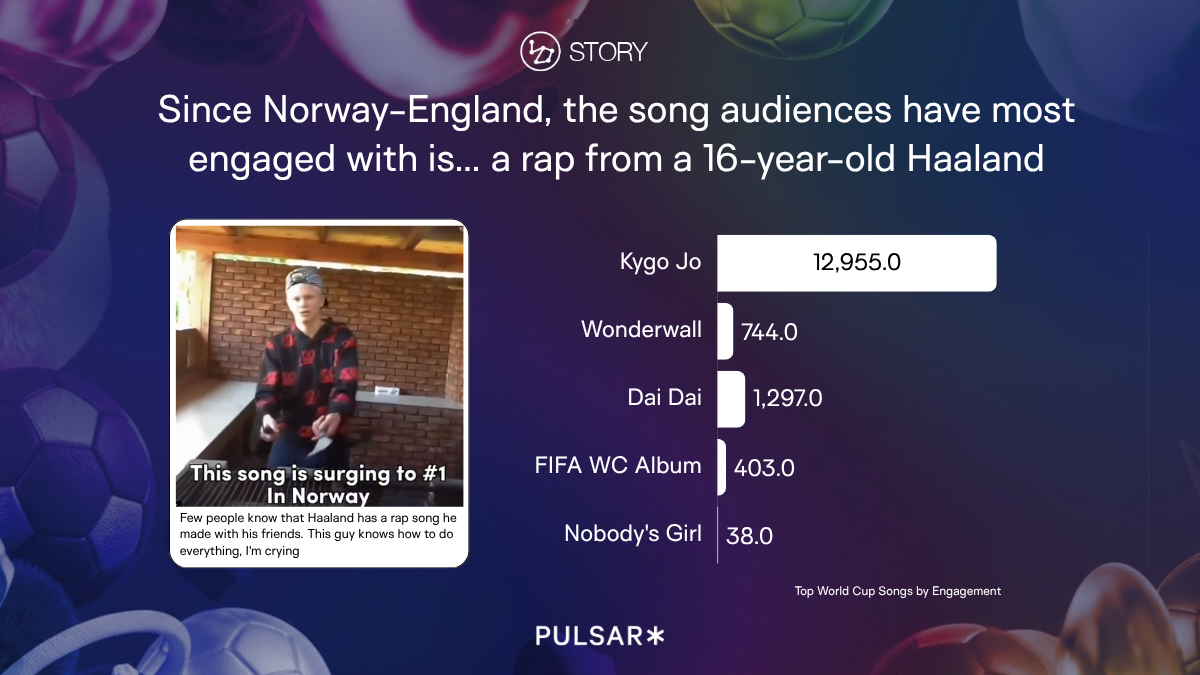
Pulsar Story's engagement analysis showed the scale of the reaction. And when Story measures the top engaging songs in the World Cup, Kygo Jo is massively dominating. "Kygo Jo" recorded 12,955 engagements, around ten times more than the next most-engaged World Cup song.
Top World Cup songs by engagement
Kygo Jo ran roughly 10x ahead of the next track on the list.
Source: Pulsar Story. Top World Cup songs by engagement across the 2026 tournament.
A personal piece of Haaland's history had become one of the tournament's biggest cultural moments.
Internet culture
The celebration that became an internet language
The Viking Row created another layer of Haaland's influence.
The Norwegian team's celebration, inspired by the image of players and supporters rowing together in a longboat, quickly moved beyond the stadium. Led by Haaland, the gesture became something fans could recreate and share.
As a non football fan, the most entertaining thing this World Cup was the Viking Row. Brought a whole new vibe to the tournament. @Erling #FifaWorldCup2026 pic.twitter.com/Z1MEeBAeam
— Eeswar C K (@eeswarck) July 19, 2026
The celebration appeared across social platforms through fan versions, AI-generated clips, pet videos and television coverage around the world.
Google joined the conversation with an interactive search experience that showed seven cartoon Vikings rowing across the page when users searched Haaland's name. Each Viking represented one of his seven World Cup goals.
The moment demonstrated how quickly football culture now moves between physical spaces and digital platforms. A celebration created by players became something audiences could participate in themselves.
Commerce
Turning attention into commercial impact
The attention surrounding Haaland also created significant commercial momentum.
Norway jerseys sold out internationally, with strong demand from supporters and collectors. Haaland gained around 20 million Instagram followers during the tournament, while the pink boots worn by Haaland alongside Kylian Mbappé and Vinícius Jr became one of the most recognisable visual trends of the competition.
The commercial impact followed the emotional connection fans had already built with the player. People were drawn to the moments, stories and personality surrounding Haaland.
That connection is what separated his World Cup from a typical tournament performance.
The takeaway
The Haaland effect
Haaland's World Cup showed how modern football influence is created.
The biggest sporting figures now exist across multiple spaces at once. They compete on the pitch, shape conversations online and create moments that audiences adapt into their own culture.
| Pillar | The signal | What it means for brands |
|---|---|---|
| Music | 12,955 engagements, ~10x the next song | The biggest music moment was a track no brand commissioned |
| Internet culture | Viking Row meme + Google Easter egg | Give people a gesture to copy and platforms will amplify it |
| Commerce | Jerseys sold out; ~20M new followers | Commercial pull followed the culture, not a media plan |
The takeaway
- ▸Build for participation. The moments that travelled were the ones audiences could recreate and share themselves.
- ▸Rough can beat polished. A teenage bedroom recording out-engaged every official release by around ten to one.
- ▸Culture leads commerce. Jerseys and followers followed the emotional connection, not the other way round.
Norway's journey ended in the quarterfinals, but Haaland's presence continued growing after the final match. His goals started the conversation, yet the wider cultural response defined it.
The Haaland phenomenon was a story of how one player became the centre of a global conversation, proving that influence in football is measured through far more than results.
Follow the World Cup coverage
This dispatch is produced by Pulsar Story, our autonomous research agent. Discover the latest World Cup intelligence, updated daily.
More from the series
- Why the World Cup's biggest brand wins were earned, not bought
- How unofficial brands are winning World Cup 2026
- AI video is the World Cup's fastest-growing meme format
- World Cup 2026: which brands are winning?
- From pints to posts: UK pubs fuel World Cup engagement
- Barge World Cup stunts: the Adidas vs Nike Hudson River duel
Frequently asked questions
+What is the Haaland phenomenon?
It describes how Erling Haaland became the most talked-about player of World Cup 2026 despite Norway losing in the quarterfinal. Pulsar Story tracked it across music, internet culture and consumer behaviour: a number-one teenage rap, the Viking Row celebration, a Google search Easter egg, and a commercial surge in jerseys and followers.
+Did Norway win the World Cup?
No. Norway lost 2-1 to England in the quarterfinal. Haaland still finished as the tournament's leading striker with seven goals.
+What is the Kygo Jo song?
Kygo Jo is a rap Erling Haaland recorded in 2016 with two Norway youth teammates, Erik Botheim and Erik Tobias Sandberg, under the group name Flow Kingz. After Norwegian producer Kygo remixed it during the tournament, it reached number one on Spotify Norway and drew 12,955 engagements, around ten times the next World Cup song.
+What is the Viking Row celebration?
The Viking Row is Norway's celebration, inspired by players and supporters rowing together in a longboat. Led by captain Martin Ødegaard and embraced by Haaland, it spread across social platforms through fan versions, AI-generated clips, pet videos and television coverage worldwide.
+What was Google's Viking Row Easter egg?
Searching Erling Haaland on Google triggered an interactive experience showing seven cartoon Vikings rowing across the page, one for each of his seven World Cup goals.
+How was this World Cup analysis done?
This dispatch was produced by Pulsar Story, our research agent, which scans the open social conversation around the tournament in real time and surfaces the stories that are moving brand relevance. It scores each brand and moment on net sentiment, engagement per post, share of conversation, and visibility, powered by Pulsar Narratives AI.
About this analysis
Narrative, visibility, and reach figures in this article come from Pulsar Story, analyzing the public social conversation across World Cup 2026. Visibility per mention is a Pulsar metric and is not affiliated with any official tournament ranking. Figures are drawn from the public posts Story read at the time of analysis and will keep moving as the tournament runs.
See how Story works like a senior researcher on your team: brief it once, and it continuously delivers analysis across your live data.
This article was created using data from TRAC
Spotlight
media-entertainment
Why the biggest World Cup brand wins came from earned media
entertainment