Why social listening is your essential engine for campaign performance
Use Case guide contents
From metrics to movements
In the modern marketing landscape, the question is no longer whether your campaign reaches a large audience, but whether it truly resonates with the - and understanding why could be the key to giving your brand advantage. Marketers need to move past relying on a relatively static set of metrics - impressions, clicks, likes - to gauge a campaign's performance. These metrics provide a top-down view of success, offering a quantifiable snapshot of reach and immediate action. However, they tell only a fraction of the story. They can reveal what happened, but they are fundamentally unable to explain the most critical factor: why it happened.
This is the shift driving the most successful brands today. Successful brands recognize that a campaign’s performance is not just a function of paid media spend; it is a direct result of cultural resonance. To definitively analyze this, a brand must be an attentive listener in the digital world. Social listening is the strategic discipline that allows for this. It is the digital equivalent of being in the room for every conversation about your brand, your industry, and the cultural moments shaping your audience’s lives. It transforms the vast, noisy, and often chaotic landscape of digital dialogue into a source of actionable intelligence that powers campaign analysis, informs real-time adjustments, and provides a definitive view of long-term impact.
The central premise of this guide is that social listening is no longer a "nice-to-have" tool for community managers. It is the non-negotiable engine for any brand serious about campaign performance testing and analysis in a world where audiences, not brands, are in control. It provides the qualitative context to the quantitative data, enabling a brand to move from simply measuring reach to truly understanding cultural connection.
Real-Time performance & reputation management: using agility to your advantage
In the digital age, a campaign's performance is a continuous, living thing. It is no longer enough to launch a campaign and wait for the post-mortem. Marketers must be agile, ready to adapt and optimize in real time. Social listening provides the "always-on" feedback loop necessary for this kind of live optimization and for navigating the complexities of modern reputation management.
Traditional analytics platforms often provide a backward-looking view of performance. Social listening, by contrast, provides real-time data on how a campaign's messages and creative are resonating with different audiences. Using both Pulsar CORE and Pulsar TRAC, a brand can track the engagement and visibility of both paid and organic content against competitors in real-time, allowing for rapid adjustments to messaging or media spend to maximize effectiveness.
GivingTuesday: understanding the landscape of ongoing conversation
The annual GivingTuesday campaign provides an illuminating example of a global movement that is fundamentally driven by cultural trend tracking for campaign performance testing and analysis. A brand participating in GivingTuesday cannot simply rely on traditional metrics like donation volume to measure its success. Its performance is intrinsically linked to the collective participation and cultural narratives it inspires. Each year, Pulsar partners with GivingTuesday to track the campaign live on the day over 24 hours to uncover the stories uncovering on the world’s biggest day for generosity.
While the financial metrics for GivingTuesday 2024 were indeed record-breaking - with a reported $3.6 billion donated in the U.S. alone, a 16% increase from the previous year - the true measure of the campaign’s performance is found in a deeper analysis of audience consumption behaviours and insights from social data. Social listening could track the full spectrum of engagement, beyond financial giving.
Our analysis revealed that while financial contributions grew, there were even more significant increases in other forms of generosity such as an increase in people giving goods and an increase in those who “spoke out” about causes. For a non-profit or a brand partnering with one, measuring only the financial metric would be a profound underestimation of the campaign's success. The campaign’s true power lies in its ability to inspire diverse forms of generosity, from volunteering to advocacy.
By using a tool like Pulsar TRAC, a brand could have tracked the top hashtags, keywords, and causes in real-time during their campaign, then overlay filters to find hidden narratives in the data. For GivingTuesday, Pulsar’s live feedback revealed the shape of CTAs used in different areas of conversation. Using live campaign tracking like this allows brands to align their own messaging with the dominant conversation and identify the causes that were gaining the most traction, enabling them to participate in the movement in an authentic and impactful way. GivingTuesday’s campaign success was not a one-dimensional achievement; it was a multi-faceted cultural event, and social listening was the only way to fully capture its performance.
Andrew Huberman: surviving and thriving in a PR crisis
Sometimes a campaign happens with absolutely no planning. This is often in response to a PR crisis or viral event that has the potential to leave your brand in a spin. Using social listening, these moments can be leveraged to succeed better than even the most meticulously planned campaign.
A PR crisis can be a devastating event for a brand, but for those who understand how to navigate the digital conversation, it can become an unexpected moment of growth. Our study of the public reaction to podcaster Andrew Huberman’s personal life provides a compelling, real-world case study in how social listening can serve as a vital tool for live campaign performance testing. In this case, the "campaign" was Huberman’s public response and his brand narrative itself.
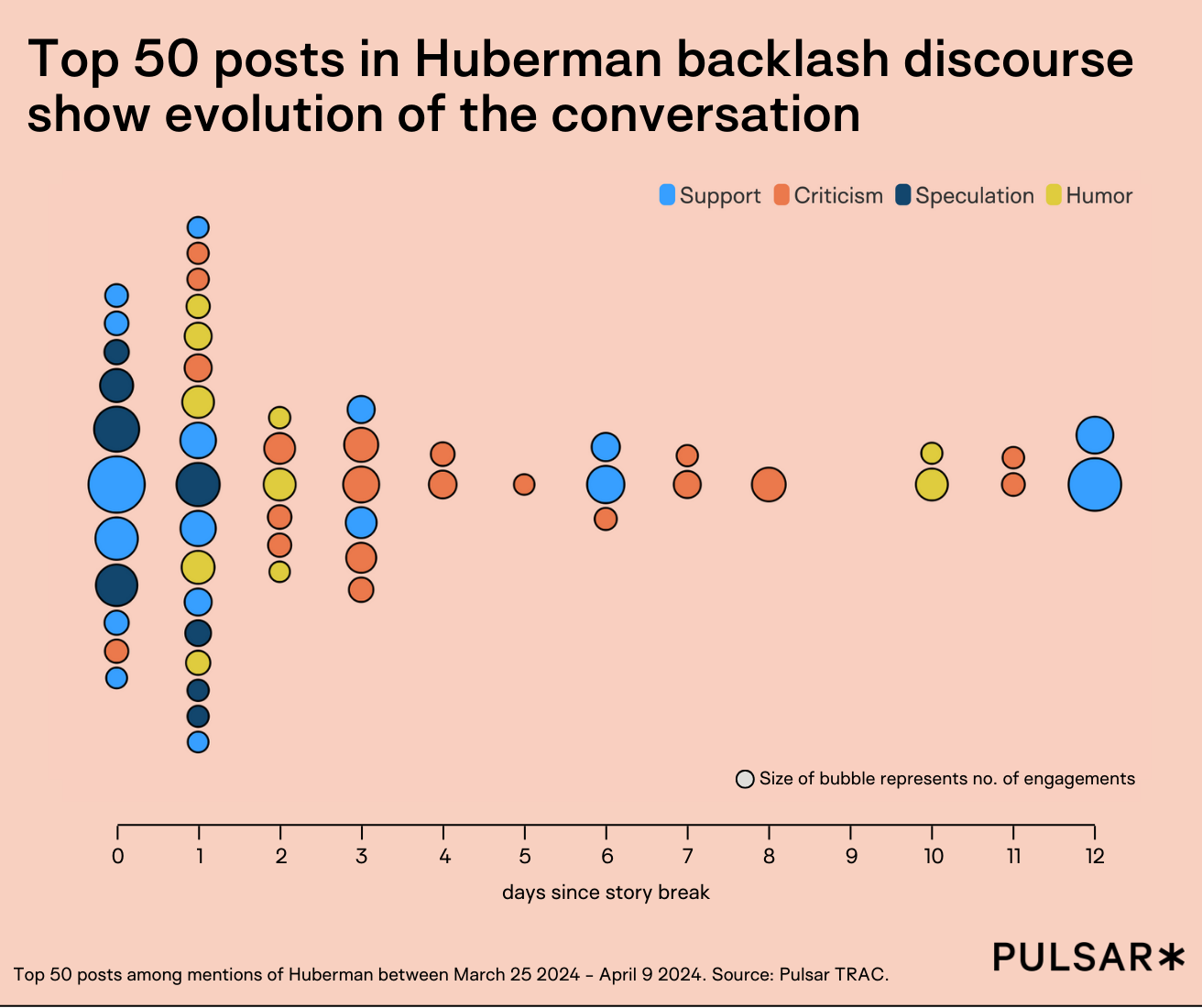
After a New York Magazine exposé detailed allegations about his personal life, a flurry of online conversation erupted, generating over 100k posts of speculation and backlash. Huberman’s response was a strategic one: he chose to "post through" the scandal, maintaining his planned content schedule and avoiding any direct comment on the allegations. This approach, while risky, was a performance of the very brand identity he had built - one of strong masculinity and problem-solving.
Social listening was able to reveal the nuanced and often contradictory reactions across different online communities, especially in platforms like Reddit. While some were critical and felt let down by his handling of the situation, a deeper analysis of his core, loyal audience showed a very different story. To them, his steadfastness was not avoidance but "audacity and strength," a "Chad move" that reinforced the very persona they had invested in. The conversation revealed a deep parasocial relationship between Huberman and his followers, where his brand’s perceived integrity was more important than the allegations themselves.
The remarkable result speaks for itself: Huberman gained around 20,000 new followers in just two days following the scandal. This outcome was not a lucky break; it was a direct result of his brand’s deeply embedded relationship with its audience, which a social listening analysis could have identified and which his crisis response then validated in real-time. This is a profound testament to the idea that campaign performance extends far beyond traditional paid media and applies to the very integrity and authenticity of a brand’s narrative in the face of public scrutiny.
Mapping the cultural landscape: analyzing the context of your campaign's performance
Before a campaign can be evaluated, a brand must understand the cultural landscape it is operating in. What narratives are gaining momentum? What are the prevailing sentiments and beliefs of the moment? Social listening provides the tools to answer these questions by acting as a "search engine for public opinion". Pulsar Narratives AI is designed to detect, understand, and rank narratives as they emerge across billions of news articles and social media posts. This capability allows marketers to map the terrain of public opinion and identify the stories that are truly driving conversation, providing essential context for campaign performance testing and analysis.
Where’s your conversation resonating? Mapping your campaign across audiences
Traditional campaign marketing often relies on broad demographic data in campaign measurement - age, gender, location - to define a target audience. However, the modern media landscape has made these classifications increasingly ineffective. A 30-year-old man living in New York today could be a tech entrepreneur, a professional gamer, or an organic food enthusiast. His motivations, interests, and media consumption habits are radically different from another 30-year-old male in the same city. The critical question for analysing a campaign is not just who the audience is, but what they care about and which communities they belong to.
This is where social listening becomes essential for analysis. Platforms like Pulsar TRAC are designed to collect audience signals from a vast range of sources, including social media, forums, news, and even first-party data, to create detailed audience segments based on psychographics and behaviors. This allows a brand to see how different communities discuss the same topic in various ways and, in turn, to measure how a campaign’s messaging has resonated with them.
Where’s your conversation resonating? Mapping your campaign across audiences
In traditional marketing, you often lean on coarse demographic labels — age, gender, income bracket — to define your target audience. But in today’s complex media environment, those labels are blunt instruments. Two 35-year-olds in Los Angeles could have totally different lives: one might be a quantified-health fanatic, the other a niche music producer. Their mindsets, concerns and media behaviour might barely overlap. So the more meaningful question in campaign analysis is not just who your audience is, but what they care about, which affinities they hold, and how different communities talk about your message.
This is exactly where social listening shines. Tools like Pulsar TRAC ingest signals from social media, forums, news outlets, in-platform conversation, even first-party data, helping you build audience segments grounded in behaviour and values. This lets you see how different communities discuss a topic in subtly different ways - and then measure how your messaging landed in each.
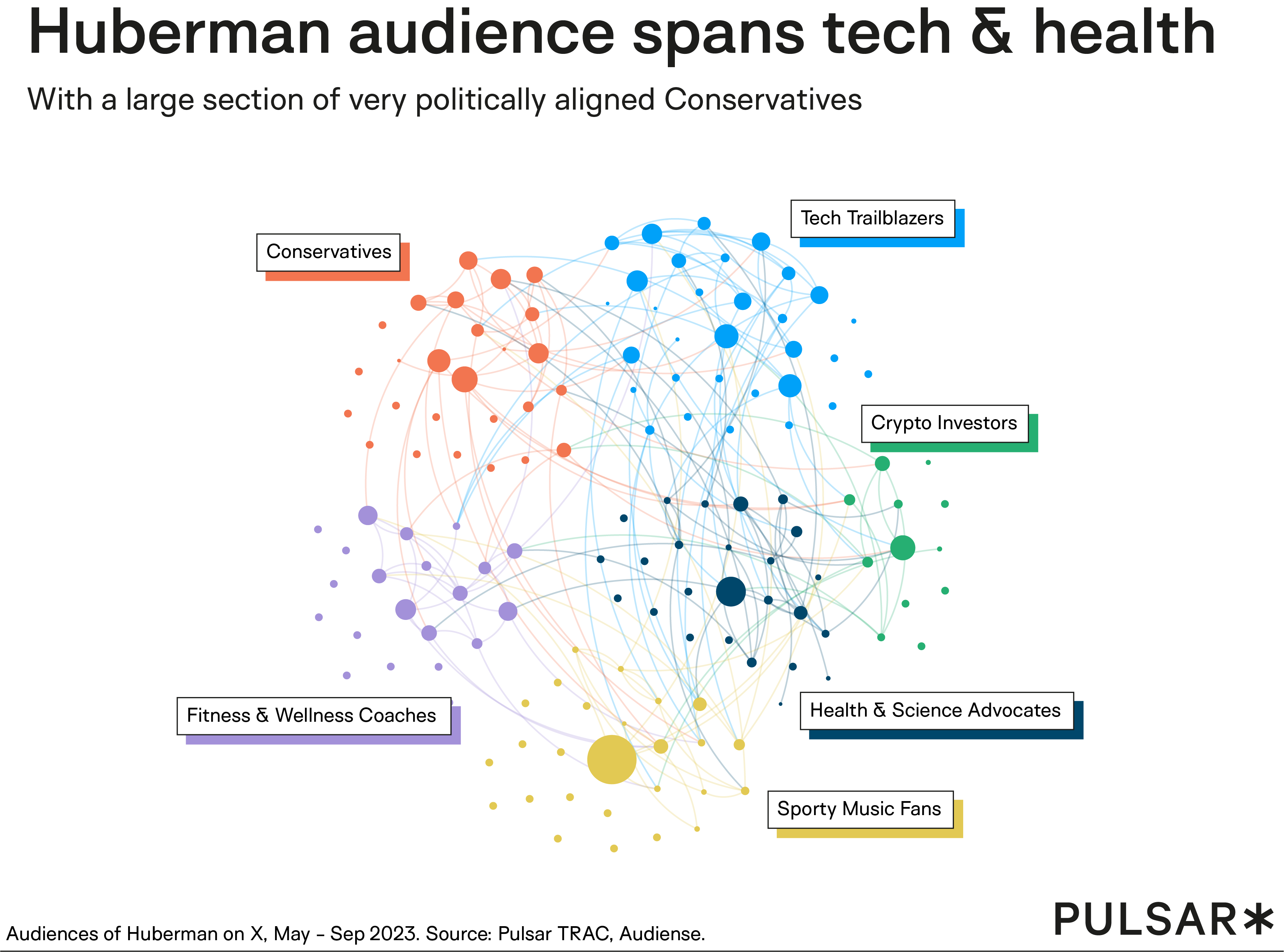
In our study of podcast advert collaborations, we examine the sponsorship alignment between Huberman Lab and Whoop. On the surface, the pairing already looks strong: Huberman Lab draws an audience keen on health, performance, neuroscience - and Whoop is a wearable doing precisely that. But what social listening reveals is that the partnership worked not simply because of demographic match, but because the audiences share deeper cultural and psychological overlap.
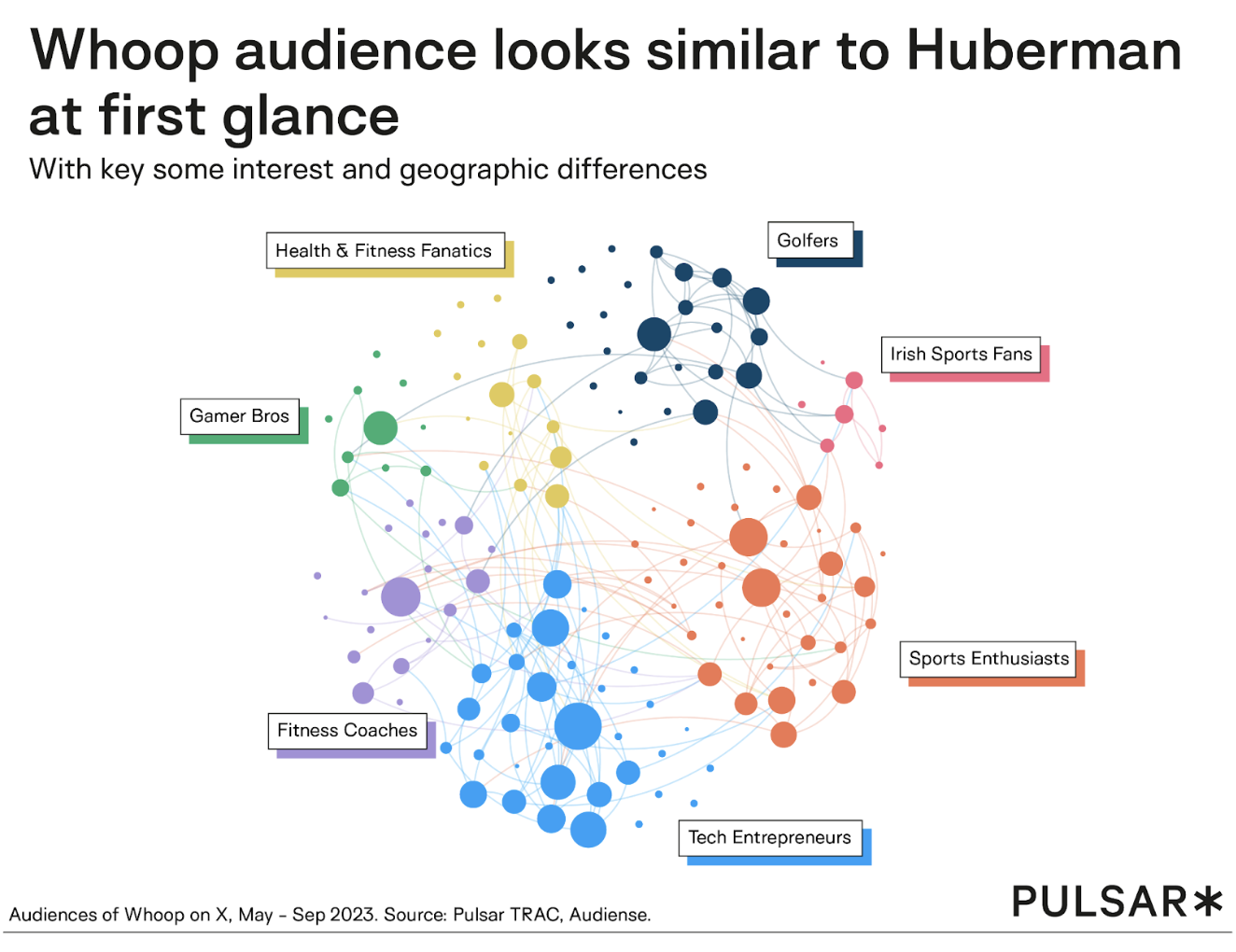
By analyzing audience intersections, you find that Huberman’s listeners and Whoop users align strongly on psychographic dimensions: they value data-driven self-experimentation, bio-optimisation, and performance-minded living. They follow health-tech innovators, engage with content around longevity and recovery, and respond to messaging framed in empirical, scientific terms. More than one in three of the influencers engaging these two audiences overlap - a striking level of alignment in a landscape with over a billion accounts on both X and TikTok. In effect, the campaign isn’t reaching “health-minded people” - it’s reaching a community that sees health as a project, an identity, a constant feedback loop.
Going deeper, social listening lets you subdivide that overlap into micro-communities. Each of these groups responds differently to messaging cues - whether you emphasise performance, recovery, or preventative health. Evaluating performance at that level helps you allocate future budgets more effectively and design future campaigns that resonate precisely with the segments most likely to convert.
The 3-Step Framework for Campaign Excellence
To translate these principles into practice, marketers can adopt a simple, three-step framework for using social listening in their workflow: Listen–Map–Analyze.
1. Listen
This is the foundational step. It involves systematically tracking digital conversations to understand the audience, the cultural context, and the competitive landscape. For campaign analysis, a brand must listen for more than just mentions of its name. This stage is about identifying emerging trends, detecting nuanced sentiment, and uncovering how the campaign's message is being received. Using a platform like Pulsar TRAC, which consolidates data from a wide range of social, news, and search sources, a brand can conduct in-depth audience research to evaluate its strategy from the very beginning.
2. Map
Once the data is collected, the next step is to map the insights onto specific audience segments and cultural narratives. This is about identifying the "shape" of the audience - whether it is a cohesive community or a fragmented collection of sub-groups, and how the campaign has performed within each. Using a platform like Pulsar Narratives AI or Pulsar TRAC, a brand can go beyond raw data to understand the underlying narratives that are driving conversations about its campaign. This mapping process is critical for ensuring that the campaign's performance is not judged as a monolith, but as an authentic contribution to an existing dialogue.
3. Analyze & Optimize
The final step is to analyze the insights gained from listening and mapping and to optimize the campaign's performance. This is where a brand puts its newfound intelligence into practice. This analysis can take many forms:
- Performance Measurement: Evaluating different versions of a creative asset or message for specific audience segments (e.g., the HelloFresh case study) to see which performed best.
- Real-Time Optimization: Making live adjustments to a campaign’s media spend or messaging based on in-flight performance data (e.g., the GivingTuesday campaign).
- Crisis Response: Crafting a strategic response to a reputational issue that aligns with the brand’s core narrative and is validated by real-time audience feedback (e.g., the Andrew Huberman crisis).
- Benchmarking: Using a platform like Pulsar CORE to measure the effectiveness of a campaign against key competitors, identifying a brand’s share of voice and engagement relative to the industry.
Key takeaways: Turning listening into lasting performance
The campaigns that define brands today aren’t necessarily the ones with the biggest budgets or the flashiest creative - they’re the ones built on a deep, ongoing understanding of how audiences think, feel and respond. That’s the power of social listening and shifting campaign performance from being a static scoreboard at the end of a launch to a dynamic, evolving process that starts the moment a message enters the world. Rather than relying solely on surface-level metrics like reach or click-throughs, social listening gives marketers the missing context: why something is resonating, how it’s being interpreted across different communities, and where opportunities exist to go further.
That deeper layer of insight turns performance data into something actionable. It helps you see not just what worked, but what moved people - and why. We saw this with GivingTuesday, where tracking the online conversation revealed the campaign’s true impact extended far beyond financial donations, sparking generosity in the form of advocacy, volunteering and cultural momentum. In the Andrew Huberman crisis, it helped make sense of conflicting audience reactions and showed how a brand narrative, if rooted in authenticity, can emerge stronger from scrutiny. And in the Huberman Lab x Whoop partnership, it revealed that the real strength of the collaboration wasn’t just a demographic match - it was a shared worldview and psychographic alignment that turned a sponsorship into a community-led success story.
This kind of intelligence has practical implications far beyond storytelling. Social listening enables live optimisation, allowing teams to adjust creative and messaging mid-flight based on real-time signals. It unlocks precise segmentation, helping you target micro-communities with tailored approaches that convert more effectively. It offers competitive benchmarking, showing how your campaign stacks up against others in the market. And it delivers strategic foresight, highlighting cultural shifts before they hit the mainstream so you can plan the next move with confidence.
In an environment where audience sentiment changes by the hour and cultural relevance is the real currency of attention, social listening transforms campaign analysis from a backward-looking report into an always-on engine for improvement. It’s how you close the gap between performance metrics and cultural impact - and how you ensure every campaign isn’t just seen, but felt and received by the right people.
2026 Outlook
Ready to transform your campaign performance with deep audience insight?
Explore the power of Pulsar TRAC, Pulsar CORE and Pulsar Narratives to start uncovering the insights that matter most. Our Pulsar newsletter for more expert guides and industry insights.
To learn more, sign up to our newsletter below: