Why proactive social listening is your first line of defense in detecting and fighting a PR crisis
Use Case guide contents
Unseen signals – why social listening is a non-negotiable for crisis detection and response
For decades, a brand crisis was something that erupted on the front page of a newspaper or in a prime-time news broadcast. Today, a single post on a niche forum, a viral video on TikTok, or a critical thread on a forum can bypass traditional media gatekeepers and ignite a global firestorm in minutes. For brands, this means the first sign of trouble often does not appear as a press inquiry or a customer service ticket but as a quiet, growing murmur in the hidden corners of the internet. The digital landscape has compressed the time between a nascent issue and its mainstream amplification to a near-zero window. This compression means that reactive strategies are inherently flawed; success in modern crisis management is no longer about responding well but about identifying and addressing the problem before it achieves critical mass. This is the strategic imperative that makes social listening a non-negotiable tool.
Plus, the strategic value of social listening extends far beyond simple brand defense. It allows a brand to move from a defensive, reactive posture to a proactive, prepared one. By acting as an early warning system, it can turn potential crises into opportunities to reinforce core brand values, address public concerns, and build enduring trust. The following case studies demonstrate how this strategic foresight operates in the real world, providing a clear blueprint for how to anticipate, understand, and navigate the new rules of crisis management.
Social listening in action: what real-world crises can teach us
Crises rarely unfold in a vacuum. Whether they emerge from a sudden incident, a slow-burn cultural narrative, or coordinated audience action, their trajectory is shaped by how people talk, share, and organise online. Social listening allows us to trace these dynamics in real time, uncovering the signals that show when a story is about to escalate and revealing the communities that give it momentum.
In the following case studies, we explore how different crises have played out across industries - from sustainability and aviation to influencer culture and fandom - and what they reveal about the shifting relationship between brands and their audiences. Each example demonstrates how listening closely to the conversation can transform crisis detection and response from a reactive scramble into a proactive, evidence-based strategy.
Boeing: from technical glitch to brand catastrophe
The modern crisis often starts with a single event that acts as a catalyst for a pre-existing narrative. As Pulsar learned in our research, this was precisely the case for Boeing. Following a cabin blowout on an Alaska Airlines flight, a media storm erupted, and a public conversation generated immense volume. While initial reports and some viral posts focused on Alaska Airlines, social listening data quickly revealed a deeper shift in the public narrative. The conversation was not just about the airline; it was increasingly focused on Boeing, the manufacturer of the aircraft.
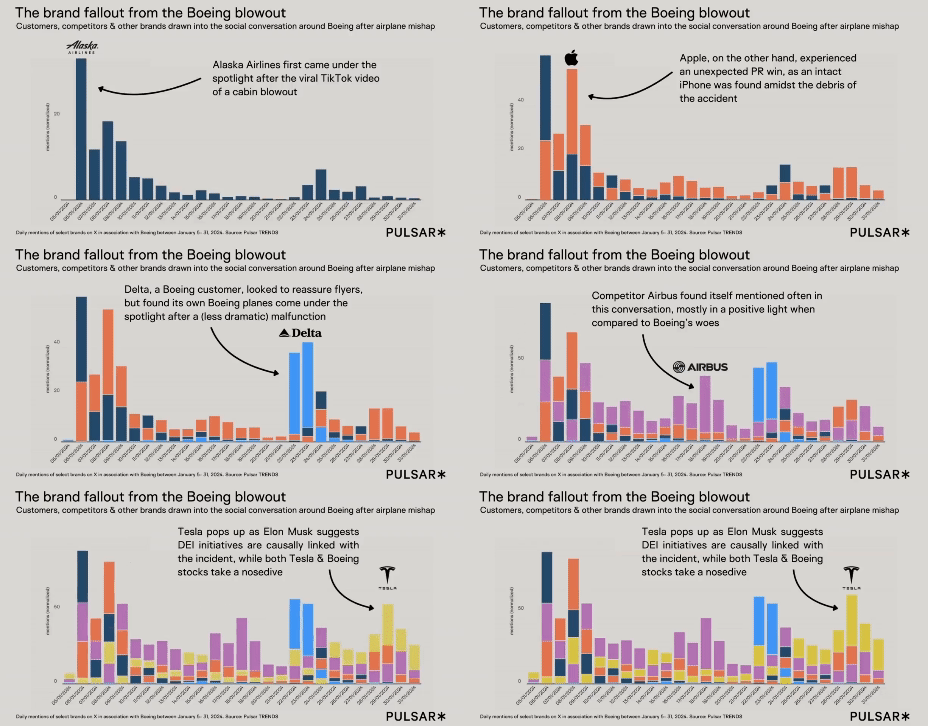
This dynamic illustrates how a crisis can propagate through a brand's supply chain like a digital contagion, creating collateral brand damage. Alaska and United Airlines, both major customers of Boeing, were pulled into the public relations fallout as they scrambled to inspect their fleets and reassure travelers. This demonstrates how the reputation of one entity can directly impact the perceived safety and reliability of its partners.
The most compelling demonstration of the crisis's impact came from the real-world consequences revealed by data. The travel search engine Kayak reported a stunning 15-fold increase in users filtering out the Boeing 737 from their flight searches following the incident. This is a critical point: a negative shift in brand reputation, first detected in online conversation, can immediately translate into a quantifiable change in consumer behavior and purchasing decisions. The crisis was not just a PR problem; it was a business continuity issue. When the death of a whistleblower, John Barnett, was announced, a separate spike of 55,000 mentions of Boeing alongside the word "whistleblower" occurred in a single day, highlighting how distinct, seemingly unrelated events can converge to amplify a core negative narrative of corporate negligence. This shows that social listening is not just about tracking events but about connecting the threads of a complex, evolving narrative.
Me checking out the Boeing planes every time I board now. pic.twitter.com/8DR5HCXmBZ
— Kevín (@KevOnStage) March 22, 2024
Moments like these highlight why it’s not enough to monitor isolated spikes in conversation. Narratives AI helps brands trace how individual incidents—like a technical fault or a whistleblower story—become stitched together into a larger narrative of corporate negligence. By mapping connections across platforms, news cycles, and communities, brands can see how reputational damage compounds over time and anticipate when seemingly separate events are about to converge. For companies with complex supply chains, this capability is critical: it allows them to prepare for crises that don’t just affect their own brand but ripple outward to partners, customers, and entire industries.
The Block Party: When Gen Z Rewrote the Rules of Fandom
The "Block Party," or "Digital Guillotine," represents a fundamental power shift in the relationship between celebrities and their audiences. Fueled by a post from a model at the Met Gala that was seen as tone-deaf and out of touch, the movement, which had been simmering for weeks, exploded. We explored in a recent blog how it began as a coordinated effort on TikTok to hold public figures accountable for their perceived ethical inaction on a sensitive global issue.
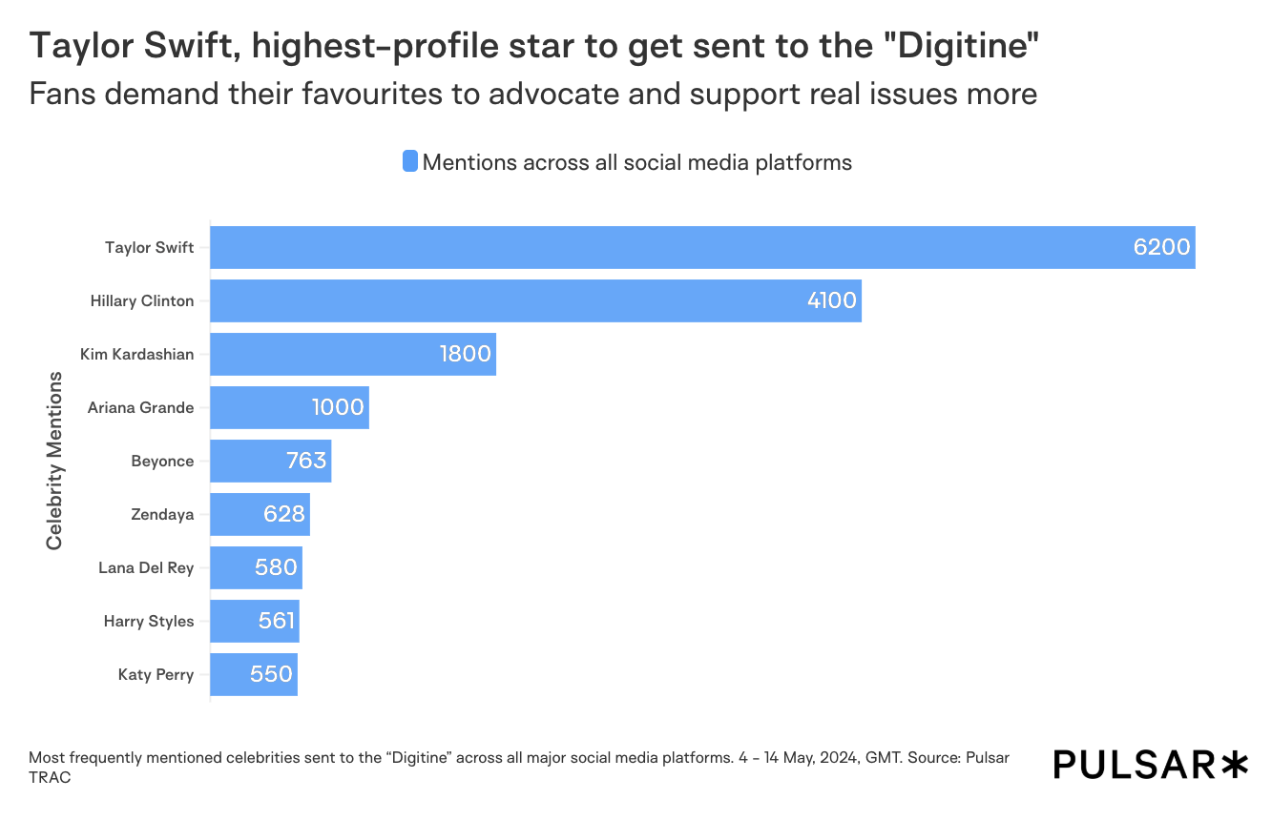
This activism signals a shift from passive consumption to active, collective agency. The initial focus on education and awareness quickly evolved into a powerful, financially motivated campaign: a boycott of the corporation of celebrity. The audience's understanding is profound: they are the gatekeepers to relevance, and by blocking a celebrity, they are directly impacting the metrics that define their value and path to riches. Pulsar TRAC showed us that Taylor Swift was the most popular person to block in the campaign. This was not because she had committed an explicit offense, but because her ubiquitous popularity made her the ultimate symbol of the disconnected celebrity class. This redefines "cancel culture" not as a fleeting moral outrage but as a direct financial punishment. For brands, the implication is clear: audiences are no longer passive consumers but active auditors of values and gatekeepers of a brand's cultural standing. A brand that fails to listen to these deep-seated cultural narratives is operating with a critical strategic vulnerability.
The Block Party shows how quickly audience activism can evolve from cultural expression into economic pressure. With TRAC surfacing sudden spikes in coordinated behaviour, and CORE segmenting which communities are driving the movement, brands can understand not just the scale but the intent behind these actions. This layered intelligence helps decision-makers separate performative outrage from genuine shifts in audience values, and spot when a symbolic act—like blocking a celebrity—signals a deeper redefinition of power in fandom. For companies tied to high-profile figures or influencers, this kind of early warning system is essential to avoid being blindsided by movements that can reshape reputations overnight.
Andrew Huberman: curated brand, contained crisis
Pulsar’s research into a PR incident surrounding Andrew Huberman offers a fascinating, counterintuitive lesson in crisis management. Following a New York Magazine exposé, the online conversation about him generated over 100,000 posts. A typical crisis playbook would have called for a public statement or a detailed apology. However, social listening revealed a more complex audience landscape. The conversation was not monolithic; it was made up of distinct audience segments, including those in the a niche forum, who expressed disappointment not with his alleged personal actions but with his PR firm's handling of the situation. His core audience felt he betrayed his brand of strong masculinity and problem-solving by using a PR firm instead of addressing the issue directly.
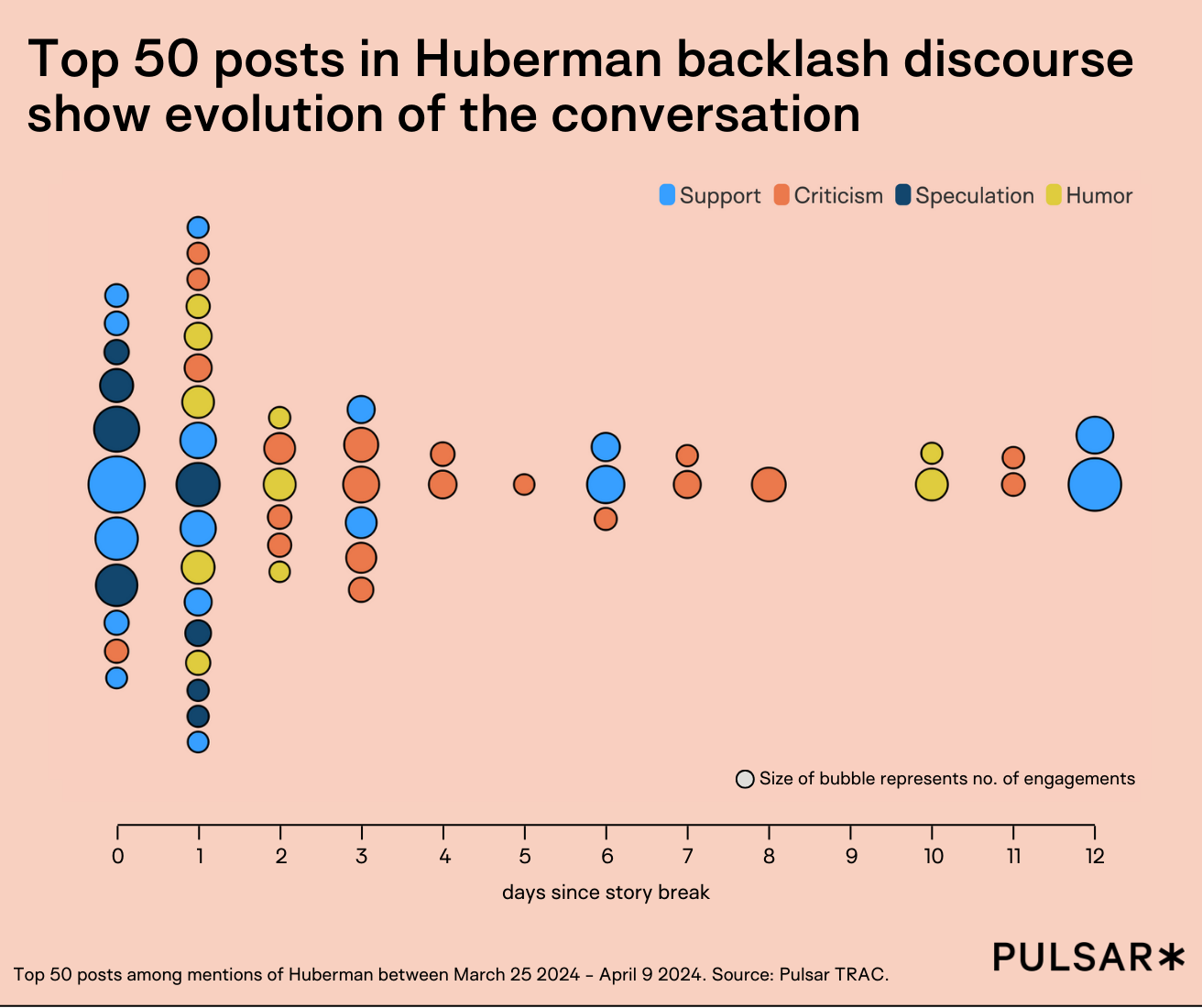
Huberman’s response was to "post through" the scandal, maintaining his planned content schedule of scientific updates and podcast episodes. Social listening showed that this seemingly defiant strategy was successful within his core community. In the two days following the scandal, he gained around 20,000 new followers. His core audience did not perceive his willful ignorance as a weakness but as an admirable reinforcement of his curated personal brand—an unwavering guru and unassailable icon. This demonstrates that a brand's pre-existing narrative can serve as a powerful defensive shield against a crisis. A one-size-fits-all response is often less effective than a tailored one based on a deep, data-driven understanding of audience segments and their specific values.
Cases like this show the importance of looking beyond overall sentiment to the nuances of different audience segments. Using CORE, brands can uncover not just what is being said, but who is saying it and how different communities frame the same event. Combined with TRAC’s ability to surface real-time spikes in conversation, this layered view makes it clear when a crisis is actually fragmenting into multiple narratives—and which audiences have the power to make or break a brand’s reputation. For Huberman, understanding these dynamics explains why doubling down on his usual content resonated with his base, even as other groups remained critical.
Greenwashing: the audience as auditor
The Greenwashing narrative is not a crisis that erupts from a single event; it is an example of a slow-burn cultural narrative that can cause a long-term reputation crisis at any moment for brands. Analysis of over 23 million social and news data points showed that the term "greenwashing" has been on the rise since 2021, driven by audiences who feel brands are not "walking the talk" on sustainability. Many of the world's largest companies are frequently part of this conversation. The online discourse is almost entirely negative and often includes misinformation.
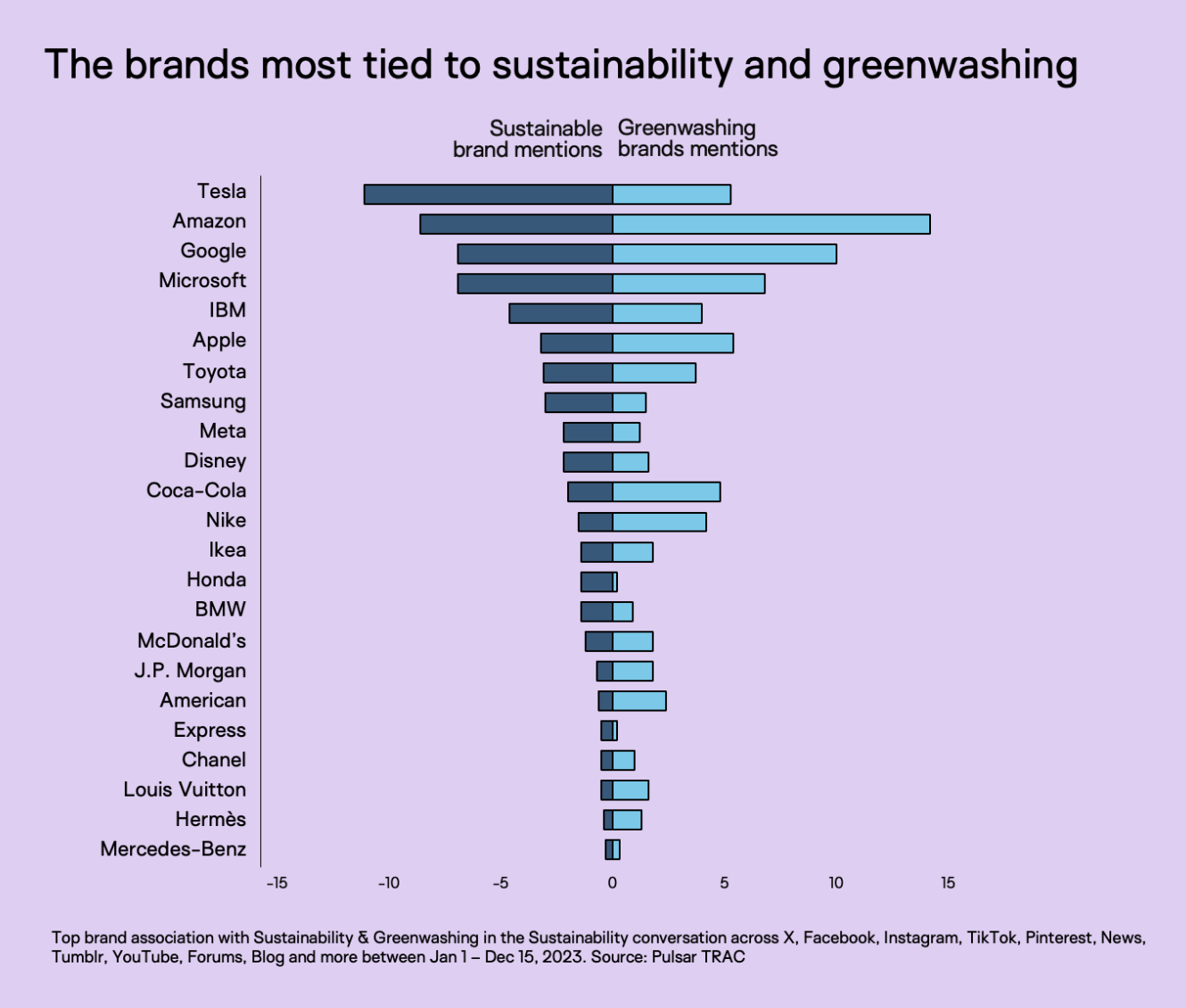
This shows how a cultural concept—environmental consciousness—has translated into a powerful narrative of corporate accountability. Audiences have begun to apply this narrative as a filter, acting as online auditors who scrutinize every brand's environmental claims. The analysis also shows that a brand's core business model determines its vulnerability to this critique. For example, Tesla, whose core business is electric vehicles, is inherently immune from this type of scrutiny, while a company like Apple, despite its significant efforts, is disproportionately affected by Greenwashing associations. This is because a brand's sustainability claims are not judged in a vacuum but against a powerful, pre-existing narrative that is constantly evolving online. The Greenwashing crisis is a long-term strategic threat that can only be understood and mitigated by continuously listening to the cultural conversation.
Social listening makes it possible to track how accusations of greenwashing emerge, spread, and take shape as cultural narratives. With Pulsar TRAC, brands can map which communities are fuelling the conversation and identify when a spike in volume signals a shift in sentiment, while Narratives AI traces how critiques move from fringe forums into mainstream press. Together, these insights give communications and sustainability teams the chance to prepare responses grounded in evidence—whether that’s clarifying a claim, adjusting messaging, or anticipating the next wave of critique.
A strategic framework: the listen–map–activate playbook
Successfully navigating the modern crisis landscape requires a structured, proactive approach. The Listen–Map–Activate framework provides a practical blueprint for leveraging social listening to move from a reactive posture to one of prepared foresight.
Phase 1: LISTEN — detect the initial signals
The first phase is about becoming an expert listener. This means going far beyond a simple search for brand mentions. It involves monitoring broader industry terms, competitor conversations, and cultural movements to detect the quiet whispers before they become shouts. This requires setting clear goals and, crucially, segmenting the audience to understand the unique language and behaviors of different online communities. The key question to ask in this phase is: What are the niche conversations, trends, or community discussions that could impact my brand tomorrow?
The Listen phase is where a brand detects the nascent greenwashing narrative before it targets a specific campaign or identifies the specific conversations in a "bro podcaster forum" that could serve as a shield in a future crisis. This proactive approach allows a brand to move from firefighting to strategic preparedness. A tool like Pulsar TRAC is the audience intelligence engine for this phase, capable of gathering a comprehensive picture of public conversations and consumer behavior from diverse sources like forums, news media, and blogs. It also provides the ability to segment audiences based on their shared interests and behaviors, providing the foundational data needed for strategic analysis.
Phase 2: MAP — understanding the narrative landscape
Once a brand has detected the faint signals, the second phase is about making sense of them. This is the strategic analysis phase, where the goal is to understand the full narrative landscape. This involves analyzing the gathered data to understand the sentiment, evolution, and key amplifiers of a conversation. The core question for this phase is: Who is saying what, why are they saying it, and what are the key beliefs, emotions, and behaviors driving the conversation?
This is the phase where a brand would map how the conversation around a single aviation incident shifted from blaming the airline to targeting Boeing as the manufacturer.3 It is also where an organization would map how the "Block Party" narrative evolved from a call for education to a coordinated boycott that targeted the source of celebrity value. A tool like Pulsar Narratives is indispensable here. It detects, summarizes, and ranks narratives in real-time and historically, allowing users to understand how different narratives are interconnected and where they originated without the need for complex Boolean queries. It provides a cultural compass for navigating a potential crisis, allowing a brand to see the full picture and understand the motivations behind a growing online movement.
Phase 3: ACTIVATE — informing your response
The final phase translates the mapped insights into a tailored, data-driven communication strategy. This is not about a generic crisis statement but about crafting specific messaging for different audience segments and channels. The guiding question is: How can we respond in a way that resonates with our audience and aligns with our brand identity?
The success of Andrew Huberman’s "post through" strategy is a perfect example of activating based on a deep understanding of audience segments. He did not address a generalized public; he spoke to the specific values of his core community, which social listening had identified as being more disappointed by his use of a PR firm than his alleged actions. This tailored approach allowed him to reinforce his brand instead of undermining it. For a brand, this means understanding which platforms are best for which messages and how to authentically align with a trend to participate in a conversation. Pulsar CORE is the tool for the "Activate" phase. It helps a brand monitor its owned media performance, track competitor strategies, and get actionable insights on what content is resonating on different channels and in different campaigns. This allows for a real-time, data-backed optimization of the crisis response, ensuring every message lands with maximum impact.
| Phase | Core Action | Key Questions | Pulsar Tool |
| LISTEN | Track keywords, topics, and broader cultural conversations across platforms, including niche forums and communities. | What is the prevailing public sentiment toward my brand, products, and industry? What are the nascent conversations that could escalate into a crisis? | Pulsar TRAC: Gathers a comprehensive picture of public conversations from diverse data sources and provides detailed audience segmentation. |
| MAP | Analyze data to understand narrative evolution, key themes, and the emotions and beliefs driving a conversation. | What is the underlying narrative driving the conversation? How are different audience segments discussing the issue, and what are their specific concerns? | Pulsar Narratives: Detects, summarizes, and ranks narratives, allowing for the visualization of their evolution and interconnectedness. |
| ACTIVATE | Create and deploy tailored, data-driven communication strategies that respond to specific audience segments and narratives. | What type of response will resonate most authentically with our core audience? Which platforms should we use to reach specific audience communities? | Pulsar CORE: Provides actionable content performance insights, competitor tracking, and a bird's eye view of owned channel performance to inform a tailored response. |
Key takeaways: competitive edge of the prepared brand
In a world where digital conversations can turn into reputation-altering events in a matter of hours, social listening transforms crisis management from reactive firefighting to proactive foresight. It allows for the early detection of issues, a nuanced understanding of the underlying narratives and audience segments, and a strategic, data-driven response that goes beyond generic damage control. The brands that succeed in this environment are not the ones with the biggest marketing budgets but the ones that are the most attentive and culturally attuned.
Each of the above cases—whether it’s accusations of greenwashing, a personal brand under fire, a corporate safety scandal, or a youth-led movement—shows how crises today are shaped less by isolated events and more by the narratives audiences build around them. Social listening provides the lens to see these narratives forming in real time, understand which communities are driving them, and anticipate how they might evolve. By studying how different crises unfold across sectors, brands can recognise the common patterns: a single spark amplified by cultural context, audience values turning into collective action, and online discourse translating into real-world consequences. Together, these examples highlight why listening isn’t just a defensive tool but a strategic necessity for navigating reputation in an unpredictable media landscape.
By truly understanding its audience and the cultural landscape it operates within, a brand can anticipate threats and turn potential crises into opportunities to reinforce its values and build enduring trust. This is the ultimate competitive advantage of the prepared brand. It is an investment in resilience, a commitment to understanding, and a clear path to gaining control of one's own narrative.
2026 Outlook
Ready to transform your crisis detection with deep audience insight?
Explore the power of Pulsar TRAC, Pulsar CORE and Pulsar Narratives to start uncovering the insights that matter most. Our Pulsar newsletter for more expert guides and industry insights.
To learn more, sign up to our newsletter below: