How to use social listening to find the right beauty influencers
TL;DR
Beauty has more creators than almost any other category, so finding beauty influencers is easy and finding the right ones is hard. Use social listening to find beauty influencers by starting with the conversation, mapping the communities in it, and ranking creators by their impact on a topic rather than their follower count.
Key Takeaways
- ▸Start with the conversation about ingredients, routines and skin concerns, not with a list of beauty influencers.
- ▸Map beauty audiences into communities, such as acne, sensitive skin, textured hair or K-beauty, and find the creators each one trusts.
- ▸Rank creators by impact on a topic, not follower count. Small creators often lead their own niche.
- ▸Listen to what creators say on video as well as in captions. Beauty is a category shaped by tutorials and reviews.
- ▸Vet audience quality and overlap before you sign. Inflated audiences are common in beauty.
In This Article
- Why is it hard to find the right beauty influencers?
- Step 1: Start with the conversation, not the creator
- Step 2: Map the communities behind the conversation
- Step 3: Rank creators by impact on the topic, not followers
- Step 4: Listen to what creators actually say on video
- Step 5: Vet audience quality and overlap before you sign
- Step 6: Check claims and compliance
- Step 7: Measure what changed
- How Pulsar helps you find the right beauty influencers
- FAQ
Beauty has no shortage of influencers. In fact, it has too many. The US beauty creator landscape, for instance, is expanding rapidly, with more than 300,000 creators now active in the market. The creator pool grew by over a third last year, even as average audience sizes declined.
That makes finding influencers easy and finding the right ones hard. Follower counts no longer predict reach, fake audiences are common, and trust has moved to small creators and credentialed experts with an online presence.
This guide shows how to use social listening to start from the conversation, not the creator: find the communities that talk about your category, see who those communities actually listen to, and vet them before you sign them up.
Why is it hard to find the right beauty influencers?
Three things make beauty a tricky market in which to spot creators who bring actual value.
There are too many creators. Creator volume keeps rising while each creator’s audience shrinks. BeautyMatter reports more than 300,000 beauty creators in the US, with creator numbers up 37% in a year and average audience size down 30%. Brands are responding with scale: at BeautyMatter’s NEXT50 summit, Morphe’s VP of Growth and Investment Strategy, Tucker Borgman, said the brand activates 150 to 200 nano creators at once.
Follower counts mislead. Platforms show content to people beyond a creator’s followers, so reach and follower count have come apart. As Ashley Banks, chief client officer at Iced Media, told Glossy: “Follower count used to be the proxy for reach, and now it’s more of a vanity metric.” Traackr founder and CEO Pierre-Loïc Assayag makes the same point from the other side: a small creator can be “huge in a micro community”. The downstream effect is that small-scale influencers with the right audiences are seeing doors open.
Trust has moved to smaller, expert voices. The creators who beauty audiences believe are often not the biggest. As Charlotte Smith, who writes The Beauty Copywriter newsletter, puts it: “a creator with 30,000 loyal followers can sometimes feel more persuasive than a celebrity with 3 million”. Google’s VP of Retail, Courtney Rose, told BeautyMatter that YouTube creators are “98% more likely to be trusted”.
The result: a creator who looks perfect on a media kit can reach the wrong people, or a community that doesn’t trust them.
Step 1: Start with the conversation, not the creator
Influencer platforms start with a database of creators. Social listening starts with what your audience is talking about.
Set up searches around the topics your product touches: ingredients (retinol, niacinamide, peptides), concerns (acne, rosacea, hyperpigmentation), routines (skin cycling, glass skin) and formats (get ready with me, routine videos, honest reviews). This shows where the conversation is growing and who is driving it.
Pulsar example: our Top 5 beauty trends on social media 2026 analyzed 850,000 conversation data points on dupes, with affordability the top motive. The same research reports that Gen Z increasingly shops by ingredient and performance rather than logo. That’s why the conversation, not the brand name, is the right starting point.
Step 2: Map the communities behind the conversation
Beauty audiences aren’t one group. The people discussing a retinol launch might include acne sufferers, anti-aging enthusiasts, dermatology followers and K-beauty fans, each listening to different voices.
Audience segmentation groups the people in the conversation into communities based on who they follow and what they share. For each community, you can see its interests, its language and the creators it trusts. That tells you which community matters most to your brand, and who can actually reach it.
Pulsar example: in our analysis of how Starface turned pimple patches into pop culture, Starface held only a small share of the conversation on X, where talk moves at meme speed, but a much larger share on forums and blogs, where long reviews and fan loyalty build.
Step 3: Rank creators by impact on the topic, not followers
Once you know the community, rank its creators by how much they shape the topic: how often their posts are seen, shared and discussed within that conversation. A nano creator with a loyal acne community can outperform a mega creator whose audience is mostly elsewhere.
Look for bridge creators, too. These are people followed by more than one community, who can carry your message from, say, dermatology fans to mainstream skincare buyers.
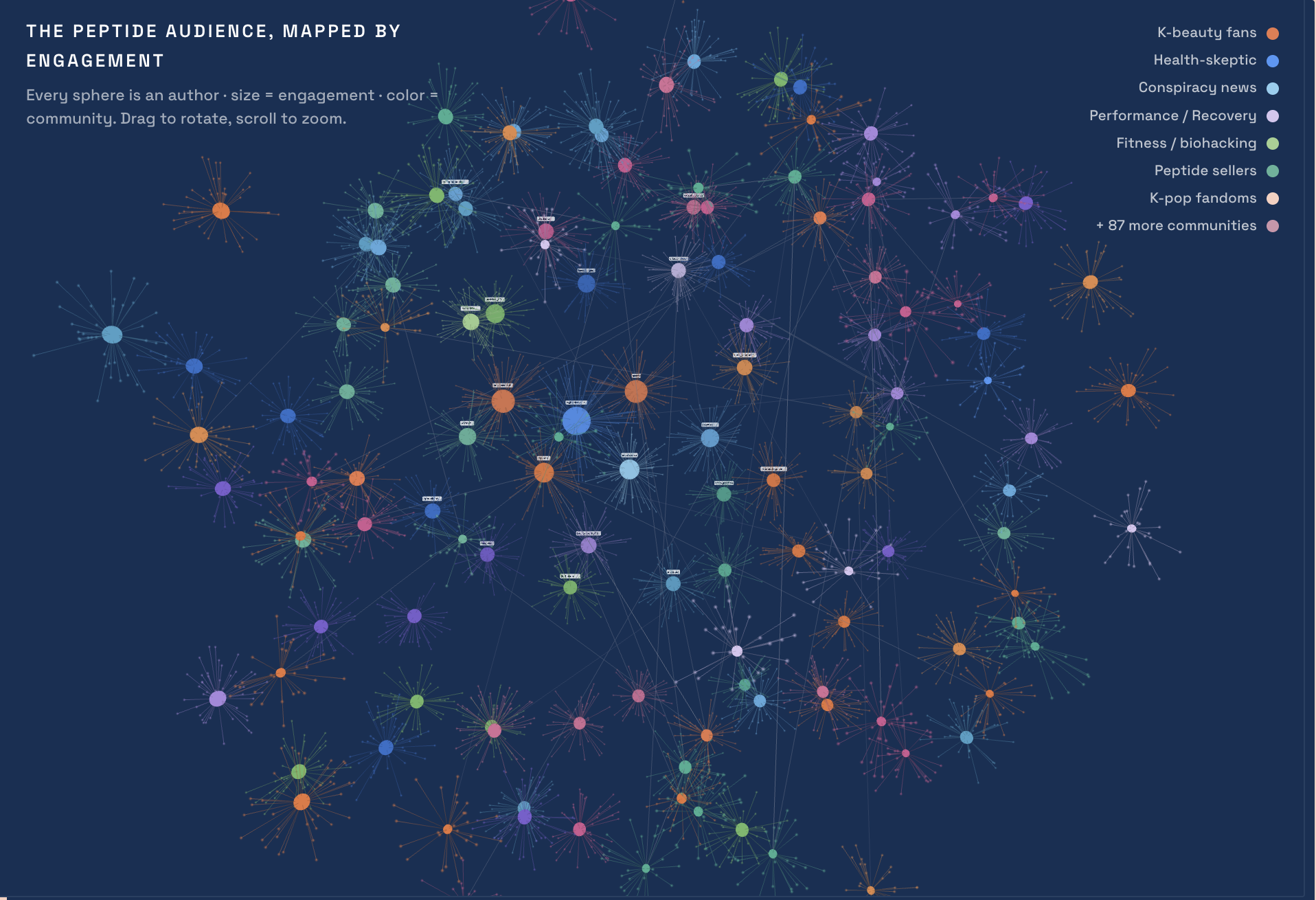
Pulsar example: in our Mapping the Peptide Audiences research, we mapped the network of people driving the peptide conversation across X, Instagram, Threads and social video (January to September 2026). K-beauty fans formed the largest cluster, but size wasn’t the whole story.
The fitness and biohacking community had narrower reach yet was one of the most engaged, while clinicians shared the most evidence-based content to a much smaller audience. The biggest hubs sat far apart, so the conversation moved through many small worlds rather than one shared feed. Copper peptides (GHK-Cu) show what bridging looks like: the audiences who engaged with the trend carried peptides from gym and biohacking culture into skincare, making them legible to beauty audiences with little interest in the gym. A creator with a foot in both worlds can move a message further than the biggest name in either cluster.
Step 4: Listen to what creators actually say on video
Beauty is a video category. Tutorials, routine videos and reviews carry narrative-setting power, and much of that is spoken, not written in captions.
Video transcription turns what creators say into searchable text. You can check whether a creator has praised or criticized your brand or a competitor, how they talk about ingredients, and whether their tone fits your brand.
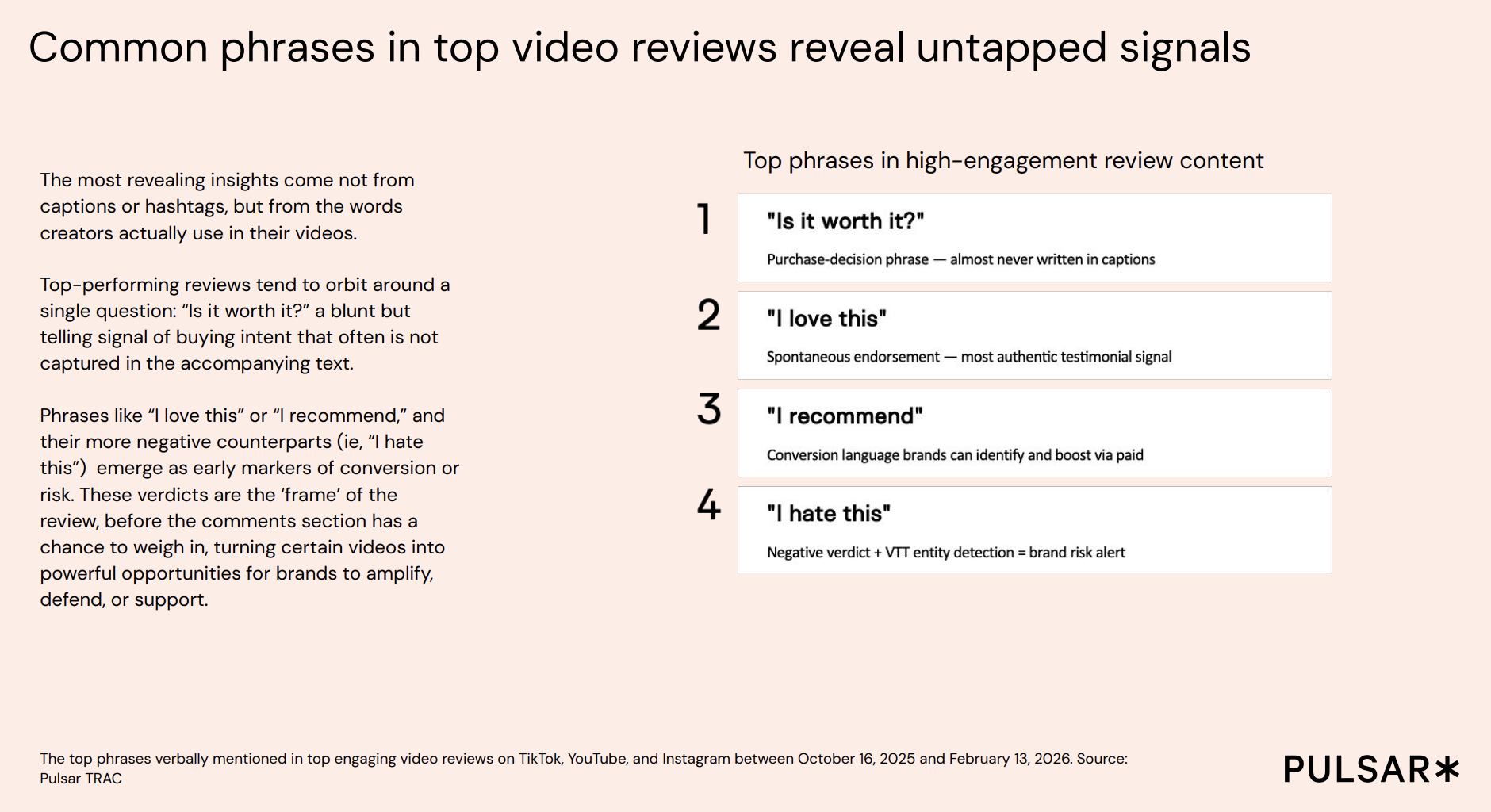
Pulsar example: in our How Social Video Reviews Shape Brands, Behaviors & Categories 2026 report, Pulsar video intelligence allows us to transcribe the most-engaged video posts from 3.4 million social video reviews. Beauty punched above its weight on engagement, and its top reviews kept returning to one question, “Is it worth it?”, a buying signal that often never appears in the text, while verdicts such as “I recommend” or “I hate this” acted as early markers of conversion or risk. Beauty brands also dominated what creators said out loud, even in videos that weren’t about them, with MAC used as the benchmark and L’Oréal as the go-to dupe for luxury products. That is the layer transcription opens up, showing which creators are really shaping opinion about your brand, and how.
Step 5: Vet audience quality and overlap before you sign
Before you sign, check that the audience is real and that it’s the audience you want. Look at comment quality, sudden follower jumps and engagement that doesn’t match reach. A SociaVault study of 100,000 accounts put beauty top of 10 niches for signs of fake or bought followers, at 52.1% against a 37.2% average (SociaVault sells detection tools, so treat the figure as indicative). Social intelligence tools that track velocity are more commonly used for spotting emerging trends or crises, but they can also be used to spot confected engagement that should attach a red flag to the creator in question.
Then check overlap. If three of your shortlisted creators speak to the same community, you’re paying three times to reach the same people. That can be a smart tactic, to hammer home the same message. But if you don’t know you’re doing it, it can also look a lot like wasted spend. Pulsar lets you cross-check audience overlap between shortlisted creators, so you can see who reaches genuinely new people before you commit.
Step 6: Check claims and compliance
Beauty is a regulated category. Creators make claims about ingredients and results, and those claims fall under advertising rules such as the ASA’s in the UK and the FTC’s in the US. Check a creator’s past content for risky claims, and build compliance checks into how you review their posts.
Step 7: Measure what changed
The right beauty influencer changes what people say and believe about your product, which matters more than how many people liked a post. So, define what success means for each campaign before it starts. That might be visibility within a community you’ve never reached, engagement on a product launch, share of voice against a competitor, or a shift in how people talk about a key ingredient. Set a baseline for those measures, then track the same ones afterwards, so the ROI you report is built around your own goals and shows exactly what each creator moved.
How Pulsar helps you find the right beauty influencers
| Step | Pulsar feature |
|---|---|
| Start with the conversation | Pulsar TRAC tracks ingredient, concern and routine conversations across social, video, forums and reviews, including region-specific sources for K-beauty and C-beauty |
| Map the communities | TRAC Communities segments the conversation into audience communities, according to shared behavior and interconnectedness |
| Rank by topic impact | The Visibility Score ranks creators by impact on a topic, not follower count. The 3D Influencer Network Graph shows bridge creators between communities |
| Listen to video | Video transcription in 16 languages turns tutorials and reviews into searchable text |
| Vet before signing | Relevance filters out off-topic noise. STORY “creator check” vets a creator and keeps watching after signing (private beta) |
| Check claims | Pulsar CLEAR checks content against advertising rules and brand guidelines |
| Measure | Narratives AI and Pulsar CORE track sentiment, share of voice and narrative shift after the campaign |
FAQ
+How do I find beauty influencers for my brand?
Start with the conversation about your ingredients, concerns and routines. Then find the communities in that conversation and the creators each one trusts, rather than searching a database by follower count.
+Are micro influencers better for beauty brands?
Often, yes. Smaller creators tend to have more engaged, more specific audiences. The right size depends on which community you need to reach.
+How can I tell if a beauty influencer has fake followers?
Check comment quality, sudden follower spikes and engagement that doesn’t match reach. Social listening also shows whether the creator is actually discussed within the community you’re targeting.
+What is a bridge creator?
A bridge creator is followed by more than one community, so they can carry a message from one audience to another, for example from dermatology fans to mainstream skincare buyers.
+What are dermfluencers?
Dermatologists and skincare experts who create content. They carry high trust in skincare, but relationships with them take longer to build.
+Which platforms matter most for beauty influencers?
Short-form social video, Instagram and YouTube lead in most Western markets, alongside region-specific platforms across APAC and beyond.
Related reading
- How to use social listening to find influencers
- Social Listening for Influencer Intelligence: Beyond Follower Count to Community Reality
- Top 5 beauty trends on social media 2026
- From Ronaldo’s skincare to WAG makeup: the top beauty narratives shaping World Cup 2026
- Best Social Listening Tools for Retail & CPG Brands 2026
- Best Social Video Analysis Tools (2026)
If you're interested in how Pulsar Tools can support your brand and strategy, simply fill out the form below and one of our specialists will contact you!