Understanding Sentiment Analysis: A Detailed Guide for B2B Teams

TL;DR
Sentiment analysis is the practice of using natural language processing to classify opinions in text as positive, negative, or neutral. For B2B teams in 2026, that polarity score is the starting point, not the answer. Modern programmes combine sentiment with emotion classification, aspect-based scoring, multi-modal analysis, and audience-intelligence layers so brand, PR, and insights teams can act on why people feel something, not just whether they are happy. This guide explains how sentiment analysis works, where it falls short, and how to build a B2B-grade programme on top of it using Pulsar TRAC, Narratives AI, and Crisis Oracle.
What you will learn:
- What sentiment analysis is and how NLP actually scores text
- The five most common limitations of traditional sentiment analysis
- How audience intelligence converts sentiment scores into business decisions
- How to track brand sentiment across social media without drowning in noise
- What modern B2B sentiment analysis looks like in 2026
Audience sentiment matters more than ever in 2026. Generative AI has flooded the open web with synthetic opinion, customer expectations have hardened, and trust in institutions remains volatile. For B2B teams, the question is no longer "do customers like us?" but "what is driving their opinion, and what should we do about it before the next board meeting?"
That is the gap sentiment analysis is supposed to close. Done well, it does. Done badly, it produces a number that is mistaken for a strategy. For the methodology on diagnosing why brand sentiment shifts, see how to measure brand sentiment shift.
Key Takeaways
- ▸Sentiment analysis classifies text as positive, negative, or neutral; emotion analysis labels the feeling (joy, anger, trust, fear); aspect-based sentiment attaches sentiment to specific topics inside one mention. See how to measure brand sentiment shift (2026).
- ▸Polarity scores alone are a vanity metric. The value sits in why sentiment is what it is and who is driving it. Pair sentiment with community-level audience segmentation.
- ▸Pulsar Group analysed 40 billion content items in the last 12 months across 50+ in-house languages, with sentiment, emotion, topics, entities, author credibility, reputation, and trust enriched on every record.
- ▸Sentiment velocity (the rate of change) is a stronger early-warning signal than the sentiment ratio snapshot. It is one of the three signals behind Crisis Oracle's P.U.L.S.E. score. See the sentiment velocity KPI entry for the formula.
- ▸Pulsar TRAC reads sentiment on text, voice, and image, so opinion on TikTok, Instagram, X, and YouTube is scored from the content itself, not just the caption.
In This Article
- What is sentiment analysis and how does it work?
- How does NLP power sentiment analysis?
- What are the limitations of traditional sentiment analysis?
- How does audience intelligence change sentiment analysis?
- What does a modern sentiment analysis workflow look like?
- What is brand sentiment and how do you measure it?
- How do you analyse sentiment across social media?
- What does the future of sentiment analysis look like?
- Frequently Asked Questions
What is sentiment analysis and how does it work?
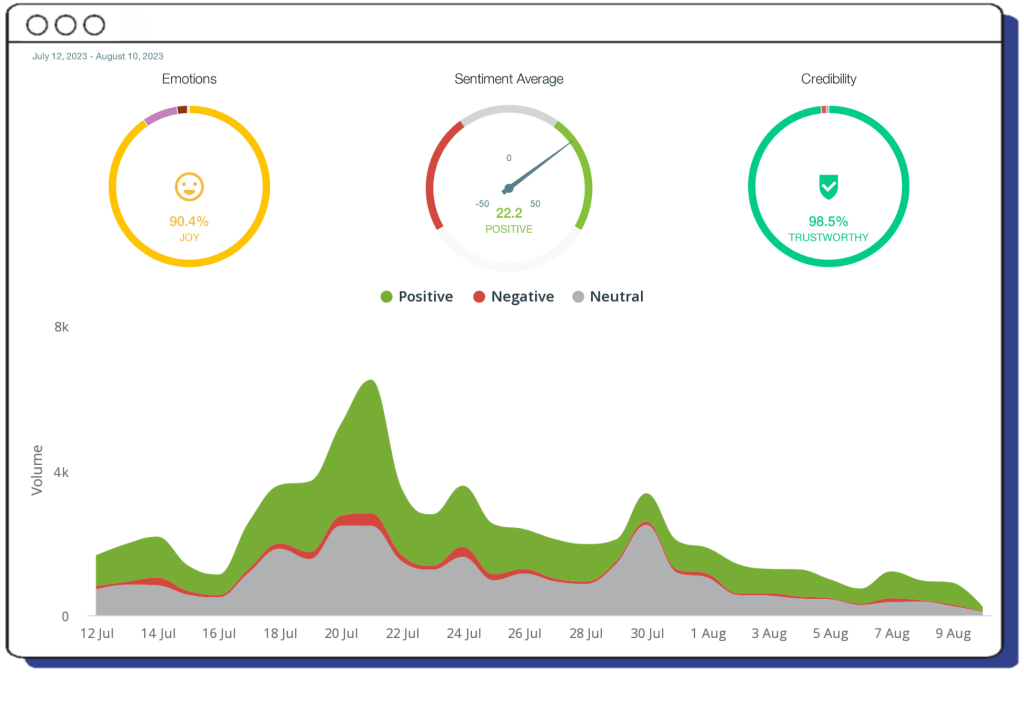
Sentiment analysis, sometimes called opinion mining, is the use of natural language processing (NLP) and machine learning to identify the emotional tone of a piece of text and classify it as positive, negative, or neutral. The output is a label, a score, or both. The input is anything written: a tweet, a review, a support ticket, an analyst report, a Reddit comment, a news headline. For the foundational concepts, see Pulsar's primer on what social listening is and what social media intelligence means.
At the simplest end, rule-based sentiment analysis counts positive and negative words against a dictionary. Modern systems go further. Machine-learning models are trained on millions of conversational examples and learn to read context, negation ("not bad"), intensity ("absolutely brilliant"), sarcasm ("great, another outage"), and topic ("the product is great but support is awful"). The closer a model is trained on conversational data drawn from the channel you care about, the more accurate it will be on that channel. Pulsar's how to measure brand sentiment shift guide walks through the diagnostic workflow step by step.
In Pulsar TRAC (see also what is Pulsar TRAC), sentiment is one layer in a stack of AI enrichments applied to every record: alongside it sit emotion, topics, entities, and more nuanced indicators such as author credibility, reputation, and trust. Each enrichment can be prompted for your specific brief, so a brand name that doubles as a phrase ("A Thousand Blows", "Monster", "Urban Decay") is scored as a brand, not as a sentiment driver.
How does natural language processing (NLP) power sentiment analysis?
NLP is the branch of artificial intelligence that teaches computers to read, parse, and interpret human language. Sentiment analysis is one of many NLP applications, alongside translation, summarisation, named-entity recognition, and intent classification. For how Pulsar applies NLP at the story level, see AI narrative analysis: how AI reads public opinion.
Inside a sentiment model, four layers of analysis typically run:
- Syntax, the grammatical structure of the sentence
- Semantics, the literal meaning of the words and phrases
- Pragmatics, the context in which the statement is made
- Morphology, how words are formed and inflected
A modern sentiment classifier combines those layers with a learned representation of the language and channel. The result is a probability distribution: this mention is 78% likely positive, 18% neutral, 4% negative. That probability is what most dashboards round up into a single label.
Sentiment analysis is also no longer a text-only discipline. Pulsar's multi-modal AI runs sentiment on video, sound, and image at scale: Voice-To-Text transcribes TikTok, Instagram, X, and YouTube content so the spoken caption is analysed alongside the written one, and Image Captioning plus OCR turns the visual into a description that the same sentiment, emotion, topic, and entity models can read. In practice, that means a video critique buried in a 60-second clip is scored as negative even when the on-screen caption is innocuous. See Pulsar TRAC for the full data and enrichment surface area.
What are the limitations of traditional sentiment analysis?
Traditional sentiment analysis has five well-documented weak points. Most B2B reporting failures trace back to one of these.
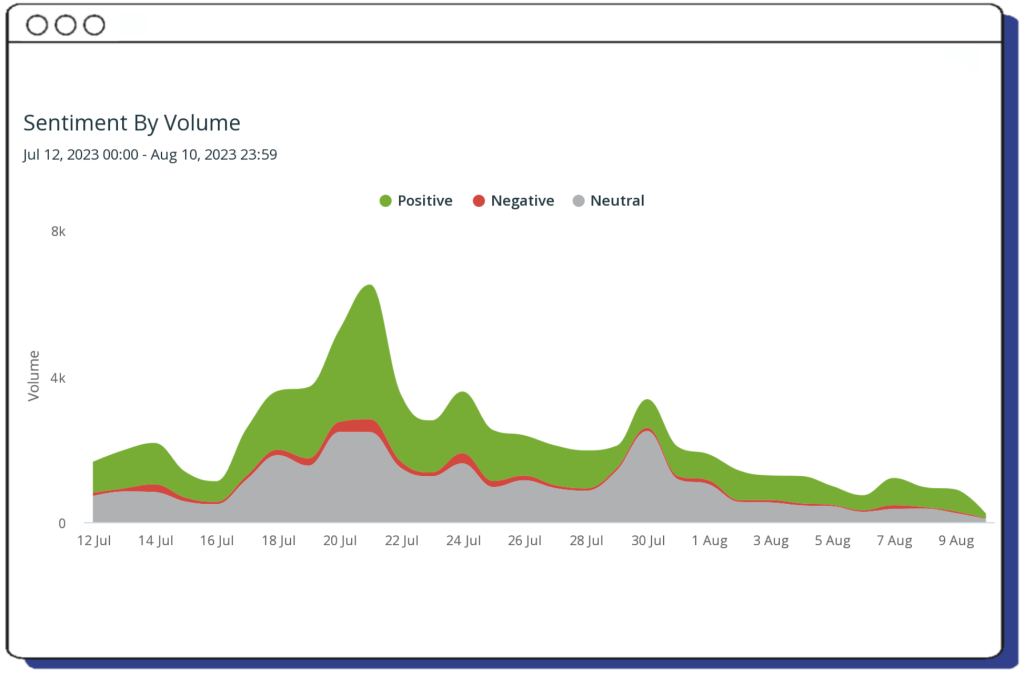
- It collapses meaning into one label. A review reading "love the product, hate the packaging" is positive and negative in the same sentence. A polarity classifier averages them to neutral. The decision-relevant detail vanishes.
- It struggles with sarcasm and irony. "Brilliant. Another outage." reads as positive to most rule-based tools. Modern transformer models do better, but accuracy still drops sharply on heavily ironic platforms like X and Reddit. See what is social media intelligence for how Pulsar handles platform-specific signal.
- It loses cultural and linguistic nuance. Translate-then-analyse pipelines, the default in most legacy tools, lose negation patterns, slang, and culturally specific framing. The score still appears, but it no longer represents the conversation.
- It tells you "what" but not "why." A 30-point drop in positive sentiment is a signal. It is not yet an insight. Without aspect-level analysis and community context, the team still has to do the interpretation work by hand. Pulsar's how to measure brand sentiment shift guide walks through the diagnostic workflow.
- It does not keep up with how language changes. Slang, emoji use, and platform-native shorthand evolve faster than static dictionaries. Models trained on yesterday's web underperform on today's conversation.
How does audience intelligence change sentiment analysis?
Sentiment analysis tells you the temperature of the conversation. Audience intelligence tells you whose temperature you are reading. The combination is what turns a polarity score into a decision. For the methodological case, see audience intelligence vs. market research.
Pulsar is the only platform that combines social listening, media monitoring, and audience segmentation in one product. That matters for sentiment because it lets you segment a conversation by community and filter the conversation based on the segment it comes from. Segmentation models range from demographics to cultural affinity, personality profiling, and online behaviours. The audience segmentation strategy guide and community segmentation hub explain how to put the model to work.
Three views sit on top of every sentiment signal in Pulsar:
- Aspect-based scoring, so a single mention can carry positive sentiment on price and negative sentiment on support.
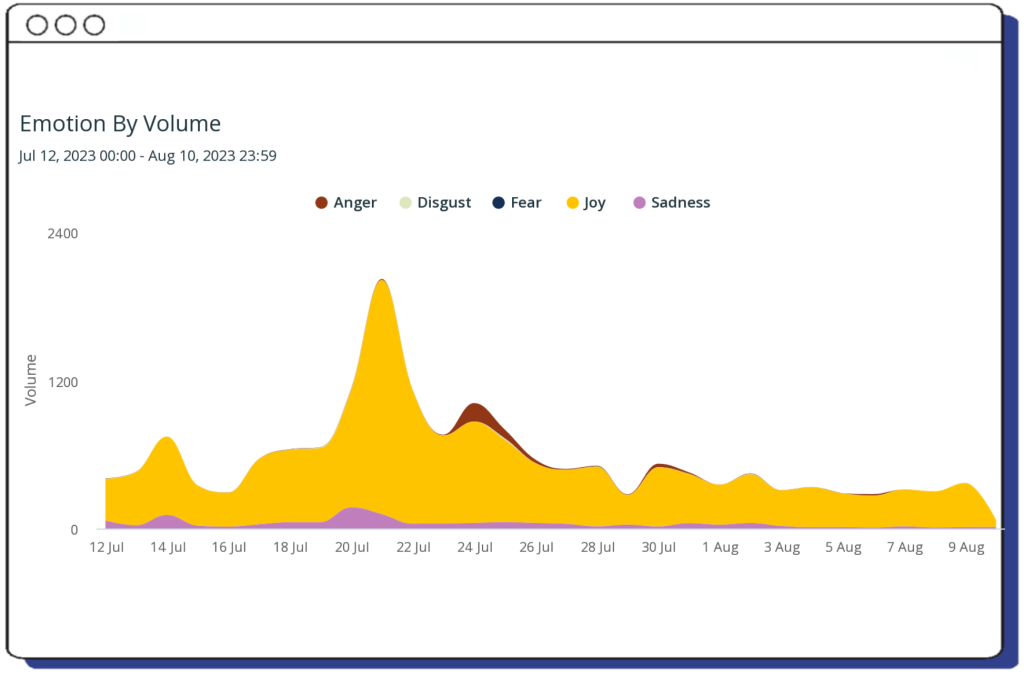
- Emotion classification, labelling the underlying feeling (joy, anger, trust, fear, surprise, disgust) using a Plutchik-style framework. See how to measure brand sentiment shift.
- Community-level breakdown, so the headline 68% positive sentiment can be split into an 82% positive sustainability community and a 61% negative customer-service community.
The shift matters for B2B because B2B buying decisions involve multiple stakeholders with different sentiment drivers. A procurement lead and a security architect can sit on opposite sides of the same conversation. A brand-level number averages them out and tells you nothing useful.
The cleanness of the underlying data also matters. Pulsar's Relevance AI uses semantic affinity rather than boolean queries to decide whether a piece of content belongs in your dataset. Configured around your brand context, it filters out the noise that would otherwise drag sentiment averages in the wrong direction. For how this fits into a full programme, see how to build a social media intelligence programme.
What does a modern sentiment analysis workflow look like in 2026?
The table below compares the three generations of sentiment tooling most B2B teams are currently choosing between. For a wider tool review, see the best social listening tools 2026 guide and the best social media intelligence tools roundup.
| Capability | Rule-based (legacy) | AI sentiment (current) | Pulsar TRAC |
|---|---|---|---|
| Polarity scoring (positive / negative / neutral) | ✓ | ✓ | ✓ |
| Sarcasm and context handling | ~ | ✓ | ✓ |
| Aspect-based sentiment (topic-level scoring) | No | ~ | ✓ |
| Emotion classification beyond polarity | No | ~ | ✓ |
| Native-language scoring (50+ languages) | No | ~ | ✓ |
| Multi-modal sentiment (text, voice, image, OCR) | No | ~ | ✓ |
| Community-level sentiment breakdown | No | No | ✓ |
| Sentiment velocity as a narrative-risk signal | No | No | ✓ |
The audience-intelligence column is not aspirational. Pulsar's data foundation covers 40 billion content items analysed in the past 12 months across EMEA and North America platforms (X, Facebook, Instagram, Reddit, YouTube, LinkedIn, Threads, TikTok, Bluesky), APAC platforms (Weibo, WeChat, Xiaohongshu, Douyin, Bilibili), Web 2 and reviews (Amazon, Trustpilot, G2-style sources), news and broadcast, and first-party data such as support tickets and survey responses. Sentiment that ignores half of that surface area is, by definition, partial. For how velocity is calculated and reported, see social listening KPIs and metrics.
What is brand sentiment and how do you measure it?
Brand sentiment is the aggregate feeling consumers express toward a company, evident in reviews, social posts, comments, support transcripts, analyst notes, and conversations on Reddit, Discord, and niche forums. The full playbook is in brand reputation monitoring and the brand reputation solution overview.
A defensible B2B brand-sentiment measurement programme has four moving parts:
- Source breadth. Reviews (G2, Trustpilot, Capterra), social (X, LinkedIn, Reddit, YouTube), news, and community channels. Single-source sentiment is biased sentiment. Pulsar CORE covers your owned channels; Pulsar TRAC covers earned and competitive.
- Baseline. A sentiment number means nothing without the trailing-12-month baseline it sits against. 60% positive is excellent against a 45% baseline and concerning against an 80% baseline. See the real-time brand tracking primer.
- Aspect breakdown. Product, pricing, support, leadership, ethics, and security typically each carry their own sentiment in B2B. Reporting them as one number hides the signal that matters.
- Velocity tracking. Trajectory beats snapshot. A brand improving from 55% to 65% positive is in a stronger position than one declining from 75% to 65%, even though both end at the same ratio.
For the methodology in detail, see the Pulsar guide on how to measure brand sentiment shift and the brand narrative monitoring playbook.
How do you analyse sentiment across social media?
Social platforms remain the largest open source of opinion data, but the mix keeps shifting. Long-form discussion has moved to Reddit, Discord, and Substack; short-form opinion is split across X, Threads, Bluesky, and TikTok comments; APAC conversation lives on Weibo, WeChat, Xiaohongshu, and Douyin; review sentiment lives on G2 and Trustpilot. A 2026-grade sentiment programme reads all of them. For the broader strategic picture, see how to set up a social listening strategy.
The mechanics of a social sentiment workflow are straightforward:
- Define the brand entity, including official handles, common misspellings, product names, and known ambiguities.
- Collect mentions from every channel you care about, ideally through a single platform so the data is comparable.
- Run sentiment, emotion, aspect-level, and multi-modal scoring in the native language of the content.
- Cluster mentions into communities and narratives, so the picture you see is by audience, not by channel. Pulsar's network mapping treats social data as a graph and shows how information flows between communities, rather than assuming everyone is influenced by the same hub. See audience and community segmentation for the methodology.
- Watch velocity, not just ratio, and pair it with a crisis-detection layer like Crisis Oracle's P.U.L.S.E. score for early warnings. Read the social listening for crisis management playbook and narrative risk monitoring framework.
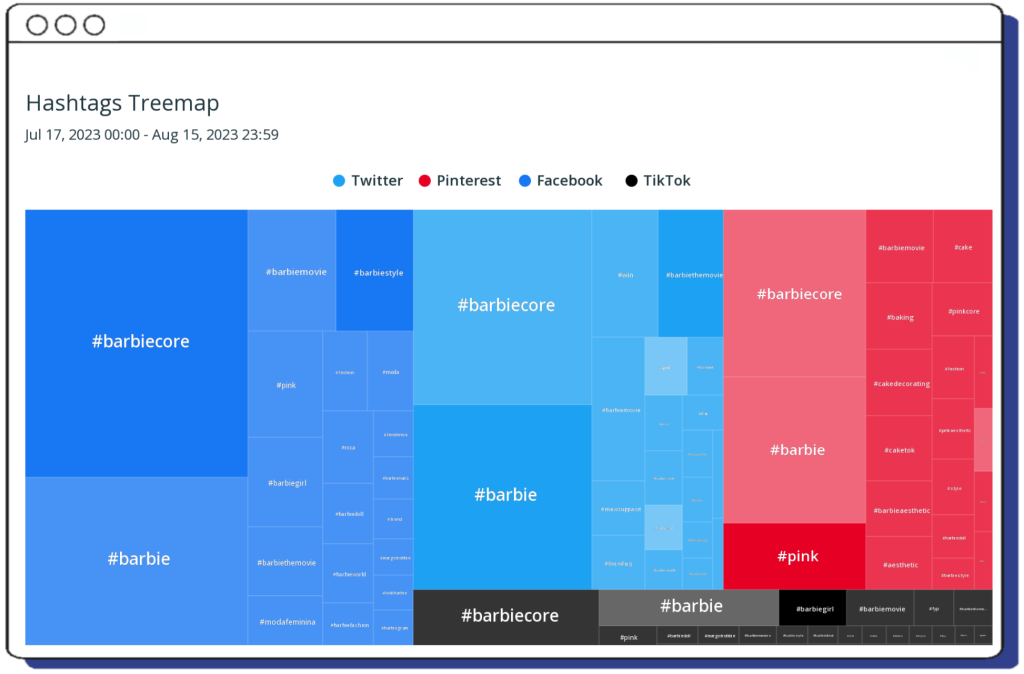
For X (formerly Twitter) specifically, the platform's enterprise API tier remains the standard data source for high-volume sentiment monitoring, although coverage and rate limits have changed materially in recent years; build any new programme assuming a multi-platform mix from day one. PR teams should also pair sentiment with the PR social-listening playbook and brand misinformation detection guide.
What does the future of sentiment analysis look like?
Three shifts are reshaping sentiment analysis in 2026, and B2B teams are starting to feel each of them in their pipelines.
From mention-level scoring to narrative-level intelligence. Executives do not want twelve dashboards. They want to know which stories are building around the brand, how each one is trending, and which one is about to break out. Narratives AI uses NLP, LLMs, and retrieval-augmented generation on billions of news and social data points to detect, summarise, and rank emerging narratives in real time. Sentiment is one of the dimensions Narratives AI scores each story on, so insights teams can report at narrative altitude rather than per-post. Background reading: what is Narratives AI, Narratives AI for insights professionals, and how AI reads public opinion.
From reactive monitoring to predictive intelligence. Traditional crisis monitoring fires on volume, sentiment, author, or keyword triggers at the post level, and is retrospective by design: you have to know what the crisis is before it is a crisis. Crisis Oracle reframes this by treating brand conversations as narratives, not isolated posts, and scoring each narrative with P.U.L.S.E. (Persistent Upshift in Latent Signal Emergence). Instead of asking "is sentiment negative?", P.U.L.S.E. asks "is this narrative gaining dangerous momentum?", combining Volume, Visibility, and Velocity into one stable, comparable risk score. The Crisis Oracle launch post walks through the framework end-to-end.
From copilots to autonomous agents. Most AI tools wait to be asked. Pulsar's wider TeamMates layer is a library of agentic AI workers: each TeamMate is trained to handle a specific job (cultural trends, reputation intelligence, threat detection, ad compliance, influencer vetting) using sentiment, emotion, narrative, and audience data as inputs. See Pulsar TeamMates: insight agents and the Threat Sentinel TeamMate for sentiment-driven risk monitoring. For ad-compliance review, Pulsar Clear turns ad submissions into a compliance report in minutes. The shift is not from human to AI, it is from AI autonomy to AI judgment.
For more on testing communications before they go live, Pulsar's Synthetic Audiences generate simulated representations of real-world audiences from demographic, behavioural, and social data. PR teams use them to pressure-test a response against the audience currently talking about a crisis before publishing anything.
The throughline across all three shifts is simple: sentiment analysis is necessary, but on its own it is not enough. The job of a modern B2B insights function is to combine sentiment with audience, narrative, and velocity, and to translate the result into a decision before the window closes.
Frequently Asked Questions
+What is sentiment analysis in simple terms?
Sentiment analysis is the use of software to read text and decide whether the opinion in it is positive, negative, or neutral. It is applied to reviews, social media posts, support tickets, news, and any other written feedback, so brands can measure how people feel about them at scale. See what is social listening for the related foundations.
+What is the difference between sentiment analysis and emotion analysis?
Sentiment analysis classifies text as positive, negative, or neutral. Emotion analysis goes one level deeper and labels the specific feeling driving the sentiment, typically joy, anger, fear, sadness, surprise, trust, or disgust. Emotion analysis is more useful for diagnosing why customers feel the way they do, not just whether they are happy. Pulsar's how to measure brand sentiment shift guide covers the diagnostic workflow in detail.
+How accurate is modern sentiment analysis?
Modern transformer-based sentiment models reach high accuracy on clean text and lower accuracy on sarcasm-heavy or multilingual content. The biggest accuracy gains in 2026 come from native-language scoring, aspect-based analysis, multi-modal inputs (voice, image, OCR), and Relevance AI filtering that removes off-brief content before the score is calculated.
+What is aspect-based sentiment analysis?
Aspect-based sentiment analysis attaches sentiment to a specific topic inside a single piece of content, rather than scoring the content as one block. A review reading "love the product, hate the packaging" returns positive sentiment on product and negative sentiment on packaging. Rule-based systems collapse the same mention to neutral and lose the actionable signal.
+Why is sentiment analysis important for B2B brands?
B2B buying decisions are made by buying committees with different stakeholders weighing different concerns. Sentiment analysis, layered with aspect-based scoring, audience segmentation, and community-level sentiment, exposes how each stakeholder group is reacting. That intelligence informs positioning, product roadmap, customer success priorities, and PR response. See enterprise social listening use cases for examples.
+What is sentiment velocity and how does P.U.L.S.E. use it?
Sentiment velocity is the rate at which sentiment around a topic or narrative is changing over time. Pulsar's Crisis Oracle uses velocity as one input in its P.U.L.S.E. (Persistent Upshift in Latent Signal Emergence) score, alongside Volume (scale of the narrative) and Visibility (reach and engagement). Instead of asking "is sentiment negative?", P.U.L.S.E. asks "is this narrative gaining dangerous momentum?" and produces a stable, comparable measure of narrative risk.
+How does Pulsar's sentiment analysis differ from other social listening tools?
Pulsar TRAC combines polarity scoring with aspect-based sentiment, Plutchik-style emotion classification, native-language models across 50+ languages, multi-modal analysis on voice and image, audience segmentation, and community-level breakdown. Narratives AI rolls mention-level signal up to story-level sentiment using NLP, LLMs, and RAG, and Crisis Oracle uses the P.U.L.S.E. score to flag narrative-level risk in real time.
In summary
Sentiment analysis is the foundation of any modern audience-intelligence programme, not the ceiling of one. Treat polarity scores as the entry point, then layer aspect-based sentiment, emotion, multi-modal inputs, audience segmentation, and velocity on top. For B2B teams in 2026, that combination, delivered through Pulsar TRAC, Narratives AI, and Crisis Oracle, is the difference between reporting a number and changing a decision.
If you're interested in how Pulsar Tools can support your brand and strategy, simply fill out the form below and one of our specialists will contact you!