The media-fication of social media – how platforms are evolving in 2026
- Media & Entertainment
New behavioral norms are solidifying across social media platforms and users. The first of these relates to how they instinctively use the platforms, the second how they relate to the rules and incentives shaping their time on social media.
In the first of these, and across several key platforms, users are shifting from active participants to viewers. Instagram demonstrates particularly clearly. Only seven percent of activity now involves sharing with friends, while most behavior centres on watching, saving, and following.
Social interaction has not disappeared, but under the media-fication of social media it increasingly happens around content rather than through direct connection. Engagement begins with exposure to media-like formats and only later becomes interactive.
This marks a change in the social contract of many such platforms. Interaction is no longer the starting point but the result. Audiences respond most strongly to content that feels intentional and coherent rather than spontaneous or personal. As a result, media literacy on social platforms—knowing what content performs, how algorithms surface it, and why—now shapes engagement more than personal relationships or network proximity.
So which platforms are pushing this shift furthest, and how do audiences distinguish between them?
Certain platforms are perceived as 'broadcast' channels
In the context of the Great Fragmentation the media-fication of social media has led platforms to absorb different functions once unified under traditional media. Scale, discovery, liveness, authority, and narrative continuity no longer coexist in a single channel. Instead, they are distributed across platforms, each with its own rules for visibility and participation.
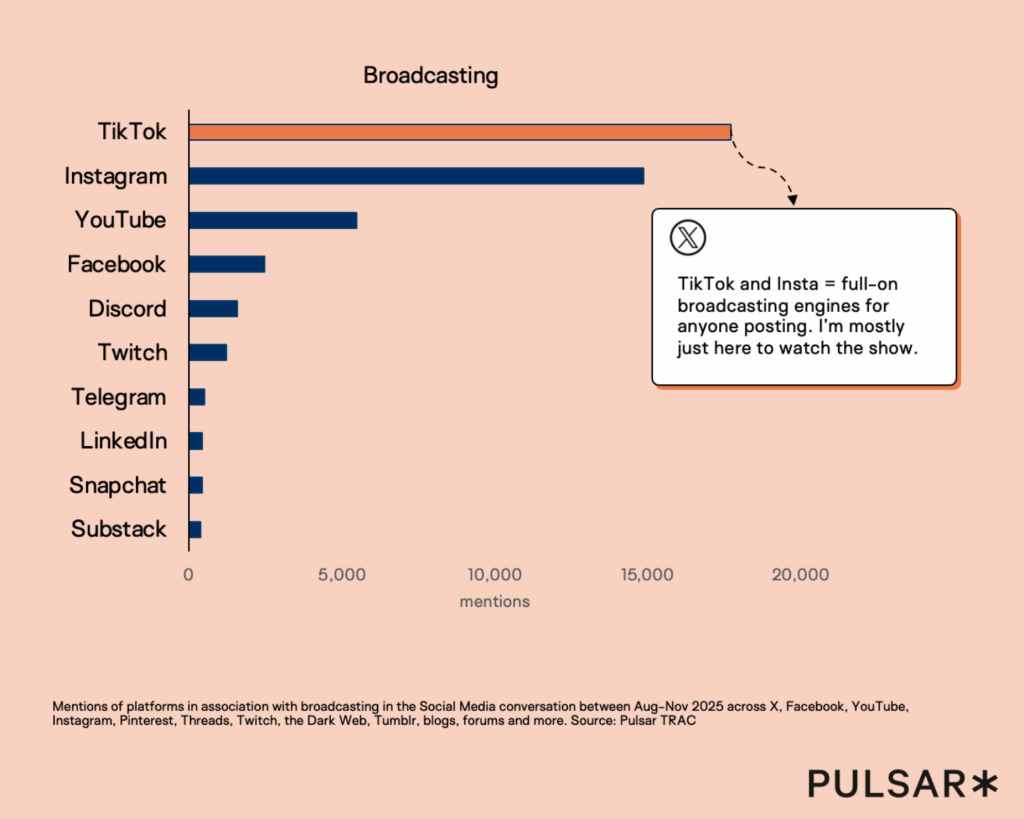
Not surprisingly, visual- and streaming-led platforms dominate associations with broadcasting when we track platform mentions using Pulsar TRAC.
- TikTok and Instagram concentrate fragmented mass reach. They operate as always-on discovery engines, where audiences encounter content without prior intent and where visibility is driven by algorithmic circulation rather than brand or creator equity. These platforms fragment broadcast into moments, trends, and formats, prioritizing speed and adaptability over continuity.
- YouTube consolidates fragmented long-form media. It retains the logic of programming and episodic storytelling, but without schedules or gatekeepers. Attention here is intentional and sustained, making it the primary home for narrative depth in a fragmented media environment.
- Twitch represents the fragmentation of live media. Real-time broadcast persists, but it is restructured around participation rather than spectatorship. Visibility is earned through presence and community rather than reach alone, shifting live media from mass events to shared experience.
- LinkedIn captures a narrow but influential fragment of traditional media. It replaces business and trade publishing with a feed-based model where authority, expertise, and professional identity drive visibility.
- Snapchat remains largely outside the broadcast fragment. Its emphasis on private and networked communication shows that the media-fication of social media does not pull all platforms toward mass media behavior.
What was once a unified broadcast system has splintered into multiple media logics. Audiences now navigate between platforms depending on whether they seek discovery, depth, liveness, or authority. Strategy in a fragmented media landscape is no longer about reach everywhere, but about choosing which fragment of broadcast to occupy.
Algorithms are not just vital for navigating volume of media – they also shape the brand of platforms
Algorithmic influence now defines how platforms are perceived. The media-fication previously described means that for many users the feature that defines their time spent on social media is not the communities they share the space with, but the mechanics underpinning the algorithm that delivers their content.
How, then, do audiences talk about these algorithms in relation to different platforms?
YouTube dominates discussions about algorithms, epitomising its nature as the ultimate ‘lean-back’ location for algorithmically-delivered content, but this is not just technical. Audiences see it as a place where recommendations can make or break creators, with sixty-eight percent of mentions linking the platform to discoverability and growth.
Forums follows as a space where users dissect how feeds work, share workarounds, and debate bias in real time.
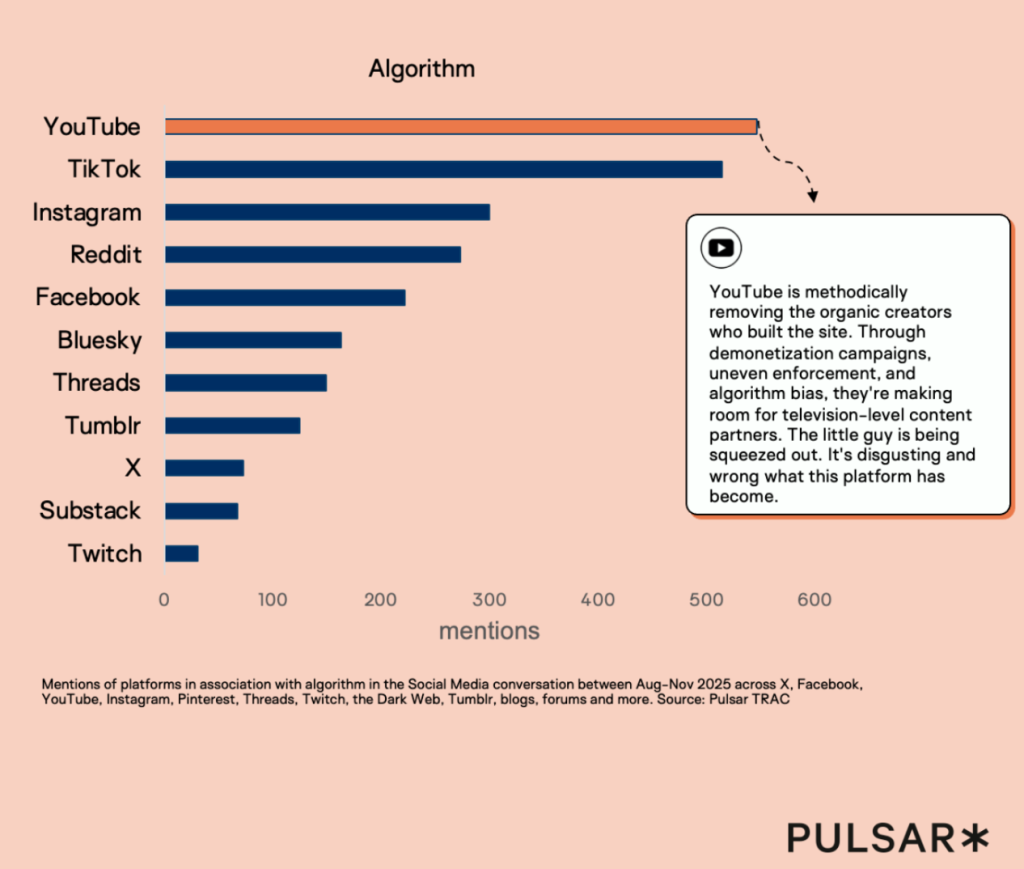
Other platforms reveal different patterns. Bluesky generates conversation around algorithm choices and moderation. X plays host to conversations around how to 'fix' the algorithm, and its weighting in favor of different groups or values (ie, 'free speech absolutists')
Twitch demonstrates algorithmic quirks in live streaming, where retention and raids shape visibility more than passive scrolling. TikTok and Instagram, despite their algorithmic sophistication, are largely discussed as polished black boxes rather than platforms to analyze.
View on Threads
What the media-fication of social media means for brands
So what’s the takeaway from all this?
Conversations about algorithms cluster where transparency or controversy exists, not necessarily where technology is most advanced. As the media-fication of social media continues, brands must understand not only how algorithms function, but how users interpret and talk about them.
In a media-fied social landscape, influence depends on platform literacy, narrative alignment, and choosing the right media logic rather than simply maximizing reach.
For a deeper dive into the full Great Fragmentation study, read it here.
To stay up to date with our latest insights and releases, sign up to our newsletter below:
This article was created using data from TRAC