Anthropic vs OpenAI: How Claude’s Super Bowl Ad Shifted AI Brand Perception 2026
- Tech

The year was 1984 when Apple detonated an era-defining Super Bowl ad, the one that introduced the Macintosh and cast IBM as Big Brother. “You’ll see why 1984 won’t be like ‘1984,’” the narrator promised, as a freedom fighter sent her hammer hurtling through the screen of the oppressor.
40 yearas later, during another Super Bowl, Anthropic attempted a similar act of moral disruption by positioning itself as the sober alternative to the world's leading AI company.
Anthropic just took a big swipe at OpenAI's decision to put ads in ChatGPT. Anthropic is airing ads mocking ChatGPT ads during the Super Bowl, and they're hilarious 😅 Anthropic is also committing to no ads in Claude https://t.co/LR1v4xz9ds pic.twitter.com/PXoaZtmCWA
— Tom Warren (@tomwarren) February 4, 2026
“Clearly dishonest” was one of Sam Altman’s reaction to Anthropic’s eight-million-dollar campaign, “A Time and a Place,” which extolled Claude’s ad-free purity mere days after OpenAI declared advertising as its new access model.
First, the good part of the Anthropic ads: they are funny, and I laughed.
But I wonder why Anthropic would go for something so clearly dishonest. Our most important principle for ads says that we won’t do exactly this; we would obviously never run ads in the way Anthropic…
— Sam Altman (@sama) February 4, 2026
But the parallel had already taken hold: one company speaking in the logic of reach, the other in the language of restraint. The ad turned that contrast into an allegory about trust—an emotion technology still struggles to earn.
OpenAI was trying to warm the world up to the idea of advertising. At roughly the same moment, Anthropic’s CEO Dario Amodei was publishing one of his long warnings about AI power outrunning governance, framing itself as antidote to black-box industry norms.
The Adolescence of Technology: an essay on the risks posed by powerful AI to national security, economies and democracy—and how we can defend against them: https://t.co/0phIiJjrmz
— Dario Amodei (@DarioAmodei) January 26, 2026
Then, the Super Bowl work translated that tension into a morality play, titled “Treachery” and “Betrayal,” and organized around a single unease: sponsored intent has a way of migrating into conversations people experience as private.
The argument travelled quickly online, translated into a tangible bump in Claude interest and downloads, and sharpened the competitive frame.
As Mark Ritson has noted, it delivered something the category rarely manages: real differentiation, in a landscape that so often collapses into benchmark talk.
We used Pulsar Narratives AI and TRAC to map how perceptions of Claude and ChatGPT shifted post campaign, and to pinpoint the dimensions where the narrative moved most.
What we're covering:
Claude sees the positivity uplift after Super Bowl
Claude sees the positivity uplift after Super Bowl
Claude’s Super Bowl ads did something that disappears if you only look for spikes. When we measure narrative positivity before and after the campaign, we see a shift in how both brands are being talked about, not simply how loudly they are being mentioned.
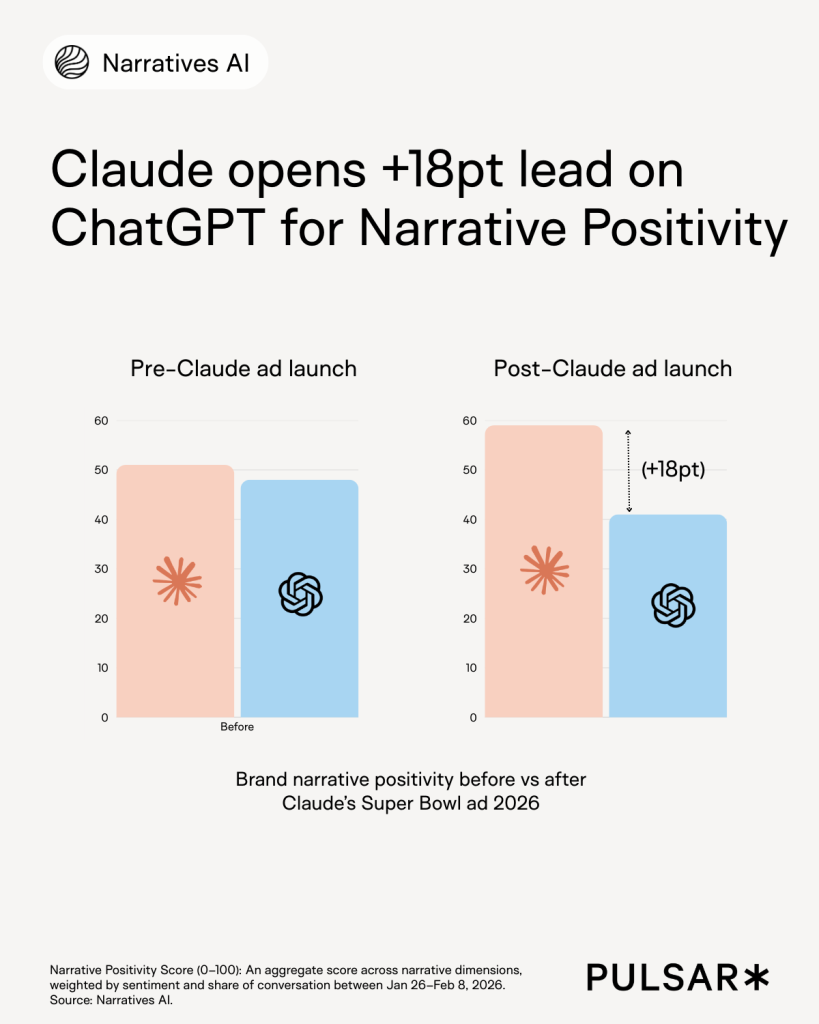
In the pre-launch window, the landscape is relatively stable. When we measure the narrative positivity of Claude and ChatGPT respectively they are near the 50 baseline, with only a modest difference between them. Most of the conversation remains anchored in capability comparisons.
Post-launch, the stability disappears. Claude rises into the high 50s and ChatGPT slides toward 40, leaving Claude with a clear +18 point lead. Relative to the pre-campaign gap, the distance between the two narratives widens sharply, and the separation becomes the story.
Two things make this especially significant. First, the movement is symmetrical in effect and opposite in direction. Claude gains positivity while ChatGPT loses it, which points to competitive reframing rather than a standalone halo. And because this metric is an aggregate across narrative dimensions weighted by sentiment and share of conversation, it reflects changes in meaning, not just more people talking.
Trust makes AI wars into vibe management
To map the narrative terrain, we split perception into four dimensions: Trust encompassing reliability, privacy, ethics, transparency; Performance covering quality, speed, sophistication, versatility; Experience touching use cases, UX, ease of use, tone; Culture spanning positioning, community, social currency, identity.
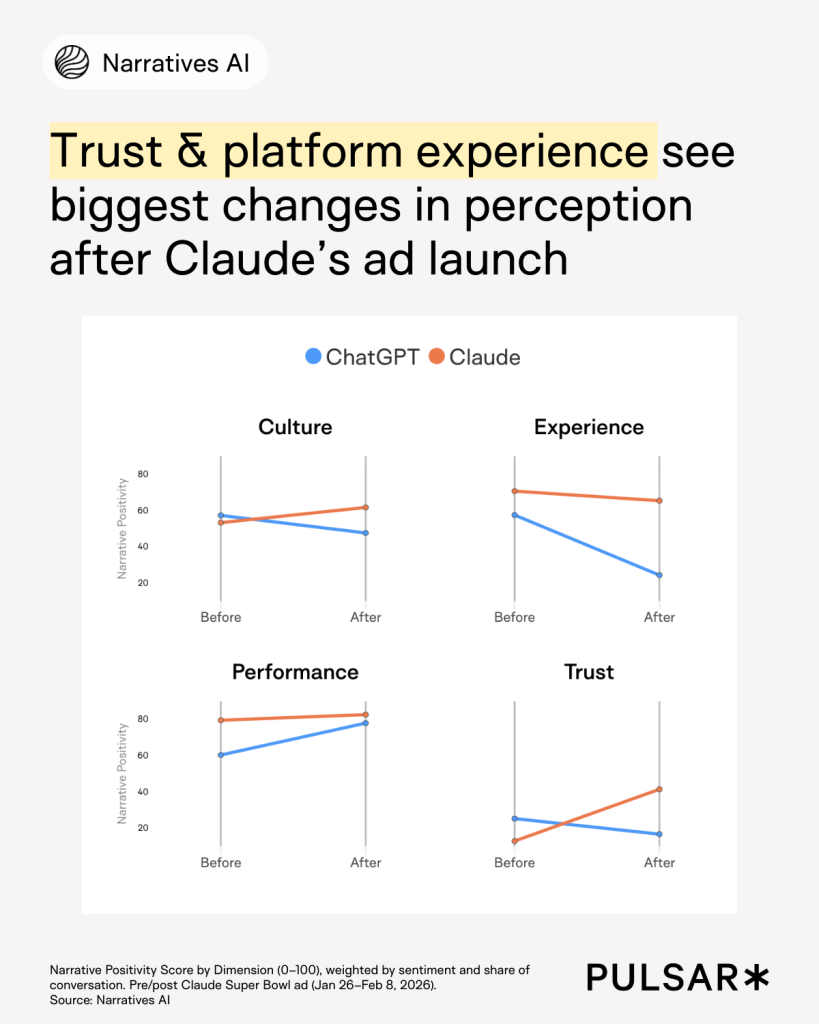
Once you break the narratives down that way, a clear pattern emerges. Post-campaign, Claude peaks positivity gains of 122% in Trust and 15% in Culture. This points to more than noise: the ad reshaped affinity around steadiness and cultural fit.
ChatGPT’s biggest slide lands in Experience, down 33% vs pre ad levels, with timing doing a lot of work. A major outage ignites user frustration in the same window, and Claude’s spot lands when patience is already thin, making it harder for ChatGPT to keep the benefit of the doubt.
Meanwhile the marketing dimension, unplotted here, barely moves, with Claude up only 2.3%, suggesting the ad dissolved into larger questions of platform intent and life.
So why does Trust become the dimension that pulls the two brand narratives furthest apart after the ad?
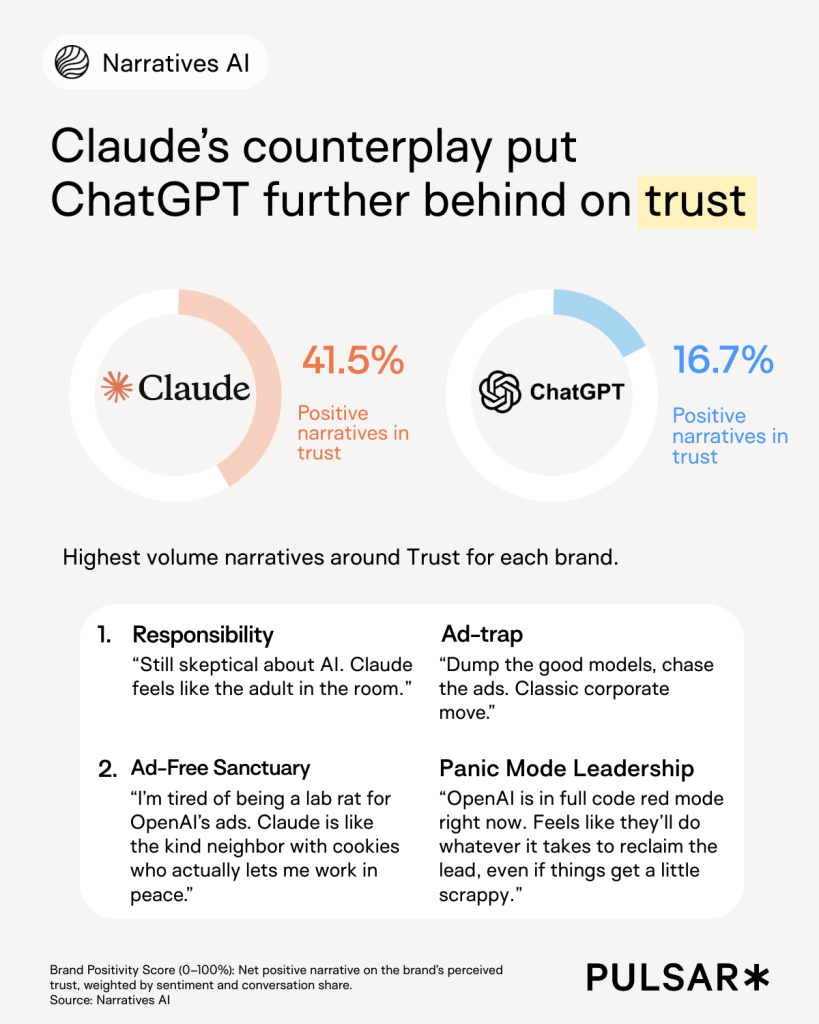
Trust is a hard currency in a category people still half distrust in AI. Even so, when you isolate the trust narratives by brand, the divergence is unmistakable: Claude rises from 12.8% to 45.5% positive trust narratives, about 255% growth, while ChatGPT slips from 25.3% to 16.7%, down roughly 34%.
Meanwhile, ChatGPT’s erosion signals something subtler: audiences no longer suspending judgment about its commercial drift, folding future incentives into the product’s very character.
Claude is being narrated as Responsibility and Ad Free Sanctuary, a grown up tone paired with a promise of calm. The trust shift makes more sense when you consider the scaffolding beneath it: Anthropic’s research first identity, Amodei’s EA shaped worldview and his recent 19,000 word warning about AI power and safety, and a product cadence that now reads as quietly formidable, with Opus 4.6 making the case that principle can travel with performance.
View on Threads
ChatGPT, by contrast, carries the opposite burden. Its default status turns the product into a public utility and every decision into a political event. Leadership turbulence, shifts in tone, hints about monetization, its association with MAGA & ICE, all of it reads louder when you are the established leader.
OpenAI president Greg Brockman and his wife donated $25 million to MAGA Inc in 2025.
There's a push to boycott ChatGPT, that tool is now added to https://t.co/wIRId1ok1T https://t.co/OO8bMfstPi
— jordan (@JordanUhl) February 4, 2026
Plus, Altman’s own public journey sharpens that reading: once widely associated with the language of AI safety, now positioned as the executive steering the product toward advertising, he becomes part of the trust calculation whether he intends to or not.
Trust, at a certain point, stops being an attribute and becomes a belief. The marketing contrast hardens into cultural verdict, and the verdict turns on intent, something close to “soul.”
Who’s driving the narratives? Audience maps show concentrated impact
The audience maps also offers a quiet correction to the idea that Super Bowl advertising automatically produces mass conversion. Here, the campaign’s most visible effect is not the arrival of new audiences. It is the tightening of sentiment inside an already invested world, where the question of ads is experienced as a breach rather than a footnote.
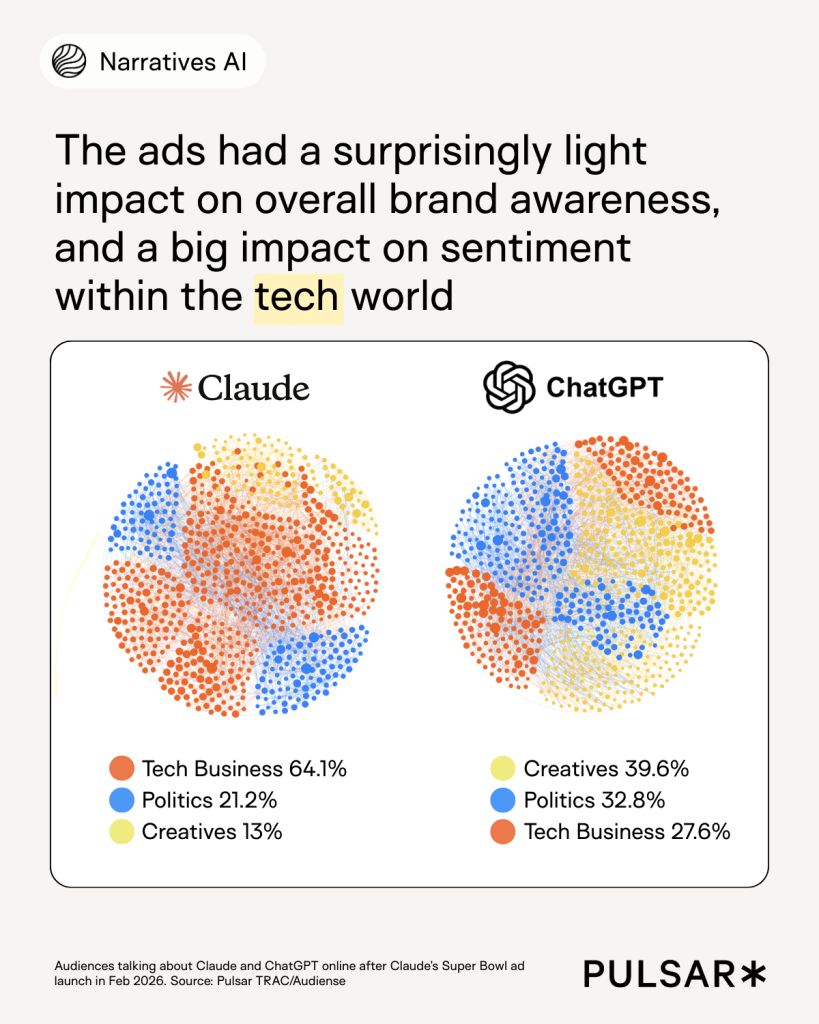
Claude’s post launch audience skews heavily Tech Business (64.1%), with Politics and Creatives remaining peripheral. ChatGPT’s audience stays broad and heterogeneous, led by Creatives (39.6%) and Politics (32.8%), with Tech Business at 27.6%. That breadth reflects default status. It also disperses narrative coherence.
For Claudes, though the ad draws no new types of crowds, its ad tends to make the brand concentrates in a tight invested circle (tech + business), binding "Claudians" into communal identity. This cohesion runs deeper than online chatter suggests: less fractious ChatGPT crowds, more a steady cohort judging models by backbone and motive.
To stay up to date with our latest insights and releases, sign up to our newsletter below:
This article was created using data from TRAC