What the Great Fragmentation Means for Marketers
- Media & Entertainment

The web does not feel like one place anymore.
As users, we all experience it. You open TikTok and slip into one version of yourself. You switch to X and adopt another. On Discord, behavior changes again. Tone, language, credibility, even humor all shift depending on where you are.
Audiences now move fluidly between platforms that operate on entirely different cultural logics. Meaning, influence, and attention no longer concentrate in one place. Instead, they fragment across ecosystems, formats, and communities, each with its own norms, incentives, and identities.
For marketers, this fragmentation is not theoretical. It shows up in missed resonance, campaigns that travel poorly, and messages that perform well in one space but fall flat in another.
Scale alone no longer guarantees impact. Consistency no longer means repetition. And channel by channel optimization increasingly misses how culture actually moves.
What we are seeing is The Great Fragmentation, a structural shift from a platform centric internet to a culture centric one. Thriving in this environment requires a different way of seeing audiences, platforms, and influence. Below are the five shifts defining what effective marketing looks like now.
Table of Contents
Shift 1: Cultural targeting replaces demographics and interests
Shift 2: Narratives become the unit of strategy
Shift 3: Platforms become message constraints
Shift 4: Creative becomes multi format by default
Shift 1: Cultural targeting replaces demographics and interests
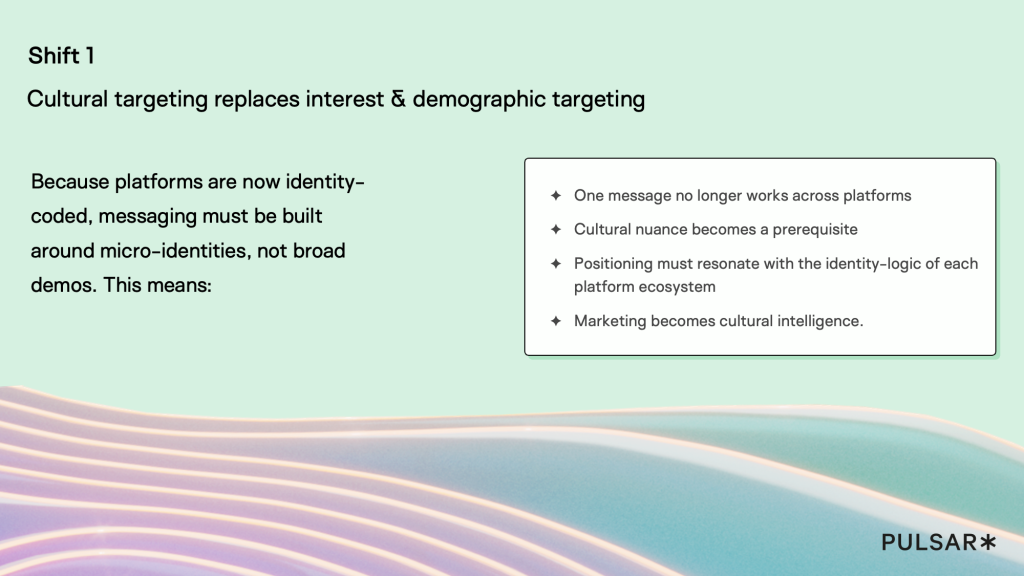
Platforms are no longer neutral distribution layers. Each one encodes its own identity logic, social norms, and value system. People don’t simply use platforms , they perform different versions of themselves within them.
As a result, messaging built around broad demographics or surface level interests increasingly fails to land. A message that feels credible on forums may feel hollow on TikTok. A tone that works on X may collapse on Discord.
Targeting now requires cultural fluency, not just data precision.
Effective positioning is built around micro identities shaped by shared language, aesthetics, beliefs, and behaviours , not age brackets or generic interest clusters. Resonance comes from aligning with how people see themselves within a specific platform culture.
Marketing shifts from segmentation to interpretation. Cultural nuance moves from a competitive advantage to a baseline requirement.
Shift 2: Narratives become the unit of strategy
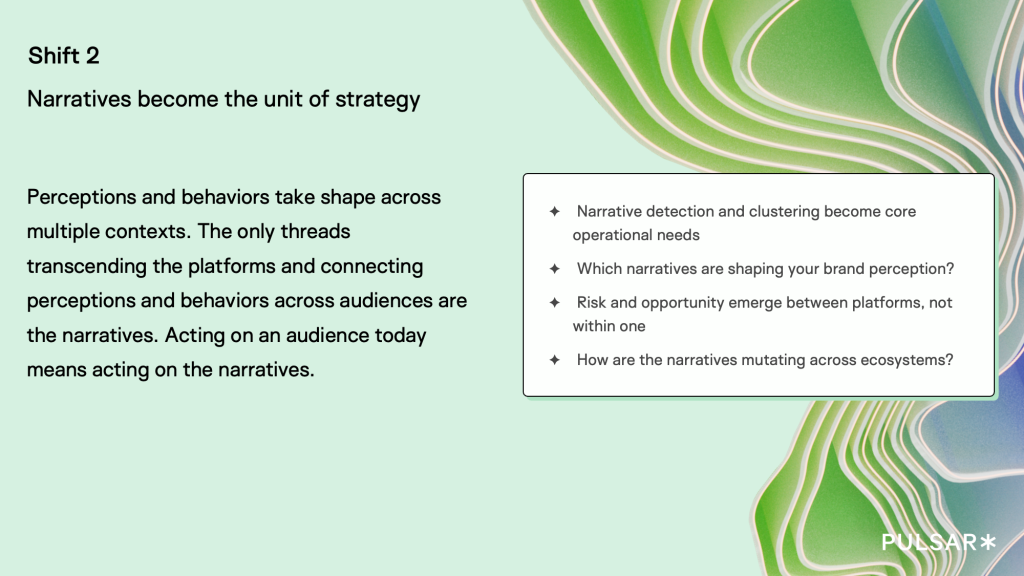
Perceptions and behaviors no longer form inside single platforms. They emerge between them.
Ideas now travel as narratives, repeated, remixed, contested, and reframed as they move across communities and formats. The connective tissue of the fragmented web is no longer the channel or the content type, but the story being told and retold.
To influence audiences today is to influence the narratives shaping them.
That means understanding:
- Which stories are gaining traction
- How those stories mutate by ecosystem
- Where momentum is accelerating or stalling
Risk and opportunity increasingly surface in the gaps between platforms, not within any single one. Strategy shifts away from campaign execution toward narrative detection, clustering, and evolution.
Shift 3: Platforms become message constraints
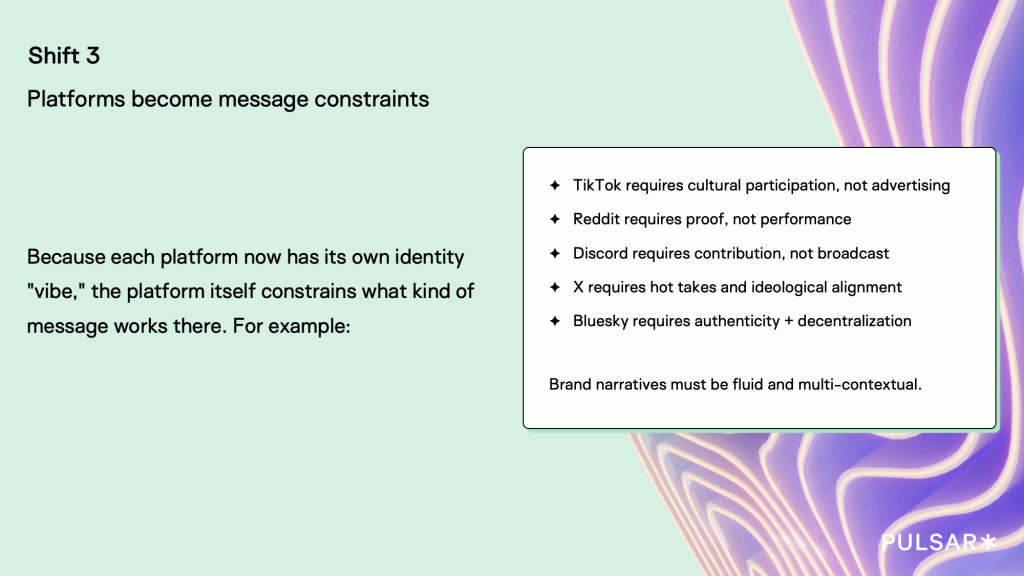
Every platform actively constrains what kinds of messages can succeed.
- TikTok rewards cultural participation and remixing
- Forums reward proof, expertise, and credibility
- Discord rewards contribution, presence, and trust
- X rewards ideological alignment and immediacy
- Bluesky rewards authenticity and decentralised norms
- These are not stylistic preferences. They are structural constraints.
A message cannot simply be resized or reformatted across platforms. It must be rewritten to fit the identity logic of each ecosystem. Brand narratives need to remain coherent while adapting to radically different expectations around tone, authority, and participation.
In a fragmented environment, consistency is no longer achieved through repetition , it’s achieved through meaning.
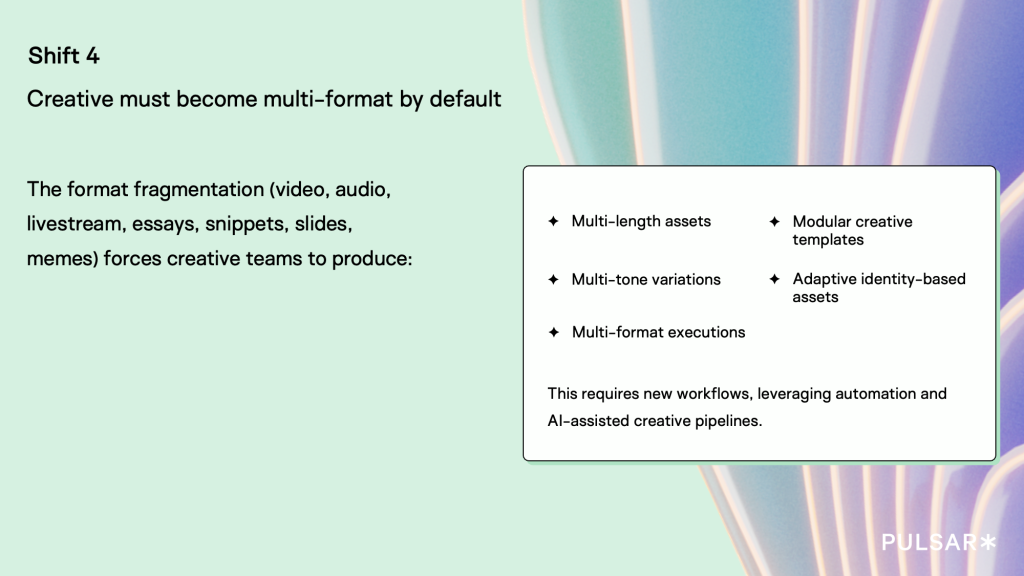
Shift 4: Creative becomes multi format by default
Fragmentation reshapes formats as much as platforms.
Video, audio, livestreams, long form essays, short snippets, slides, memes, and even comment threads all play different roles in how narratives move. Audiences encounter ideas at different depths and speeds depending on context.
This makes the traditional “hero asset” model obsolete.
Creative teams now need modular systems capable of producing multiple lengths, multiple tones, and multiple formats outputs that can flex across platform norms and audience states.
That shift demands new workflows , often supported by automation and AI-assisted creative pipelines , and a reframing of creative strategy itself. The goal is no longer asset production, but narrative orchestration across formats.

Shift 5: Measurement moves from channels to narratives
Traditional metrics struggle to capture impact in a fragmented environment.
Impressions, clicks, and engagement measure activity within platforms , not influence across them. The new currency is narrative momentum: how ideas grow, spread, mutate, and shape behaviour across ecosystems.
Modern measurement focuses on:
- Share of narrative rather than share of voice
- Narrative velocity and relative scale
- Points of origin and paths of evolution
- The communities driving momentum
- The behavioural shifts that follow adoption
ROI becomes cultural, not just media driven. Influence is measured through narrative lift, not isolated performance metrics.
The strategic implication
Fragmentation doesn’t make marketing harder. It makes it different.
Winning now depends on understanding how culture fragments, where meaning concentrates, and how audiences move between identities, platforms, and narratives. The brands that thrive are those that listen across ecosystems, act with cultural intelligence, and design for movement rather than reach.
The splintered web rewards those who understand not just where people are , but who they are being in each space.
This kind of insight requires tracking how audiences, platforms, and narratives intersect over time. Pulsar TRAC enables cross ecosystem behavioral mapping, while Narratives AI identifies the stories and frames shaping perception as they travel between communities.
For a deeper dive into the full Great Fragmentation study, here we go👇 (enlarge to read fullscreen)
To stay up to date with our latest insights and releases, sign up to our newsletter below:
This article was created using data from TRAC