
Absolut vs Smirnoff: Who is winning the vodka narrative battle?
- Food & Drink

Vodka is often (if erroneously) described as one of the more ’tasteless’ alcohols. As such, its sales have been more linked to cultural norms and individual branding than many other beverages. Analyzing the conversation that takes place around vodka, and vodka brands, therefore provides a lens into how people want to drink, gather, and belong right now.
Using Narratives AI and Pulsar TRAC, we mapped how Absolut and Smirnoff are being talked about online between July 2025 and January 2026. What emerged was one of the clearest narrative divides we have seen between two otherwise comparable brands.
Smirnoff wins the good-vibes economy
When we aggregate narrative positivity across key dimensions, Smirnoff clearly outpaces Absolut. Smirnoff reaches an overall narrative positivity score of 60.5, compared with Absolut’s 39.3.
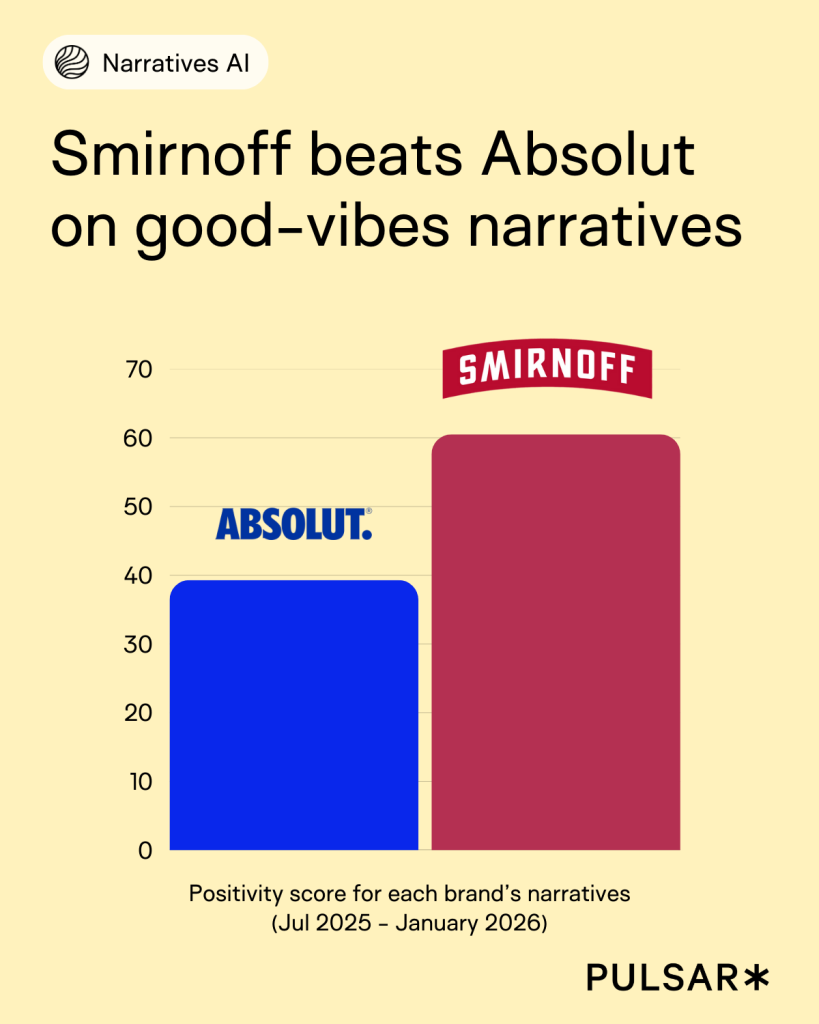
That gap is built through accumulation rather than dominance. Smirnoff gathers strength across high-volume, socially functional dimensions such as occasion, price, culture, and flavor. Absolut’s advantage is narrower and more concentrated, with its strongest signal coming through perceptions of quality.
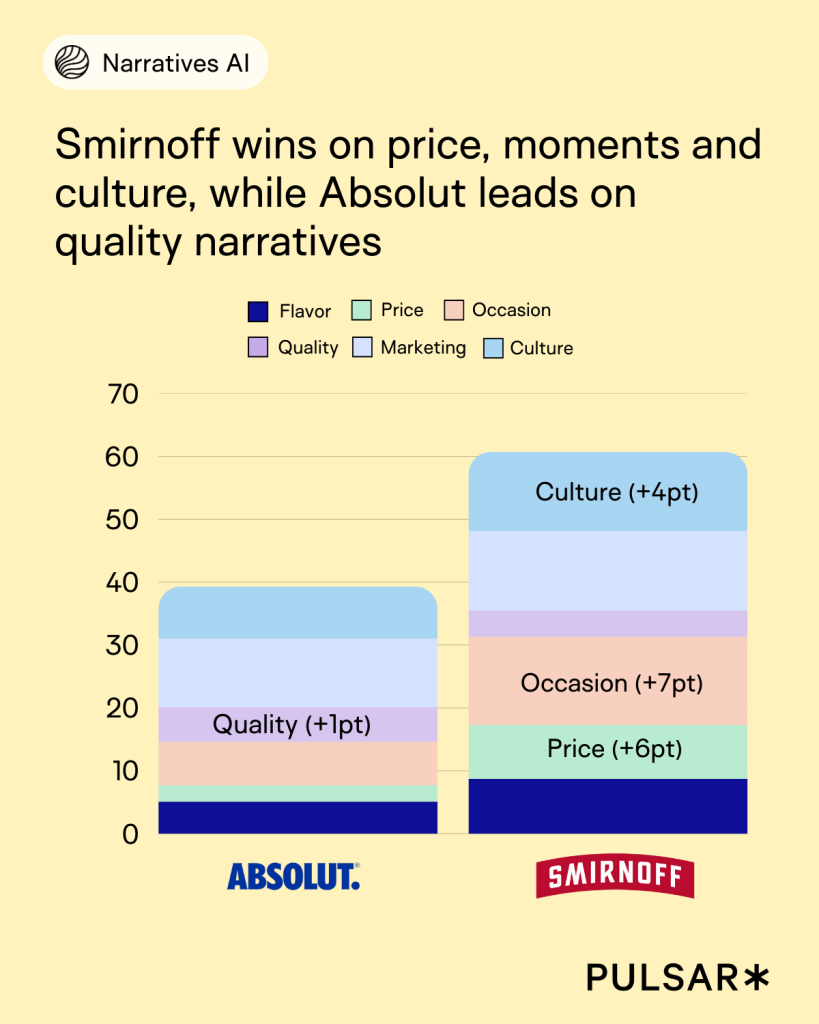
In vodka, that difference shapes how brands move through real social situations. Smirnoff benefits from being widely acceptable, quickly agreed upon, and easy to introduce into shared moments. Absolut tends to enter later in the decision process, when taste, aesthetics, or intention are already guiding the choice. One brand travels easily across group dynamics, while the other performs best once a moment has already been defined. Let's dig deeper further into some dimensions.
Occasion is doing the heaviest lifting
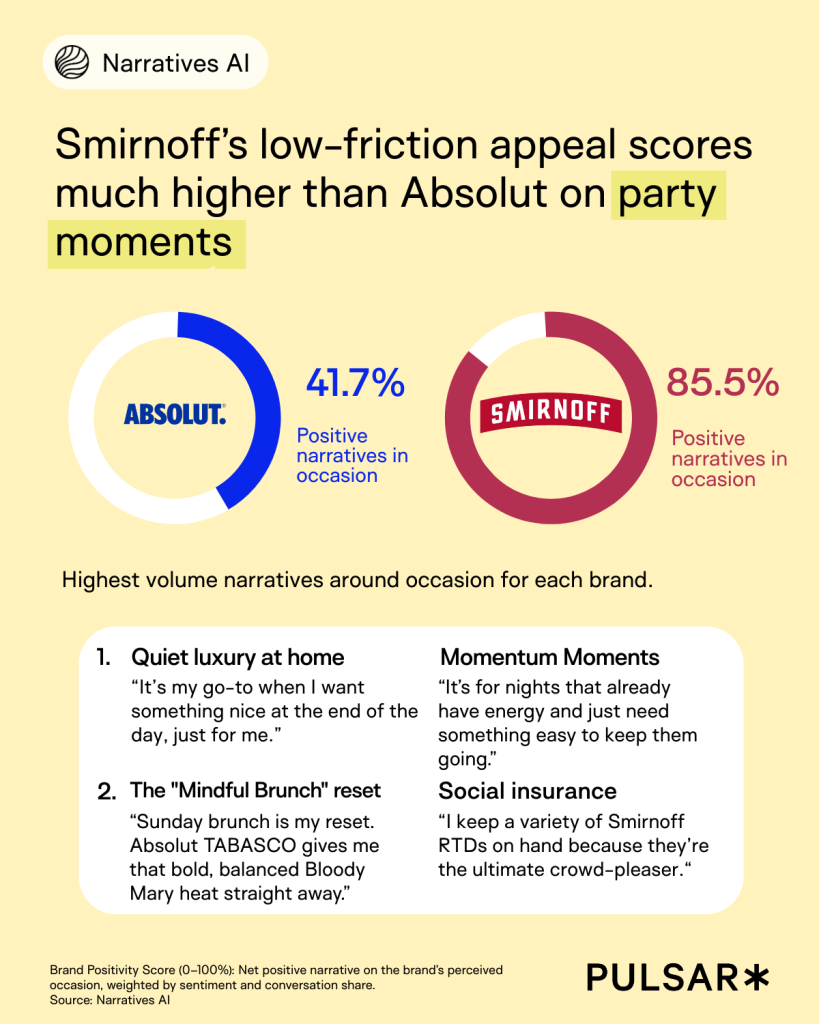
The strongest driver of Smirnoff’s narrative advantage is occasion. Smirnoff is repeatedly framed as low-friction social glue — the bottle that shows up when energy is already high and decisions need to be simple.
RTD (ready-to-drink) formats play a central role here. They turn Smirnoff into a form of social insurance: something you bring when you want momentum without negotiation. Festival bags. Pre-drinks. House parties. Group chats that end with “just grab whatever.” Taste, effort, and price fade into the background.
Absolut’s occasion narratives look very different. They lean toward more intentional, moment-specific use: quiet evenings at home, a planned brunch, drinking framed as a small, chosen ritual rather than a shared default. When Absolut enters the conversation, it tends to do so through clearly defined moments rather than continuous presence.
View this post on Instagram
The Absolut Tabasco launch illustrates this well, triggering the single largest one-day social spike of the year (+1,292%) and underscoring how the brand performs best when it creates a distinct occasion that people actively opt into.
Culture tells the deeper story
Culture sharpens the contrast even further. Smirnoff’s cultural narratives are driven by scale and circulation. The brand appears in festivals, music clips, meme formats, and youth-coded absurdity where speed and shareability matter more than refinement.
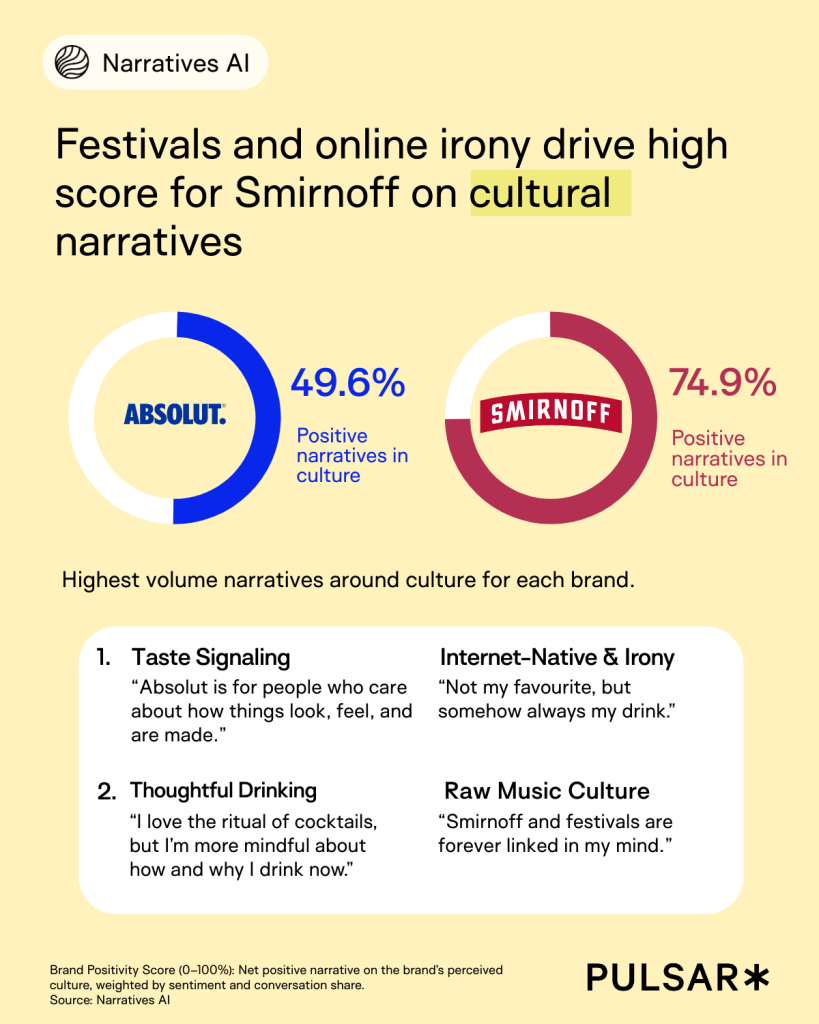
It shows up inside fast-moving cultural loops that thrive on participation rather than authorship: reposts, inside jokes, low-effort visuals, and moments designed to be passed along rather than preserved. In these spaces, Smirnoff functions less as a statement and more as a social signal that keeps things light, accessible, and collective.
Girl on club dancefloor has her feet cooled by a friend pouring smirnoff ice on them (2000) pic.twitter.com/TfLZ7PBP7a
— Beni 🧠 (@benixbt) January 23, 2026
Absolut’s cultural presence operates on a different logic. It leans into taste-making, aesthetics, and intention, often appearing in more authored contexts where visual identity, design, and creative control are foregrounded. The conversation around Absolut carries a stronger sense of deliberateness: people talk about it as much as they talk with it. This gives the brand cultural depth and credibility, but within limited audience networks.
In narrative terms, Smirnoff feels participatory and frictionless. Absolut feels curated and expressive. The contrast reflects a broader shift in contemporary drinking culture, where social value increasingly comes from low-effort, low-ego participation rather than performative taste. Smirnoff benefits from this shift by aligning with how people want to show up together now, while Absolut continues to resonate most strongly when drinking is framed as a considered, authored choice.
Who is shaping the stories?
Audience structure helps explain why these narratives diverge so clearly.
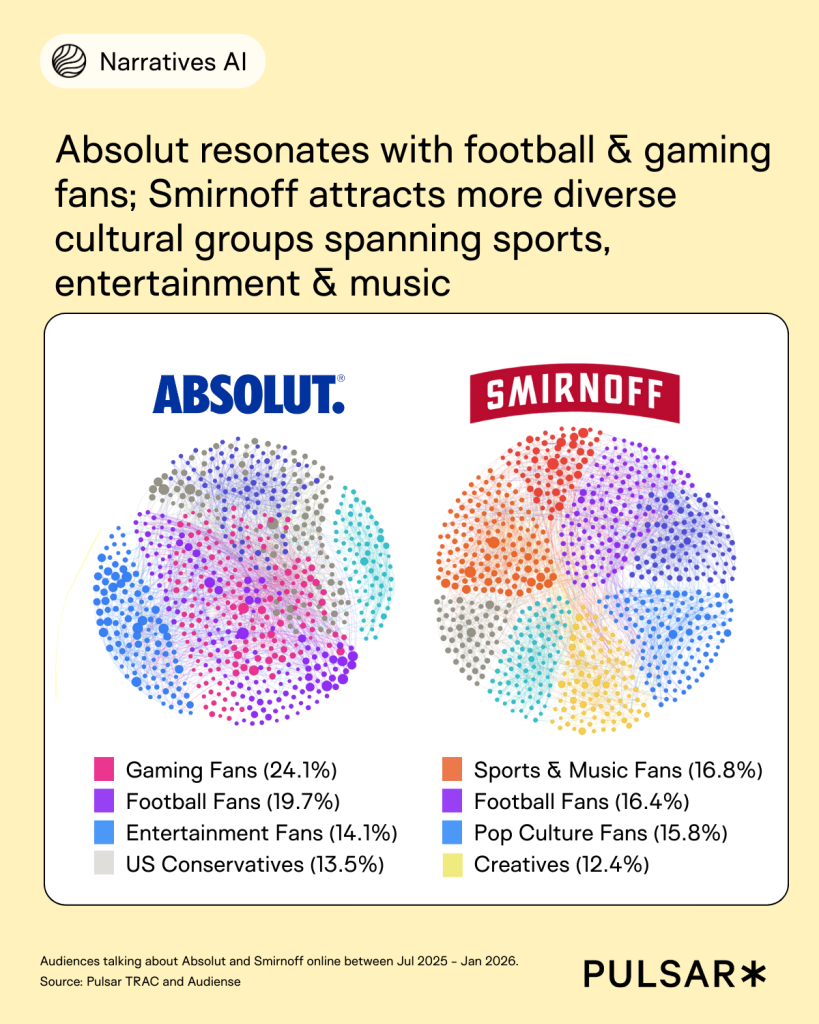
Smirnoff’s conversation is carried by a wide, overlapping mix of cultural groups. Sports fans, music audiences, nightlife communities, and youth-led entertainment spaces all contribute to its presence, creating a dense web of cultural crossover. Its audience skews younger and more gender-diverse, particularly within the 18–34 range, which allows the brand to circulate easily across social contexts rather than anchoring to a single identity. Smirnoff benefits from scale, but more importantly from cultural adjacency: it shows up wherever people already are.
Absolut’s audience is narrower and more defined. A significant share of its conversation comes from gaming and football communities, particularly among millennial men.
@l.priv.1k Ch2 s2 where did u go😭#fyp #foryou #chapter2season2 #ogfortnite #latenightfinds ♬ original sound - jonas
Within these spaces, the brand carries strong resonance and recognition, often tied to taste, ritual, and brand perception. However, this concentration also limits how far Absolut travels across broader cultural circuits. Its narratives deepen within specific communities, rather than spreading horizontally across many.
Smirnoff’s audience mix enables frequency and familiarity across everyday moments. Absolut’s audience mix favors depth, where meaning accumulates through fewer, more intentional touchpoints.
What this means for brands
In a category as mature as vodka, growth rarely comes from novelty alone. Leadership is shaped less by claims of superiority and more by which brands feel culturally present when people gather, celebrate, and make choices together. It comes from fitting effortlessly into moments that already matter. And that is where the gap between Absolut and Smirnoff is becoming increasingly hard to ignore.
Neither position is wrong. But they do not compete on equal footing.
As vodka continues its quiet comeback, the brands that pull ahead will be those that understand how people want to feel together, not just what they want to drink. Narratives AI shows where those stories are forming. Pulsar TRAC reveals who is carrying them. Together, they explain why some brands feel inevitable when the moment arrives, while others remain optional.
To stay up to date with our latest insights and releases, sign up to our newsletter below:
This article was created using data from TRAC