How social listening can track influencer partnership performance and transform influencer identification
Use Case guide contents
The influence economy has become one of the core engines of modern marketing. With the sector bringing in billions projected to expand to $48 million dollars by 2027, brands are increasingly recognizing its proven effectiveness. Leveraging personality and loyal audiences, brands can typically expect to achieve a consistent and reliable ROI for every dollar spent on influencer campaigns. But with rapid growth has come complexity: the market is saturated, audiences are fragmented, and traditional ways of identifying and tracking influencers simply don’t cut it anymore.
For mid-to-senior marketers and strategists, the challenge is clear: scaling authenticity at pace. Vanity metrics like follower count or impressions might once have been enough, but today they’re an unreliable compass. The real value of influence lies in trust and relevance. Audiences are shifting towards creators they see as relatable experts, signalling a broader move from entertainment to education, from broadcast to conversation.
In this landscape, brands need more than surface-level demographics. They need the ability to analyse audience consumption behaviours and insights from social data across the digital spectrum - from Twitch streams to X threads, private forums to Google searches. This is where social listening for influencer identification and tracking influencer partnership performance becomes non-negotiable: it transforms influence from guesswork into a data-driven strategy rooted in cultural intelligence.
Strategic application: using audience intelligence to optimise influencer partnerships
Social listening provides the strategic foundation necessary to vet, select, and measure influencer partners against concrete business objectives, rather than subjective popularity.
Deep audience alignment that makes sense for your brand
Successful influencer partnerships are not built on shared category affiliation but on shared behavioral signals and deep audience affinity. Utilizing social listening to verify the genuine overlap between a brand's target consumer and an influencer's community is paramount to ensuring the value for money of the investment. We dove into a unique brand partnership between Whoop and Huberman Lab.
When the digital health-tech wearable company Whoop sought partnerships, initial audience analysis might have flagged surface differences: Whoop’s audience included affinities for golf and gaming, while the Huberman Lab podcast audience leaned toward science and finance. However, a deeper analysis using Pulsar TRAC’s cross-comparison tools revealed that key metrics - age, gender, location, and interests - matched nearly perfectly.
The analysis showed that over 60% of sub-audience intersections exhibited moderate or high similarity, with six being highly similar. Critically, a 38% match between the influencers reaching both communities was observed, an impressive correlation given the scale of accounts on social platforms. This precision demonstrated that behavioral affinity (the desire for biohacking, optimization, and productivity) was a stronger predictor of conversion than a superficial product match. Whoop identified the opportunity to align its specialized product with the powerful lifestyle Huberman expounds, cultivated through his scientific reputation and deep trust among his listeners. Social data proved that the partnership secured a direct channel to an audience already predisposed to the philosophy underpinning the product.
Why superficial data can be a liability
Traditional demographic data - follower count, age, gender, and location - provides only a superficial understanding of a consumer base. Digital communities are no longer defined by fixed attributes but by shared interests, values, and behavioral signals. Without segmenting audiences based on their affinity and interest profile, marketers are unable to predict behavior accurately and risk misaligned campaigns.
This deficiency is amplified by the accelerating pace of culture. New trends break out every day, requiring marketers to anticipate cultural diffusion rather than react to established trends. When relying on manual trend identification, brands are perpetually late. Advanced platforms like Pulsar Narratives offer AI-driven trend detection that helps users move on consumer trends early and can rank and predict each trend's growth potential. This capability is critical because it transforms the marketer from a trend follower into a trend investor, ensuring genuine first-mover advantage and maximizing the cultural relevance of any influencer partnership before the market becomes saturated.
Finding the right influencers for your brand
Influencer partnerships in esports are high stakes: audiences are vast, fragmented, and highly sceptical of inauthentic activations. For esports hub BLAST, success depended on knowing not just which creators have reach, but which ones carry weight within specific communities. We spoke to BLAST about how they use Pulsar - they gave us an insight into how to use social listening for influencer partnerships.
In esports, influence doesn’t sit neatly with a single “star player” or organisation. It lives in the network of players, coaches, analysts, teams, streamers, and fans who make the ecosystem thrive. For BLAST, one of the world’s leading esports tournament organisers, this complexity made influencer identification a central challenge. Success depended on knowing which voices authentically carried weight in a fast-moving culture, and which ones could amplify BLAST’s tournaments to new audiences.
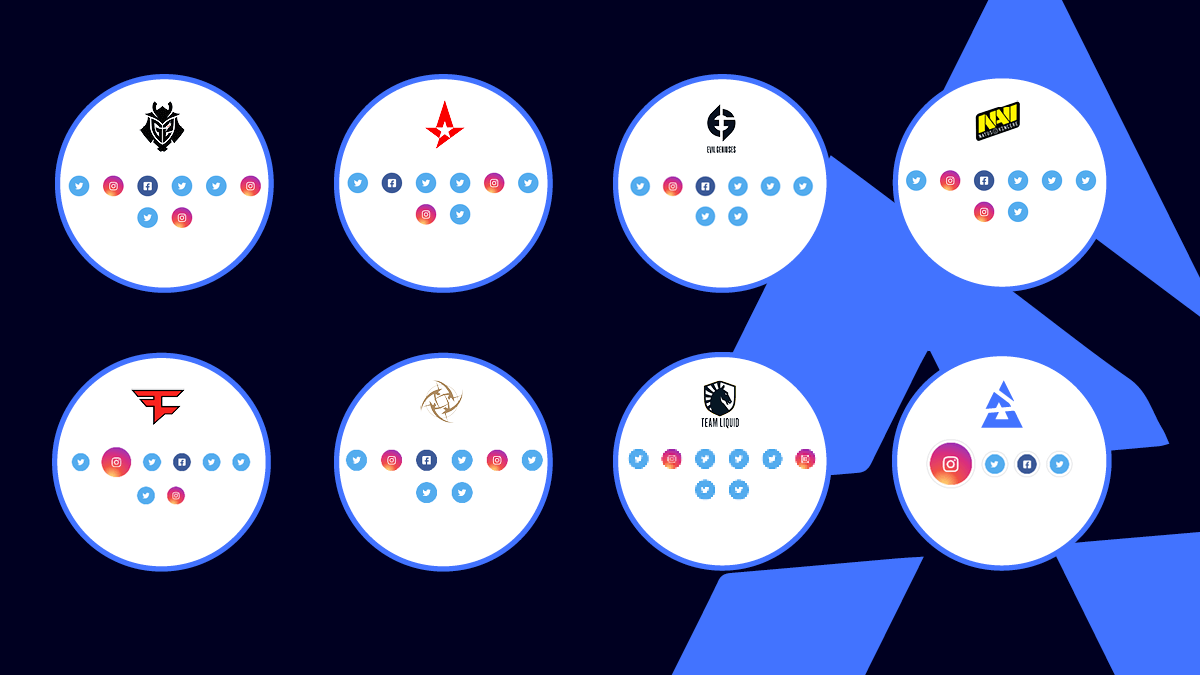
By using Pulsar TRAC to monitor tournament conversations across Twitter, Instagram, Twitch and more, BLAST sees not just who mentions them, but who actually shapes engagement and sentiment. Tracking the activity of 12 partner teams - including players and coaches - highlights how often they talk about BLAST, how much traction that content generates, and the impact it has on brand equity.
This is the level of depth brands need for influencer identification. Marketers can uncover the creators who drive conversation in specific communities. In BLAST’s case, some of the most valuable influencers aren’t the ones with the largest audiences, but the ones fans turn to for humour, commentary, or trusted insight. Social listening reveals those cultural carriers - the people who extend credibility, not just visibility.
Mapping these flows also shows how influence travels. A meme or highlight might originate from a player’s post, spread through a team account, and break into mainstream coverage. By following that path, brands can pinpoint the creators who are central to narrative spread, rather than those who simply repeat it.
For marketers, the benefits are twofold:
- Smarter partnerships. By proving which influencers genuinely move the needle, brands can prioritise budget towards creators with cultural capital, rather than wasting spend on inflated reach.
- Stronger propositions. Data-backed influencer maps make for better pitches to commercial partners, showing exactly how influencer activity expands reach and ROI.
- Future-proofing. With audiences shifting constantly, always-on listening ensures brands stay aligned with the voices that matter now, and can spot tomorrow’s rising talent early.
What BLAST demonstrates is that social listening transforms influencer identification from guesswork into strategy. For any brand operating in fast-moving cultural spaces - whether esports, fashion, beauty, or consumer tech - this approach is what keeps influencer marketing authentic, efficient, and impactful.
Calculated bets: maximising ROI in partnerships
Measuring ROI in influencer marketing must evolve beyond impression counts to the effective validation of strategic goals and the proven activation of specific consumer segments.
Barilla’s objective in sports sponsorship was to reposition pasta, which is often associated with unhealthy diets, by linking the brand to health and activity. We researched Barilla’s investment in tennis star Coco Gauff, signed when she was just 14, which was a long-term, calculated bet that paid off massively.
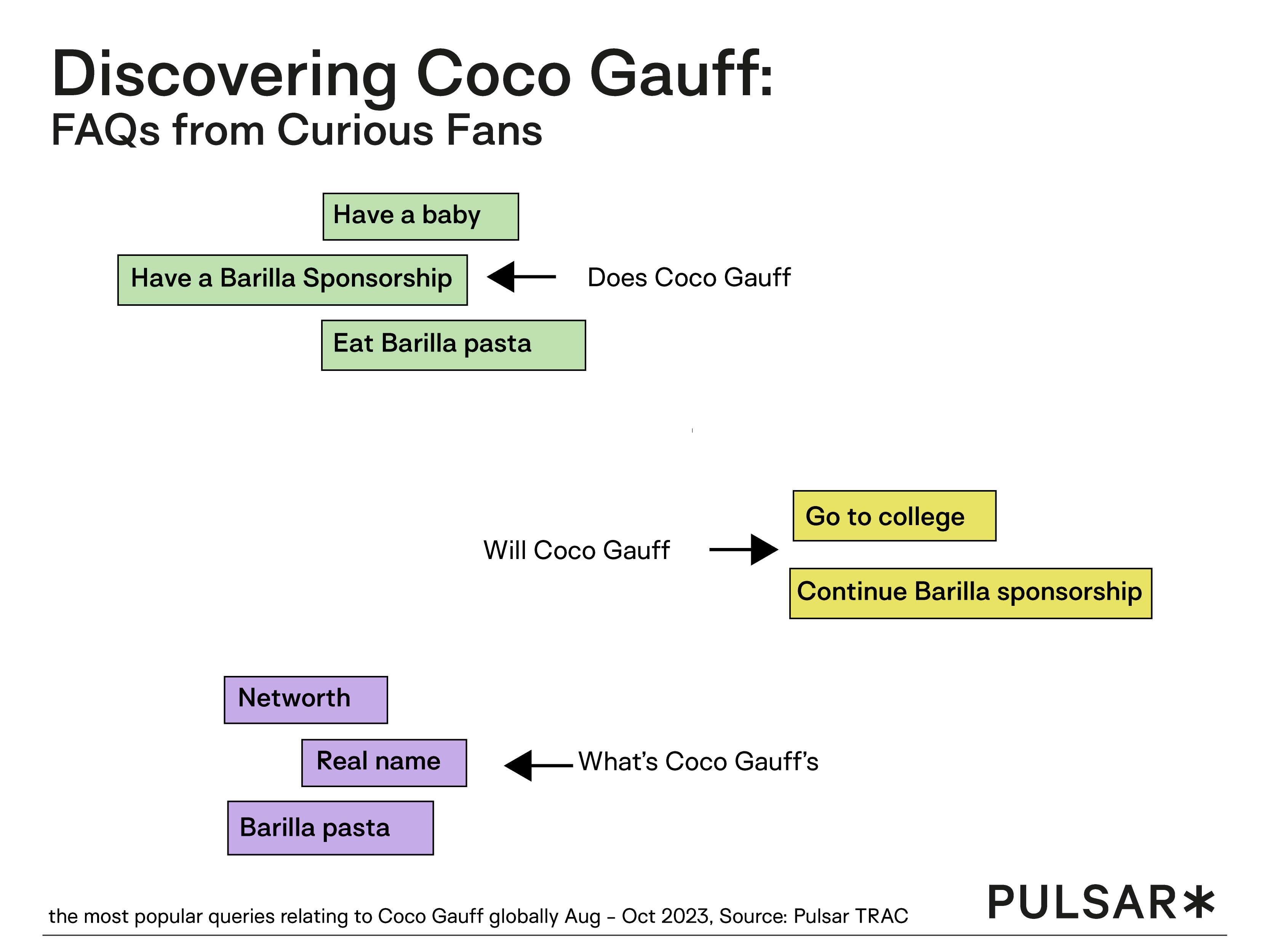
Using social listening through Pulsar TRAC, we can validate and prove the efficacy of this bet from the outset, with increased ROI streaming in following Gauff’s US Open victory. The analysis confirmed that Gauff’s audience displayed strong affinities for sport, for health, for family, and for inspirational women, aligning perfectly with Barilla’s desired positioning. The data went deeper, revealing the audience’s intimate story through search data - showing curiosity about her net worth, college plans, and family views. Quantifying this personal connection confirms the emotional resonance necessary for authentic endorsement, guaranteeing trust that cannot be fabricated through paid advertising.
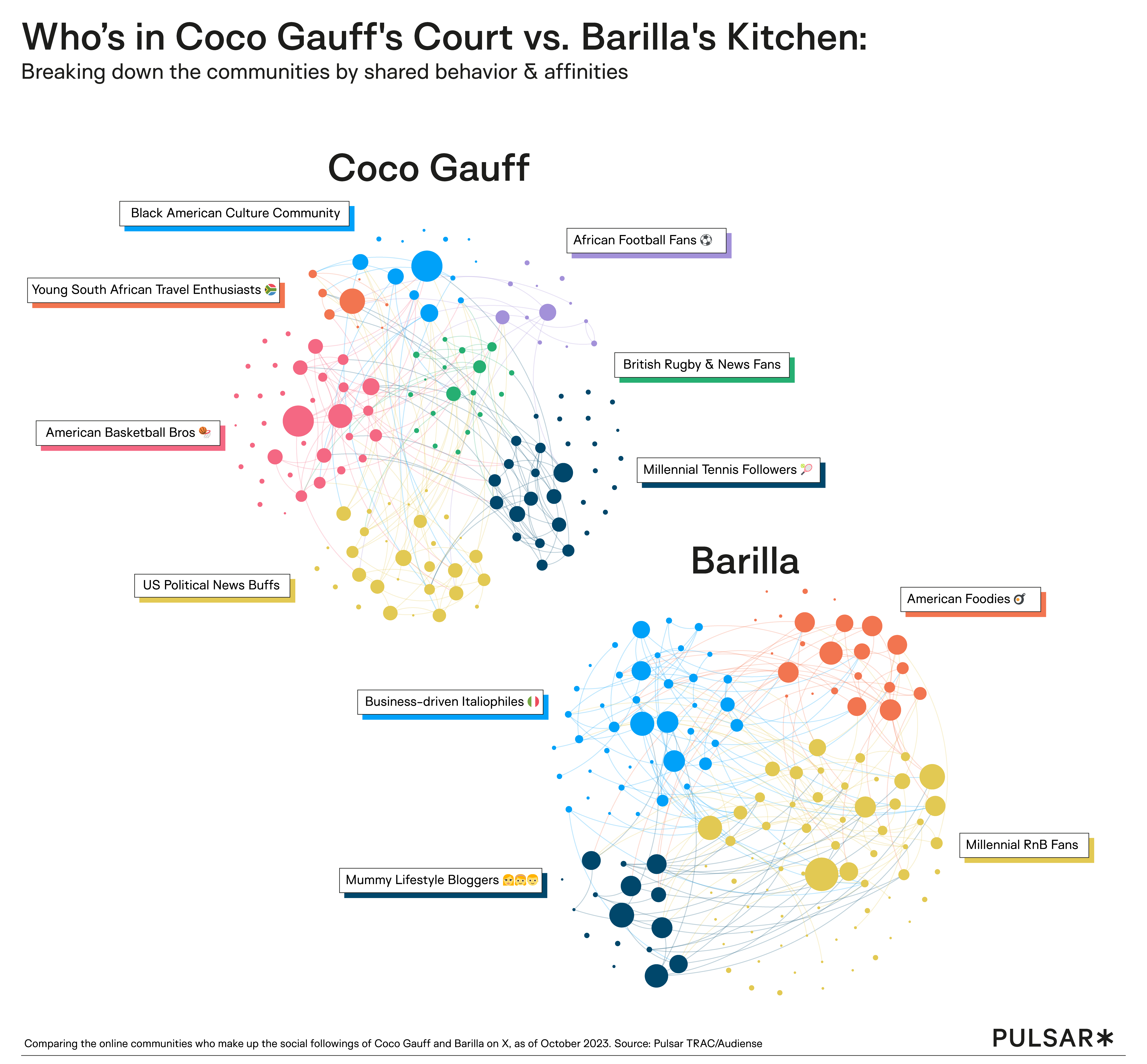
Furthermore, the analysis demonstrated concrete tactical value by showing the partnership activated specific segments within Barilla’s existing fanbase, including "Business-driven Italiophiles" and "Millennial RnB fans". By linking campaign engagement with these specific community activations, the strategic value of the investment was unequivocally validated. Brands further utilize Pulsar CORE to track the influencer’s content performance - benchmarking their visibility, engagement rate, and micro-engagements against competitors and their own owned channels. This tracking capability allows marketers to connect social campaign performance directly to website visits via Google Analytics.
Brand competition & cultural agility: mapping the battlefield
A critical function of social listening is enabling brands to identify untapped, high-potential communities and micro-influencers by analyzing the audiences of competitors and cultural leaders. This provides the competitive whitespace necessary for efficient marketing spend.
The Sidemen collective commands a devoted, predominantly male, Gen Z fandom built on powerful parasocial relationships. We researched The Sidemen’s cultural sway and the communities that follow them. For competing brands, direct engagement is often cost-prohibitive and risky. The optimal strategy is to use this cultural hub as a type of jumping off point for your brand, by embedding yourself in the Sidemen universe.
A brand can employ Pulsar TRAC and Pulsar Narratives AI to deconstruct the audience of the Sidemen’s "Superfans" and "Sunday Sidefans". This involves isolating the other affinities outside of themselves - specific sports, complementary clothing brands, or technology - that the Sidemen themselves do not yet sponsor. Pulsar Narratives AI helps in cultural trend tracking for influencer identification and tracking influencer partnership performance by surfacing all niche trends in relevant categories (e.g., gaming, fast food) using industry-specific AI that combs through billions of data points globally.
Once these adjacent interests are identified, the brand can pinpoint the micro-influencers who speak directly to these newly discovered, lower-saturation communities. The Sidemen’s fans feel proud to buy their products, viewing it as sharing in the group’s success. A sophisticated competitive strategy analyzes the components of this parasocial trust (authenticity, aspiration) and identifies micro-influencers who can reproduce that trusted dynamic in a smaller, lower-cost niche. This analysis allows the brand to secure high conversion rates without the massive investment required to engage the core Sidemen entity directly.
Similarly, in competitive environments like esports, organizations such as BLAST must continuously track how high-profile public channels, including competitors and partners, are performing using Pulsar CORE to ensure their partnerships maximize reach and engagement in a volatile market. This constant benchmarking validates that the identified influencers are driving competitive performance.
Risk mitigation and brand safety: navigating exposure to conversation
Social listening is the ultimate insurance policy, identifying hidden conversational risks and highly localized toxicity before they manifest as brand crises.
The Momfluencer category, which we conducted a study into, was once an easy shortcut to reach maternal audiences - but it has since become a significant liability, with over 107,000 mentions analyzed revealing widespread scrutiny. The dominant narrative risk revolves around the welfare and exploitation of children, signaled by conversational clusters and hashtags like #kidsarenotcontent. This liability is severe for family-focused brands.
The critical danger is that toxicity is often highly localized and intense. Analysis shows that 15% of the conversation is dedicated to 'snarking' (intense criticism), often concentrated in subreddits like r/parentsnark, which had over 18,000 posts and 16,000 members dedicated to criticizing parent influencers. This targeted, niche hatred poses a bullying risk and highlights deep dissatisfaction. We can analyse each individual sub-audience and forum board to find exactly where these danger zones lie.
This case demonstrates that brand risk rarely begins with a viral public outcry; it brews in niche, deeply engaged, critical communities. Standard social monitoring often misses this localized toxicity. Therefore, social listening like Pulsar that covers the "dark social" sphere on niche forums and the dark web and provides deep audience segmentation on popular platforms serves as a crucial early warning system. Brands must use Pulsar TRAC to map these high-risk communities and utilize AI models for misinfo detection and sentiment analysis. Similarly, Pulsar’s NewsGuard integration can provide warning signs for misinformation exposure related to influencers and partners. Marketing and legal teams must be fully aware of the dangers of intervening in a space that they don’t entirely understand, minimizing exposure to potential high-profile crises like the Ruby Franke case.
The right tools: how can Pulsar help with your influencer marketing?
An effective influencer strategy relies on three intelligence functions working together. Pulsar integrates them into a single workflow, giving brands the visibility they need to choose the right partners and prove performance:
- Audience Intelligence with Pulsar TRAC
Identify the communities that matter most. TRAC lets you segment audiences in real time, showing how different groups talk about the same topic in different ways — essential for matching creators with the audiences you want to reach. - Narrative Mapping with Pulsar Narratives AI
Spot the stories shaping influence. Narratives AI analyses billions of posts, videos, and articles to detect and rank emerging conversations, surfacing the cultural drivers behind audience behaviour. - Performance Tracking with Pulsar CORE
Measure the impact of every partnership. CORE benchmarks your content against competitors and peers, while tracking the results of influencer activity across your owned channels.
Together, these capabilities give marketers the depth of insight needed to scale authenticity, cut inefficiency, and deliver ROI from influencer partnerships.
The strategic value matrix: influencer marketing goals and social data solutions
| Strategic Goal | Challenge | Social Listening Solution (Pulsar TRAC/Narratives/CORE) | Key Business Outcome |
| Deep audience fit & affinity | Relying on demographics leads to misaligned messaging and low conversion. | Pulsar TRAC Audience Segmentation identifies shared behavioral signals, interests, and sub-communities. | Partnership longevity, optimized content tailoring, and authentic credibility. |
| Value for money (ROI) | Measuring only vanity metrics (likes, follower growth) masks true engagement and impact. | Pulsar CORE tracks influencer performance against owned channels, benchmarking real reach and engagement rates. Validates investments against audience activation goals. | Measurable conversion pathways, optimized media spend, and validation of long-term strategic bets. |
| Brand competition & agility | Chasing trends after they peak or missing early adopter communities. | Pulsar Narratives AI surfaces, ranks, and predicts trend potential, identifying which communities are driving diffusion. Pulsar CORE benchmarks competitor influence. | First-mover advantage, culturally relevant campaign timing, and identification of competitive whitespace. |
| Risk mitigation & brand safety | Blind spots regarding potential controversies or niche 'snarking' communities. | Pulsar TRAC detects localized, high-risk conversations and deploys AI models for misinfo and sentiment analysis. | Protection of brand reputation, proactive crisis management, and liability reduction. |
Frameworks and Practical Steps: The Listen–Map–Activate Blueprint
Influencer identification and performance tracking can feel messy: thousands of creators, fragmented audiences, and cultural trends that move at speed. To cut through that complexity, brands need a clear framework. This process moves through three critical phases - Listen, Map, and Activate - to ensure that partnerships are both culturally relevant and performance-driven.
Phase 1: Listen — find the signals that matter
Every influencer strategy begins with listening. This is where brands swap guesswork for data, building a 360° view of the cultural landscape they want to enter.
- Track the conversation universe. Using Pulsar TRAC, marketers can see the full spread of public conversation — from social threads and Twitch streams to online news and search data. This shows not just what’s being said, but where and by whom.
- Detect emerging narratives. With Pulsar Narratives AI, brands identify the specific storylines that are shaping opinions — whether that’s a growing mistrust of momfluencers, or the rise of creators positioning themselves as educators rather than entertainers.
- Segment the drivers. TRAC also reveals which audience communities are driving those narratives, and how they differ in their behaviours. This makes it clear whether a trend is relevant to your consumer base or just noise elsewhere.
The output of the Listen phase is a clear map of which narratives matter and which audiences are fuelling them - the foundations for choosing the right partners.
Phase 2: Map — chart the influence network
Once the audience landscape is defined, the next step is mapping the pathways of influence. This is about turning raw intelligence into a strategy for who to work with and why.
- Visualise the ecosystem. Influence doesn’t move in straight lines. With TRAC, brands can see the clusters of creators and communities that amplify each other — from macro “hubs” with mass visibility to micro-influencers with deep trust in niche forums.
- Measure overlap and affinity. TRAC’s affinity analysis shows where a prospective influencer’s audience intersects with your own, or with target segments. This is how brands like Whoop validate that partnering with Huberman wasn’t just high-profile, but highly relevant.
- Assess risk. Every ecosystem has its fault lines. TRAC can identify negative clusters — such as anti-influencer or anti-brand communities — and flag creators who sit too close to those risky areas.
The Map phase delivers a ranked shortlist of influencers, validated by their audience overlap, network position, and risk profile. In BLAST’s case, this meant identifying not only the biggest esports names, but also the analysts and team members whose content consistently spread tournament narratives to new communities.
Phase 3: Activate — launch, track, and adapt
The final stage is execution, supported by an always-on feedback loop.
- Tailor the activation. Insights from Listen and Map guide campaign design — shaping content that feels authentic to each influencer’s audience, whether that’s a macro Instagram audience or a niche gaming subreddit.
- Track performance in real time. With Pulsar CORE, brands measure how influencer content lands across owned and partner channels. CORE benchmarks engagement, reach, and visibility against competitors, so marketers see instantly what’s resonating and what isn’t.
- Optimise the loop. If a narrative shifts, or ROI dips, the cycle begins again. CORE surfaces underperforming assets, while Narratives and TRAC highlight whether the cultural conversation has moved on or a new audience driver has emerged. Brands can then adapt campaigns within hours, not months.
The outcome of the Activate phase is not a one-off campaign, but a living strategy — one that evolves as fast as audiences do.
The Listen–Map–Activate Framework in Practice
| Framework phase | Objective | Required Insight | Pulsar Tool |
| Listen | Identify the cultural landscape, needs, and emerging trends. | Unfiltered audience signals, main topics, and key narratives in a sector. | Pulsar TRAC & Pulsar Narratives AI |
| Map | Chart the influence pathways, segment relevant communities, and identify optimal partners. | Influencer ecosystems, audience overlap (affinities), behavioral profiles, and potential risk zones. | Pulsar TRAC & Pulsar CORE |
| Activate | Execute the campaign, measure effectiveness, and optimize in real-time. | Real-time engagement rate, best-performing assets, community reception, and content suggestions. | Pulsar CORE & Pulsar TRAC |
Key takeaways: how social listening powers influencer identification and ROI
Influencer marketing is no longer about reach for reach’s sake. The brands that get it right are those that can evidence genuine behavioural connection, proving that the communities they want to reach and the creators they partner with truly overlap. Social listening is what makes that possible.
By integrating advanced social listening, organizations gain a competitive edge in several key areas. They future-proof partnerships by analyzing risks, such as localized toxicity and conversational hot zones, thus mitigating reputational crises and safeguarding brand safety. Furthermore, they maximize value for money by moving past vanity metrics to measure genuine audience activation and alignment with specific strategic goals.
With Pulsar TRAC, marketers can segment audiences in real time to understand who is driving conversations and which communities really matter. Pulsar Narratives AI tracks the cultural storylines that audiences care about, surfacing where those narratives begin and how they spread. And with Pulsar CORE, teams benchmark performance across owned and partner channels, making it clear which partnerships deliver value and which don’t.
The result is an influencer strategy that is authentic, efficient and future-proof. Social listening can go so much further than simply validating influencer choice - it helps brands maximise ROI, uncover competitive whitespace, mitigate reputational risks before they escalate and find the influencers that are the perfect vibe match for your brand.
2026 Outlook
Ready to transform your influencer identification with deep audience insight?
Explore the power of Pulsar TRAC, Pulsar CORE and Pulsar Narratives to start uncovering the insights that matter most. Our Pulsar newsletter for more expert guides and industry insights.
To learn more, sign up to our newsletter below: