
Walmart vs. Costco: Who is Winning the Big-Box Narrative Battle?
- FMCG

TL;DR
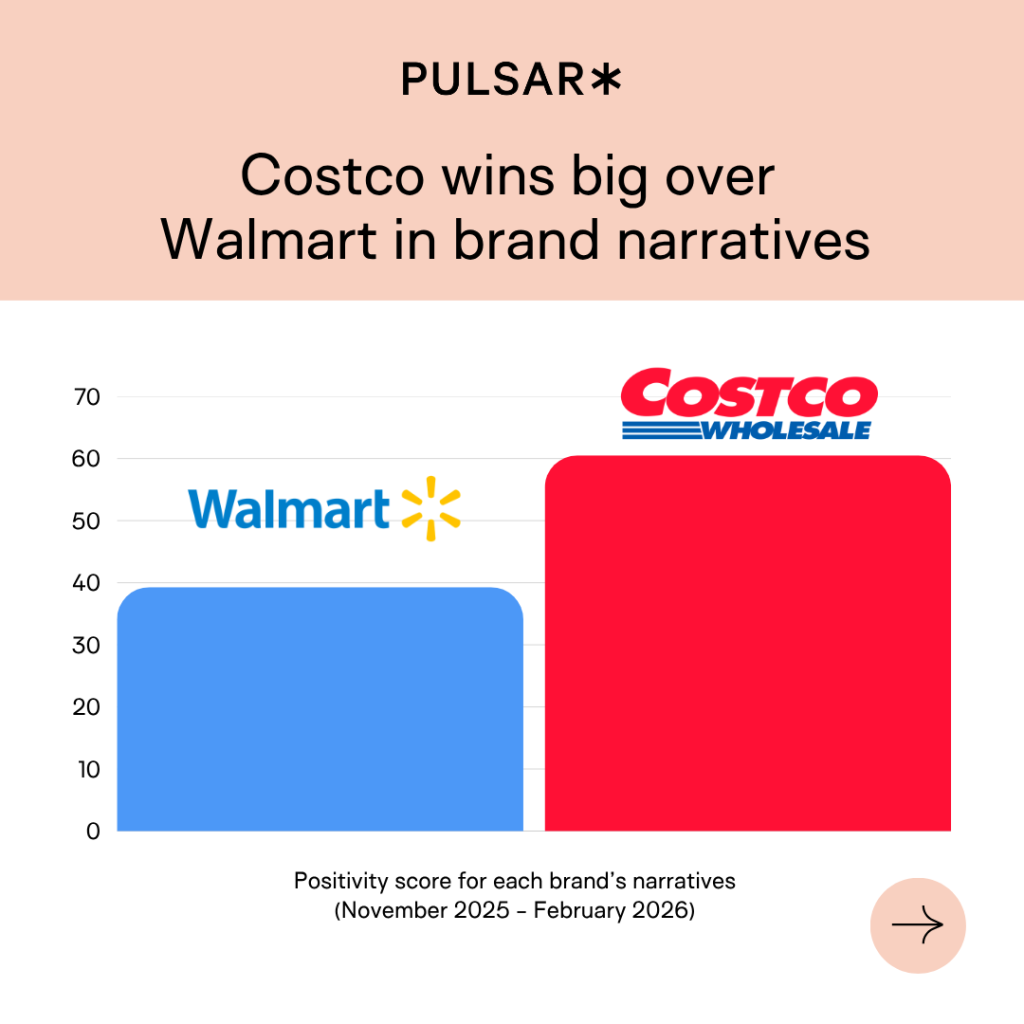
Pulsar's Narratives AI analysis of US public conversation (November 2025 to February 2026) found Costco leads Walmart in brand narrative by 22 points (61 vs 39 positivity score) across all six narrative dimensions — shopping experience, trust, value, product quality, culture, and marketing. The gap is largest in shopping experience (+6.3) and trust (+5.9), driven by Costco's community-first model and more politically insulated audience base.
The retail landscape has reached a fascinating crossroads. Since 2019, big box retailers have outpaced the S&P 500, now trading at premiums that rival major technology firms. And this is all taking place against a competitive landscape that's shifting. With Target struggling and Amazon continuing to dominate the digital doorstep, a more direct rivalry has intensified: Walmart versus Costco.
While Walmart ($680 billion in FY2025 revenue) and Costco ($275 billion) once operated under distinct philosophies of value, those lines are now blurring. With Walmart's Sam's Club aggressively expanding into membership, both brands are competing to become the default destination for everyday essentials.
Using Narratives AI, we analyzed public opinion between November 2025 and February 2026 to understand which brand is shaping the conversation.
Key Takeaways
- ▸Costco scores 61 vs Walmart's 39 in overall brand positivity — a 22-point gap described as rare in the US retail category.
- ▸Costco leads across all six narrative dimensions, with the largest advantages in shopping experience (+6.3) and trust (+5.9).
- ▸Costco's audience is structurally more resilient: distributed across lifestyle and financially minded communities, less exposed to partisan volatility.
- ▸Walmart's narrative is weighed down by recurring friction — stock issues, service inconsistency, and political flashpoints — that its scale cannot neutralise.
- ▸Brand perception in retail is increasingly shaped by experience and trust, not price or footprint alone.
In This Article
Costco Wins Big Over Walmart in Brand Narrative
Across Pulsar's analysis, Costco achieves a positivity score of 61 compared to Walmart's 39. A 22-point gap of this size is rare in the US retail category and signals a clear imbalance in perception.
This gap holds across all six narrative dimensions used in the analysis:
- Value and Pricing: cost perception, deals, bulk savings, price fairness and membership ROI
- Product and Quality: range, own label, fresh food, electronics, pharmacy and exclusives
- Shopping Experience: in-store journey, online experience, checkout, navigation and service
- Trust and Ethics: labour practices, wages, sourcing, sustainability and leadership
- Culture and Identity: who shops there, social meaning, community and brand belonging
- Marketing and Occasions: seasonal campaigns, key retail moments and visibility
How the Six Narrative Dimensions Compare
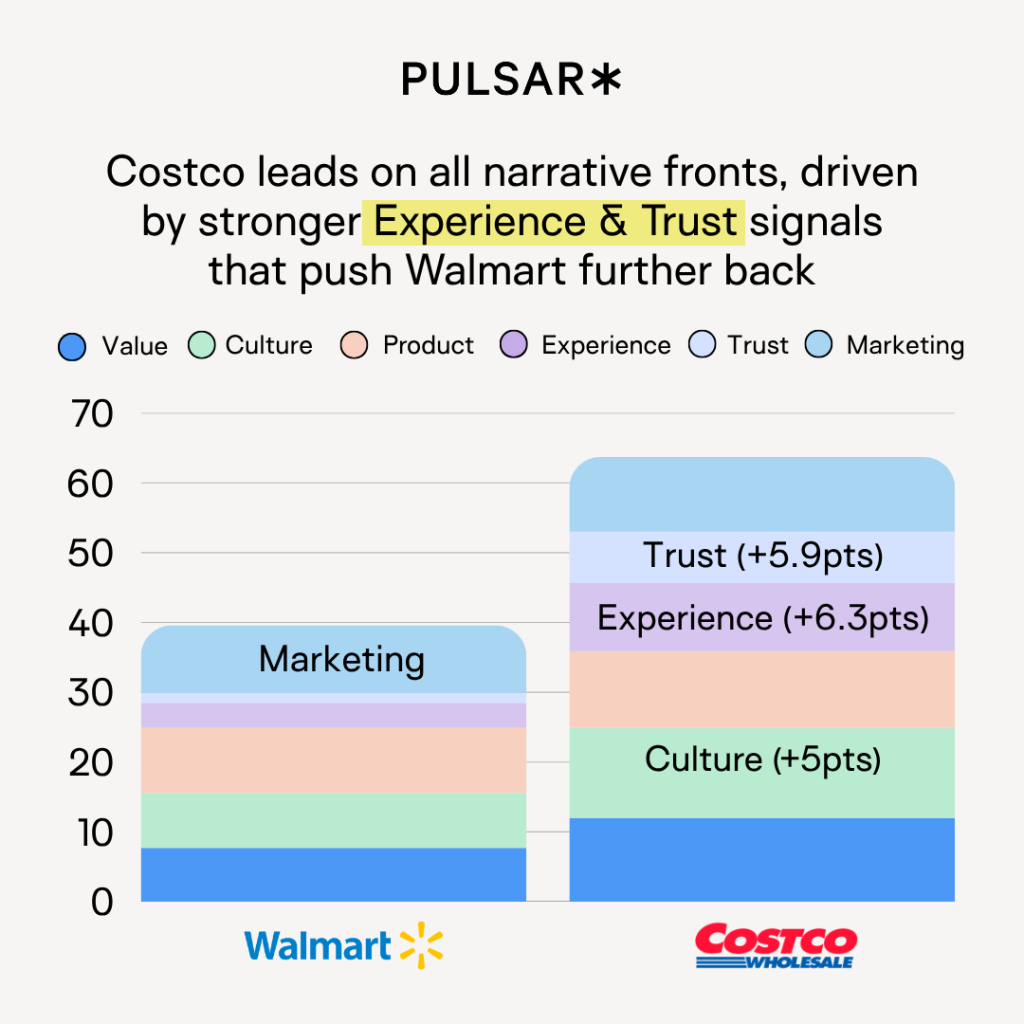
Costco leads across each dimension. The largest differences appear in shopping experience and trust, where it outperforms Walmart by +6.3 and +5.9 points, followed by a notable advantage in culture. These dimensions tend to have a significant impact on dynamics stores closely monitor, such as repeat behaviour and long-term preference. Walmart comes closest to its competitor in marketing, where its scale supports strong visibility.
| Narrative Dimension | Costco | Walmart | Costco Advantage |
|---|---|---|---|
| Shopping Experience | Higher | Lower | +6.3 pts |
| Trust and Ethics | Higher | Lower | +5.9 pts |
| Culture and Identity | Higher | Lower | Notable |
| Value and Pricing | Higher | Lower | Positive |
| Product and Quality | Higher | Lower | Positive |
| Marketing and Occasions | Higher | Closest gap | Smallest gap |
Community-Driven Experience Strengthens Costco
For all that these brands champion value and operational efficiency, it's something more intangible — culture — that reinforces Costco's relative strength. 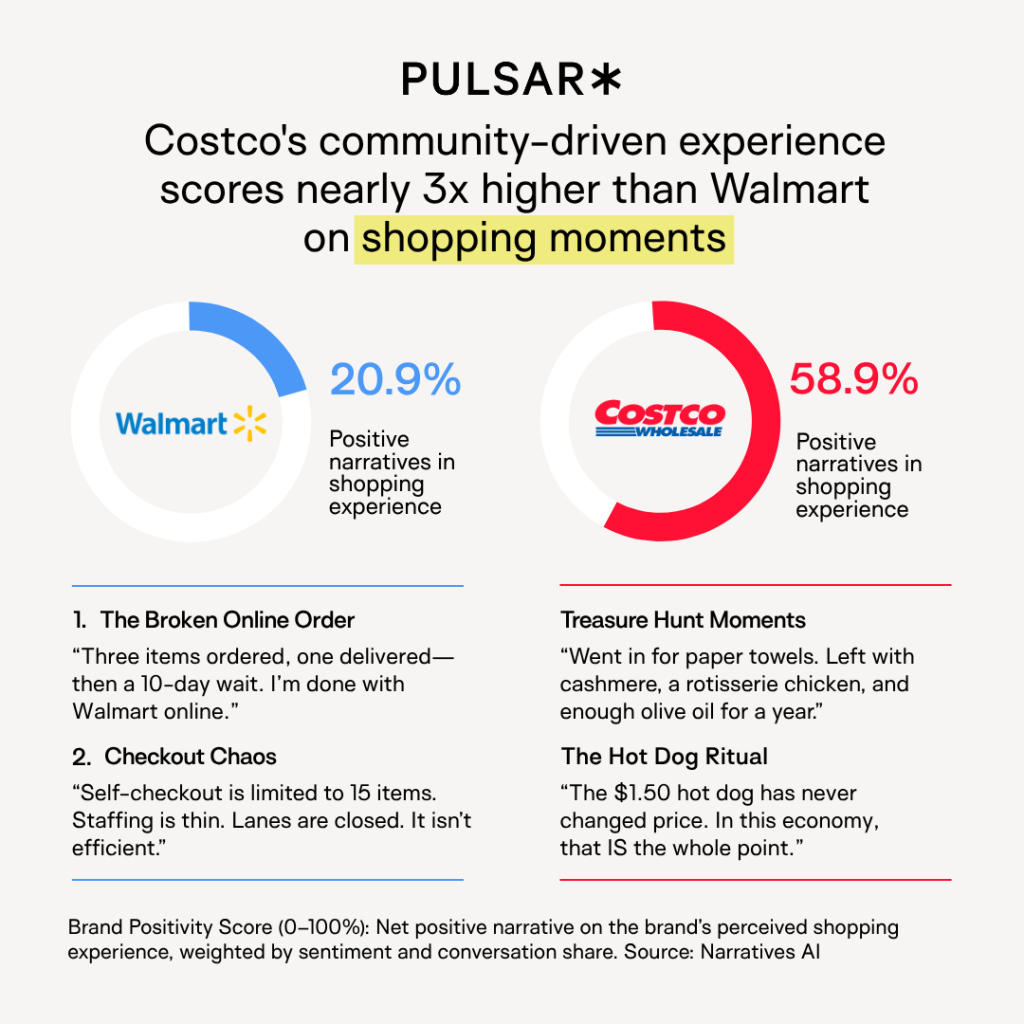
Costco has created an environment that feels predictable in a category often defined by friction. Its limited assortment and structured layout reduce complexity, making the shopping journey feel controlled and intentional. Over time, this consistency builds trust in the experience itself.
Costco leads across the board unsurprisingly, with Shopping Experience driving significantly more positivity. Its cult following and community-driven loyalty through treasure hunt discoveries, shared tips, and immersive rituals. Over time, this creates a quasi-third space, where participation strengthens membership and deepens engagement beyond bulk pricing alone.
View on Threads
This is especially evident in Costco's well-known $1.50 hot dog combo, which has become a cultural touchpoint in its own right. Even the CEO's participation in taste-test discussions and viral trends reinforces perceptions of trust, consistency, and community alignment, further strengthening Costco's brand experience.
it lowk be like that pic.twitter.com/G32K5s54WK
— p - baldrouin (@sidsmustache) April 7, 2026
Walmart's scale creates a different reality. Its experience is broader but less controlled, and the narrative reflects this. Despite Walmart's digital-first ambitions, conversations frequently return to points where the system breaks down, whether through stock issues or service inconsistency. Its experience narrative is weighed down by recurring stories of missing items and broken customer service. When some of these basics falter, the most visible consumer touchpoint becomes a source of frustration.
These moments carry weight because they sit at the most visible point of interaction with the brand.
Who's Driving the Narrative for Each Brand
Audience composition also helps put the contrast into focus.
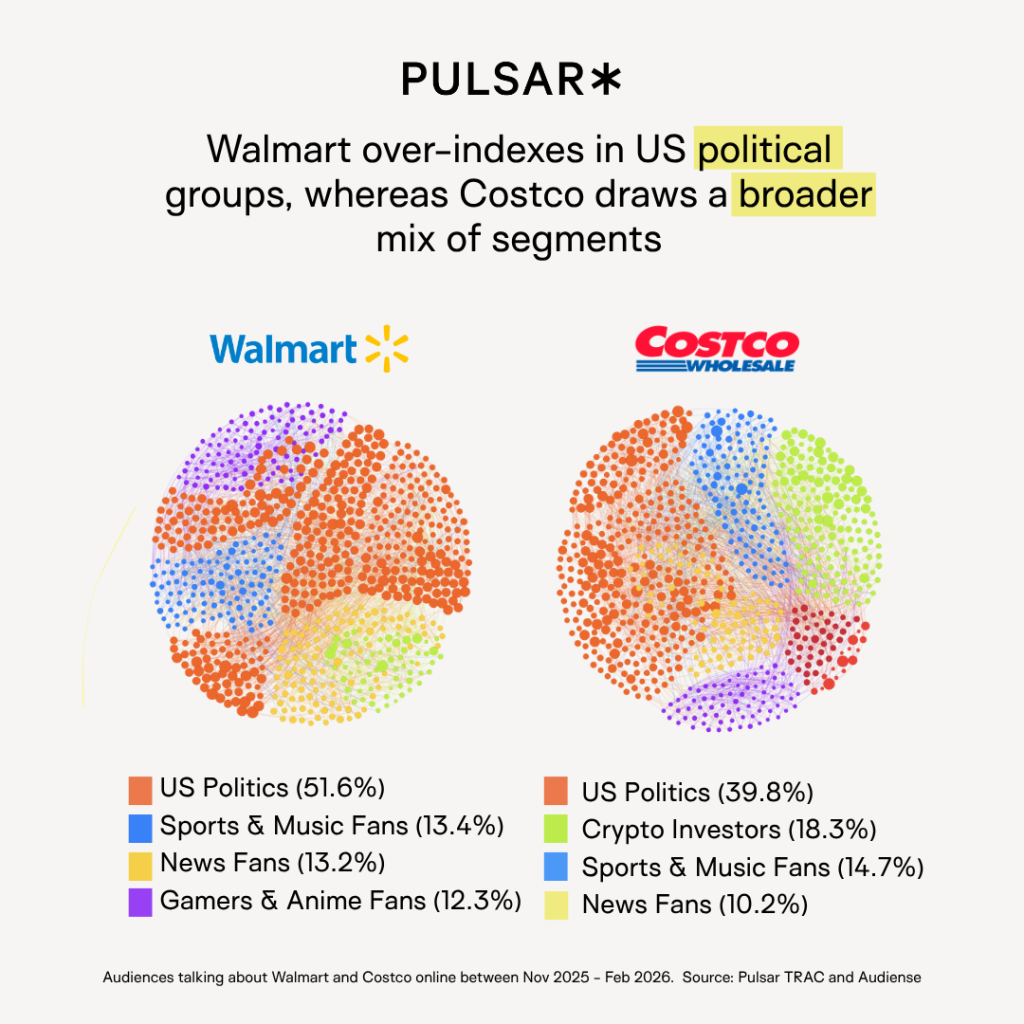
Walmart's conversation skews heavily toward US political communities, where policy, labor, pricing, and ownership debates regularly intensify scrutiny of the brand's value positioning.
Walmart's scale, its role in American working-class communities, and its long-standing position as a lightning rod for labor, trade, and culture-war debate mean political audiences remain the most vocal segment in its narrative ecosystem.
That dynamic is extended when the brand is constantly pulled into wider partisan moments — for example, the 2025 backlash after Walmart heiress Christy Walton funded an anti-Trump newspaper ad — which tends to amplify criticism rather than positive brand association.
Costco's audience, on the other hand, is more distributed across lifestyle and economically pragmatic segments, including a notable presence among crypto investors and financially minded communities.
These audiences tend to engage with Costco through the lens of value, smart spending, and membership ROI. The conversations are less ideologically charged, which creates a steadier and less volatile narrative environment. It also means Costco's brand positivity is structurally more resilient: it is not dependent on keeping political communities happy.
Audience Narrative Profile: Costco vs. Walmart
| Dimension | Costco | Walmart |
|---|---|---|
| Primary audience communities | Lifestyle, financially minded, crypto-adjacent | US political communities |
| Conversation tone | Value-driven, low ideological charge | Politicized, scrutiny-heavy |
| Narrative resilience | High — not dependent on political goodwill | Vulnerable to partisan flashpoints |
| Recent narrative disruptor | $1.50 hot dog; CEO taste-test moments | Christy Walton anti-Trump ad backlash (2025) |
The Bottom Line
The gap between Costco and Walmart can be read as part of a bigger shift in how people perceive retail brands.
Price and scale still matter, of course, but they are not the whole story anymore. What really seems to stick is the experience people have and the level of trust they feel. That is what shapes not just where they shop, but how they talk about those brands afterward.
Costco's advantage feels pretty baked in at this point. It comes from being consistently strong across experience, trust, and even cultural relevance. Walmart is still massive in terms of reach, but its perception feels a bit more vulnerable, with more friction in how people experience and talk about it.
What This Means for Brand Teams
- ▸Experience is the new moat. A 22-point positivity gap between two retailers at comparable value positioning signals that service consistency and in-store culture now drive brand perception as much as price. Brands that allow recurring friction in their customer journey pay a compounding narrative cost.
- ▸Audience composition shapes narrative resilience. Costco's distributed, less ideologically engaged audience means its positivity score is structurally more durable. Brands whose conversations are dominated by politically active communities face higher exposure to partisan volatility — independent of what the brand actually does.
- ▸Ritual beats reach. The Costco hot dog is not a marketing campaign — it is an earned cultural touchpoint that generates sustained positive conversation. At scale, membership rituals that embed into daily identity will out-earn any seasonal campaign.
Frequently Asked Questions
+Which brand has the better public narrative — Costco or Walmart?
According to Pulsar's Narratives AI analysis covering November 2025 to February 2026, Costco leads with a positivity score of 61 versus Walmart's 39 — a 22-point gap across all six narrative dimensions. The gap is largest in shopping experience (+6.3) and trust (+5.9).
+Why does Costco outperform Walmart in brand perception?
Costco's advantage is rooted in consistent shopping experience, community-driven loyalty, and a structurally less volatile audience base. Its limited assortment, predictable layout, and cultural touchpoints — like the $1.50 hot dog — generate sustained positive narrative that Walmart's broader, more friction-prone experience cannot match.
+What are the six narrative dimensions used in this analysis?
Pulsar's Narratives AI assessed both brands across: Value and Pricing; Product and Quality; Shopping Experience; Trust and Ethics; Culture and Identity; and Marketing and Occasions. Costco leads in every dimension, with the largest gaps in shopping experience and trust.
+How does audience composition affect brand narrative resilience?
Costco's conversation is driven by lifestyle and financially minded segments, insulating it from partisan volatility. Walmart's audience skews heavily toward US political communities, making its narrative more susceptible to ideological flashpoints — as seen in the 2025 backlash around Christy Walton's anti-Trump newspaper ad.
+What methodology was used for this brand narrative analysis?
This analysis was conducted using Pulsar's Narratives AI platform, which detects and clusters the underlying stories and beliefs shaping public perception across billions of posts. The data covers public conversation from November 2025 to February 2026, assessed across six narrative dimensions for both Costco and Walmart.
+What does narrative intelligence reveal that standard sentiment analysis misses?
Standard sentiment analysis counts positive and negative mentions. Narrative intelligence, as used in this analysis, clusters the underlying stories driving those mentions — showing which belief systems, community identities, and recurring themes shape perception over time. For brand teams, this distinction matters: a brand can have positive sentiment overall while carrying a damaging narrative in a high-influence community segment.
Methodology: Analysis conducted using Pulsar Narratives AI. Data covers public social conversation from November 2025 to February 2026. Positivity scores assessed across six narrative dimensions: Value and Pricing, Product and Quality, Shopping Experience, Trust and Ethics, Culture and Identity, and Marketing and Occasions. All scores reflect public conversation analysis and do not constitute financial or investment advice.
Want to run this kind of narrative analysis for your brand or category? Talk to the Pulsar team.
To stay up to date with our latest insights and releases, sign up to our newsletter below:
This article was created using data from TRAC