
Chipotle vs Taco Bell: How a viral controversy split two brands apart
- Food & Drink

In January 2026, a viral claim suggested that Chipotle Mexican Grill’s “owner/CEO” had donated to an ICE agent’s legal fund.
@alexmorningnews #greenscreen billionaire bill ackman’s gofundme donation is sparking outrage, backlash at #chipotle #boycott #chipotleboycott ♬ original sound - Alexontv
The company moved quickly to clarify that the donor was a former shareholder with no current ties to the brand. But, by then, the narrative had already taken hold. The correction, while accurate, was largely beside the point.
Historically, these two brands have not been natural competitors. Chipotle built its reputation around supply chain transparency and fresh ingredients, while Taco Bell built cultural momentum through playful menu experimentation, limited-edition merchandise, and the particular appeal of a $5 Taco Tuesday. Yet, between November 2025 and February 2026, the gap between them in public conversation widened in measurable ways.
Chipotle emerged with a politicized brand, a 31% stock drop, and a CEO comment about “leaning into $100k earners.” Taco Bell emerged culturally insulated. Using Pulsar's Narratives AI and TRAC, we mapped how public perceptions of each Mexican food brand diverged, and the audiences driving those narratives.
Taco Bell takes the lead in the narrative race
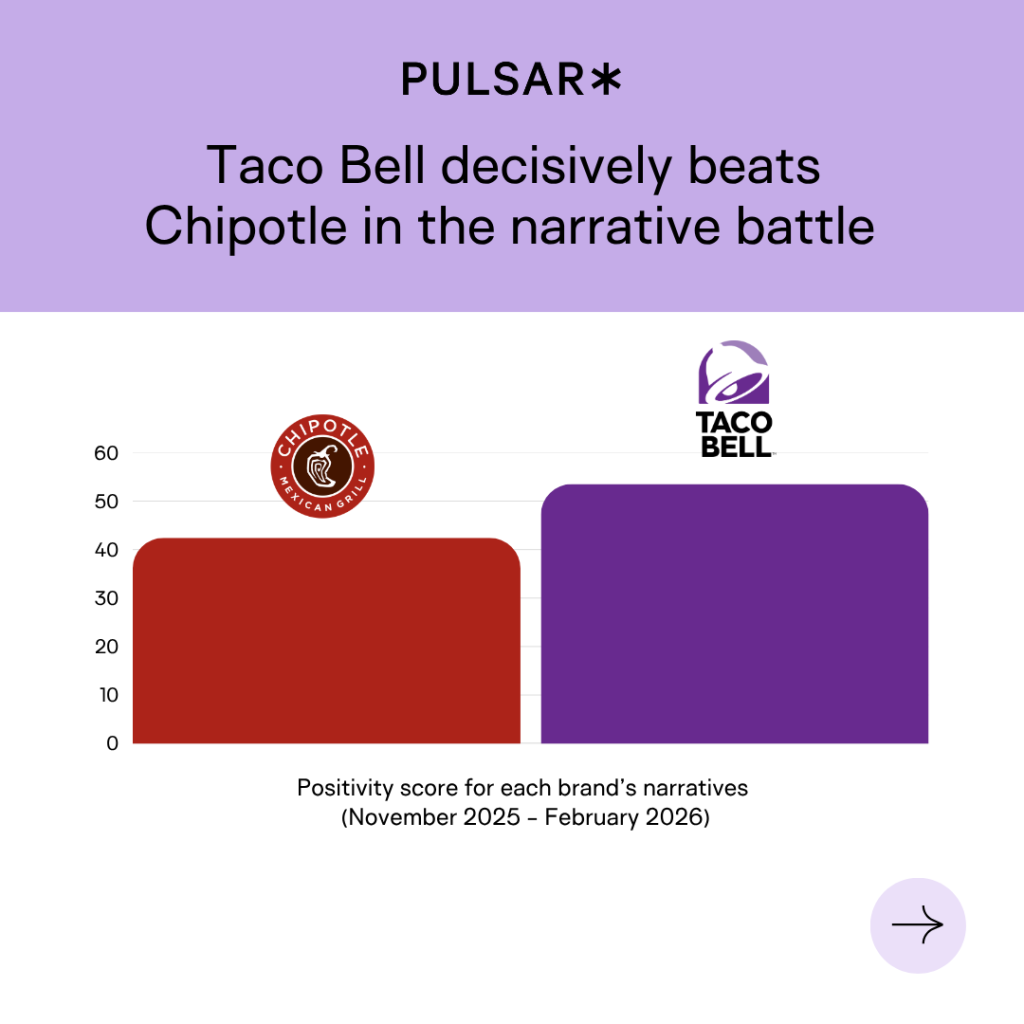
Using Narratives AI to measure brand positivity, Taco Bell pulls ahead with a score of 52.6, compared with 46.1 for Chipotle. Taco Bell’s narrative feels relatively positive, cohesive, and culturally resonant, while Chipotle’s has grown more fragmented.
To understand where that gap comes from, we break the narratives down across five dimensions, and the picture becomes more specific and interesting than a single positivity score allows.
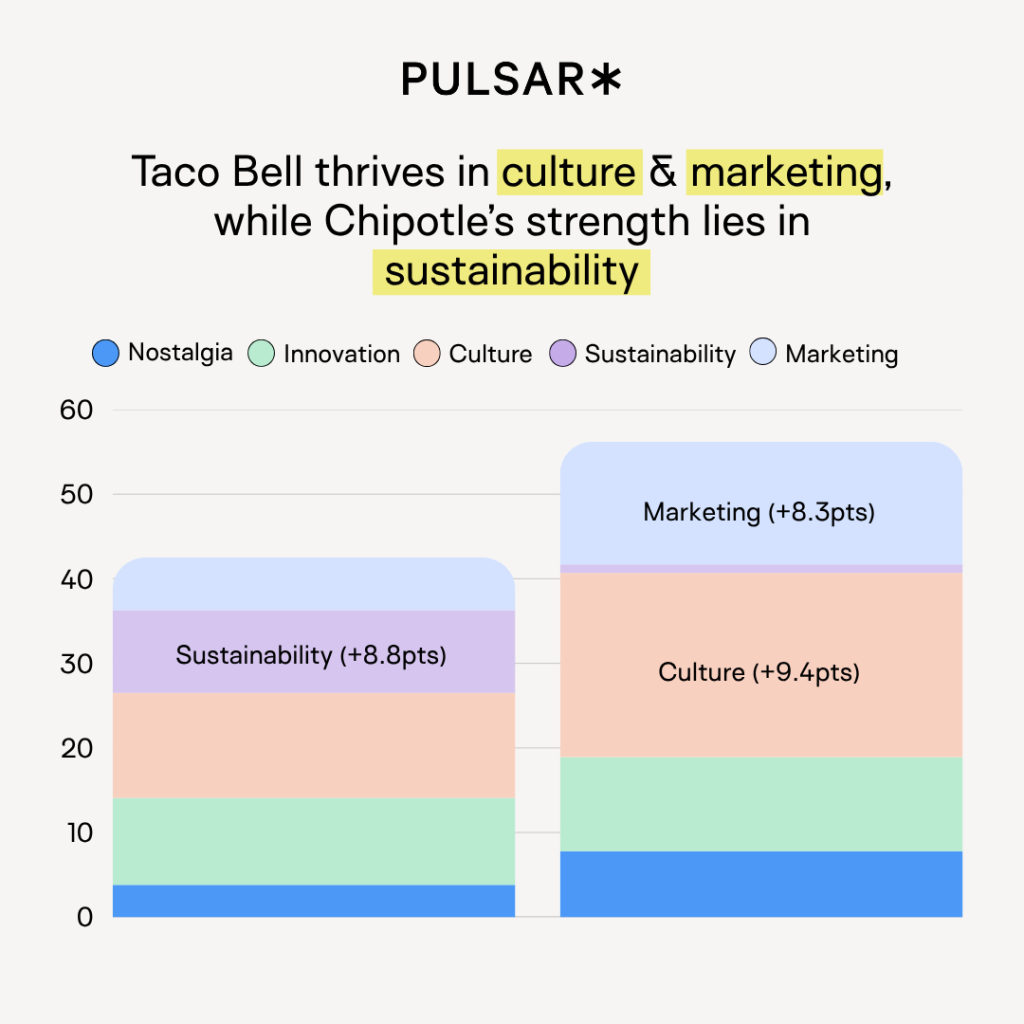
- Nostalgia reveals whether a brand lives in cultural memory as something worth returning to, or something audiences have quietly left behind.
- Innovation gauges whether a brand is perceived as moving forward with genuine creative energy, or simply maintaining what already exists.
- Culture maps how embedded a brand is in the daily rituals and shared identity of its audience, beyond the transaction itself.
- Sustainability tests the depth of trust audiences place in a brand's ethical commitments, sourcing claims, and environmental responsibility.
- Marketing shows how audiences receive and spread a brand's creative output, whether as content they want to share or evidence they want to use against it.
Taco Bell leads on culture (+9.4 points) and marketing (+8.3 points). Chipotle's advantage is real and hard-won, but it is concentrated in quality and sustainability (+8.8 points). The two brands are strong in opposite areas, which means the rivalry is less a head-to-head contest than a question of which kind of brand equity matters more in the current moment.
Chipotle earns the quality story…then loses control
Where Chipotle stands out is sustainability. Over 75% of its sustainability mentions are positive vs 39.2% for Taco Bell.
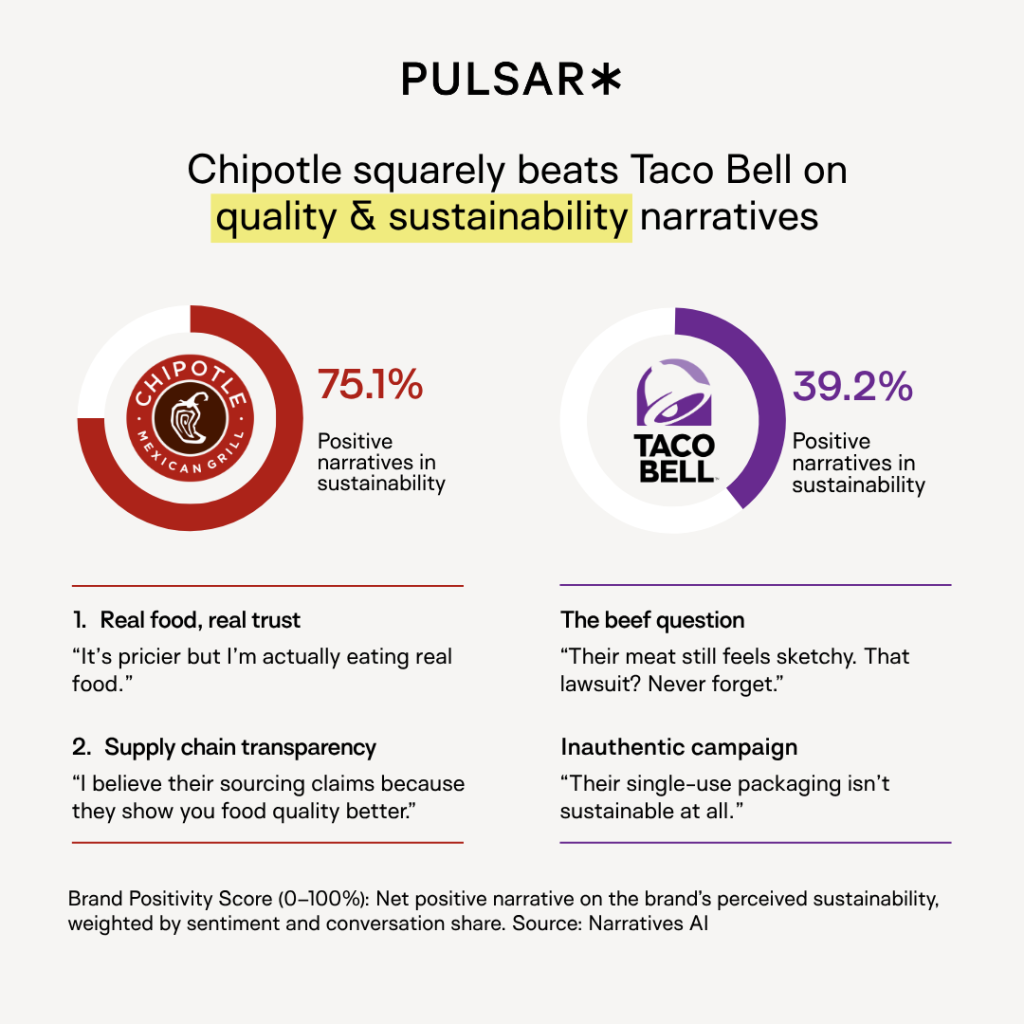
Chipotle audiences highlight food quality and authenticity, often justifying a slightly higher price. Peer-to-peer trust in an ingredient claim is one of the most durable forms of brand capital.
Love chipotle. In my town it’s hard to get fresh ingredients and semi healthy food. And it’s delicious plus my kids love it
— 𝕏SportsHawk (@XSportsHawk) March 11, 2026
Taco Bell's sustainability narrative, by contrast, still carries the residue of older doubts around ingredient quality and packaging. Those concerns are years old. They remain active in public memory regardless.
But strength in one dimension does not protect a brand from turbulence in others. In early 2026, Chipotle's quality narrative was effectively drowned out by a combination of business headwinds and a political controversy the brand did not cause and could not fully contain.
Why does Taco Bell win on culture?
Culture, as measured by Narratives AI, captures the degree to which a brand has moved from something people consume to something people participate in. By that measure, the two brands are not close.
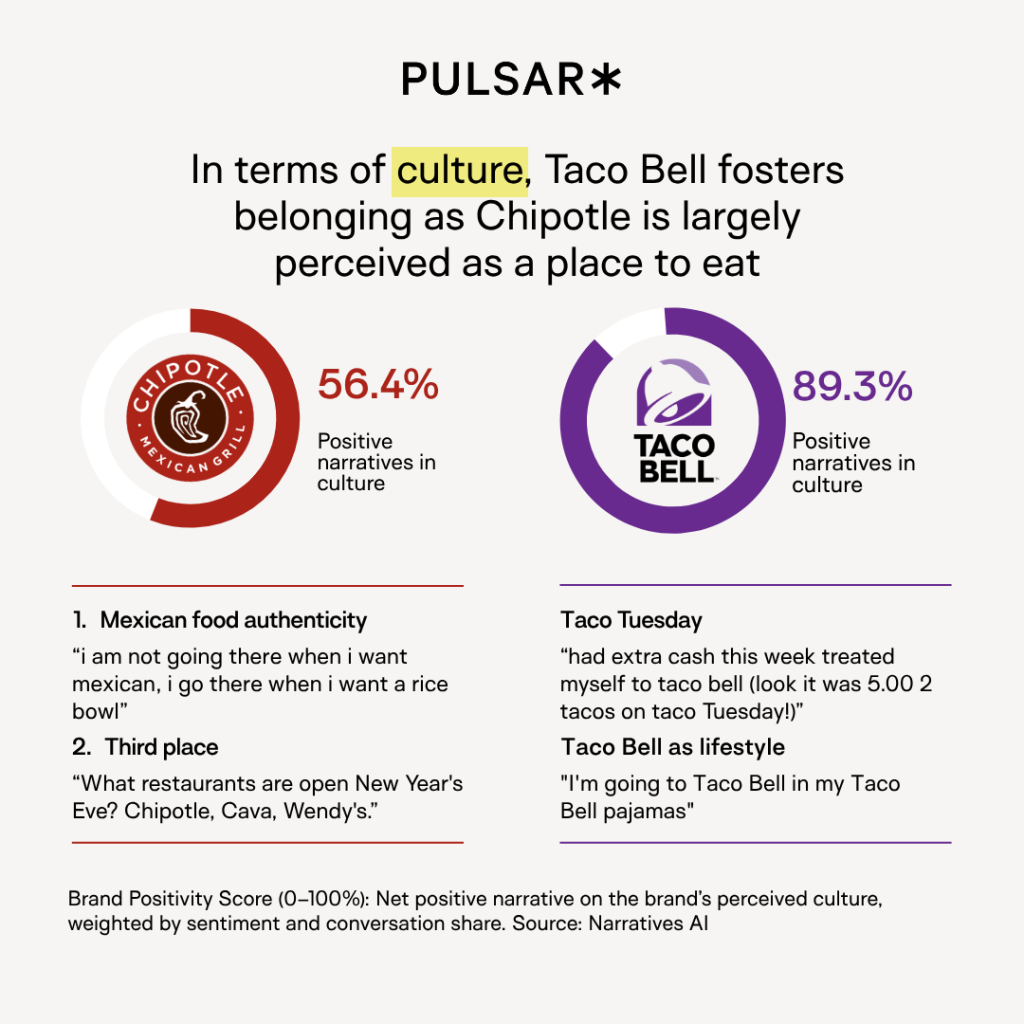
Taco Bell scores 89.3% positive. What’s most interesting about Taco Bell's cultural equity is that much of it was not built by Taco Bell at all. Taco Tuesday has existed as a consumer ritual since at least 1933, and remains a celebrated ritual, a small act of fun or self-care.
@turnuptwinstv #tacobell #tacos #tacomukbang #beef #massfollowing #tacotuesday #fyp#fypシ #fortoupage #foodies @tacobell ♬ original sound - TurnUpTwinsTV 👯♀️
Fans weave Taco Bell into late-night routines, social content, and fan-made creations, giving it meaning far beyond the plate. Taco Bell's masterstroke was recognising a behavior already in circulation and moving strategically to own it.
Across gaming, streaming, and the broader language of online self-expression, Taco Bell surfaces in places where people are already forming identity and habit, by attaching to spaces where social identity and consumption already overlap, rather than attempting to manufacture new ones from scratch.
@.livewashleyy Sunday reset!>> 💗🫶🏻 new style do you like it? Im obsessed!! 😍😍 #viral #preppy #blowup #fyp #skincare ♬ son original - 🎧
i look forward to a full taco bell skincare range https://t.co/MBjA3SkLAp
— Mick Mangles (@itsyaboidougie) March 12, 2026
Even where food quality perception is low, cultural participation remains high. The two variables are operating independently, which is the clearest signal that something beyond the product is doing the work.
Chipotle's cultural narrative tells a different story. The brand appears as a category solution rather than a personal one — a reliable choice for a rice bowl or a holiday meal, but seldom part of a personal ritual. Its audience completes a transaction and moves on. There is no participatory layer, no annexed ritual, no community infrastructure generating narrative on its behalf.
The implications are not always immediate. Over time, however, brands with strong cultural presence develop audiences that participate in shaping their narrative. Others remain more contained. When external pressure increased in early 2026, these dynamics began to separate more clearly.
Which audiences are driving each brand's narrative?
Chipotle and Taco Bell do not just sell different food. They live in different parts of the internet. Chipotle’s conversation skews toward politically engaged communities, including conservative and crypto-adjacent circles. Taco Bell’s network clusters around music fans, sports culture, gaming communities, and younger creative audiences.
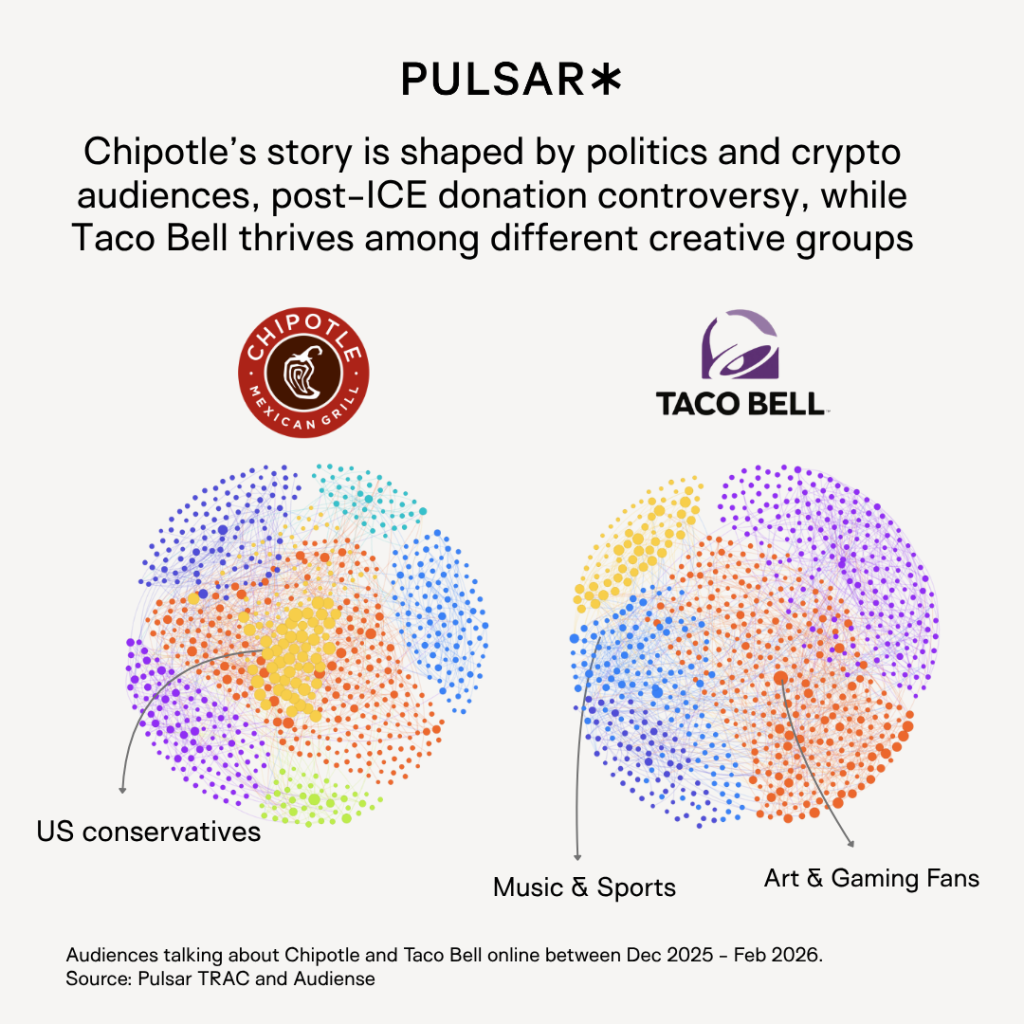
That structure changes how narratives move. A misleading claim, such as the ICE association with Chipotle, can attach to the brand and spread quickly through politically charged networks. In those spaces, attention arrives primed for conflict, and even minor events can escalate into boycotts or outrage cycles.
Taco Bell circulates somewhere else. Product announcements and nostalgic revivals move through culture-first communities that turn the brand into memes, fandom, and shared rituals.
In one environment, stories turn into arguments. In the other, they turn into culture. The result is a different narrative dynamic: Chipotle gets debated, while Taco Bell gets shared.
To stay up to date with our latest insights and releases, sign up to our newsletter below:
This article was created using data from TRAC