Enterprise Brand Tracking: Real-Time vs Survey

TL;DR
Survey-based brand tracking measures what a representative sample says when asked, in monthly or quarterly waves. Real-time brand tracking measures unprompted conversation across social, news, forums, and search as it happens. Enterprise leaders in 2026 run both as complementary layers: surveys for board-level equity benchmarks, and real-time narrative AI to navigate live cultural shifts, algorithmic distribution, and dark social signals. Platforms like Pulsar supply the real-time layer.
- ▸Surveys answer macro equity and reach: how much does the representative market know, feel, and commit to? Real-time answers velocity and context: which narratives are forming now, where are they spreading, and why?
- ▸As survey response rates keep sliding (the flagship US employment survey fell under 45% post-pandemic; Federal Reserve Bank of San Francisco, 2025), relying on surveys alone leaves dangerous blind spots between waves.
- ▸Real-time signal fills that gap, but only if you filter outrage noise from material brand risk by tying conversation to commercial metrics.
- ▸The modern edge sits in six upgrades: dark social, LLM emotional taxonomy, synthetic-data validation, algorithmic amplification, outrage-versus-impact filtering, and a three-tier signal matrix.
If you own brand health at an enterprise, the live question in 2026 is not whether to track your brand, but how. The quarterly survey wave is still the trusted benchmark, yet insight into brand perception now arrives late: only 9% of CMOs say they have unlocked real-time insights into their market (NIQ, 2025), even as reputation forms in public and in real time. This guide defines enterprise brand tracking, sets the survey and real-time approaches side by side, and details the six modern upgrades that separate a raw listening dashboard from a real brand intelligence program.
In This Article
What Is Enterprise Brand Tracking in 2026?
Enterprise brand tracking is the continuous measurement of how an organization is perceived, preferred, and evaluated over time. At enterprise scale, spanning sub-brands, international territories, and diverse stakeholder segments, it directly informs capital allocation, campaign pivots, and board reporting.
Definition
Brand tracking is the longitudinal measurement of brand health metrics, such as awareness, consideration, sentiment, and narrative equity, to identify equity shifts, diagnose their root causes, and correlate marketing investment with long-term commercial impact.
Historically, tracking meant a single recurring questionnaire. Today, tracking describes an objective, not a single tool. Modern enterprises pair prompted research (asking recruited panels) with revealed digital behavior (analyzing unprompted public and semi-public conversation). The two are longitudinal partners, not rivals, and the future of brand tracking assumes both run side by side.
The Core Dual Approach: Survey vs Real-Time
To build a resilient insights program, teams evaluate both data inputs across speed, depth, and operational utility. The table below is the clearest side-by-side view.
| Dimension | Survey-Based Tracking | Real-Time Brand Tracking |
|---|---|---|
| Primary question | How does the broader market evaluate us overall? | What stories are driving perception right now, and where? |
| Data source | Recruited panel respondents | Social, news, forums, search, broadcast, and community hubs |
| Cadence & speed | Waves (monthly / quarterly); results take weeks | Continuous (always-on); signal arrives in real time |
| Signal type | Prompted, stated intent (what people say when asked) | Unprompted, revealed behavior (what people share organically) |
| Core measurement | Unprompted awareness, funnel consideration, NPS | Share of voice, narrative momentum, emotional taxonomy, viral velocity |
| Primary weakness | Retrospective lag; declining panel response rates | High data noise; needs LLM interpretation to separate outrage from revenue risk |
| Pulsar layer | Complements existing trackers (import first-party data) | Pulsar TRAC + Narratives AI + Pulsar CORE |
Read the columns as complements, not competitors. Surveys deliver a representative, projectable read of the whole market and the stated attitudes you cannot always infer from behavior. Real-time tracking delivers speed, scale, and context, reading millions of unprompted signals and the narratives moving them. The weakness of one is the strength of the other, which is why enterprise programs layer both.
The 6 Modern Upgrades to Enterprise Brand Tracking
Standard listening dashboards report raw volume and basic positive-or-negative sentiment. Modern enterprise programs go further, integrating six advanced frameworks that turn a feed of mentions into a decision-ready signal.
1. The dark social and micro-community void
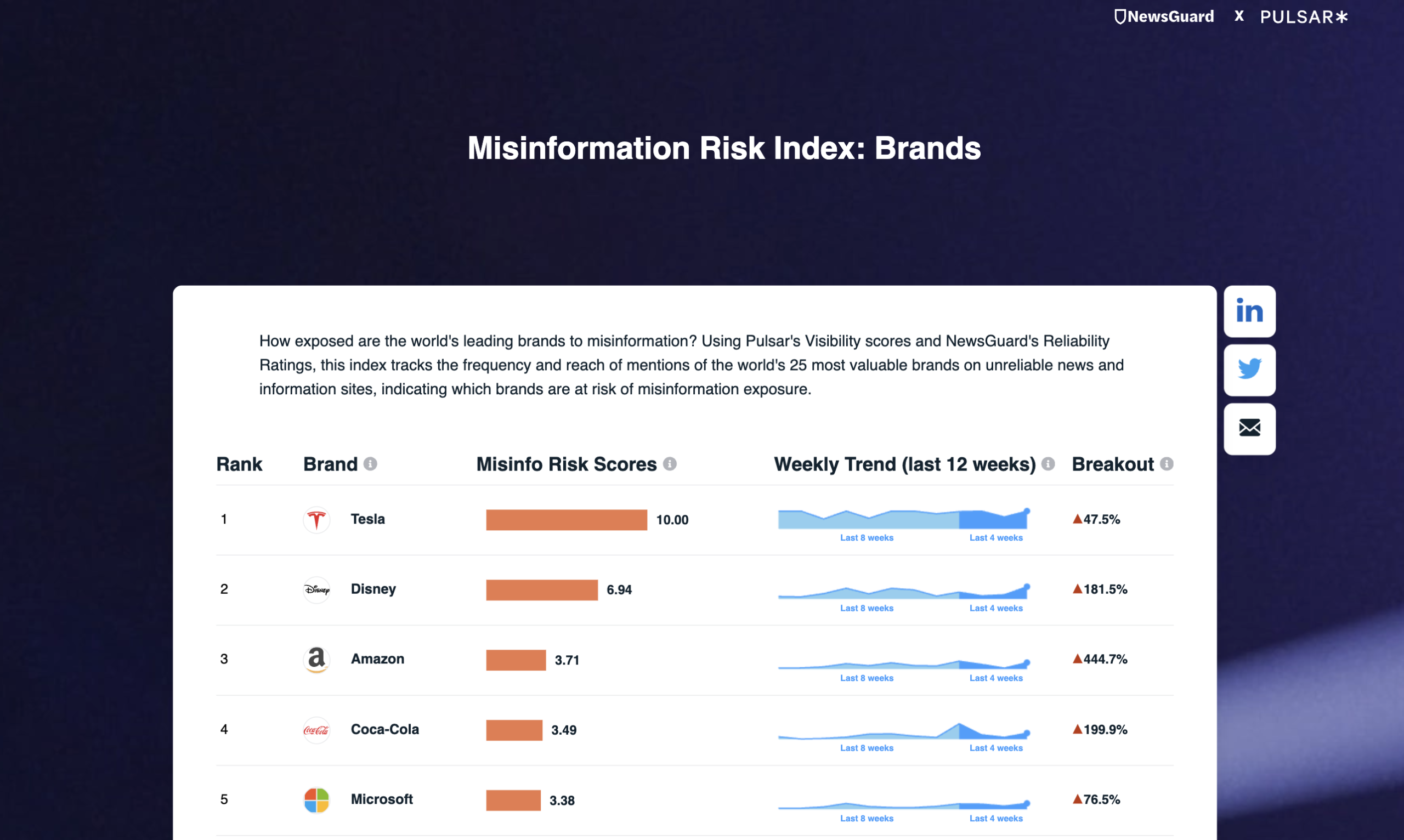
Brand sentiment rarely starts in press releases or public posts; it brews in semi-private and alternative spaces long before it surfaces anywhere a survey can see it. By the time a sentiment drop registers on a quarterly wave, the narrative has often already matured inside these dark social nodes. This is exactly where Pulsar's coverage sets the pace: it tracks dark social across alternative and semi-private platforms such as Discord, Telegram, and Rumble, alongside forums, broadcast, and the dark web, so you can follow a narrative's velocity from early semi-private chatter to broad public coverage, which is also where brand misinformation tends to incubate before it breaks. That breadth runs deep: Pulsar draws on 45+ aggregated source types across 200+ languages and processes more than 40 billion documents a year, with 100% data access (never sampled) and 24 months of rolling retention.
2. Beyond positive and negative: LLM-driven emotional taxonomy
Standard keyword sentiment fails on sarcasm, nuance, and contextual intent. Modern real-time tracking uses custom LLM classifiers to map conversation into specific emotional dimensions, such as skepticism, betrayal, nostalgia, hype, and disillusionment. A single post expressing genuine betrayal from a high-value customer carries far more strategic weight than 500 low-effort negative posts from drive-by accounts. Reading that difference is the point of an emotional taxonomy, and it is a core function of Pulsar's narrative and emotion AI.
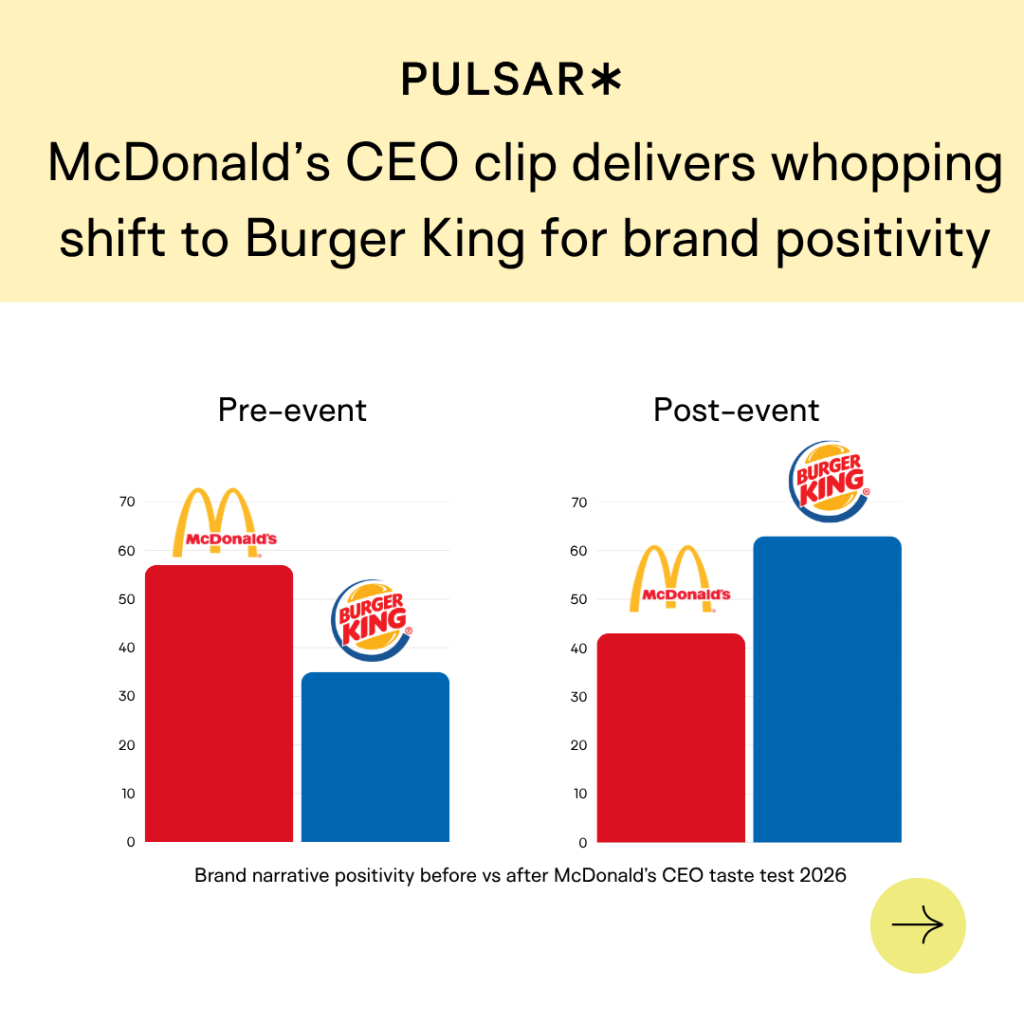
This is why narrative, not raw sentiment, is what you need to manage. Take McDonald's in early 2026, when its CEO posted an awkward on-camera taste test of the new Big Arch. A sentiment score would have logged the spike and moved on. Narrative analysis showed what actually changed. Within a day, McDonald's went from a 22-point lead in brand positivity to trailing by 20 points. The shift was almost entirely driven by culture and authenticity, while price barely moved and leadership perceptions dropped.
Reputation doesn't usually unravel because people suddenly become more negative. It shifts because a moment reinforces a narrative that was already there.
3. The synthetic-data reality check
As survey response rates hit historic lows, research teams increasingly turn to synthetic respondents, AI personas trained on historical panel data to simulate survey answers instantly. Useful, but risky in isolation. Real-time social and web listening provides the mandatory empirical truth-check: a live behavioral signal keeps synthetic personas grounded in real-world cultural shifts rather than drifting into AI hallucination. In practice, real conversation data is what validates that a synthetic model still reflects the market.
4. Algorithmic amplification versus raw volume
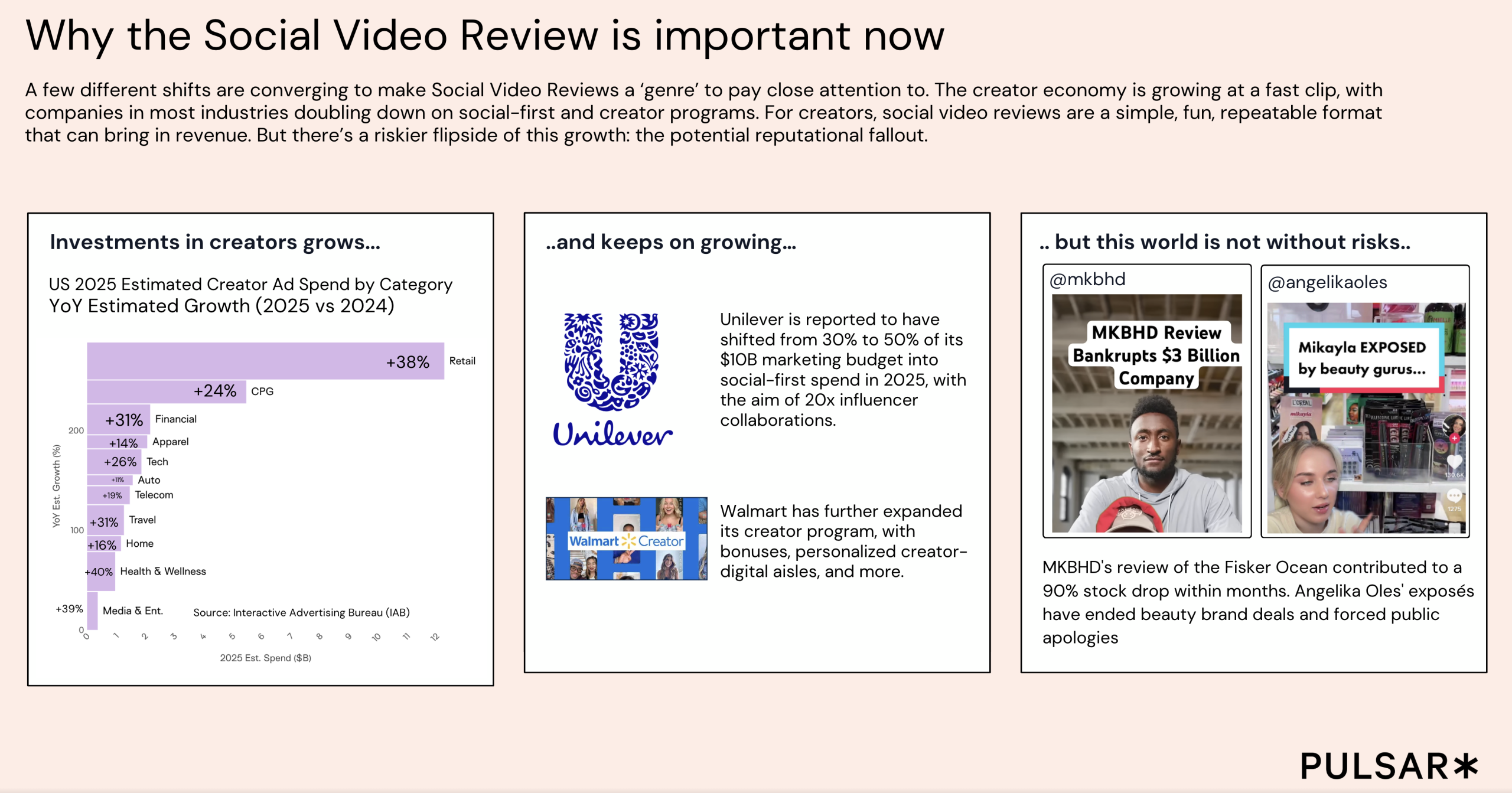
In an algorithmically curated feed environment, social video and short-form formats included, volume is a secondary metric. A topic with only 50 initial comments can reach millions overnight if its watch-time and share ratios trigger recommendation engines. Modern tracking monitors distribution velocity, such as audio re-use, bookmark rates, and share speed, to anticipate reach before it happens. Pulsar's narrative momentum scoring works on the same principle: it flags which belief clusters are gaining velocity before aggregate sentiment turns, so teams get a genuine head start rather than a retrospective count.
5. Filtering the outrage-versus-impact paradox
Data fatigue is the fastest way to lose executive buy-in. Viral outrage does not automatically translate into brand equity destruction or churn. Advanced programs cross-reference real-time narrative spikes with commercial indicators, such as organic search volume, web traffic, and conversion velocity, to separate temporary social noise from material brand risk. The discipline is simple to state and hard to do: escalate a spike only when it shows up in behavior, not just in the feed.
6. The three-tier enterprise signal matrix
Rather than forcing one data source to answer every team's question, leading enterprises organize insight into a clear functional hierarchy, so each signal reaches the team equipped to act on it.
| Signal tier | What it tracks | Primary owner |
|---|---|---|
| Tactical | Real-time feeds, velocity alerts, crisis detection | Comms / Social / PR |
| Strategic | Narrative clusters, emotional taxonomy, intent shifts | Brand & Product Marketing |
| Foundational | Panel benchmarks, long-term equity, funnel metrics | Insights Directors & Board |
How the Two Layers Work Together
Rather than choosing between surveys and real-time platforms, enterprise organizations layer them for maximum accuracy. The foundational survey layer sets the representative baseline; the continuous real-time layer explains and anticipates movement in between.
Foundational Layer
Quarterly and annual survey benchmarks (Kantar, Ipsos, YouGov, and peers). Measures macro equity, funnel, and reach across a representative sample.
⇅ validated by representative baselines / guides the next questionnaire
Continuous Layer
Always-on real-time narrative AI (Pulsar TRAC and Narratives AI). Measures daily velocity, dark social, emotional taxonomy, and emerging risk.
The three connections between the layers are what make the program work:
- Surveys validate the baseline. They confirm that directional signals from real-time data reflect the broader population, not just the vocal minority who post.
- Real-time data provides the explanation. When survey consideration drops four points, real-time narrative intelligence pinpoints the exact story, competitor move, or viral product feature that caused it. This is how Pulsar closes the media-public gap: reputation is not just what the press reports, it is what the public actually believes, tracked before it reaches critical mass.
- Real-time informs the next survey. Live conversation reveals emerging consumer terminology and unexpected blind spots, so questionnaire design stays relevant wave to wave.
Pulsar's Reputation AI is built for exactly this handoff, mapping live social and news signal onto the kind of quantitative frameworks brand teams already report, in real time and over time. If you are assembling a modern brand tracking stack, the continuous layer is the piece a survey-only program is missing.
Frequently Asked Questions
+Can real-time brand tracking replace survey-based tracking entirely?
No. Real-time tracking analyzes unprompted online conversation, which is inherently self-selected. Surveys remain necessary for projectable, representative population samples and unprompted baseline awareness metrics. The two run as complementary layers, not alternatives.
+How do you prevent social media noise from over-influencing strategy?
By tying real-time narrative momentum to commercial validation metrics, such as branded search intent, daily web traffic, and conversion velocity, to confirm whether conversation is actually changing consumer behavior. A spike is escalated only when it shows up in behavior, not just in the feed.
+How often should an enterprise update its brand health metrics?
The standard framework combines continuous real-time monitoring for daily reputation management and crisis detection with monthly or quarterly survey waves for long-term equity benchmarks. Real-time covers the gap between waves; the waves anchor the real-time read to a representative baseline.
+What is dark social, and why does it matter for brand tracking?
Dark social refers to conversation in semi-private spaces like Discord servers, forum micro-communities, niche Slack groups, and messaging channels. It matters because narratives frequently form and mature there before they surface in public feeds or register on a survey, so tracking velocity across these nodes gives the earliest warning of a perception shift.
+What is narrative momentum, and how is it different from sentiment?
Sentiment scores how positive or negative a body of conversation is right now. Narrative momentum measures which belief clusters are gaining or losing velocity over time. It is more predictive: by the time sentiment turns negative in aggregate, the underlying narrative has usually already been building, and momentum scoring catches it while it is still forming.
+Can synthetic survey data replace real panels?
Not on its own. Synthetic respondents, AI personas trained on historical panel data, can simulate answers quickly, but they risk drifting from reality as culture shifts. Real-time behavioral signal from live conversation is the empirical truth-check that keeps synthetic models grounded, which is why the two are used together rather than one replacing the other.
+What is Pulsar's approach to real-time brand tracking?
Pulsar TRAC provides always-on tracking across social, news, broadcast, and forums, Narratives AI maps the belief clusters and emotional taxonomy driving sentiment, and Pulsar CORE brings owned and first-party data into the same view. It layers narrative frames over performance metrics for a 360-degree read of brand tracking across both the tactical and foundational horizons.
Bottom Line
Real-time and survey brand tracking are not competing choices; they are two layers of one program. The survey gives you a representative, board-ready benchmark. Real-time narrative AI gives you the velocity, context, and early warning to act between waves, provided you filter outrage from impact and route each signal to the team that owns it. As response rates keep sliding and culture moves faster than any quarterly cycle, the enterprises that win are the ones that treat the wave as the baseline and the live signal as the steering wheel.
To see the continuous layer working against your own brand and category data, request a Pulsar demo. The team will show how Pulsar tracks brand health in real time and maps the live conversation onto the frameworks your brand team already reports.
Sources and Further Reading
- What is brand tracking? (And how it has changed in the AI era)
- The future of brand tracking with social listening
- Detecting brand misinformation with social listening
- Best brand tracking tools for enterprise teams (2026)
- What is narrative intelligence? Definition and use cases
- Pulsar brand tracking and reputation intelligence
- Pulsar TRAC: real-time social listening and media intelligence
- NIQ (2025): CMO Outlook, Guide to 2026 (share of CMOs with real-time insight)
- Federal Reserve Bank of San Francisco (2025): Do Low Survey Response Rates Threaten Data Dependence? (Economic Letter 2025-07)
About this guide
This guide was written by the Pulsar Platform editorial team, led by Dahye Lee, Senior Marketing Innovation Lead. Third-party figures are attributed to their named sources (NIQ, Federal Reserve Bank of San Francisco) and reflect data published in 2025; verify against the primary source before reuse. Definitions of survey-based and real-time brand tracking reflect Pulsar's product framing alongside standard industry usage. Where Pulsar capabilities are described, they reflect Pulsar TRAC, Narratives AI, and Pulsar CORE product documentation.
If you're interested in how Pulsar Tools can support your brand and strategy, simply fill out the form below and one of our specialists will contact you!