
McDonald’s vs Burger King: How a CEO’s viral bite hurt one brand and lifted another
- Food & Drink

TL;DR
In February 2026, McDonald's CEO Chris Kempczinski posted a clip of himself biting the new Big Arch. Within 24 hours, the moment generated 47,900 mentions and 5.8 billion impressions, and a 22-point brand positivity lead over Burger King flipped to a 20-point deficit. Burger King's President responded the next morning with a 13-second Whopper bite. Pulsar Narratives AI and Pulsar TRAC measured the resulting narrative shift across Culture, Marketing, Leadership & Ethics, and Price.
What you will learn:
- How a single CEO video reversed a 22-point brand positivity gap inside 24 hours
- Why Culture and Marketing absorbed nearly all of the shift while Price barely moved
- How the bite crystallized pre-existing accountability narratives into a single focal point
- Why Burger King's post-event audience was structurally less politicized than McDonald's
- What this case reveals about leadership authenticity and narrative transfer in 2026
Burger King’s CEO takes a huge bite of a Whopper after a McDonald’s CEO video went viral over how he ate the Big Arch burger pic.twitter.com/32j2C2ZzfV
— FearBuck (@FearedBuck) March 3, 2026
In early 2026, McDonald's looked untouchable. Its stock was near record highs, US same-store sales climbed 6.8% in Q4 2025, the brand's fastest quarterly growth in over two years, and the Big Arch was lined up as its next big win.
Then CEO Chris Kempczinski took a bite, posting the clip on February 4 to build anticipation.
It barely landed, as part of a product launch. However, it wasn't long before online communities picked it up and it exploded, 47,900 mentions and 5.8 billion impressions in a day, with attention locking onto one detail people could not ignore. The bite felt hesitant and overly polished.
Sensing the reaction, Burger King moved fast. The next morning, President Tom Curtis posted a 13-second clip taking a full bite of a Whopper. It earned 235,000 likes, and the tone shifted instantly.
What began as a CEO's video review, quickly evolved into something else entirely. It became a real-time case study in how rapidly brand perception can shift, and how little intervention is needed to reshape it.
We used Pulsar Narratives AI and TRAC to track how both brands' public narratives shifted around that moment, across key dimensions that shape brand perception.
What we're covering:
McDonald's was winning. Then it wasn't.
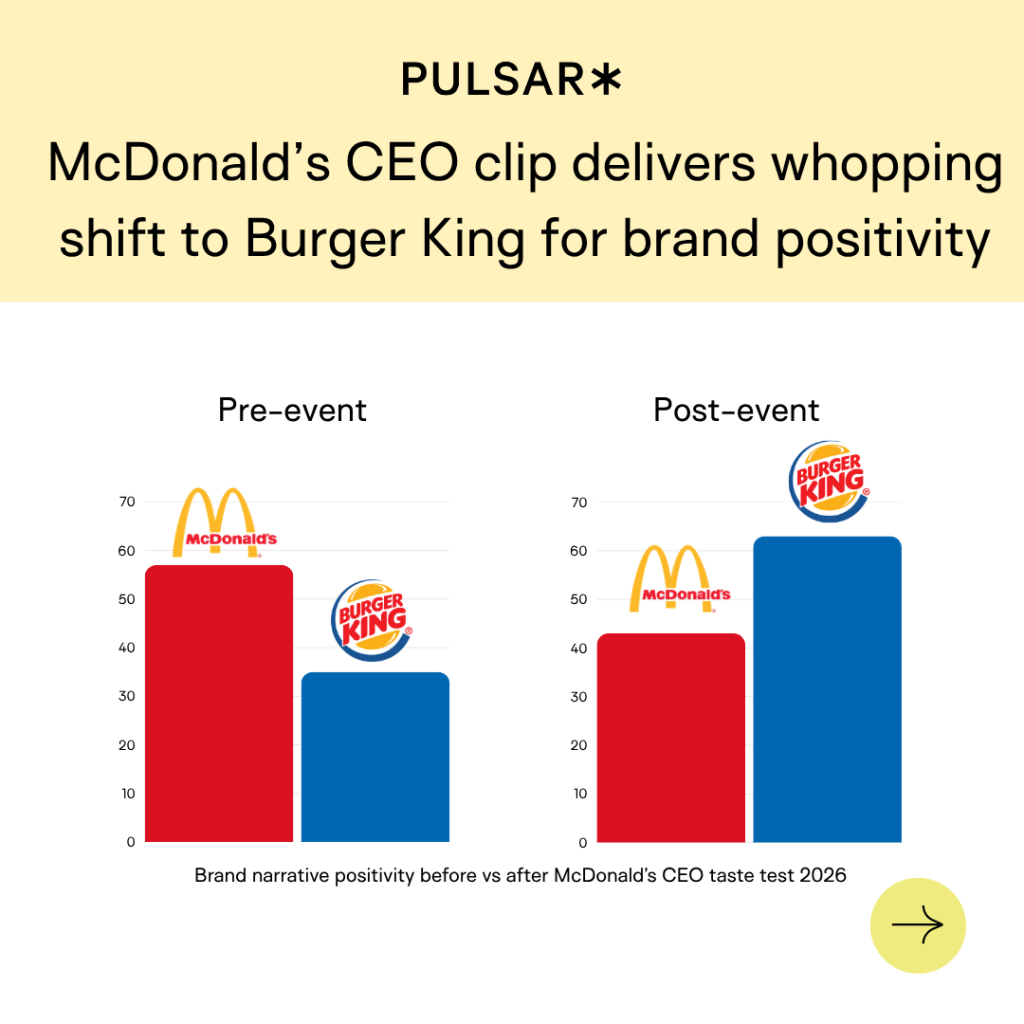
Before March 4, when the CEO video went viral, McDonald's led brand positivity 57.4 to 35.5, a 22-point gap over Burger King. But after the CEO clips, everything flips. McDonald's drops to 43.4, while Burger King climbs to 63.7. A 22-point lead becomes a 20-point deficit.
What stands out is how cleanly the shift plays out. McDonald's declines as Burger King rises. The movement mirrors itself, with one brand losing ground as the other gains it. This looks less like general volatility and more like narrative transfer.
Culture and Marketing: the dimensions where the narrative flipped
We measured brand narrative positivity by aggregating four dimensions that reflect how each brand is perceived in public conversation.
- Culture captures how embedded a brand is in shared cultural moments and communities;
- Marketing reflects how the brand's own communications and campaigns are received;
- Leadership & Ethics tracks public perception of corporate conduct and accountability;
- Price measures affordability and value perception.
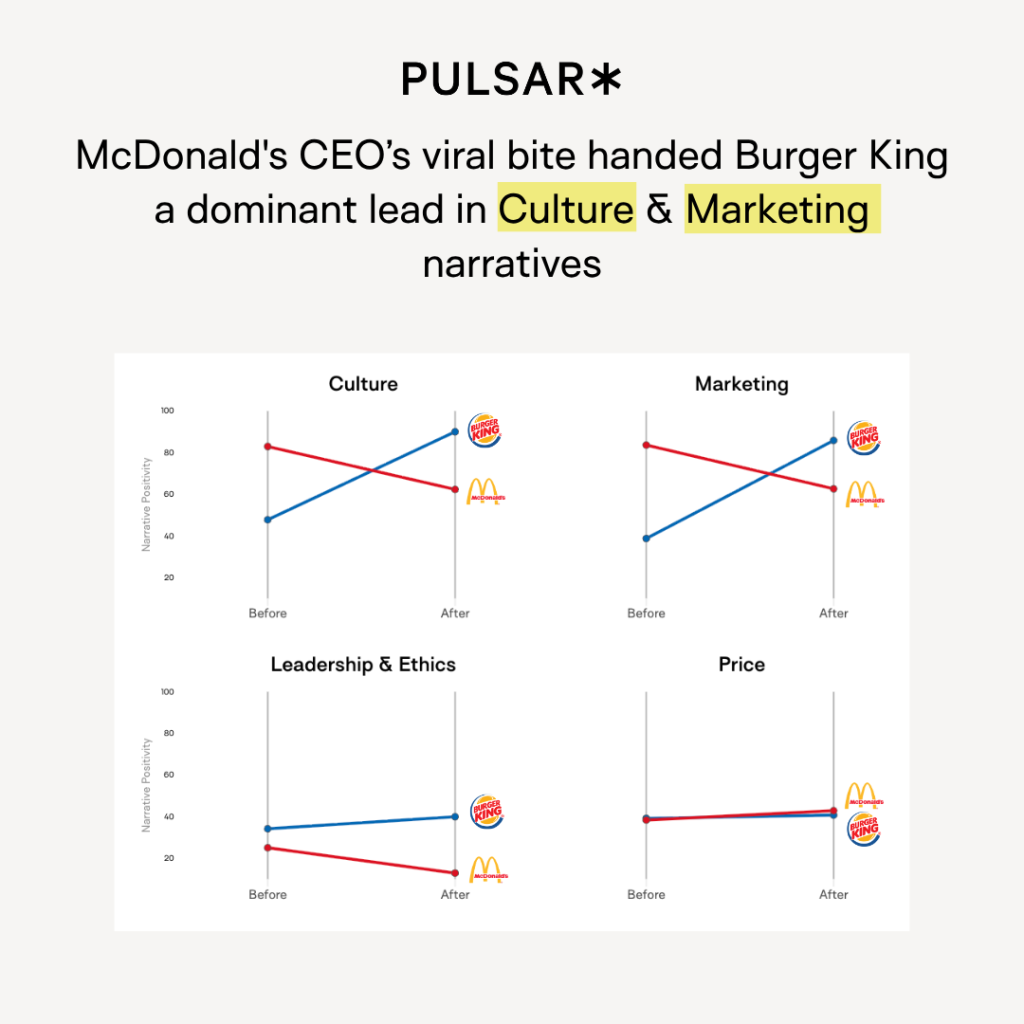
And it turned out that Culture and Marketing absorbed nearly all of the shift, two dimensions that are especially sensitive to how a brand is perceived in the cultural moment, rather than what it objectively offers. These are the areas that rise or fall on signals of authenticity, and notably, they moved in opposite directions for both brands at the same time.
When Burger King's President took a full bite of a Whopper the morning after McDonald's CEO appeared reluctant to eat his own burger, Burger King went from 47.8 to 90.1 on Culture, a 42 point gain. McDonald's drops from 83.0 to 62.4. On Marketing, the same pattern: Burger King rises from 38.8 to 85.9, McDonald's falls from 83.7 to 62.7. Price barely shifts for either brand.
On top of that, the most pronounced shift appears in the Leadership & Ethics dimension. Burger King sees a modest increase from 34.2 to 40.0 following the CEOs' bites, while McDonald's drops sharply from 25.1 to 12.9, the lowest score across the dimensions.
Although the weakness in McDonald's was pre-existing, what the CEO bite provided was a focal point. A dispersed set of accountability criticisms, each circulating separately, suddenly had a shared reference point that anyone could use to illustrate all of them at once.
Culture: from community touchstone to political prop
With that in mind, we turn to the brand narrative dimensions individually.
Culture, as measured through Narratives Intelligence, captures whether a brand has moved from something people consume to something people participate in.
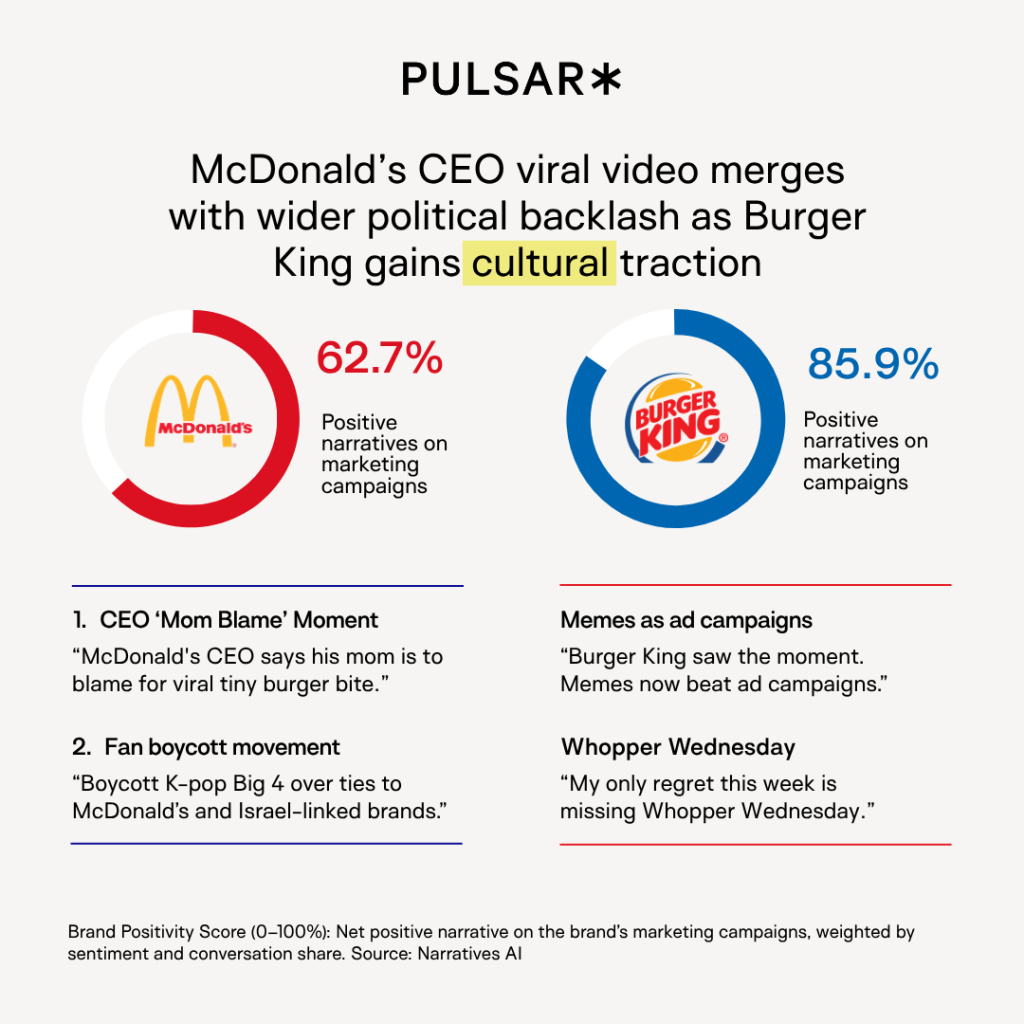
Before the CEO viral 'bite' video, McDonald's held a significantly higher cultural score, driven by entrenched fandoms and rituals, from Pokémon Happy Meal collectors trading variants to the seasonal return of the Shamrock Shake as a recurring cultural touchpoint.
Then the CEO video arrived and landed in the unexpected conversation such as Comedian Garron Nonne's TikTok.
@garron_musicHe clearly loves it♬ original sound - Garron Noone
Viral remixing of the product launch into political satire was immediate. The CEO himself became ironised into meme:
Seeing a lot of posts on the McDonald’s CEO trying the Big Arch, and how poorly the video comes across. I think you have to consider that a large restaurant chain like McDonald’s certainly preplanned for this video and had their CEO undergo extensive media training in advance. I… pic.twitter.com/GtLXEQQHyS
— James Walker (@jwalkermobile) March 3, 2026
Meanwhile, Burger King's cultural trajectory ran in the opposite direction. The brand was pulled into conversations it did not initiate and benefited from all of them. When #NoKings protests swept social media in response to political events, the Whopper appeared as a spontaneous counter symbol:
I realize there were many #NoKings protests today, and I am very much in agreement. But I do want to take this opportunity to go on record that the Whopper is one fantastic burger. @BurgerKing #TOJ pic.twitter.com/kpNms8u0K4
— Lance LeVine (@chocolatierLL) March 29, 2026
The same sentiment plays out at a quieter, habitual scale with Whopper Wednesday. This weekly ritual is entirely community-owned. Fans guard the tradition with surprising fervor, mourning its absence with a sense of personal loss: 'My only regret this week is missing Whopper Wednesday.
I forgot to mention that yesterday was Whopper Wednesday at Burger King! I think Spike wanted Two Whoppers for dinner, if I read him right! Okay Spike, Two Whoppers from Burger King coming up my hungry friend! 🍔📷 😋 pic.twitter.com/2jNe83ctz4
— Ripper (@RipperGiles17) April 23, 2026
In a period when McDonald's was attempting to author its own cultural narrative through a carefully staged video, Burger King was accumulating cultural capital through its continual remixing by different communities across contexts. The gap between authorship and reception is precisely what's captured in this dimension of 'Culture'.
Leadership and Ethics: the CEO who became the story
Leadership and ethics represent another major point of contrast, highlighting how high-stakes moments can function as powerful narrative accelerants.
McDonald's entered the period with pre existing accountability pressure. Boycott calls over a perceived association with the Israeli army. Wage exploitation framing. Worker protection concerns during ICE raids. None of it was new, but none it had so far not cohered into a single overwhelming point of view.
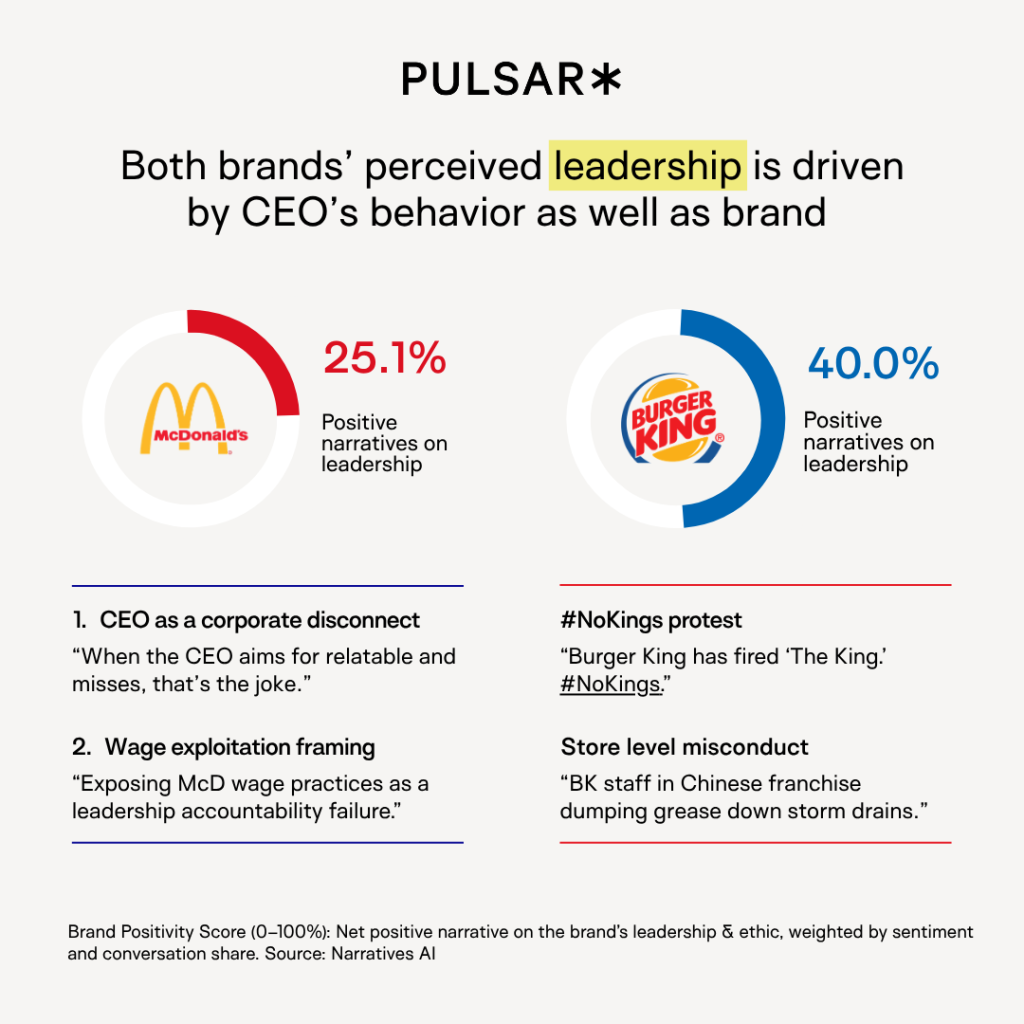
The CEO bite gave it this focus.
The CEO of McDonald's sells 9 million pounds of beef a day. He cannot eat one piece of it correctly. He has identified the responsible party. It is his mom.
— Lobsty Klawfman (@LobstyKlawfman) April 8, 2026
What makes this moment narratively devastating is what it confirmed. The bite had already established a reading of corporate caution, distance from the product, and inauthenticity.
And the WSJ interview's attempt at clarification only made the perception worse while reinforcing how a CEO's online appearance can shape brand perception, an effect long rooted in the tech industry.
It’s fascinating how leadership today isn’t just about business decisions, but also how you show up online
— Johnchidera.k (@Not4meSpor66429) April 7, 2026
The CEO became the embodiment of a leadership accountability narrative the brand had been trying to outrun for years.
Meanwhile, Burger King's Leadership & Ethics narrative is structurally distinct. The brand's 40.0 score is driven by its president's timely engagement with the Whopper "bite" moment, an intervention that appears more resonant, strategically opportunistic, and closely aligned with prevailing audience conversation.
Of course, Burger King's ethical criticisms, including store-level malpractice and broken animal welfare commitments, do exist, but they are diffuse, fragmented, and lack a single focal point. Accountability is dispersed across the organization rather than concentrated in any one figure or moment, which makes it harder to fix responsibility in public perception.
By contrast, McDonald's leadership and ethics narrative is personified and has a visible face that can absorb scrutiny. Burger King's is comparatively faceless and distributed. In this period, that lack of a focal point arguably reduced its exposure.
Who was actually talking about each brand?
The audience maps offer the clearest illustration of where both brands ended up after the viral videos.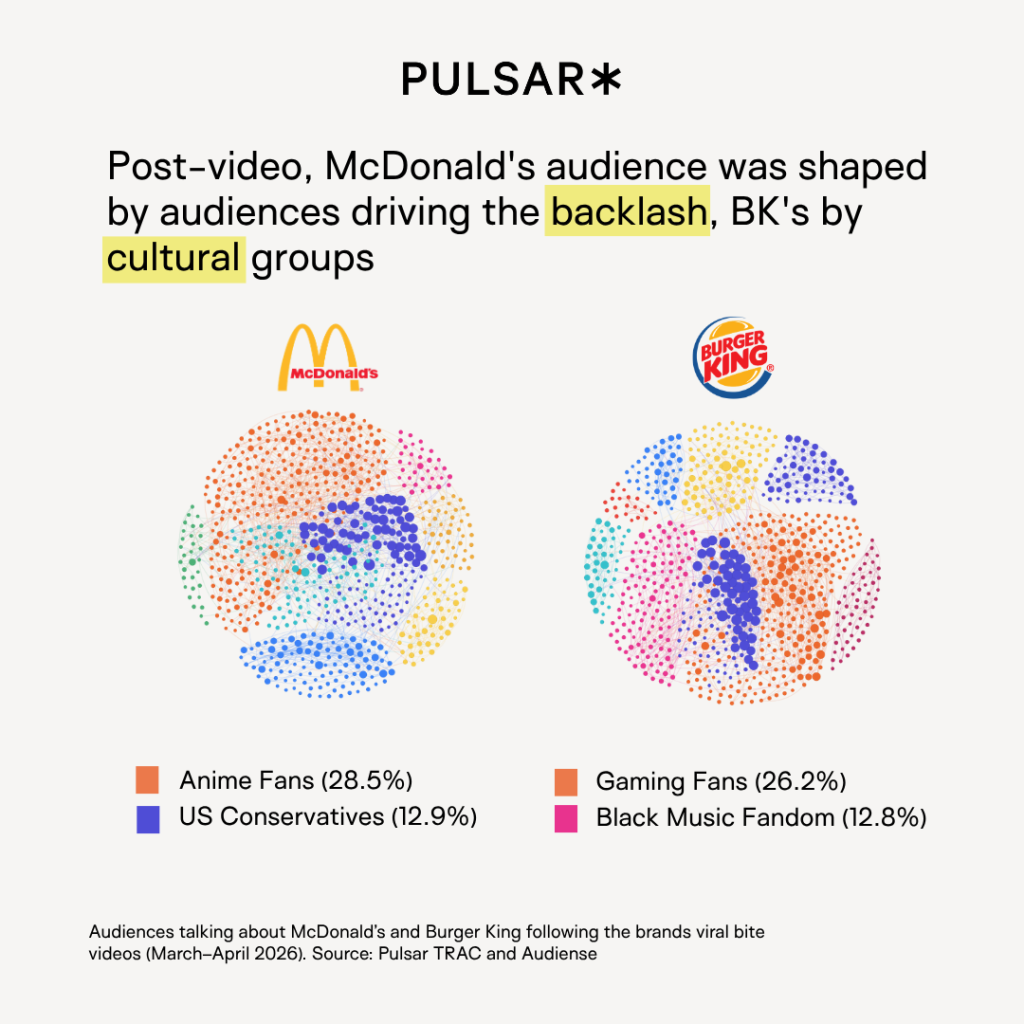
McDonald's post event audience breaks down as Anime Fans (28.5%), US Conservatives (12.8%), US Democrats (10.8%), and Argentina's pro-Milei communities (8.8%). The anime community is the largest cluster, reflecting legacy Happy Meal collector culture still active in 2026, but the second and third largest clusters are both politically defined.
Both sides of the US political divide are present in McDonald's audience, which means the brand's conversation is simultaneously split and politically charged. That structure generates conflict rather than shared cultural meaning.
Meanwhile, Burger King's post-event audience: Gaming Fans (26.2%), Black Music Fandom (12.8%), US Conservatives (9.9%), LatAm News Followers (9.7%). The Gaming Fans' presence is comparable in size, but the surrounding clusters are culturally diverse rather than politically polarised.
Black music fandom, gaming communities, and Latin American news audiences represent communities that generate cultural momentum through memes, fandom, and shared rituals, rather than political conflict.
Fixed it for you.
Mary J Blige x J Hud x Burger King https://t.co/LuseZhBC4Z pic.twitter.com/MZxjcNY3Oa— Micah Jung Un (@Micah_W17) April 28, 2026
The audience difference explains something the narrative scores alone do not. After the CEO bite, Burger King owns the communities that drive organic cultural spread. McDonald's owns the communities that drive political noise. That distinction will matter long after the meme cycle ends.
What this means for both brands
The McDonald's Big Arch story is a case study in how quickly narrative equity can transfer when a brand gives its critics a symbol they can use.
McDonald's entered the period with stronger scores on almost every dimension Yet, none of it protected the brand when a single 30 second video gave a diffuse set of accountability narratives a face, a punchline, and a permanent reference point.
Burger King won this battle by doing less, done more authentically. Tom Curtis's Whopper bite worked because it was legible, a confident act in contrast to a cautious one, performed in a leather apron rather than a corporate meeting room.
The deeper finding is about the relationship between leadership behavior and narrative ownership. Brands can accumulate cultural equity over decades. They can lose narrative control in days. The two things that determine which happens are whether the leadership moment reads as authentic, and whether the brand's existing audience has already decided what kind of story they want to tell about it.
We used Pulsar Narratives AI and Pulsar TRAC to measure brand narrative positivity before and after McDonald's CEO Big Arch taste test (January 18 to April 18, 2026). Narrative positivity scores are normalized on a 0 to 100 scale, weighted by sentiment and share of conversation. Audience data sourced from Pulsar TRAC and Audiense.
Frequently Asked Questions
+What happened in the McDonald's vs Burger King CEO bite incident?
In February 2026, McDonald's CEO Chris Kempczinski posted a video tasting the new Big Arch. The bite read as hesitant and overly polished, and online communities picked it up immediately, generating 47,900 mentions and 5.8 billion impressions in 24 hours. The next morning, Burger King President Tom Curtis posted a 13-second clip taking a full bite of a Whopper. It earned 235,000 likes and the tone shifted instantly.
+How did brand narrative positivity scores change?
Before the viral moment, McDonald's led brand positivity 57.4 to 35.5, a 22-point gap. After the event, McDonald's dropped to 43.4 and Burger King climbed to 63.7, turning the 22-point lead into a 20-point deficit. The movement mirrored itself, suggesting narrative transfer rather than general volatility.
+Why did Culture and Marketing scores absorb the entire narrative shift?
Culture and Marketing are the dimensions most sensitive to perceived authenticity in the cultural moment, rather than what a brand objectively offers. Burger King's Culture score rose from 47.8 to 90.1 (a 42-point gain) while McDonald's dropped from 83.0 to 62.4. Marketing followed the same pattern. Price barely moved for either brand, because the event was about how the brands behaved, not what they cost.
+Why did McDonald's Leadership & Ethics score collapse?
McDonald's entered the period with pre-existing accountability pressure (boycott calls, wage exploitation framing, ICE-raid worker concerns) that was dispersed and lacked a single focal point. The CEO bite gave that diffuse set of criticisms a face and a punchline, dropping Leadership & Ethics from 25.1 to 12.9, the lowest score across the four dimensions.
+How were the audience clusters identified?
Audience composition was mapped using Pulsar TRAC's native community detection together with Audiense for cross-platform identity. McDonald's post-event audience splits across Anime Fans (28.5%), US Conservatives (12.8%), US Democrats (10.8%), and pro-Milei communities (8.8%). Burger King's lands in Gaming Fans (26.2%), Black Music Fandom (12.8%), US Conservatives (9.9%), and LatAm News Followers (9.7%), culturally diverse rather than politically polarised.
+What is the broader lesson for brand and comms teams?
Brands can accumulate cultural equity over decades and lose narrative control in days. Two factors decide which happens: whether the leadership moment reads as authentic, and whether the brand's existing audience has already decided what kind of story they want to tell about it. McDonald's strong Q4 2025 sales did not protect the brand when a single 30-second video gave a diffuse set of accountability narratives a face and a punchline.
To stay up to date with our latest insights and releases, sign up to our newsletter below:
This article was created using data from TRAC