Predictive Social Listening: Moving from Reporting What Happened to Forecasting What Will

The Verdict
Listening that only tells you what already happened is a reporting function. Listening that tells you what is about to happen, and gives you the lead time to act, is a strategic function. Predictive listening is how the maturity model upgrades from monitoring to intelligence.
- ▸Predictive listening is not "AI hype on top of social monitoring". It is a methodology shift: from reading volume after the fact to reading four leading indicators (velocity, propagation, sentiment trajectory, topic adjacency) before the wave breaks.
- ▸The Predictive Listening Maturity Model has five levels: Monitor, Track, Detect, Forecast, Anticipate. Most enterprise programs operate at Level 2. The competitive edge is in Levels 4 and 5.
- ▸Pulsar Narratives AI instruments velocity and sentiment trajectory. TRAC instruments propagation. Crisis Oracle P.U.L.S.E. instruments topic adjacency. Together they produce a unified forecast view, not four disconnected signals.
- ▸The operational payoff is lead time. Forty-eight to seventy-two hours of warning before a narrative breaks is the difference between a campaign you can shape and a crisis you can only react to.
- ▸If your listening dashboard answers "what happened last week", you are running a reporting tool. If it answers "what will be the dominant audience narrative in 72 hours", you are running an intelligence system.
For the first decade of social listening, the question the dashboard answered was retrospective: what happened, who said it, how positive or negative was it, did our campaign land. That is reporting. It is a useful function, but it is a function that arrives after every decision worth making has already been made. The fast-moving 2026 operating environment has exposed the limit of retrospective listening as a strategic tool, and the gap is now being filled by a different discipline.
Predictive social listening reads the same data sources differently. It treats velocity, network propagation, sentiment slope, and topic adjacency as leading indicators rather than counted outcomes, and it returns forecasts with lead time attached. This guide codifies what predictive listening is, what the four leading signals are, the five-level maturity model that organizes them, and how an enterprise team operationalizes the upgrade from monitoring to intelligence. The discipline sits at the top of the social intelligence maturity model Pulsar has been building toward across the category.
In This Article
- Where listening breaks down today, and what predictive actually means
- The four signals of predictive listening
- The Predictive Listening Maturity Model
- How Pulsar instruments each level
- What 72 hours of lead time looks like in practice
- How to operationalize predictive listening inside a team
- Common failure modes and how to avoid them
- Frequently asked questions
Where listening breaks down today, and what predictive actually means
The standard social listening report tells a team what was said about a brand in a window that has now closed. Volume is up or down, sentiment leans positive or negative, share of voice has shifted by some percentage. That output is fine for a campaign post-mortem and useless for a decision that has to be made now (the listening-versus-monitoring distinction in practice). The decisions that matter in 2026 (escalate a crisis, accelerate a launch, fund a counter-narrative, reposition a product) all happen in the window between when a signal is forming and when it becomes obvious to everyone. Reporting tools live on the wrong side of that window.
Predictive listening is not a buzzword grafted on top of existing dashboards. It is a methodology shift. Three things change:
- The metric of interest changes from volume to rate of change. What matters is not how many mentions there are, but how fast that number is growing relative to the conversation's normal baseline.
- The unit of analysis changes from post to network. A single viral post is not a forecast. A narrative being picked up across multiple audience segments in a coordinated sequence is.
- The output changes from description to lead time. A predictive system does not just say "this is happening". It says "this will be visible to mainstream audiences in 48 to 72 hours unless something changes".
Done well, predictive listening is the difference between knowing that your brand was discussed in 12,000 posts last week and knowing that a specific narrative will reach mainstream pickup on Thursday morning. It is a forecast with an actionable horizon. Everything else is reporting.
Why this is not "AI hype"
Predictive listening is not a generative-AI feature pasted on top of a sentiment dashboard. The underlying techniques (time-series forecasting, network diffusion modeling, embedding-space topic tracking) have been used in academic information-diffusion research and at platform integrity teams for years. What is new is that they have been productised into a workflow an enterprise insights team can actually run on its own data, with confidence intervals and lead-time outputs that finance and risk teams can read.
The four signals of predictive listening
A predictive system reads four leading indicators from the same data a reporting system already collects. The difference is in what gets computed and how it is read. None of the four is individually sufficient. Together they produce the forecast.
Signal 1: Conversation velocity (rate of change, not volume)
Volume tells you where you have been. Velocity tells you where you are going. A topic that has been growing at 3% week-over-week for six months and suddenly grows 40% in three days is exhibiting a velocity signature that almost always precedes a mainstream moment, regardless of where the absolute volume currently sits. Detecting this requires baseline normalization per topic, per audience, and per platform. A 40% jump in a niche forum is a different forecast from a 40% jump on a mass channel.
Signal 2: Network propagation patterns
Who is picking up the narrative matters as much as how fast it is moving. A narrative confined to a single audience archetype is a niche story. A narrative crossing from one archetype to another (creators to journalists, practitioners to executives, fandoms to general consumers) is a propagating story. The crossing event is what insights teams call a bridge moment, and it is one of the most reliable lead indicators of mainstream pickup. Detecting it requires audience-level segmentation that goes beyond demographics. Pulsar TRAC reads this through behavioral audience archetypes built from real community membership rather than declared attributes.
Signal 3: Sentiment trajectory (slope, not average)
An average sentiment score is a snapshot. A sentiment trajectory is a slope, an inflection point, and a forecast. The metric of interest is not "what is the current sentiment" but "what is the rate at which sentiment is changing, and is it accelerating". Inflection points (the moment a sentiment slope shifts from gentle decline to steep decline, or from neutral to actively positive) are forecastable, and they almost always lead the mainstream emotional response by 24 to 72 hours.
Signal 4: Topic adjacency shifts
The most subtle of the four. Every brand and topic has a normal vocabulary of co-occurrence: which other topics, brands, and concepts are mentioned alongside it. When that adjacency map shifts (when a brand starts being mentioned next to a topic it has never been mentioned next to before), something has changed in how audiences are framing it. Topic adjacency shifts are the earliest of the four signals to register and the hardest to read without an embedding-space model that can detect new co-occurrence patterns against a learned baseline.
The four signals are designed to be read together. A high-velocity story without a propagation signal is usually a niche spike that fades. A propagation signal without a velocity signal is usually a slow-building category shift. A sentiment-trajectory inflection without an adjacency shift is a mood swing. The forecast confidence is highest when three or four of the signals fire in sequence, which is exactly the pattern that real mainstream narratives produce on the way up.
The signals in a live crisis: Boeing, 2024
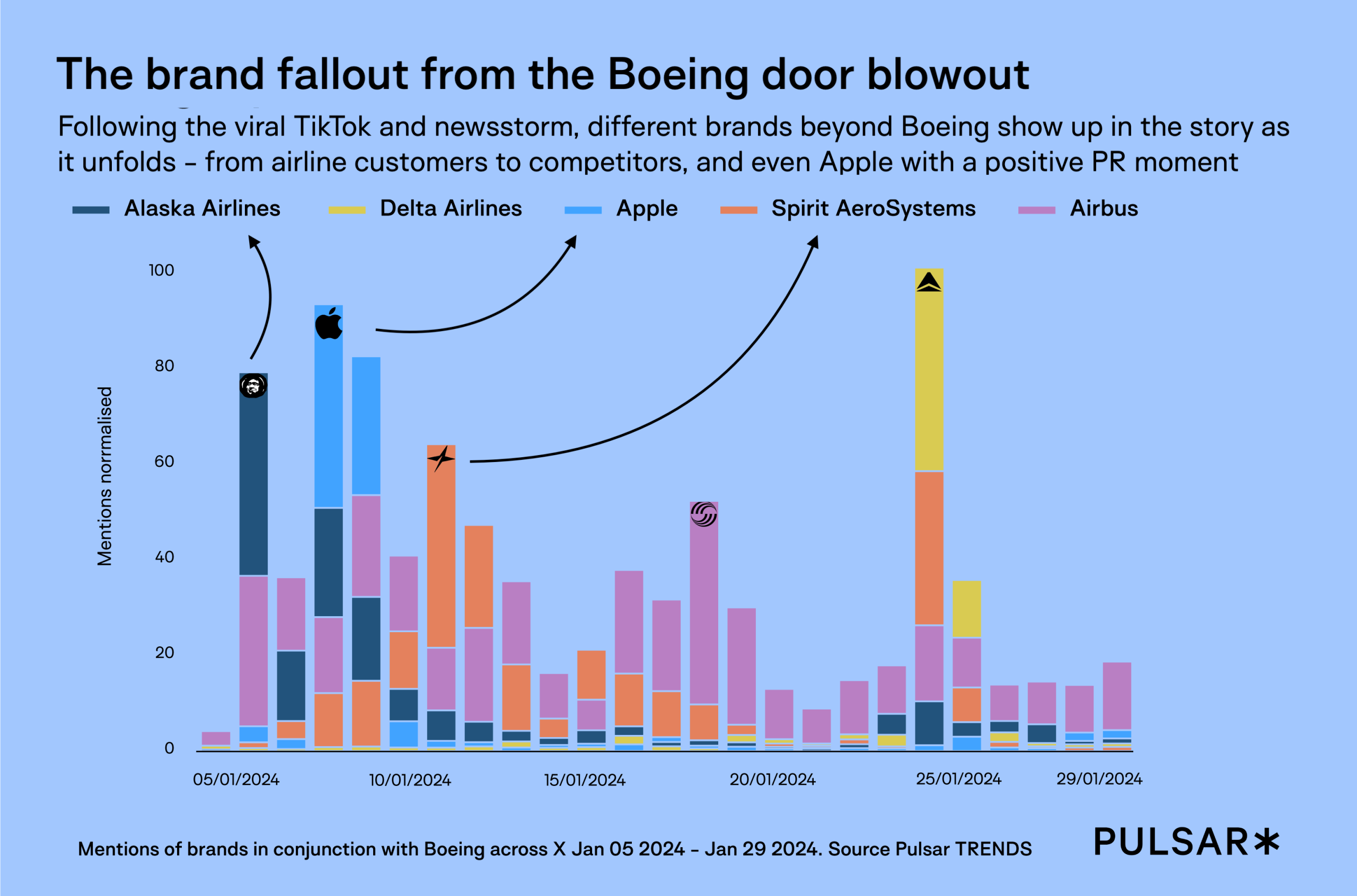
These signals are not theoretical. Pulsar's analysis of the 2024 Boeing door-blowout crisis (Mapping Brand Crises with Narrative Intelligence) traced the same indicators through a live event. The topic-adjacency map shifted: Boeing was suddenly discussed alongside Alaska Airlines, Delta, Apple, Spirit AeroSystems, and Airbus, co-occurrences that did not exist at that scale before the incident. The narrative then propagated out of aviation-safety communities into political and culture-war audiences, where a technical engineering failure was reframed as a "woke corporate" issue. A velocity spike of 55,000 mentions in a single day followed the death of whistleblower John Barnett, as the conversation moved through four phases: Blowout, Tailspin, Politicization, and Conspiracy. That analysis was retrospective mapping rather than a live forecast, but it is direct evidence that the adjacency and propagation shifts described above are real, measurable, and detectable. Read in real time, those same shifts are what open the lead-time window.
The Predictive Listening Maturity Model
The four signals only become operational when an organization has the capability to read them. Most enterprise programs today sit one or two levels below where the signals would be useful. The maturity model below names the five levels and what changes between them.
| Level | Capability | Output the team can act on |
|---|---|---|
| Level 1: Monitor | Volume and sentiment, reported post-hoc. Static dashboards, weekly or monthly cadence. | Retrospective summary. Useful for board reporting, not for operating decisions. |
| Level 2: Track | Themes and entities tracked over time. Trend lines, comparative baselines, alerting on absolute thresholds. | Awareness of what is moving. Most enterprise programs operate here. |
| Level 3: Detect | Velocity-based anomaly detection. Baseline-aware alerting that fires when rate of change exceeds historical norms. | Same-day warning. Lead time hours, not days. The minimum bar for predictive listening. |
| Level 4: Forecast | Propagation and sentiment-trajectory modeling. Multi-signal forecasts with confidence intervals and lead-time horizons. | Forecast with horizon. Lead time 24 to 72 hours, with named audience archetypes carrying the narrative. |
| Level 5: Anticipate | Multi-signal foresight combining narrative, community, visual, and topic adjacency. Scenario-level reasoning across channels. | Strategic foresight. Lead time can extend to weeks for slow-building narratives. Inputs strategy, not just response. |
The upgrade path is not symmetrical. The jump from Level 1 to Level 2 is mostly a tooling exercise. The jump from Level 2 to Level 3 is a methodology exercise: the team has to stop reading volume and start reading velocity. The jump from Level 3 to Level 4 requires propagation modeling and audience segmentation that most platforms cannot do credibly. The jump from Level 4 to Level 5 is organizational: it requires the team to combine signals across the visual, narrative, and community layers, and to integrate the output into strategic planning cycles, not just crisis response.
How Pulsar instruments each level
The Pulsar social listening stack is designed to instrument each level of the maturity model with a specific product, and to combine them into the unified forecast that Level 5 requires.
Narratives AI: velocity and sentiment trajectory
Pulsar Narratives AI instruments Signal 1 and Signal 3. It clusters conversation into the narratives audiences are actively constructing, computes velocity per narrative against a learned baseline, and tracks sentiment trajectory at the narrative level rather than the post level. Inflection-point detection is built in, so the system surfaces "this narrative just changed slope" rather than relying on an analyst to spot it manually.
TRAC: propagation and audience bridge moments
Pulsar TRAC instruments Signal 2. It builds behavioral audience archetypes from real community membership and content behavior, then watches narratives cross from one archetype to another. Bridge moments (the crossing of a narrative from one archetype's community into another's) are flagged as propagation events, because they are the most reliable forecast that a niche story is on its way to mainstream pickup.
Crisis Oracle P.U.L.S.E.: topic adjacency and multi-signal foresight
Crisis Oracle's P.U.L.S.E. methodology instruments Signal 4 and the cross-signal layer of Level 5. It maintains a topic-adjacency baseline per brand, surfaces novel co-occurrence patterns when they emerge, and integrates them with velocity, propagation, and sentiment-trajectory inputs to produce the unified multi-signal forecast that Level 5 anticipation requires. Crisis Velocity is the headline metric Crisis Oracle outputs.
TeamMates Insight Agents: the automation layer
Pulsar TeamMates Insight Agents run on top of the four signal layers, automating the monitoring, alerting, and report-generation cycle so analysts spend their time interpreting forecasts rather than producing them. This is the operational mechanism that makes Level 4 and Level 5 sustainable beyond a single skilled analyst.
Threading underneath all of this is the authenticity layer. Predictive forecasts run on contaminated data forecast bot campaigns, not audiences. Every signal computed in the stack runs on the authenticity-scored dataset Threat Sentinel produces, so the velocity, propagation, and sentiment trajectories represent real human signal rather than coordinated inauthentic activity.
What 72 hours of lead time looks like in practice
The abstract value of predictive listening is "earlier signal". The concrete value is what a team can do in the window the lead time opens up. Three short illustrations make the point.
Scenario 1: A crisis avoided
A consumer health brand's velocity model flags an unusual rate-of-change in a previously low-volume narrative thread on a community platform. Propagation modeling shows the narrative crossing from a single archetype (concerned parents) to a second (independent reviewers). The combined signal triggers an alert 56 hours before any mainstream pickup. The comms team uses the window to brief the customer service team, pre-write a response, and engage three creator-tier stakeholders directly. When the narrative breaks mainstream on day three, the brand has a prepared, calm, evidence-led response in market within hours rather than days. The crisis becomes a manageable conversation rather than a defining moment.
Scenario 2: A trend captured
A beauty brand's topic-adjacency model detects a new co-occurrence pattern: the brand's category language is starting to appear alongside a previously unrelated cultural narrative. The signal is small but distinctive. Forty-eight hours later, the company's product team has a draft creator brief, a paid-social variation in test, and a buyer's note ready to send to retail partners. By the time competitors notice the trend, the brand is already on the inside of the conversation rather than chasing it.
Scenario 3: An innovation cue
A B2B software company's product team uses predictive listening to track narrative velocity in a practitioner community segment relevant to its category. A specific workflow pain point starts accelerating in mention rate across three previously disconnected forums in the same week. The signal is too early to act on as a feature roadmap input on its own. It is exactly the right input as an early customer interview prompt. The team conducts five conversations the following week, and the resulting evidence informs a product bet that becomes the next quarter's most successful release. Predictive listening did not write the spec. It directed the team's attention to a question worth asking three months earlier than the standard win-loss cycle would have.
How to operationalize predictive listening inside a team
The tooling is necessary but not sufficient. The teams that actually move from Level 2 to Level 4 are the ones that change three things alongside the platform.
Roles and the responsibility chain
Predictive output is only useful if there is a clear chain of who reads it, who decides what to do, and who has the authority to act. The pattern that works in enterprise programs is a dedicated insights analyst owning the daily forecast review, a comms or brand lead with named authority to act on Level 3 and 4 alerts, and an executive sponsor (usually CMO or Chief Communications Officer) who reviews the weekly forecast summary and adjudicates ambiguous signals. Without the named authority to act, predictive forecasts produce a paper trail of "we saw it coming" without the operational benefit.
Cadence and the alert ladder
The right cadence is layered. Real-time alerts only for Level 3 velocity-spike events that meet a defined threshold. Daily forecast review (15 minutes maximum) for Level 4 outputs. Weekly forecast meeting (45 minutes) for Level 5 strategic foresight, including cross-functional attendance from product, comms, and risk teams. The temptation to put everything in real-time produces alert fatigue and trains the team to ignore the output. A disciplined alert ladder, with most signals batched to the daily review and only the genuine emergencies escalating immediately, is what makes the system sustainable.
Calibration and the post-mortem cycle
Forecasts are wrong sometimes. The teams that improve are the ones that run a monthly calibration cycle: every alert that fired gets a retrospective tag (true positive, false positive, missed signal), the thresholds are reviewed quarterly, and the analyst team is explicitly measured on calibration improvement, not just alert volume. A predictive system that is never wrong is one that is too conservative to be useful. A system that is calibrated and improving is one the team learns to trust.
Common failure modes and how to avoid them
Three failure modes recur in enterprise predictive listening programs. All three are avoidable with deliberate design.
- False positives from coordinated networks. A velocity spike driven by a coordinated bot or campaign network is not an audience signal. Running every alert against the authenticity layer before it escalates is the single most important quality control.
- Alert fatigue from over-tuned thresholds. Lowering thresholds to "catch everything" produces a dashboard of constant alerts that the team learns to ignore. Tune thresholds upward until the team is acting on roughly 80% of alerts within 24 hours. If less, the threshold is too low.
- Forecast without action chain. A predictive system without a named decision-maker and a pre-agreed response playbook produces "we saw it coming" stories, not avoided crises or captured trends. The action chain is the half of the system that lives outside the platform.
Frequently asked questions
+What is predictive social listening?
Predictive social listening is a methodology that reads social data as a set of leading indicators (velocity, network propagation, sentiment trajectory, and topic adjacency) to produce forecasts about what is about to happen, rather than reports about what already happened. The output includes a lead-time horizon, typically 24 to 72 hours for narrative events, with longer horizons available for slow-building strategic shifts. It is distinct from social monitoring, which is retrospective by design.
+How is predictive listening different from social monitoring?
Social monitoring reports volume, sentiment, and share of voice for a window that has now closed. Predictive listening computes rate of change against a learned baseline, watches narratives propagate across audience archetypes, tracks sentiment slope and inflection points, and detects shifts in topic adjacency before mainstream pickup. The output of monitoring is descriptive. The output of predictive listening is a forecast with a lead-time horizon attached, which is what makes it a strategic rather than a reporting function.
+What are the four signals of predictive listening?
The four signals are conversation velocity (rate of change against a learned baseline, not absolute volume), network propagation (which audience archetypes are picking up the narrative and whether it is crossing into new ones), sentiment trajectory (slope and inflection points rather than averages), and topic adjacency shifts (changes in the co-occurrence map of brands and topics that signal new framing). The four are read together. Forecast confidence is highest when three or four signals fire in sequence.
+What is the Predictive Listening Maturity Model?
The Predictive Listening Maturity Model is a Pulsar framework that names five levels of capability: Monitor (volume and sentiment, retrospective), Track (themes tracked over time), Detect (velocity-based anomaly detection), Forecast (propagation and trajectory modeling with lead-time horizons), and Anticipate (multi-signal strategic foresight). Most enterprise programs currently operate at Level 2. The competitive advantage in 2026 sits at Levels 4 and 5, where the team is producing forecasts with horizons rather than reports after the fact.
+How much lead time can predictive listening realistically provide?
For narrative-level events (a story breaking, a crisis forming, a trend crossing into mainstream), realistic lead times are 24 to 72 hours when three or four signals fire in sequence. For slow-building strategic shifts (category narrative drift, emerging consumer trends, audience archetype migration), lead times extend to several weeks. The window depends on the signal sequence and the baseline volume of the topic. The constraint is that lead time is a property of the methodology, not of the platform alone. An organization operating at Level 2 of the maturity model will not see Level 4 lead times even on a Level 4 platform.
+What is the difference between Pulsar Narratives AI and Crisis Oracle in predictive listening?
Narratives AI instruments the narrative layer of predictive listening: it clusters posts into the stories audiences are constructing, tracks velocity and sentiment trajectory per narrative, and surfaces inflection points. Crisis Oracle, through its P.U.L.S.E. methodology, instruments the multi-signal foresight layer: it integrates velocity, propagation, sentiment, and topic-adjacency signals into a unified forecast and outputs Crisis Velocity as the headline early-warning metric. Together they form the Forecast and Anticipate layers of the maturity model. Narratives AI surfaces the story. Crisis Oracle integrates the story with all the other signals to produce the actionable forecast.
Related reading:
Crisis Velocity: The Predictive Metric for Brand Protection ·
Bot Noise, AI Content, and the Authenticity Crisis ·
Social Listening for Crisis Management ·
AI Narrative Analysis: How AI Reads Public Opinion ·
Best Narrative Tracking Tools for PR Teams 2026 ·
Narrative Attacks and Narrative Risk ·
How to Monitor Brand Narrative and Measure Belief Shift ·
Brand Reputation Monitoring: A Complete Guide for 2026 ·
What is Brand Tracking? (And How It's Changed in the AI Era)
About the author
The Pulsar Platform content team writes about narrative intelligence, audience analytics, and predictive measurement for heads of insights, strategy leaders, and CMOs at enterprise B2B and B2C organizations.
Last updated: May 2026.
If you're interested in how Pulsar Tools can support your brand and strategy, simply fill out the form below and one of our specialists will contact you!