
Mapping Brand Crises: When Narratives Move Faster Than Facts
- Agencies

Social listening for mapping brand crises is the strategic use of multi-channel digital data to identify, track, and interpret reputational risk as it unfolds. Rather than counting mentions or sentiment alone, it combines Audience Intelligence—to understand which stakeholders are driving a crisis—with Narrative Intelligence—to track how stories form, escalate, and change direction across platforms.
As media gatekeeping collapses and narratives fragment, brand crises are no longer isolated events but networked phenomena shaped by cultural and political context. Social listening defines a crisis by audience reaction and narrative mutation, not the triggering incident, enabling organisations to move from reactive response to informed resilience within the digital ‘Golden Hour’.
Traditional tools like surveys operate on delay; social listening maps the live climate of trust, surfacing weak signals in niche communities before volatility reaches the mainstream. For leadership teams, this shift supports earlier, more strategic intervention when reputational risk is still manageable.
What Social Listening Reveals About Mapping Brand Crises Right Now
The current landscape of brand crises is shaped by heightened stakeholder grievance and the increasing weaponization of corporate narratives. Social listening reveals several structural shifts that challenge traditional crisis playbooks.
- Grievance as accelerant: Economic anxiety and institutional distrust have created a “dry tinder” environment, where minor missteps can quickly escalate into crises of values rather than performance.
- Coordinated hostile activism: Among younger audiences, hostile activism—including disinformation and organised online attacks—is increasingly viewed as a legitimate tool for change, meaning crises are often driven by coordination rather than spontaneous outrage.
- Chaos-driven escalation: Many modern crises ignite without warning and resist technical fixes because they stem from cultural failures, not isolated operational issues.
- AI as reputation gatekeeper: Reputation is now shaped as much by what generative AI models surface as by search or media coverage, requiring brands to monitor how they are represented in AI outputs.
- Employees as early signals: Internal sentiment has become externally visible, with negative employee reviews frequently acting as the first weak signal of leadership or governance risk.
How Audience & Narrative Intelligence Apply to Mapping Brand Crises
The application of high-level intelligence to crisis mapping is best understood through the lens of specific, high-stakes scenarios where traditional monitoring would have proved insufficient. Pulsar’s research into the aerospace, finance, automotive, and sustainability sectors provides the evidentiary basis for this strategic shift.
The "Cluster" Crisis: Mapping Boeing’s Blowout
In our analysis of the Boeing reputation crisis, we utilized the concept of the "Cluster" crisis to illustrate how a single brand's failure can destabilize an entire ecosystem. Following the high-profile Alaska Airlines cabin blowout in 2024, narrative intelligence revealed that the fallout was not contained to Boeing alone. Instead, the conversation created a "tailspin" that implicated competitors (Airbus), customers (Delta), and even unrelated technology partners (Apple).
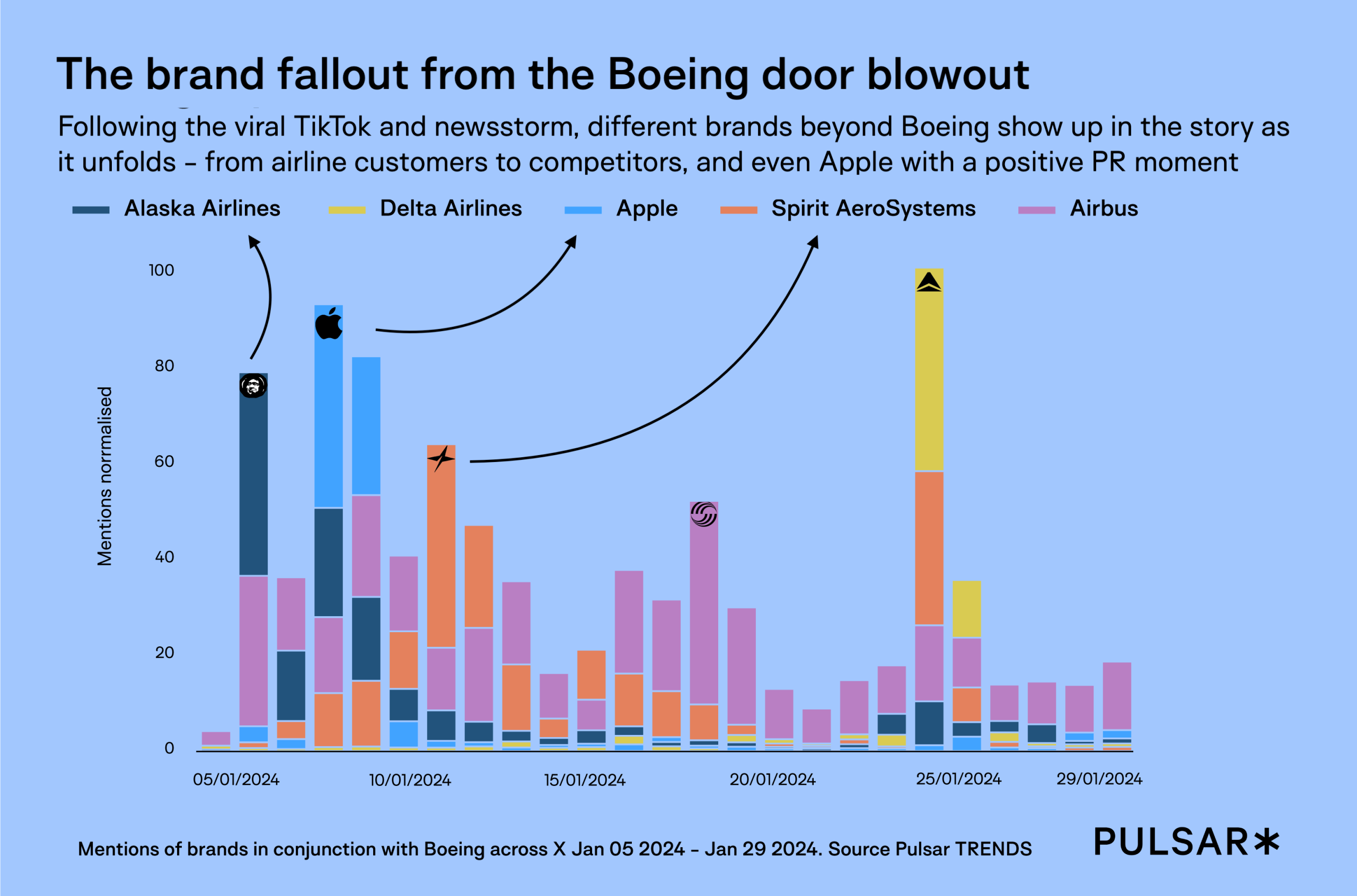
This mapping of the narrative arc showed that a crisis is rarely a closed loop. For Boeing, the operational failure was rapidly reframed as a "culture war" issue. Social listening detected a significant spike in political conversation—distinct from safety concerns—where figures like Elon Musk cast the company’s issues as a result of "woke" corporate mentality prioritizing DEI over engineering excellence. This politicization mutated the crisis from a technical engineering challenge into a polarized battle over corporate values.
The narrative darkened further following the death of whistleblower John Barnett. Pulsar detected a massive spike of 55,000 mentions in a single day, linking the brand to "foul play" and "self-inflicted" wounds. This shows how a safety crisis can evolve into a conspiracy thriller narrative if the information vacuum is not filled with authoritative data. For decision-makers, the implication is that crisis mapping must monitor "adjacent narratives" to understand when an operational issue is being hijacked by external political or social agendas.
| Narrative Phase (Boeing) | Primary Driver | Audience Reaction | ||
| The Blowout | Operational failure. | Immediate safety concern and technical speculation. | ||
| The Tailspin | Ecosystem involvement. | Scrutiny of airline partners and competitor comparisons. | ||
| The Politicization | Cultural reframing (DEI). | Polarized debate over corporate "wokeness." | ||
| The Conspiracy | Whistleblower incident. | Deep distrust and narratives of corporate "foul play." |
Organizations must map their "reputational neighbors." A crisis for a peer brand or a key supplier can rapidly become a crisis for the entire sector. Using Pulsar TRAC, brands can identify these spillover effects early and distance themselves from the specific failure while reinforcing their own safety or engineering protocols.
The "Hypocrisy" Crisis: Weaponized Terminology and Greenwashing
The rise of greenwashing accusations represents a new form of "Hypocrisy Crisis" that is particularly difficult to map without narrative intelligence. In our reports on The Audiences of Sustainability, we mapped how terms like "Ethical," "Conscious," and "Green" have become high-risk keywords that trigger immediate scrutiny.
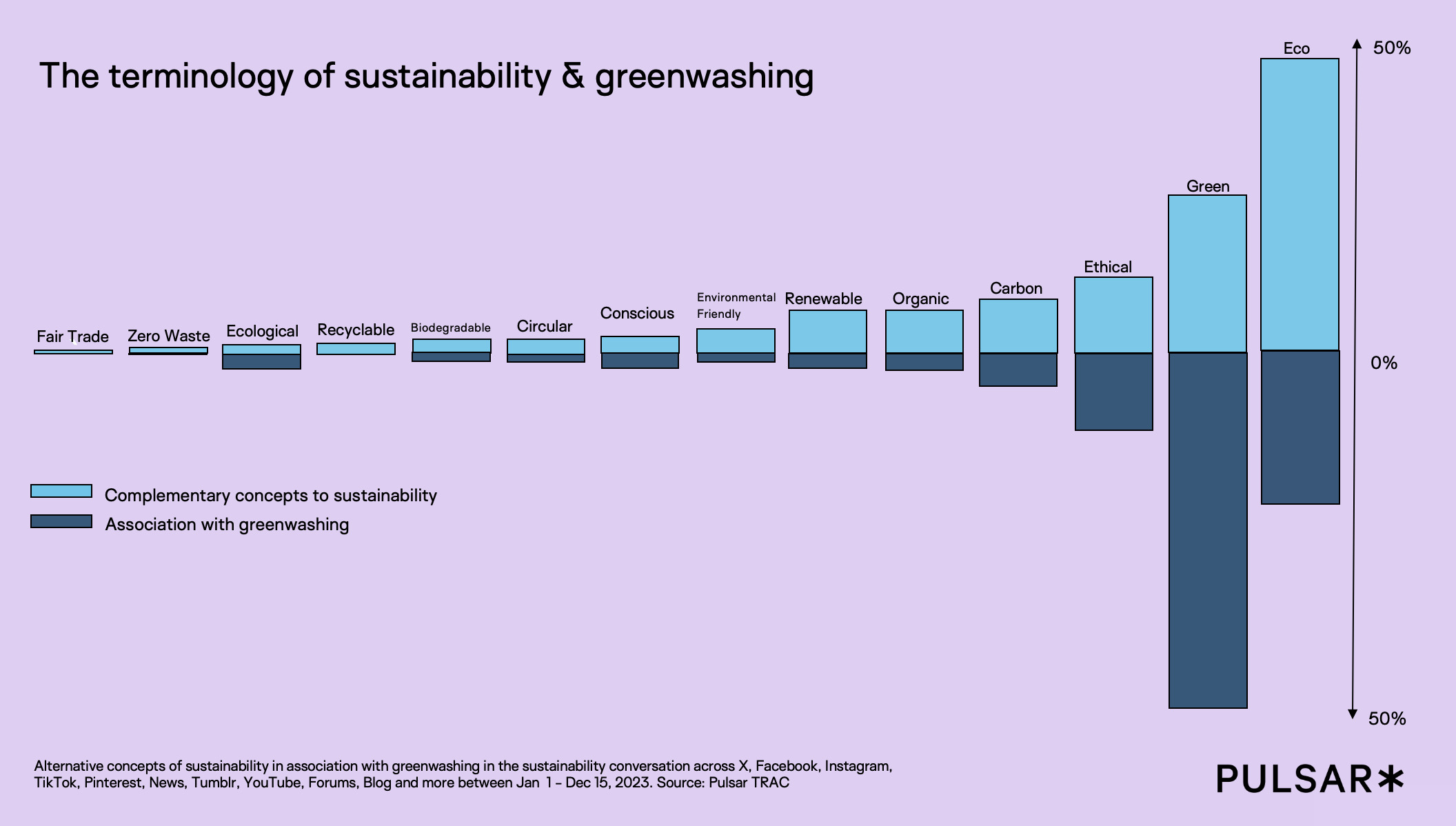
The mapping revealed a profound "Audience Split." Climate activists typically drive the greenwashing narrative, calling out perceived gaps between corporate claims and reality. Conversely, advertising agencies and industry strategists often discuss the strategy of sustainability in a way that feels disconnected from public reception. This disconnect creates a "reputational trap" where a brand’s attempts to communicate its ESG (Environmental, Social, and Governance) goals are seen as evidence of manipulation.
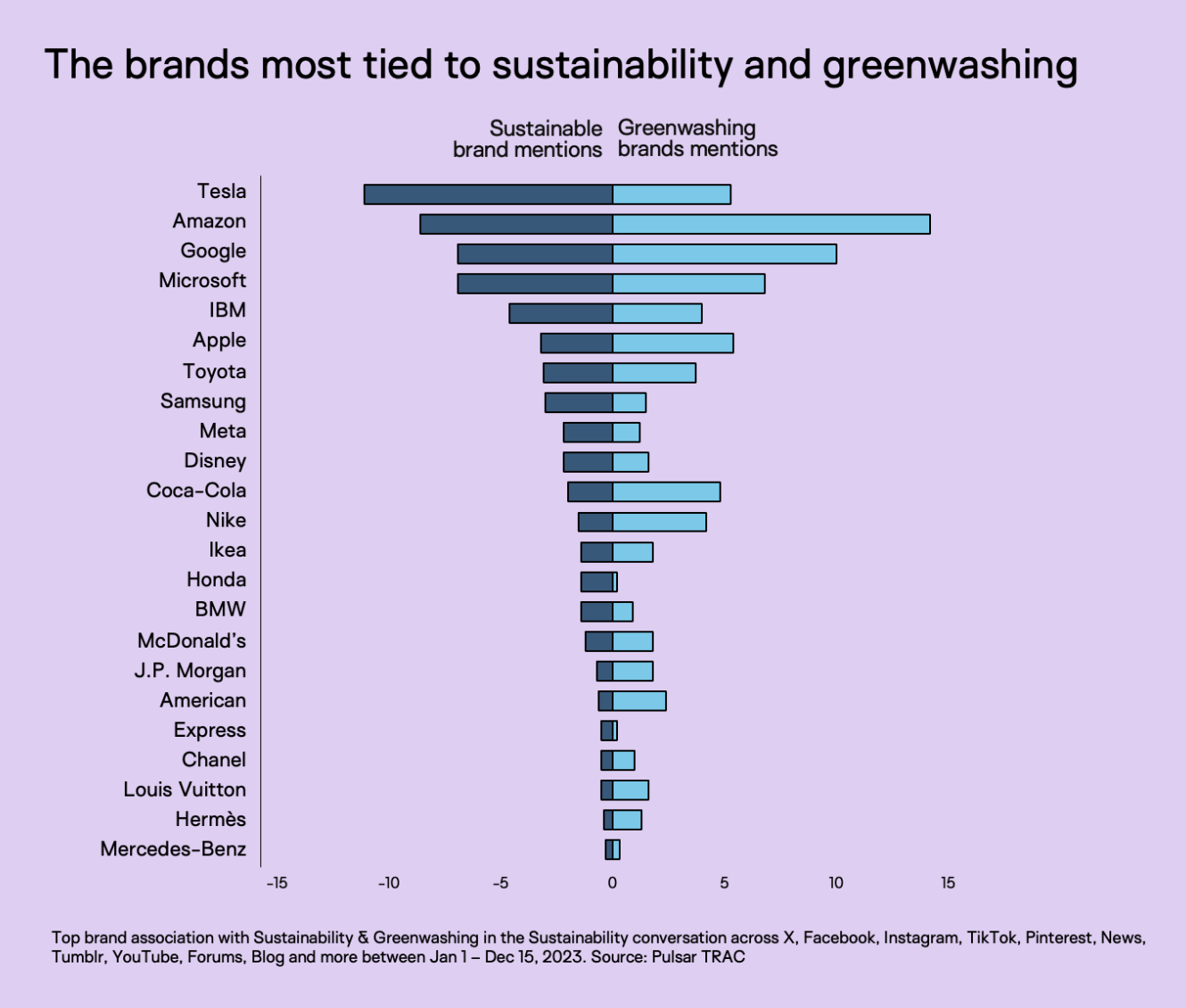
Examples include Toyota, which faced accusations for its perceived delay in EV adoption, and Coca-Cola, whose sustainability goals were linked to a "war on farmers". These narratives often merge with geopolitical misinformation, making the crisis map even more complex. Brands must audit their sustainability vocabulary before launching campaigns. By using Pulsar Narratives, leaders can see how specific terms are currently being "weaponized" by different audience segments and adjust their messaging to avoid triggering a hypocrisy narrative.
The "Trust" Collapse: Quantifying Deception and Channel Dynamics
The Volkswagen Dieselgate scandal remains the benchmark for quantifying the impact of corporate deception on social perception. In our research, we found that trust in the VW brand fell by a staggering 57% during the scandal. The analysis of brand attributes showed that even the most loyal consumers "lost their faith to the point of desertion," a phenomenon we describe as the "Mud Sticks" effect.
Crucially, the data revealed a distinct split in channel dynamics:
- News and Blogs: Drove visibility—the primary source of "what people saw".
- Twitter (X): Drove volume and reach—the primary engine of "how people reacted".
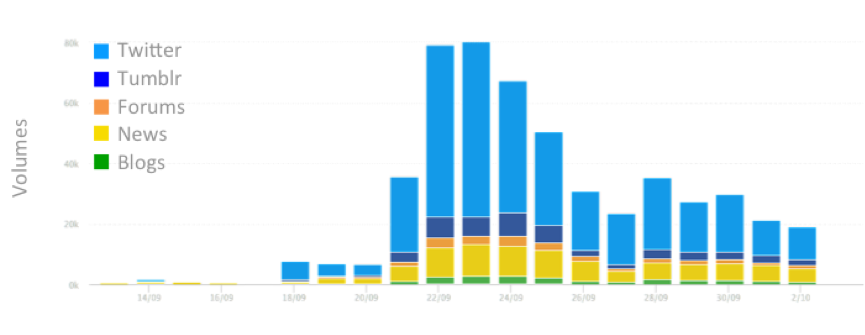
This distinction is vital for crisis response strategy. While many brands attempt to use humor or lighthearted engagement to defuse a crisis (as O2 successfully did during a network outage), our analysis argued that this would be disastrous for a crisis of deception like VW's. In such cases, the only viable route is a "sincere admission of guilt" and a commitment to transparency.
The tone of a crisis response must match the nature of the crisis. In crises of "competence," humor and rapid service-recovery can work. In crises of "integrity," only radical transparency and sincerity can begin the long process of trust recovery. Decision-makers should use Pulsar CORE to track how their official messaging aligns with the emotional needs of the audience detected in TRAC.
The "Velocity" Crisis: Silicon Valley Bank and Reputation Alert Quadrants
The collapse of Silicon Valley Bank (SVB) represents the ultimate "Velocity Crisis," where the speed of modern communication transformed a financial speculation into a mainstream panic within hours. Our research into the Silicon Valley Bank collapse showed that there was "low social buzz" offering limited warning before the stock plummeted; however, once the decline began, the conversation exploded instantly.
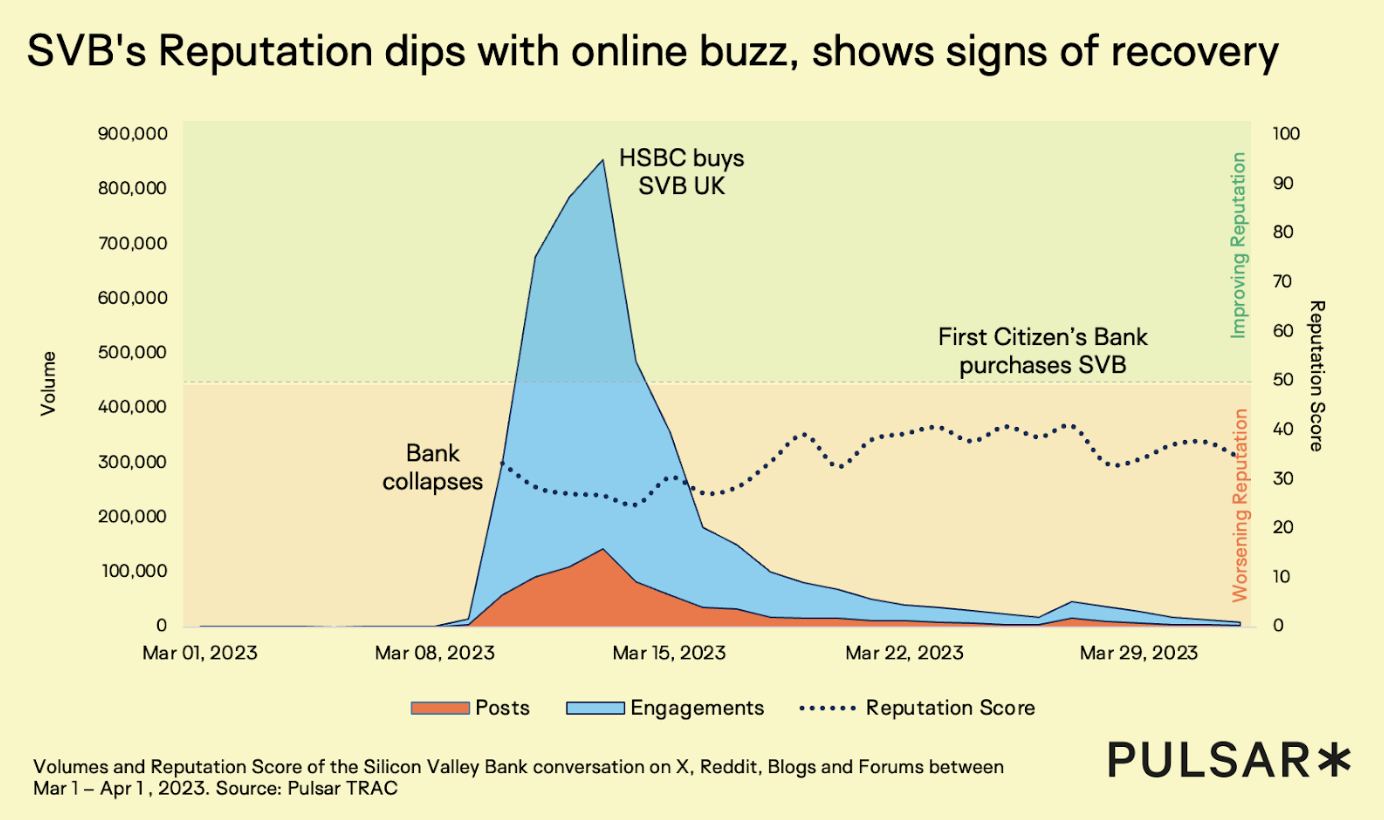
The SVB crisis map showed a distinct fracture along political lines. US Conservatives blamed "woke" policies (a narrative parallel to the Boeing crisis), while Progressives blamed deregulation. Tech startups, the core customer base, were the only group focused on the practical "payroll" reality of the situation.
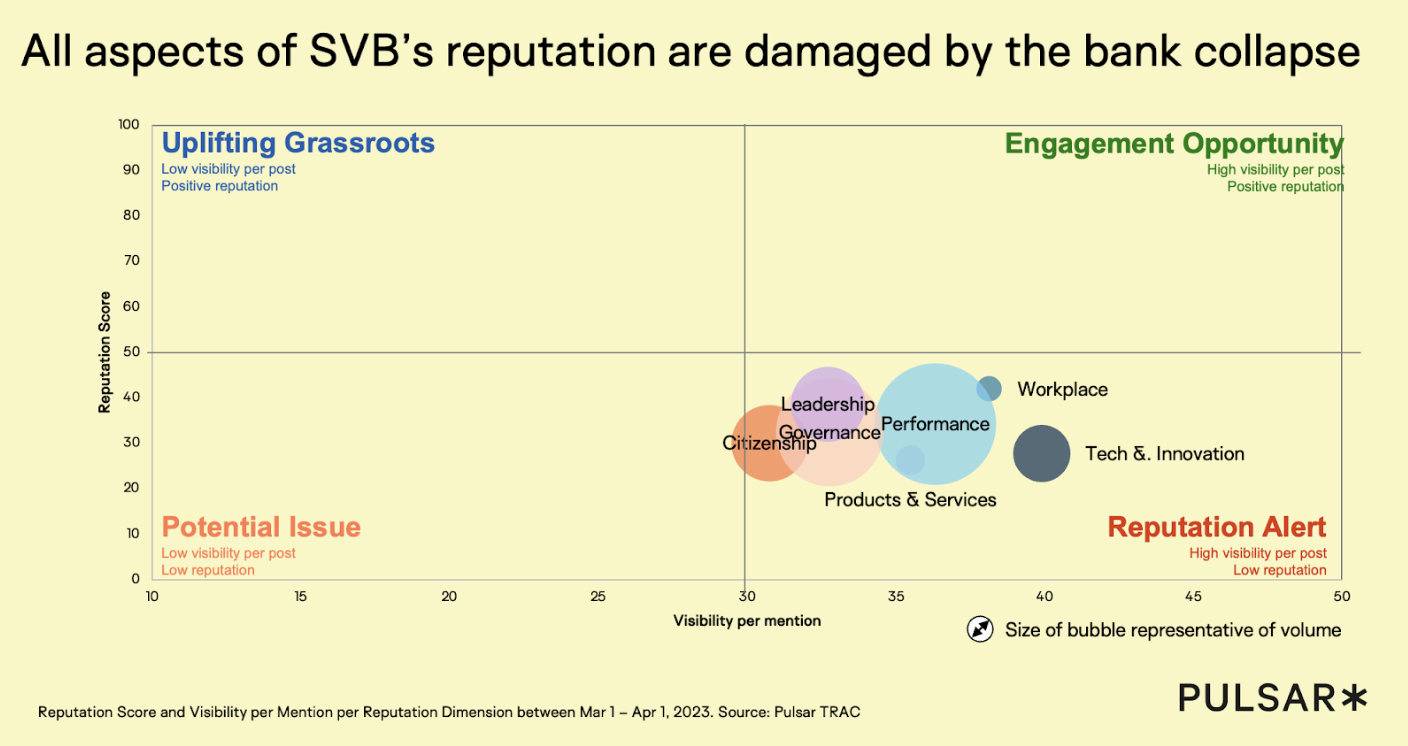
To help leaders navigate this, we utilize the Reputation Alert Quadrant, which maps Visibility against Reputation. SVB moved instantly into the "High Visibility / Low Reputation" zone—the most dangerous quadrant for any brand. In this zone, silence is seen as guilt, but any communication is scrutinized by polarized audience segments looking to confirm their existing biases.
| Visibility | Reputation | Quadrant Status | Recommended Action | |||
| Low | High | Under-the-radar | Build "reputational capital" through proactive storytelling. | |||
| High | High | Brand Leader | Maintain consistency; focus on "brand stewardship." | |||
| Low | Low | Vulnerable | Addressing core operational or cultural issues before they scale. | |||
| High | Low | Crisis Alert | Urgent, high-stakes communication; total transparency. |
From this we can learn that speed is the only defense in a velocity crisis. Organizations must have "Message Banks" and pre-approved response templates for various scenarios—from data breaches to financial volatility—to ensure they can act within the ‘Golden Hour’.
Practical Framework: Mapping the Crisis Lifecycle
To effectively act on social listening insights, organizations must adopt a "Listen-Map-Activate" framework that integrates audience intelligence into every stage of the crisis lifecycle.
Stage 1: Detection of Weak Signals
The objective is to move from "monitoring" to "early-threat detection." This involves setting up queries that go beyond brand names to include "Risk Keywords" identified in the Greenwashing and Boeing reports (e.g., "safety culture," "ethical," "whistleblower")
- Signals to track: Spikes in negative sentiment on niche forums, employee grievances on Glassdoor, and the emergence of coordinated bot activity.
Stage 2: Narrative Mapping
Once a signal is detected, the brand must map the "Narrative Arc." This involves identifying which communities are amplifying the story and whether it is merging with existing cultural or political conflicts.
- Questions to ask: Is this a "Cluster" crisis involving our ecosystem? Is there an "Audience Split" in how the story is being interpreted?.
Stage 3: Activation of Segmented Response
Traditional crisis management often relies on a single press release. Narrative intelligence demands a segmented response.
- Actionable steps: Deliver technical, fact-based data to industry experts; sincere, empathetic admissions of guilt to loyalists; and transparent, long-form content to news outlets to control the "visibility" layer of the crisis.
Conclusion & Next Steps
Mapping brand crises in 2026 is no longer a discretionary PR function; it is a core requirement for organisational resilience. As trust fragments and grievance intensifies, reputation has become one of the most valuable assets a brand has — accounting for nearly 30% of market value in the S&P 500. Reputation is therefore also one of the most vulnerable assets a business holds, with material impact on enterprise value and long-term viability.
Social listening provides the only real-time framework capable of navigating this environment. By combining Audience Intelligence to identify who is driving a crisis with Narrative Intelligence to understand how stories are forming and escalating, organisations can shift from reactive damage control to proactive risk management. Across cases such as Boeing, Wirecard, and Silicon Valley Bank, the pattern is consistent: crises that are not mapped early become crises that cannot be contained.
Key takeaways for leadership
- Beyond mentions: Move from tracking volume to tracking narrative direction of travel.
- Niche matters: Monitor vertical forums and specialist communities where crises often surface first.
- Segment stakeholders: Activists, investors, employees, and customers interpret crises differently—and require distinct responses.
- Speed and sincerity: Velocity crises demand immediate action; trust crises demand transparency and accountability.
- AI as gateway: Monitor how generative AI systems represent your brand, as these are increasingly shaping public perception.
To stay up to date with our latest insights and releases, sign up to our newsletter below: