Social Listening for Competitive Analysis: From Mention Counting to Narrative Intelligence


TL;DR
Most social listening tools count competitor mentions. Pulsar clusters them into narratives, segments them by audience, and scores which stories are gaining momentum — giving strategy and comms teams intelligence they can act on before a narrative peaks.
Social listening has become a standard input for competitive analysis, with platforms including Brandwatch, Meltwater, and Talkwalker all offering competitor tracking as a core feature. The meaningful difference between tools is not whether they track competitors, but what they track.
Basic platforms measure mention volume, sentiment, and share of voice. Advanced platforms, led by Pulsar, cluster competitor conversations into narratives, segment the audiences amplifying those narratives, and score which stories are gaining momentum. For teams running competitive intelligence at scale, the distinction between mention counting and narrative intelligence determines whether social listening surfaces signal or noise.
Published April 2026 · Pulsar Platform Editorial Team
Key Takeaways
- ▸Most social listening platforms report competitor mention volume and sentiment. Volume tells you what happened; narrative momentum tells you what is about to happen.
- ▸Pulsar's audience-first architecture segments every competitor mention by the community producing it at ingestion, producing fundamentally different intelligence than keyword-first platforms.
- ▸Narrative momentum scoring identifies which competitor stories are accelerating before they reach peak volume, giving comms and strategy teams a meaningful window to respond.
- ▸Community-level share of voice is more actionable than aggregate share of voice — it reveals whether a competitor is gaining ground in the audiences that matter to your business.
- ▸For APAC markets, data source coverage (Weibo, WeChat, Xiaohongshu, Douyin) is the critical platform selection criterion — most Western platforms cover these only partially.
In This Article
- What is social listening for competitive analysis?
- What social listening actually reveals about competitors
- How to use social listening for competitor research: a structured approach
- Social listening platforms for competitive analysis: comparison
- Competitor analysis examples: what social listening reveals in practice
- How to choose a social listening platform for competitive analysis
- Frequently asked questions
What is social listening for competitive analysis?
Social listening for competitive analysis is the practice of monitoring and interpreting the public conversation around competitor brands, products, and categories to inform strategic decisions. At its core, it answers four questions: what is being said about competitors, who is saying it, how fast those narratives are spreading, and what they signal about shifts in market positioning.
The use case spans several functions. Comms and PR teams use competitive social listening to anticipate narrative risks before they escalate. Product and insight teams use it to identify unmet needs surfaced in competitor reviews and community discussions. Brand teams use it to benchmark narrative share of voice and track how competitor campaigns land across different audience segments.
The challenge is that most social listening implementations for competitive analysis stop at volume and sentiment. A spike in competitor mentions triggers an alert; a drop in sentiment scores flags a potential issue. But volume and sentiment are lagging indicators. By the time a narrative shows up in volume data, it has often already reached the audiences that matter most.
What social listening actually reveals about competitors
Effective competitive social listening produces six categories of intelligence:
1. Narrative positioning
What stories are competitors actively building, and which are forming organically without their control? Narrative clustering groups millions of posts into coherent themes, distinguishing between managed brand narratives (campaign-driven) and emergent community narratives (authenticity-driven or crisis-driven).
2. Audience composition
Who is amplifying competitor content? Network analysis maps the communities sharing, engaging with, and creating content about competitors — revealing whether their audience is growing into new segments or concentrating in existing ones. For a methodological guide, see How to Understand Your Audience Beyond Demographics.
3. Share of voice by community
Aggregate share of voice figures obscure more than they reveal. The relevant question is not "does Competitor A have more mentions than us?" but "does Competitor A own the conversation in the audience segment we are targeting?" Community-level share of voice answers this.
4. Narrative momentum
Some competitor narratives are accelerating; most are not. Momentum scoring quantifies how quickly a narrative is gaining velocity, predicting future volume rather than reflecting it. A narrative with low current volume but high momentum is more strategically important than one with high volume and flat momentum.
5. Content and channel strategy
Which formats, channels, and topics are generating meaningful engagement for competitors? Social listening at the content level reveals patterns in competitor creative strategy without relying on self-reported data.
6. Crisis and risk signals
Negative narratives form in community spaces before they reach mainstream channels. Early detection of emerging competitor crises — a form of narrative risk monitoring — is a legitimate competitive intelligence use case: understanding when a competitor is under reputational pressure informs your own timing and positioning decisions.
How to use social listening for competitor research: a structured approach
Step 1: Define your competitive intelligence questions
Social listening generates volume. Before configuring monitoring, define the specific questions the data needs to answer. Common competitive intelligence questions include:
- Which competitor narratives are resonating with the audience segments we are targeting?
- Where are competitors gaining share of voice in categories we want to own?
- What unmet needs are surfacing in competitor communities that our product could address?
- Which competitor campaigns are generating genuine audience engagement versus paid reach?
- Are there early signals of a competitor reputational event that could shift market dynamics?
The questions determine the query structure, the data sources required, and the analytical approach.
Step 2: Configure competitor monitoring with audience segmentation
Standard competitor monitoring tracks brand mentions and hashtags. Audience-first monitoring tracks the communities generating those mentions. The difference matters because the same competitor mention means different things depending on whether it originates in an industry analyst community, a consumer advocacy group, a journalist network, or a general public audience.
Pulsar TRAC natively segments every competitor mention by audience at ingestion, so the question "who is saying this?" is answered alongside "what are they saying?" without requiring a secondary analysis step.
Step 3: Cluster competitor conversations into narratives
Keyword monitoring produces lists of mentions. Narrative clustering produces the stories within those mentions. For a competitor tracking exercise, narrative clustering reveals:
- Which stories competitors are successfully associating their brand with
- Which stories are associating with their brand without their intention (emerging issues, community concerns, third-party commentary)
- How narrative prominence shifts over time relative to your own brand narratives
Pulsar Narratives AI processes competitor data through the same narrative clustering pipeline it applies to brand data, producing a side-by-side narrative map of the competitive landscape.
Step 4: Score narrative momentum
Not all competitor narratives warrant the same response. Momentum scoring separates high-velocity narratives (accelerating fast, likely to peak) from plateau narratives (widely discussed but not growing) and declining narratives (losing audience engagement).
For competitive intelligence, momentum scoring answers: which competitor narrative should I be responding to now, versus monitoring at a lower frequency?
Step 5: Translate findings into strategic actions
Competitive social listening data is most valuable when it connects directly to decisions. Typical strategic applications include:
- Positioning adjustments: Identify narrative gaps where competitor messaging is weak and your product is strong
- Content and campaign timing: Launch counter-narrative content when competitor momentum is decelerating
- Product roadmap input: Surface unmet needs from competitor community discussions
- Crisis opportunity mapping: Understand the reputational landscape before making bold category claims
- Sales enablement: Equip sales teams with evidence-based competitor narratives drawn from real audience data rather than internal assumptions
Social listening platforms for competitive analysis: comparison
| Platform | Narrative clustering | Audience segmentation | Momentum scoring | Multilingual | Crisis early-warning | G2 |
|---|---|---|---|---|---|---|
| Brandwatch | Limited | Post-processing | No | Broad | Alert-based | 4.4 |
| Pulsar | Native (Narratives AI) | Native (audience-first) | Yes (proprietary) | 200+ languages | Yes (Crisis Oracle) | 4.3 |
| Talkwalker | Partial | Limited | No | Strong multilingual | Alert-based | 4.2 |
| Meltwater | Summary-level | Limited | No | Broad | Alert-based | 4.1 |
| Quid (NetBase Quid) | Strong NLP | No | No | Moderate | No | 4.1 |
| Sprinklr | Limited | No | No | Broad | Alert-based | 3.9 |
Source: G2 ratings as of Q1 2026. Feature assessment based on published product capabilities.
For a broader view of the market, see our guide to the best social listening tools in 2026.
Brandwatch (G2: 4.4)
Best for: Structured monitoring workflows requiring strong data volume and enterprise integrations — well-suited to compliance-conscious teams with established reporting processes.
Limitations: AI capability limited to summarisation; lacks native narrative clustering or audience-first architecture. Competitive intelligence use cases requiring narrative depth will hit analytical limits quickly.
Pulsar (G2: 4.3)
Best for: Global comms, insight, and strategy teams that need to understand not just what is said about competitors, but who is saying it and which narratives are accelerating — across 45+ source types and 200+ languages.
Limitations: Premium pricing positions it for enterprise and mid-market buyers; teams with basic brand monitoring needs or small budgets may find dedicated, lighter-weight tools more practical as a starting point.
Talkwalker (G2: 4.2)
Best for: Teams needing strong visual analytics, multilingual coverage, and news or broadcast monitoring across global markets.
Limitations: Audience segmentation depth and narrative intelligence are limited compared to audience-first platforms. Competitive intelligence output tends toward volume and sentiment rather than narrative or community-level analysis.
Meltwater (G2: 4.1)
Best for: Teams entering social listening for the first time; media monitoring and PR coverage tracking at a competitive price point.
Limitations: Competitive intelligence use cases hit its analytical ceiling quickly. Better suited to media monitoring than audience or narrative analysis; not designed for community-level segmentation or narrative momentum.
Sprinklr (G2: 3.9)
Best for: Enterprise teams already running Sprinklr for CX or social management who want a unified platform and can consolidate social listening into an existing contract.
Limitations: The listening module is not purpose-built for competitive intelligence. Lacks narrative clustering, audience segmentation, and crisis early-warning; for teams with deep competitive intelligence requirements, a dedicated platform will outperform it.
Competitor analysis examples: what social listening reveals in practice
Example 1: Spotting a competitor narrative vulnerability before it peaks
Pulsar's greenwashing research created using Pulsar TRAC shows how category-level monitoring can surface competitive advantage. By tracking audience conversations around sustainability claims, the analysis identified Apple, Coca-Cola, Nike, and J.P. Morgan as brands facing backlash for environmental messaging — with Apple drawing particular scrutiny over its carbon-neutral Apple Watch. Tesla, by contrast, proved significantly more resilient, its credibility grounded in a core product mission audiences already accept as genuinely sustainable.
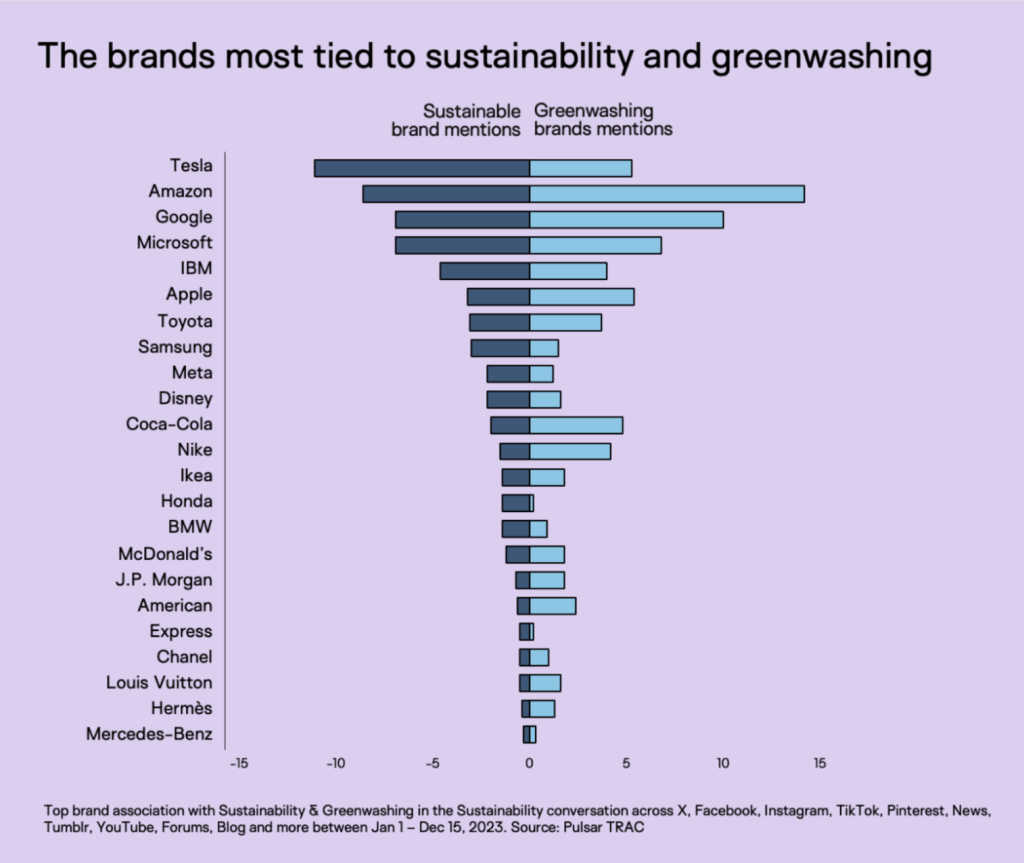
For brands in the same categories, this analysis pinpoints the specific types of claim most likely to attract criticism — and shows exactly where competitors are exposed.
Example 2: Identifying unmet needs in competitor communities
Standard competitive benchmarking compares mention volumes and sentiment scores. Audience intelligence goes further, measuring the emotional architecture of competitor relationships. Pandora used Pulsar TRAC to reveal that brand love is not a single metric but a compound of shared values, authentic identity, and a brand's integration into daily life — with more than half of surveyed marketers agreeing that a truly loved brand must align with a customer's values.
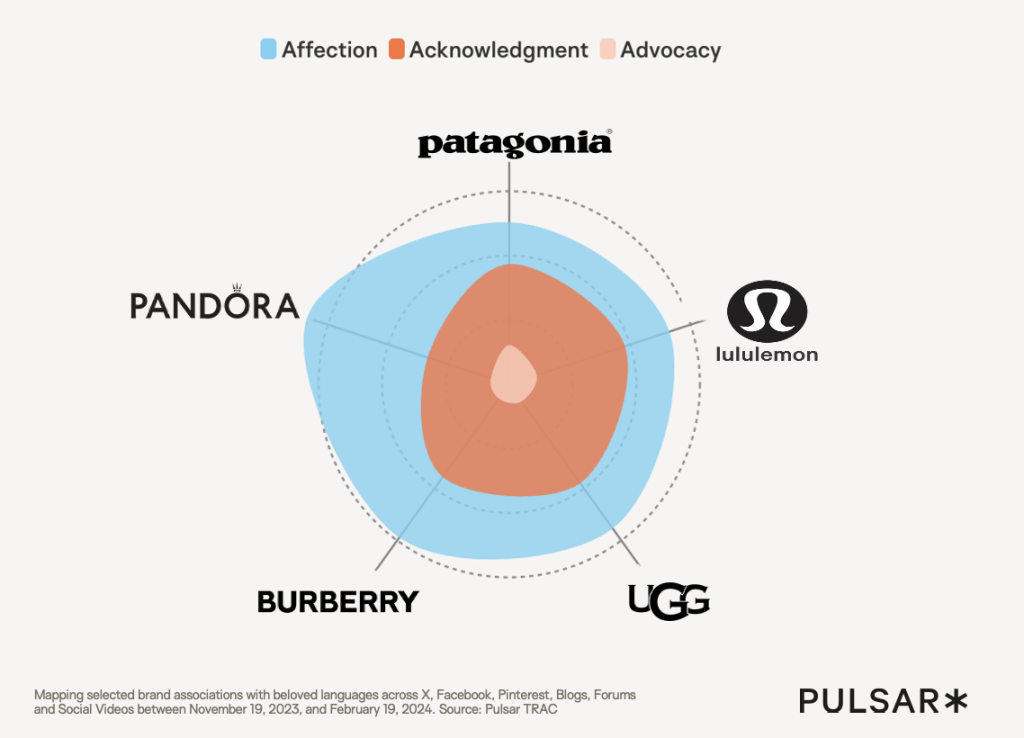
By mapping how Pandora and comparable brands — including Apple, Nike, and Adidas — were discussed across audience communities, the analysis surfaced specific competitor weaknesses: neglecting existing customers, inconsistent messaging, and failure to act on cultural signals. These are vulnerabilities invisible to share-of-voice analysis. Social listening made them measurable and, crucially, actionable.
Example 3: Mapping brand personality shifts - the AI chatbot competitive landscape
Pulsar's Social Brand Personality Index tracked public perception of ChatGPT, Claude, and Gemini from August 2023 to July 2024. ChatGPT saw a significant decline in perceived functionality as user expectations outpaced its reputation. Claude recorded a drop in sincerity driven by conservative audience associations with its ethical principles. Gemini struggled to recover excitement ratings after its rebrand from Bard.
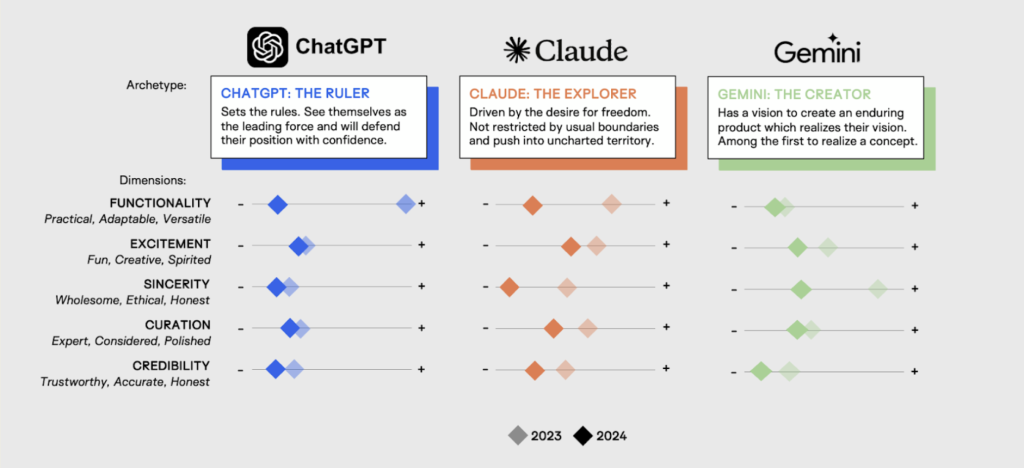
Each finding maps directly to a competitor opportunity — on reliability, authenticity, and distinctiveness respectively. Applied to any competitive set, the methodology transforms qualitative brand perception into a structured map of where advantages can be built.
How to choose a social listening platform for competitive analysis
If you are a global comms or PR team running competitor narrative tracking across multiple markets, prioritise multilingual narrative clustering and momentum scoring. You need to know which competitor stories are accelerating in which markets, not just total global volume. Pulsar's 200-language coverage with native narrative clustering is built for this use case.
If you are an insight or research team building competitive intelligence reports for internal stakeholders, prioritise audience segmentation depth and community-level analysis. Platforms with native audience-first architecture produce more analytically coherent output than those with bolt-on segmentation modules.
If you are a brand or marketing team benchmarking share of voice and campaign performance against competitors, prioritise content-level analytics and channel-by-channel breakdowns. Ensure the platform covers the sources your competitors are actually active on, including owned channels and category-relevant platforms beyond the major social networks.
If you are an enterprise procurement or strategy team evaluating platforms for a competitive intelligence programme, prioritise compliance (SOC 2 Type II, ISO 27001), data retention depth (24 months minimum for trend analysis), and API flexibility for integration with existing intelligence infrastructure.
If you are an agency managing competitive monitoring across multiple clients, prioritise breadth of data sources, multi-account management, and visual reporting outputs clients can act on independently.
Explore Pulsar's competitive intelligence capabilities
Pulsar TRAC combines social listening with native audience segmentation and Narratives AI to support competitive monitoring at the narrative level, across 45+ source types and 200+ languages. Explore Pulsar's social listening platform →
Frequently asked questions
+What is the difference between social listening and social monitoring for competitive analysis?
Social monitoring tracks specific, predefined terms: brand names, product names, hashtags. Social listening interprets the meaning behind what is tracked, clustering mentions into narratives, segmenting by audience, and identifying trends and risks that would not surface from keyword counts alone. For competitive analysis, social monitoring tells you how often competitors are mentioned; social listening tells you what those mentions mean and where they are heading.
+How much historical data do I need for competitive social listening?
Competitive benchmarking requires at least 12 months of historical data to account for seasonality in conversation patterns. Longitudinal trend analysis comparing your narrative trajectory against competitors over product cycles or campaign periods typically requires 18 to 24 months. Platforms with rolling 24-month data retention, like Pulsar TRAC, support this without requiring archive retrieval.
+Can social listening reveal competitor strategy before it is publicly announced?
Yes, with meaningful limits. Community conversations about competitor products, job postings correlated with product development activity, beta tester discussions, and analyst commentary often signal strategic direction before formal announcements. Social listening captures these signals when the monitoring covers the right community spaces. It does not replace human intelligence or structured market research, but it surfaces early signals that direct investigation.
+What is narrative momentum scoring and how does it apply to competitor tracking?
Narrative momentum scoring measures how quickly a conversation cluster is accelerating or decelerating, expressed as a rate of change rather than a volume count. For competitor tracking, it identifies which competitor narrative is gaining velocity right now and will likely peak in the coming days, allowing teams to respond proactively rather than reactively.
+How accurate is social listening for competitive intelligence across languages?
Accuracy varies significantly by platform and language. Platforms with native-language models or trained multilingual classifiers produce substantially better results than those applying translated English-language models. For APAC-market competitive intelligence, coverage of platforms including Weibo, Xiaohongshu, and Douyin with native-language analysis is the meaningful differentiator.
+Can I use social listening to identify competitor influencers and community amplifiers?
Yes. Network analysis maps which accounts are driving the amplification of competitor narratives, segmented by community affiliation and topic focus. Pulsar's Visibility Score identifies competitor amplifiers by topic relevance, not by total follower count, which produces a more accurate picture of who actually has influence in the conversations that matter.
+What is the difference between share of voice and narrative share of voice?
Share of voice measures the percentage of total category mentions attributable to your brand versus competitors. Narrative share of voice measures the percentage of a specific thematic conversation your brand owns versus competitors. A brand can have low aggregate share of voice while leading narrative share of voice in the specific stories that drive purchase decisions in its target segment. Narrative share of voice is the more strategically meaningful metric for competitive positioning.
If you're interested in how Pulsar Tools can support your brand and strategy, simply fill out the form below and one of our specialists will contact you!