Pulsar vs Onclusive: Audience Intelligence vs Media Intelligence

TL;DR
Pulsar Platform and Onclusive both work in social listening and media intelligence, but they take different approaches. Onclusive is a social listening and media intelligence platform. Pulsar is an audience and narrative intelligence platform built around community mapping and predictive narrative analysis powered by AI agents.
- ▸Onclusive leads on breadth: Broad data sources across social and web (including TV, radio, and surveys), a rare LinkedIn integration, and Onclusive’s earned-media and PR measurement stack.
- ▸Pulsar advances social listening and audience intelligence across social, broadcast (TV, radio, podcasts), and dark web, plus Narratives AI, community-mapping audience segmentation, visual and social video analysis, and an agentic layer (Pulsar TeamMates and the autonomous research agent that turns social signals into actionable media and comms plans.
- ▸On media intelligence, it is really group versus group: Pulsar Group also owns Vuelio (EMEA) and Isentia (APAC), which frees the Pulsar platform to specialize in audience intelligence.
- ▸Both are enterprise, custom-quote. Both include SOC 2 Type II, as well as ISO 27001.
What you’ll learn
- What Onclusive is
- Onclusive’s genuine strengths, and where it leads
- How the two approaches differ
- Where Pulsar’s approach differs
- A feature comparison across 15 dimensions
- Which teams typically choose each platform
Onclusive and Pulsar Platform are frequently shortlisted together by enterprise teams buying social listening and media intelligence, but they answer questions from different starting points. Onclusive, whose social listening product was formerly sold as Digimind, is a broad media and market intelligence platform. Pulsar is a full-spectrum social and media intelligence platform: advanced social listening on top of broadcast data (TV, radio, and podcasts) and dark web sources, combined with audience intelligence, Narratives AI, and an agentic toolset (Pulsar TeamMates and the Pulsar autonomous research agent) that turns social signals into actionable media and comms plans.
The cleanest way to frame the choice: Onclusive connects listening to earned-media measurement; Pulsar connects it to the communities and narratives behind a conversation.
In this article
What is Onclusive?
Onclusive Social is the social listening and market intelligence product that was sold for more than two decades as Digimind. Digimind was founded in France in 1998 and built a reputation in European enterprise and public-sector markets for broad media coverage and competitive benchmarking. In August 2022, Digimind was acquired by Onclusive, a PR and earned-media measurement company, and the product was rebranded as Onclusive Social.
Strategically, the acquisition repositioned the product. Onclusive Social now sits inside a wider stack that includes Onclusive Media Monitoring (earned media across news, print, broadcast, and online) and Onclusive PR Analytics (campaign impact and coverage-quality measurement).
Onclusive’s Genuine Strengths
A fair comparison starts by acknowledging where Onclusive is genuinely strong. These are not token concessions; they are real reasons buyers choose the platform.
- Breadth of source coverage: Broad data sources across social and web including offline channels such as TV and radio, plus surveys and broad web and social coverage. For teams whose mandate is “track everything, everywhere,” that footprint is a legitimate advantage.
- LinkedIn integration: a concrete differentiator that is rare among social listening platforms, and one Pulsar buyers should weigh seriously if LinkedIn conversation is central to their category.
- Market intelligence and Google Search Trends: the Market Intelligence module adds competitive landscape analysis and search-trend signals alongside social monitoring.
- Earned media and PR measurement: integration with Onclusive Media Monitoring and PR Analytics gives comms teams a single stack for coverage tracking, distribution measurement, and reporting.
- Audience analysis: identification of who is discussing a brand, including influencers and detractors, with analysis by brand affinity, reach, engagement, and geography, plus communication gaps and audience opportunities.
- Global and regulatory reach: presence across 190+ countries, including APAC and Asian social sources such as Weibo, a 24-month historical archive, and particular strength in legal, regulatory, and political monitoring.
How the Two Approaches Differ
Both platforms analyse audiences and trends. Where they differ is in how that analysis is packaged and put to work. Onclusive offers a suite of social and media intelligence tools, connected to its earned-media measurement, including audience analysis of who is discussing a brand, its influencers and detractors, and audience opportunities.
Pulsar is built as modular products on one shared data, intelligence, and access layer, so a team can take a single product or the whole suite and configure it around its own challenge or goal. At the center is the audience graph, which connects communities, audiences, creators, brands, channels, topics, and narratives, so every product reads the same picture of who an audience is and what moves them. Pulsar TRAC tracks public conversation across 45+ source types, including social, news, forums, reviews, ecommerce, and the dark web, in 195 countries and 200+ languages, with APAC sources such as Weibo, WeChat, Xiaohongshu, and Naver. Audience segmentation is built into the listening engine, and multimodal analysis reads what is said in a video as well as its caption. Narratives AI surfaces and predicts the narratives shaping public opinion across a 40-month live index, tying each one to the communities driving it, and Pulsar’s autonomous AI analyst, works 24/7 on the raw data lake for each brand, producing brand-health briefs, answering natural-language questions with cited charts, and running deep research such as narrative origin tracing.
Studio, CORE, and CLEAR carry the work into execution: Studio generates on-brand creative grounded in audience and narrative data and tests it against synthetic personas before launch, CORE measures how owned content performs, and CLEAR checks creative against regulatory codes in real time.
For buyers, the choice comes down to what the team needs the platform to do day to day. Both platforms cover social listening and media monitoring. Onclusive is a natural fit for teams that want that coverage reported alongside Onclusive’s earned-media measurement and PR analytics, particularly where those are already in use. Pulsar suits teams that want advanced social listening and media monitoring connected to an audience graph and a set of AI agents that carry the work from insight to action. The most reliable test is to run both platforms on the same live brief, such as a recent campaign, a competitor launch, or a past issue, and compare three things: the depth of the audience view, how early each surfaces an emerging narrative, and how directly the output turns into a plan the team can act on.
Where Pulsar’s Approach Differs
Narrative intelligence
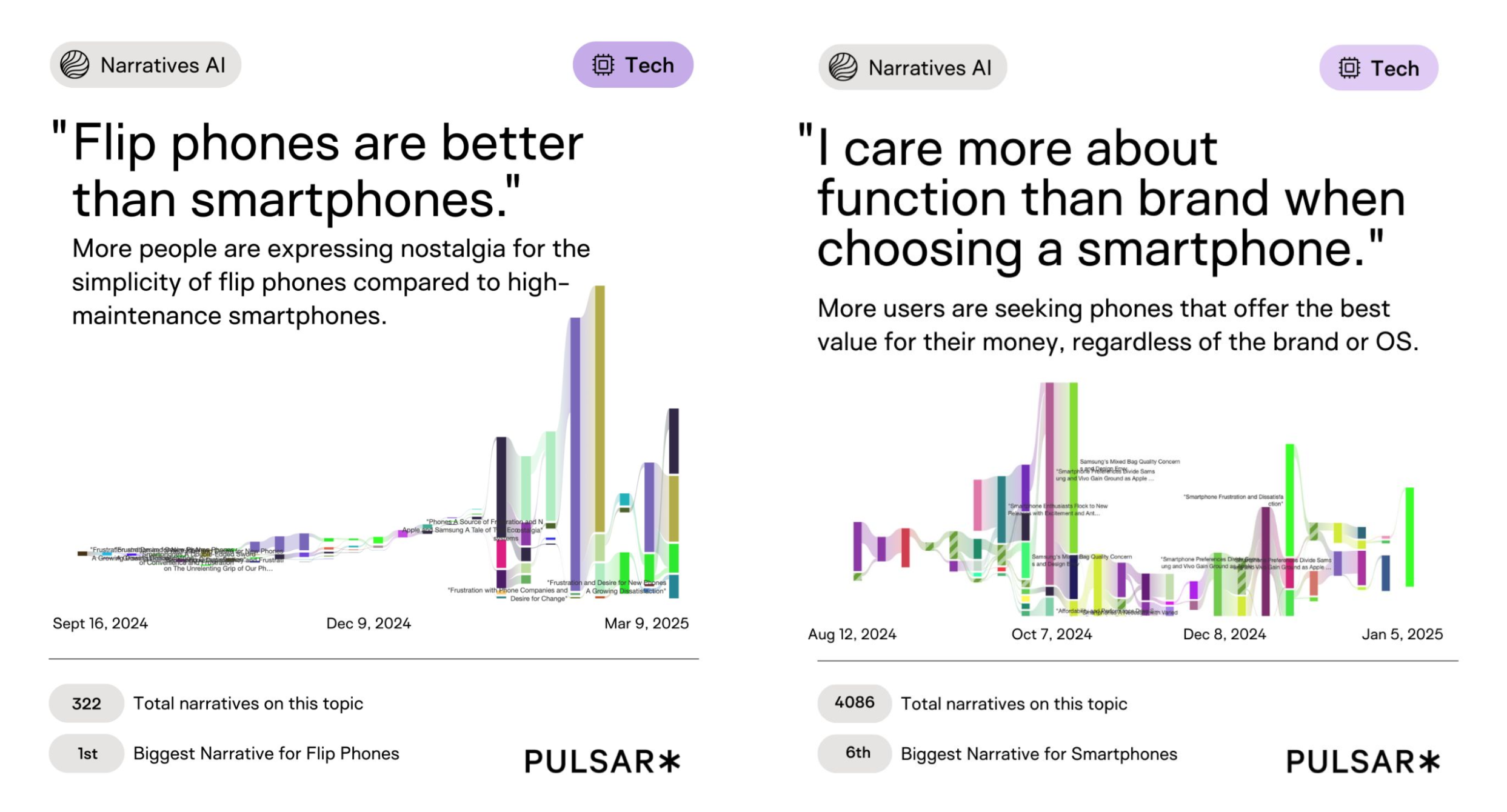
Narratives AI, Pulsar’s search engine for public opinion, surfaces and predicts the narratives shaping public opinion and behavior. It indexes framings, the arguments inside conversations, and ranks them by momentum across a 40-month live index, with hundreds of millions of articles and posts added every day and an archive from 1 January 2023. Teams search it with simple keywords, with no Boolean needed, and can see where a narrative came from, how it is evolving, and where it goes next, and compare narratives emerging in news media with those taking off on social. Each narrative is tied to the communities driving it, so teams see both the framing and the faction: who holds it, and why. Trends Oracle builds on the same index to forecast which shifts will land in a category and when to act. Onclusive also offers AI narrative features: In Brief summarizes social conversations and surfaces key narratives, In Brief Panorama analyzes emerging and growing topics, and In Brief Listening identifies trends, emerging themes, and signals of change. Pulsar’s distinction is that narratives sit inside the audience graph, connected to the communities propagating them and to the agents that act on them.
Predictive crisis intelligence
While both platforms cover core crisis detection, they cater to different operational demands. Onclusive provides reliable monitoring, delivering real-time alerts on sentiment drops or keyword spikes, paired with a visual dashboard and Peak Analysis to explain conversation surges.
Powered by continuous scanning and its P.U.L.S.E. scoring engine, Pulsar evaluates narrative momentum across spread, intensity, and amplification. Its AI review layer adds contextual nuance—distinguishing genuine brand threats from isolated noise while Threat Sentinel extends protection to emerging digital risks like deepfakes and coordinated misinformation campaigns.
For buyers, compare both platforms against a past crisis event: Pulsar will demonstrate how effectively it predicted momentum, filtered noise, and escalated true threat levels.
Agentic AI
Pulsar TeamMates are autonomous AI agents that run continuously across live data on a defined intelligence remit, rather than waiting for an analyst to query a dashboard. The roster spans Oracles (predictive risk, including the Crisis Oracle), Sentinels (the Threat Sentinel for adversarial campaigns and deepfakes), and Custodians (including Pulsar CLEAR for advertising compliance). Alongside them, the Pulsar autonomous research agent packages findings into a publishable, decision-ready intelligence narrative. This shifts the operating model from “AI that assists analysts” to “AI agents that do a category of analyst work autonomously,” which is particularly valuable for lean intelligence teams scaling through automation rather than headcount.
Taken together, that is the larger point about Pulsar in this comparison. Advanced social listening across social, broadcast, and dark web feeds Narratives AI, audience segmentation, and the agentic layer, so the platform does not just report what is happening; it turns social signals into actionable media and comms plans.
Audience depth and APAC coverage
Pulsar pairs Audience Insights with a two-way Audiense integration for community structure and behavioral analysis, and ingests the full digital spectrum including forums, dark social, and a deep APAC layer (Xiaohongshu, Weibo, WeChat, Douyin, Bilibili, Naver, Baidu). Pulsar TRENDS adds 17 years of historical data for longitudinal analysis of how cultural narratives evolve. Onclusive also covers APAC and Asian social sources, including Weibo, with a 24-month archive, so teams with significant APAC exposure should compare the two source lists directly against their priority markets.
Visual and social video analysis
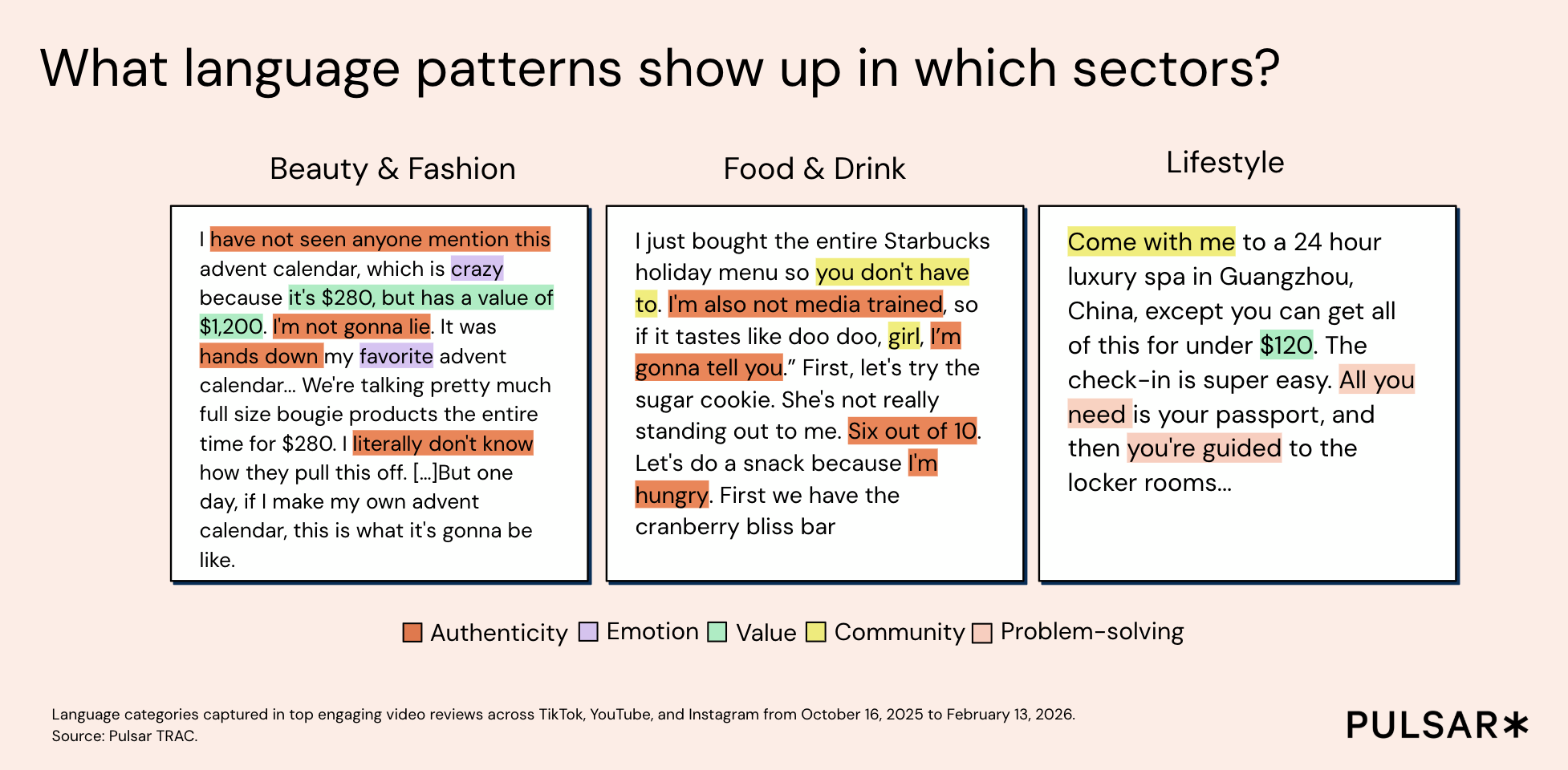
A growing share of brand conversation now happens in images and social video rather than text. Pulsar TRAC includes dedicated Image AI: a Logo Detection model that finds brand logos inside user-generated photos and social video stills, and an Image Caption model that labels and clusters the visual content of a post so it can be searched, filtered, and segmented alongside text. Pulsar ingests social video and YouTube as native sources, which means visual signals feed the same audience and narrative analysis as everything else, rather than sitting in a separate, text-first index. For a deeper look at how image and video data fits modern social intelligence, see our guide to the best visual social listening tools in 2026.
Pulsar vs Onclusive: Feature comparison across 14 dimensions
Which Teams Typically Choose Each Platform
When Onclusive is the right call
- PR and comms teams whose primary mandate is broad media coverage tracking across news, TV, radio, print, and social, reported in one stack.
- Teams that need integrated earned-media measurement and PR analytics alongside listening.
- Communications, marketing, brand, and insight teams that want social listening, audience analysis, crisis alerting, and AI narrative summaries in the same stack as earned-media measurement.
- Brands for whom LinkedIn conversation tracking is a specific, high-priority requirement.
- Organizations focused on legal, regulatory, and political monitoring at global scale.
When Pulsar is the right call
- Brand strategy and cultural intelligence teams that need to understand the beliefs and communities shaping behavior.
- PR teams running proactive narrative risk programs, where the goal is detecting a crisis before it breaks.
- Insight and research functions that need psychographic segmentation grounded in real community structure.
- Global teams with significant APAC exposure who want Xiaohongshu, Weibo, WeChat, Douyin, Bilibili, Naver, and Baidu in the same index as their global data.
- Lean intelligence teams scaling through agentic AI rather than headcount.
Frequently Asked Questions
+Is Onclusive Social the same as Digimind?
Yes. Onclusive Social is the rebranded version of Digimind, the social listening and market intelligence platform founded in France in 1998. Onclusive acquired Digimind in August 2022 and folded it into its PR and earned-media stack. Because the product was rebranded in 2022, some older reviews and third-party pages still use the Digimind name, so buyers may encounter both names during evaluation. They refer to the same product.
+What is the main difference between Pulsar and Onclusive?
Both platforms cover social listening, media monitoring and audience analysis. Onclusive is a media and market intelligence platform optimized for breadth of coverage across news, TV, radio, print, and social, with integrated earned-media measurement. Pulsar is an audience and narrative intelligence platform that uses community mapping to identify real communities, clusters underlying beliefs through Narratives AI, and runs Pulsar TeamMates as autonomous agents. The difference is emphasis: Onclusive’s strength is connecting listening to PR measurement; Pulsar’s is depth on communities, narratives and AI agents.
+How do the two platforms approach narrative intelligence?
Both platforms offer AI clustering features, built on different models. Onclusive’s In Brief summarises social conversations and surfaces key clusterings, In Brief Panorama analyses emerging and growing topics, and In Brief Listening identifies trends, emerging themes, and signals of change. Pulsar’s Narratives AI clusters the underlying beliefs in roughly 500M posts per day and maps which communities carry them. Teams whose mandate includes narrative strategy or predictive belief tracking should test both against the same brief.
+What is Onclusive’s biggest strength?
Breadth of source coverage. Onclusive monitors broad data sources across social and web including offline channels such as TV and radio, plus surveys and broad social and web coverage, and integrates with Onclusive’s earned-media monitoring and PR analytics. Its LinkedIn integration is also a genuine differentiator that is rare among social listening platforms. For teams whose job is broad media coverage tracking and reporting, those are real advantages.
+What does Onclusive cost?
Onclusive does not publish a public price list. Pricing is custom-quote only and varies with module mix, source coverage, and seat count. As with any enterprise listening contract, confirm exactly which modules and data sources are included, and negotiate notice periods and data-exit terms up front.
+Which platform is better for crisis monitoring?
Both platforms support crisis monitoring. Onclusive offers real-time crisis alerting, alongside emerging topic identification and trend analysis. Pulsar’s Crisis Oracle adds a predictive P.U.L.S.E. score that combines spread, intensity, and amplification, designed to flag how a reputational risk is likely to develop before it reaches mainstream coverage. The most reliable test is to replay a past incident from your own category in both platforms.
Bottom Line
Onclusive and Pulsar are both credible platforms that take different approaches. Onclusive is a strong fit for teams that want broad media and social coverage, audience analysis, crisis alerting, and AI narrative summaries in the same stack as earned-media measurement, with genuine strengths in LinkedIn and offline channels such as TV and radio. Pulsar is a strong fit for teams that want advanced social listening plus audience and narrative intelligence, run through customized workflows and brand-specific ontologies, so they can see where a conversation affects, challenges, or boosts their brand and act on it through an agentic AI layer.
The differentiators to test for Pulsar are its source coverage, including APAC, broadcast and dark web data, how early Narratives AI surfaces a shift in your category, how the Crisis Oracle's P.U.L.S.E. score escalates a live issue, and what the autonomous research agent and wider Pulsar TeamMates deliver without prompting. The differentiators to test for Onclusive are its source breadth, LinkedIn and offline coverage, real-time alerting, In Brief narrative features, and earned-media integration. The best way to decide is to run both against the same brief on your own category data.
To see how Pulsar handles your own brand and category data, request a Pulsar demo. The team will scope a session against your specific intelligence questions and benchmark Pulsar's output against your current Onclusive workflow.
Sources and Further Reading
- Pulsar Platform: Social Listening Solutions
- Pulsar TRAC: Data and Listening
- Narratives AI: Narrative Intelligence Hub
- Audience Insights: Community Segmentation
- Pulsar Crisis Oracle: P.U.L.S.E. predictive crisis intelligence
- How Insight Agents (Pulsar TeamMates) automate social listening workflows
- Community-based audience segmentation: beyond demographics
- Onclusive: company and product overview
- Onclusive Social: social listening product page
- Onclusive: In Brief launch announcement, January 2025
- Vuelio: media intelligence and PR platform (Pulsar Group, EMEA)
- Isentia: media intelligence (Pulsar Group, APAC)
Methodology and source attribution
This comparison was compiled by the Pulsar Platform Editorial Team in June 2026 and revised in September 2026, using only publicly available product documentation, vendor websites, and third-party review sites. Onclusive capabilities (broad data sources across social and web including TV and radio, LinkedIn integration, Market Intelligence with Google Search Trends, Sentinel crisis alerting, In Brief, In Brief Panorama and In Brief Listening, audience analysis, APAC and Asian social coverage, 24-month archive, ISO 27001 and GDPR compliance, and the Digimind-to-Onclusive rebrand history) are drawn from Onclusive product pages and announcements. Pulsar capabilities (Narratives AI ~500M posts/day, Crisis Oracle P.U.L.S.E. score, Pulsar TeamMates roster, TRENDS 17-year archive, SOC 2 Type II + ISO 27001 + GDPR) are drawn from Pulsar’s own product pages and Pulsar Group plc public disclosures. No proprietary benchmarking or NDA-restricted procurement data was used. Where capabilities are described as “leading” or “rare,” the framing reflects vendor positioning, not an independent benchmark, and should be verified by buyers during procurement against their own use case.
Disclosure: this article is published by Pulsar Platform. Pulsar-favorable claims are linked to underlying product pages or third-party sources wherever possible. Platform data reflects publicly available information as of September 2026 and may change. Pricing and contract terms should be confirmed directly with each vendor during procurement.
If you're interested in how Pulsar Tools can support your brand and strategy, simply fill out the form below and one of our specialists will contact you!