Best Visual Social Listening Tools 2026: Image, Video, and Audio Analysis Compared

The Verdict
Most "social listening" platforms still only read text. The brands that win on short-form social video, runway moments, and unboxing culture in 2026 use platforms that score image, video frames, audio, and logos as first-class signals, and only three do this credibly.
- ▸Visual social listening in 2026 is not a single feature. It is four capabilities working as one: image recognition, video frame analysis, audio and video transcription, and multimodal sentiment that fuses the three with the caption layer.
- ▸For visual-first categories (fashion, beauty, CPG, sports), text-only listening now misses more brand-relevant signal than it captures. The intelligence gap is structural, not incremental.
- ▸Eight platforms in this comparison have meaningful visual capability. Three (Pulsar, Brandwatch, Talkwalker) integrate visual signal into a narrative-aware analytical layer. Five offer visual as a side capability.
- ▸Pulsar's video intelligence pipeline transcribes both spoken word and on-screen text in video, in unlimited languages, and feeds the transcript into the same Narratives AI layer as text content.
- ▸If your vendor cannot tell you the share of your brand mentions that appear only in video audio or only in untagged images, you have a measurement blind spot covering most of your category.
The majority of brand-relevant social content in 2026 is visual. Short-form social video, Instagram Reels, YouTube long-form, and image-led platforms have absorbed the cultural conversation that text platforms used to host. For a brand in fashion, beauty, CPG, sports, or any visual-first category, this is not a stylistic shift. It is a measurement crisis. Text-only social listening reads captions, hashtags, and comments. It does not read what creators show on camera, what they say on camera, what logos appear in UGC, or what scenes a product is associated with.
"Visual social listening" is the category of tools designed to close that gap. Not all of them close it equally. This guide compares eight platforms on the four capabilities that matter: image recognition, video frame analysis, audio and video transcription (VTT), and multimodal sentiment. Each entry includes a "best for" verdict, honest strengths, and documented limitations. For broader category context, see the enterprise buyer's guide to social listening tools and the best tools for spotting consumer trends in 2026.
In This Article
Why text-only listening is breaking in 2026
Three structural shifts have moved the centre of gravity of social conversation from text to visual content, and the consequences for any brand still measuring conversation with a text-only tool are now severe.
Video is the default format. Short-form social video, Reels, Shorts, and YouTube have absorbed the time, attention, and cultural production that used to sit in text feeds. For most consumer categories, more than half of brand-relevant content is now video. A text-only listening tool sees the caption ("new haul today") and zero of the on-camera content that drives the actual conversation.
Consumers do not tag brands when they genuinely use them. The most commercially valuable UGC, the photo of a product in real use, the unboxing video, the everyday lifestyle shot, is overwhelmingly untagged. Image recognition is the only way to see it. Without image recognition, your dashboard is reading curated brand-tagged content (small, performative) instead of authentic brand-shown content (large, behavioural).
Brand mentions in video happen out loud, not in captions. A skincare creator filming a 10-minute routine mentions twelve brands verbally and tags one. A tech reviewer references three competitors on camera and writes none of them. Audio and video transcription (VTT) is the only way to surface these mentions, and the gap between what creators say on camera and what they write in captions is now the largest single intelligence gap in the discipline.
For visual-first categories, the combined effect is that a text-only listening tool now misses more of the relevant conversation than it captures. The dashboards look fine. The blind spot is structural.
What visual social listening actually has to include
"Visual" is the wrong word for the category. The capability needed in 2026 spans visual, audio, and the analytical layer that fuses them with text. A genuine visual social listening platform has to handle four things, not one.
| Capability | What it does | Why it matters |
|---|---|---|
| Image recognition | Identifies logos, products, scenes, objects, and people in still images and video frames, without needing a caption or tag. | Captures the authentic, untagged brand appearances that text monitoring cannot see at all. |
| Video frame analysis | Samples and analyses frames across a video to detect scenes, products, and on-screen text over time. | A video is a sequence of contexts, not a single image. Frame-level analysis captures arc, not just thumbnail. |
| Audio and video transcription (VTT) | Transcribes spoken word in video and on-screen text overlays into searchable, analysable text, in multiple languages. | The largest single intelligence gap in 2026. Spoken brand mentions are the dominant form of brand reference in creator video. |
| Multimodal sentiment and narrative | Combines visual, audio, and text signal into the same analytical layer for sentiment, topic, narrative, and trend. | Visual signal that is siloed in a separate dashboard is not intelligence. Integration into the narrative layer is what makes it usable. |
For a longer walk-through of what each layer does and why, see our companion guide on visual social listening: image and video analysis.
How we evaluated the tools
Methodology
Each platform was scored on the four capabilities above plus three operational dimensions: language coverage on VTT, integration of visual signal into the analytical layer (siloed vs unified), and reporting workflow. Scoring drew on independent G2 and Gartner Peer Insights review consensus, product documentation last reviewed May 2026, and hands-on capability checks where access was available.
Pulsar authored this comparison. We have made the methodology, source dates, and scoring criteria explicit so readers can audit the verdicts. Where Pulsar is positioned at the top of the list, we lead with capability evidence rather than self-citation.
The 8 best visual social listening tools in 2026
Tools are listed in order of analytical depth on visual and audio signal, from platforms where visual is a first-class capability integrated into the narrative layer, to platforms where visual is a side feature.
1. Pulsar Platform
Best for: Narrative-aware visual and audio intelligence with VTT in unlimited languages.
G2: 4.3/5 | Image recognition: yes | VTT: yes (spoken word + on-screen text) | Languages: unlimited
Pulsar is the only platform in this comparison where visual signal is built into the same analytical layer as text from the ground up. Pulsar's video intelligence pipeline covers short-form social video, YouTube, and Instagram Reels. Video Text Transcription (VTT) transcribes both the spoken word and the on-screen text overlays inside video content, in unlimited languages, and feeds the transcript into Narratives AI, the same belief-clustering layer that operates on text. The product foundation underneath this is Pulsar TRAC, the audience and narrative intelligence engine.
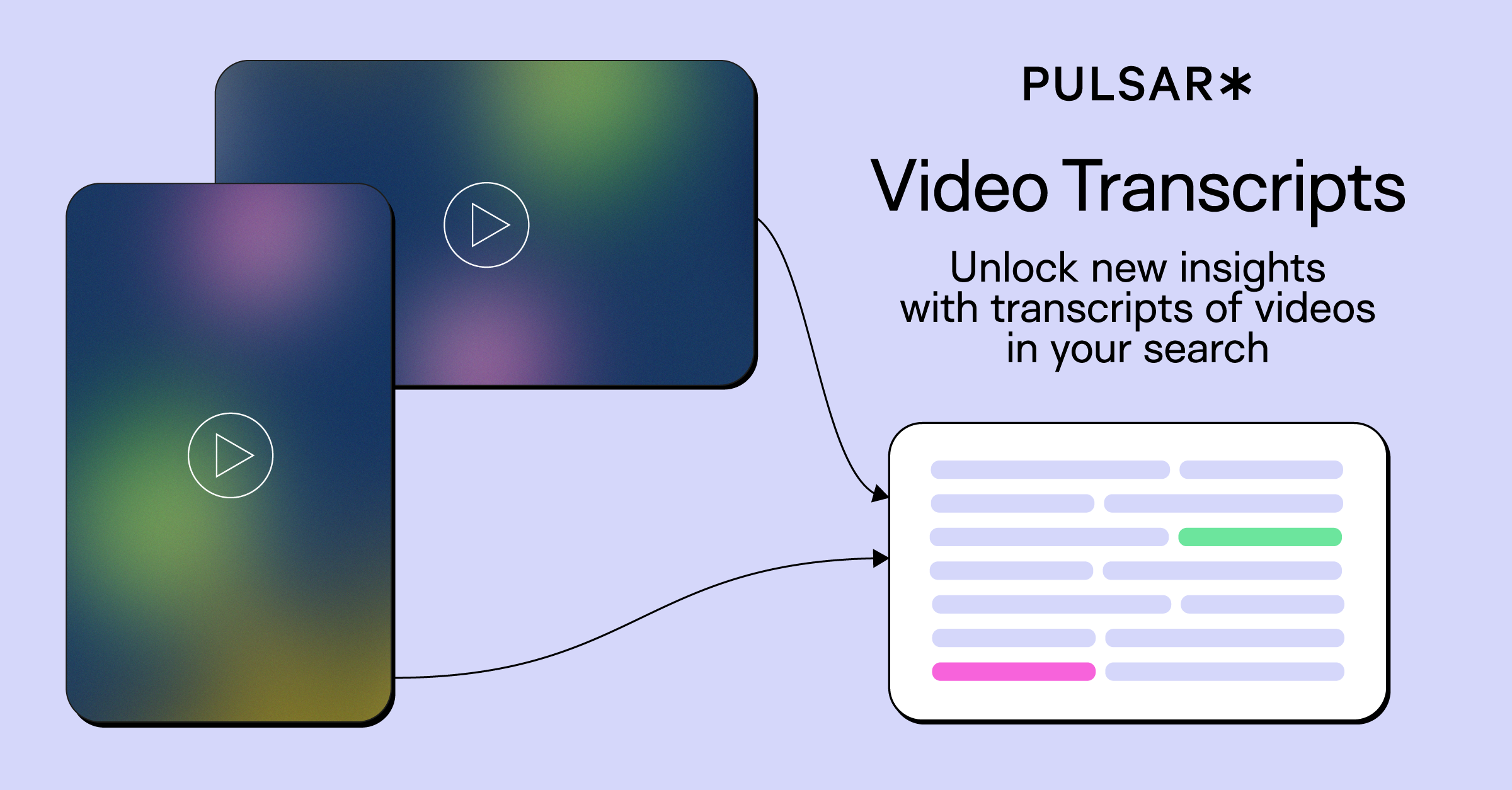
The result is that a brand mention spoken by a creator in a 60-second video is treated as a first-class signal alongside a tweet, a forum post, or a news article. Logo detection captures untagged brand appearances in UGC, and the same engine surfaces community intelligence on the audiences producing that content. Audio narrative tracking extends the same intelligence to podcasts and audio content, which is a unique capability in the category and increasingly important for the creator economy.
Pros:
- +VTT transcribes both spoken word and on-screen text in video, in unlimited languages
- +Visual signal is integrated into Narratives AI rather than siloed in a separate visual dashboard
- +Audio and podcast narrative tracking, unique in the listening category
- +Logo and product recognition in untagged UGC
- +Multimodal sentiment combines visual, audio, and caption signal
Cons:
- −Enterprise contract structure; less accessible for small teams or single-campaign projects
- −Smaller G2 review base than the most established competitors
- −Steeper onboarding for teams arriving from simpler mention-monitoring tools
2. Brandwatch (Iris and Image Insights)
Best for: Logo and image recognition at enterprise scale with deep historical archive.
G2: 4.4/5 (600+ reviews) | Image recognition: yes | VTT: limited | Languages: 30+
Brandwatch is the most established enterprise-grade visual listening capability in the comparison, with mature logo, object, scene, and activity recognition through Image Insights, and Iris for AI-assisted analysis. The historical archive is extensive, and integration with the broader Brandwatch listening suite is well developed. For teams that need image and logo monitoring at large scale with strong reporting infrastructure, Brandwatch is a credible choice.
The trade-off is video. Brandwatch's video and audio transcription coverage is narrower than Pulsar's, and visual signal is presented largely as its own analytical surface rather than being deeply fused with narrative intelligence on text content. For a head-to-head capability breakdown, see Pulsar vs Brandwatch.
Pros:
- +Mature logo, scene, and object recognition at enterprise scale
- +Deep historical visual archive
- +Strong reporting infrastructure and enterprise integrations
- +Largest G2 review base in the category
Cons:
- −VTT coverage narrower than narrative-aware video platforms
- −Visual signal often presented as its own dashboard rather than fused with narrative intelligence
- −Iris AI is primarily summarisation rather than narrative-aware analysis
- −Opaque pricing; enterprise sales process required
3. Talkwalker (Visual IQ)
Best for: Brand-safety image classification and crisis-alerting at multilingual scale.
G2: 4.4/5 | Image recognition: yes (Visual IQ) | VTT: partial | Languages: 150+ text, fewer for VTT
Talkwalker's Visual IQ provides logo, scene, object, and activity recognition with strong brand-safety classification, which makes it a popular choice for teams running large-scale advertising or sponsorship monitoring where image context matters. Multilingual text coverage (150+ languages) is the broadest in this comparison, and the crisis-alerting system is mature.
Now part of Hootsuite, Talkwalker also powers Hootsuite Insights. The combination is operationally convenient for teams already in the Hootsuite ecosystem. Visual signal depth at the narrative layer is less developed than at Pulsar, and product direction following the consolidation is something enterprise buyers should ask about explicitly.
Pros:
- +Strong logo, scene, and brand-safety image classification (Visual IQ)
- +Broadest multilingual text coverage in the category
- +Mature crisis-alerting and visual-content escalation workflow
- +Integration with Hootsuite ecosystem
Cons:
- −VTT and spoken-word transcription less developed than image classification
- −Audience segmentation and narrative analysis depth less than specialised platforms
- −Dashboard rigidity limits custom analytical workflows
- −Product direction under Hootsuite ownership worth confirming during evaluation
4. YouScan
Best for: Pure-play image recognition at an accessible price point.
G2: 4.8/5 (277 reviews) | Image recognition: yes (strong) | VTT: limited | Languages: regional focus
YouScan is the most visible specialist in visual social listening and a credible image-recognition engine in its own right, with strong logo, object, scene, and activity detection. Insights Copilot, its ChatGPT-based conversational AI agent, is one of the more accessible AI surfaces in the category. For teams whose primary need is "see logos and products in images at scale, cheaply" YouScan is a sensible choice.
The trade-off is in video, audio, and the analytical layer. YouScan's video and spoken-word transcription is significantly thinner than narrative-aware platforms, and reviewer consensus flags sentiment and topic analysis quality as a known limitation. For a head-to-head, see Pulsar vs YouScan: AI-Powered Social Intelligence vs Visual Social Listening.
Pros:
- +Strong dedicated image recognition (logo, object, scene, activity)
- +Insights Copilot is a usable conversational AI surface
- +Accessible price point compared with enterprise platforms
- +Strong G2 review base and customer support reputation
Cons:
- −Video and spoken-word transcription significantly thinner than narrative-aware platforms
- −Sentiment and topic analysis quality flagged as weak in independent reviews
- −No deep audience segmentation or community analysis
- −Limited narrative or trend forecasting layer
5. Brand24
Best for: SMB visual mention tracking with accessible AI features.
G2: 4.6/5 (337 reviews) | Image recognition: basic | VTT: minimal | Languages: limited
Brand24 is the strongest SMB-tier option in the category. Visual capability is more limited than the specialists, but pricing is transparent and accessible, AI features (including LLM brand-mention tracking across ChatGPT, Perplexity, Gemini, Claude, and AI Overviews) punch well above the price point, and the platform is genuinely usable without enterprise onboarding. For agencies and small or mid-sized teams that need visual coverage as part of a broader mention-monitoring practice, Brand24 is a practical choice. For where the two platforms diverge as teams scale, see Pulsar vs Brand24.
Pros:
- +Transparent, accessible pricing
- +Strong AI features for the price tier, including LLM brand-mention tracking
- +Quick setup; usable without enterprise onboarding
- +Emotion analysis beyond basic sentiment
Cons:
- −Image and visual capabilities are basic compared with specialists
- −Minimal video transcription or audio analysis
- −Audience segmentation and narrative depth limited
- −Outgrown quickly by teams that need deep visual analytics
6. Sprinklr Insights
Best for: Visual listening bundled into an enterprise CXM stack.
G2: 4.2/5 | Image recognition: yes | VTT: partial | Languages: 30+
Sprinklr Insights includes visual capability inside a much broader unified CX suite that also covers social publishing, advertising, and customer service. For large organisations that need visual listening as one input into a unified omnichannel CX workflow with strict approval chains, Sprinklr's breadth is the strength.
The trade-off is depth. Visual analysis sits inside a sprawling product surface where listening is one module among many, and analytical depth on visual signal is consistently rated below specialist visual listening platforms. For a focused comparison, see Pulsar vs Sprinklr: deep audience intelligence vs CXM platform.
Pros:
- +Unified CX platform across social, advertising, and customer service
- +Visual signal feeds the broader CX dashboard, not just listening
- +Strong for large organisations with approval-chain workflows
Cons:
- −Visual capability is one feature inside a much larger product surface
- −Analytical depth on visual signal below specialist platforms
- −Onboarding complexity and total cost of ownership
- −Limited narrative-aware video analysis
7. Meltwater (Radarly)
Best for: Media-monitoring teams adding visual on top of earned media tracking.
G2: 4.1/5 | Image recognition: yes (Radarly) | VTT: limited | Languages: 218 text
Meltwater (with the Radarly capability inherited from the Linkfluence acquisition) provides image recognition and broad multilingual coverage on top of its core media monitoring strength. For PR and earned-media teams that need to add visual brand monitoring without leaving the journalist-database and press-pickup workflow they already use, Meltwater is a practical fit.
As a primary visual social listening tool, however, the depth on video and audio is less developed than specialists, and the listening side overall sits in the shadow of the platform's stronger media-monitoring identity. For a deeper comparison, see Pulsar vs Meltwater: audience intelligence vs consumer monitoring.
Pros:
- +Broadest text-side multilingual coverage in the category
- +Combined media monitoring and visual listening in one platform
- +Strong journalist database for PR teams
Cons:
- −Video and audio analysis less developed than specialist visual listening platforms
- −AI surfaces are primarily summary-based
- −Interface and reporting can feel dated relative to newer platforms
- −Audience segmentation and community analysis limited
8. NetBase Quid
Best for: Consumer-research-led visual workflows and category trend analysis.
G2: 4.4/5 | Image recognition: yes | VTT: limited | Languages: 30+
NetBase Quid is positioned for insights and consumer research teams that want visual signal alongside structured market research workflows. Image recognition is competent, and the platform pairs well with proprietary research panels and category trend studies. For consumer research teams running brand health and category trend programmes, NetBase Quid is a sensible adjacent capability.
The trade-off is the same as for several enterprise generalists: visual is a real feature, but it does not sit at the centre of the product, and integration into a narrative-aware analytical layer is less developed than specialist platforms.
Pros:
- +Strong fit with consumer-research workflows and brand health studies
- +Competent image recognition and category trend visualisation
- +Integrates with proprietary research panels
Cons:
- −Video and audio analysis less developed than specialists
- −Visual signal not fused with a narrative-aware analytical layer
- −Smaller community of independent reviewers
- −Enterprise pricing without transparent published rates
Side-by-side comparison matrix
When to pick which tool: a decision tree
The right platform depends on the team's primary need and the categories you operate in.
If your category is visual-first (fashion, beauty, CPG, sports, automotive) and your team needs narrative-aware video and audio intelligence: Pulsar Platform. The differentiator is VTT in unlimited languages and integration into Narratives AI rather than a siloed visual dashboard. Best for insights, brand strategy, and creator-economy intelligence.
If you need logo and image recognition at enterprise scale with a deep historical archive: Brandwatch. Strong reporting infrastructure, mature image capability, large G2 review base.
If brand-safety image classification and crisis alerting at multilingual scale are the priority: Talkwalker. Visual IQ is competitive and the multilingual coverage is the broadest available.
If you need a focused image recognition specialist at an accessible price: YouScan. The image engine is genuinely strong; understand the trade-offs on video, audio, and analytical depth before standardising on it.
If you are an SMB or agency that needs visual coverage as part of a broader mention-monitoring practice: Brand24. Transparent pricing, accessible AI features, and quick setup.
If visual listening is one input into a unified omnichannel CX workflow: Sprinklr Insights. The trade-off is depth on visual versus breadth across CX.
If you are a PR / media monitoring team adding visual on top of earned media tracking: Meltwater (Radarly). Convenient for teams already using Meltwater for press pickup and journalist outreach.
If you are a consumer research team running brand health and category trend programmes: NetBase Quid. Strong fit with research workflows; lighter on narrative-aware video and audio.
Frequently asked questions
+What is the best visual social listening tool in 2026?
It depends on your category and team. For narrative-aware visual and audio intelligence with VTT in unlimited languages, Pulsar Platform leads. For logo and image recognition at enterprise scale with a deep historical archive, Brandwatch. For brand-safety image classification and crisis alerting at multilingual scale, Talkwalker. For pure-play image recognition at an accessible price, YouScan. The "best" tool depends on whether your priority is visual + audio + narrative integration, or image recognition at scale, or affordable mention monitoring with a visual layer.
+What is video sentiment analysis and how does it differ from text sentiment?
Video sentiment analysis combines three signals: the visual content (what appears on screen), the spoken audio (what the creator says on camera), and any text in captions, hashtags, or comments. Text sentiment scores only the text layer. Genuine video sentiment requires video frame analysis, audio and video transcription (VTT), and a multimodal scoring layer that fuses the three. Most platforms still report "visual sentiment" by scoring the caption text attached to a video, which is not video sentiment in any meaningful sense.
+Can image recognition detect brand logos without a tag or caption?
Yes, and this is one of the most commercially valuable capabilities in visual social listening. Image recognition models trained on labelled brand assets can detect logos, products, and packaging in social images and video frames without requiring a hashtag, tag, or caption mention. This surfaces the authentic, untagged UGC that consumers post when they genuinely use a product, which is invisible to text-based monitoring. Accuracy varies by category, lighting, angle, and brand-asset distinctiveness; ask any vendor to demonstrate detection on real UGC from your category rather than on staged sample images.
+What is VTT in social listening, and why does it matter?
VTT (Video Text Transcription) is the conversion of spoken word and on-screen text overlays inside video content into searchable, analysable text. It matters because the dominant form of brand reference in modern creator video is verbal: creators say brand names on camera without writing them in captions, hashtags, or comments. Without VTT, those mentions are invisible to monitoring. Pulsar transcribes spoken word and on-screen text in unlimited languages and feeds the transcript into the same analytical layer used for text content.
+Which industries benefit most from visual social listening?
Visual-first categories benefit most: fashion and luxury, beauty and skincare, CPG and food and beverage, sports and entertainment, and automotive. In these industries, consumers and creators communicate primarily through image and video rather than text, brand logos and products appear in untagged content at scale, and creator video is a primary marketing channel. For visual-first categories, a text-only monitoring tool now misses more brand-relevant signal than it captures.
+How is visual social listening different from visual brand monitoring?
Visual brand monitoring counts brand appearances in images and reports volume and reach. Visual social listening adds analysis: scene and context classification, narrative association, sentiment scoring, and audience analysis on the people producing the visual content. The first is descriptive ("your logo appeared 24,000 times"); the second is interpretive ("your logo appeared 24,000 times, mostly in lifestyle contexts associated with a community that also cares about competitor X, and the narrative around it is shifting"). Most platforms offer monitoring; fewer offer genuine listening on visual signal.
See VTT in action
Book a visual intelligence demo and see what unlimited-language VTT, untagged logo detection, and multimodal narrative analysis look like applied to your brand's actual social video footprint.
Sources
- G2 reviews and ratings for each platform (cited per tool entry)
- Gartner Peer Insights: Social Media Listening and Analytics
- Pulsar: Video Analysis at Scale for Social Media Intelligence
- Pulsar: Visual Social Listening Guide
- Vendor product documentation and pricing pages, last reviewed May 2026
External capability claims should be verified with each vendor before procurement. Independent reviews referenced from publicly available G2 and Gartner Peer Insights aggregations as of May 2026.
Related reading:
Visual Social Listening: Image and Video Analysis ·
Best Social Listening Tools 2026: Enterprise Buyer's Guide ·
Best Tools for Spotting Consumer Trends in 2026 ·
What is Pulsar TRAC? ·
What is Pulsar Narratives AI? ·
Pulsar vs Brandwatch ·
Pulsar vs YouScan ·
Pulsar vs Meltwater ·
Pulsar vs Sprinklr ·
Pulsar vs Brand24 ·
Bot Noise, AI Content, and the Authenticity Crisis ·
What is Social Listening? (Definitive Guide 2026)
Last updated: May 2026.
If you're interested in how Pulsar Tools can support your brand and strategy, simply fill out the form below and one of our specialists will contact you!