The 2026 midterms have an unlikely winner: the mid-sized influencer

TL;DR
Pulsar STORY analyzed the 2026 US midterms conversation between October 22 and November 3, 2026. Mid-sized creators punched above their weight, Donald Trump dominated mentions, global narratives shaped the US race, and the best format depended on the platform.
Key Takeaways
- ▸Reach isn’t influence. A TikTok creator with just 3K followers drove the highest engagement relative to audience size: 47K likes in a matter of days.
- ▸Trump-centric, not race-centric. 357K mentions of Trump (plus 147K of “President Trump”) vs 262K for Democrats and 182K for Republicans.
- ▸Global narratives crept in. #Poland, #Iran, #deportthebolsonaros and #globalist ranked in the top 20 topics.
- ▸Video wins, whatever the platform. Visual content beat text and links everywhere, and on YouTube even long-form video drove 2.7x more engagement per post than short-form.
- ▸Emojis signal mood. 🚨 and 🇺🇸 led, and blue 💙 (68.5K) beat red 🔴 (42.8K) before the ballots were counted.
In This Article
The 2026 US midterms brought a wave of blue. But even before the final count, Pulsar's autonomous research agent, STORY, was already picking up on the shifts shaping the political conversation. From grassroots creators to short-form video and global politics, here are five things we noticed in the social and audience data:
The new political power brokers aren't necessarily the biggest
Political influence has long centred around identifying the person with the loudest voice. As more and more online campaigning takes place online, this led to a fixation on follower counts.
But our analysis of the 2026 midterm conversation suggests a subtle rewriting of this logic. Yes, endorsement from the right megaphone can change things, but this year some of the most influential voices aren’t established political commentators or accounts with millions of followers. They're mid-sized creators with highly engaged niche communities, capable of using their engaged audiences as an engine for attaining a disproportionate amount of attention.
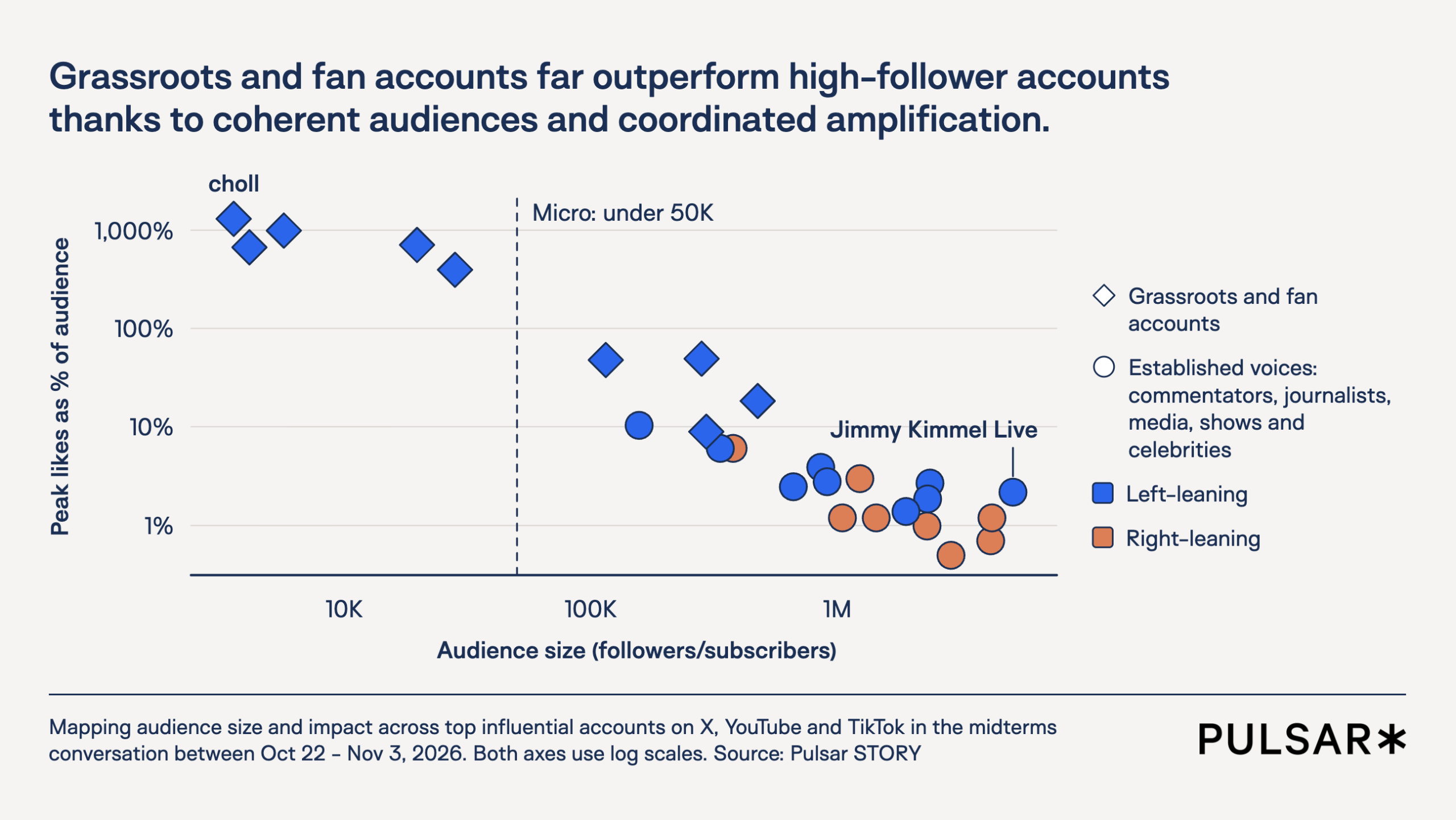
Clearly, these accounts do not exist in a vacuum. They are amplified, sometimes financially, by the political establishment. But allowing these tight-knit communities to serve as the launching pad for messaging gives the audience time first to stress test, and then get behind a narrative or idea.
For instance, TikTok creator Choll, a Kamala Harris superfan, despite having just 3K followers, generated 47K likes in a matter of days, helping boost conversations around Texas Democrats amongst younger voters.
That's a significant level of engagement relative to audience size, and a reminder that political influence doesn't always scale with follower counts on platforms defined by algorithms. For political campaigns looking to cut through an increasingly crowded conversation, reaching the largest possible audience may no longer be the priority. Connecting with the right audience can be just as valuable, if not more so.
It’s all about Trump
If there's one figure dominating the political conversation, it's (surprise) Donald Trump.
Using Pulsar STORY, we analyzed the midterms conversation across X, Facebook, YouTube, Threads, online news, blogs, forums, and social video between October 22 and November 3, 2026. One topic stood out above the rest: Donald Trump. His name generated 357K mentions, with a further 147K references to “President Trump.”
Together, that's considerably more than the 262K mentions of Democrats and 182K of Republicans. Mentions of the Senate, by comparison, stood at just 73K, while individual races barely registered.
The findings point to a conversation that was largely Trump-centric rather than focused on individual candidates or specific policy debates. The President acted as a lightning rod for conversation. This is not altogether uncommon in the US, and a presidential system, but the extent to which it happened is striking
Global political narratives are bleeding into the US race
Americans found themselves looking beyond their borders for reasons to vote in 2026 . Our analysis found that international political narratives were woven into the midterms conversation, with #Poland, #Iran, #deportthebolsonaros and #globalist all ranking among the top 20 topics. Iran alone generated 127K mentions.
These aren't simply references to events happening elsewhere. For instance, the presence of #globalist is particularly notable, as the term is also associated with conspiracy narratives – and while predominantly a right-wing or libertarian idea, it was directed as politicians both sides of the aisle.
Five countries fell to the globalist playbook. 🇵🇱
A US senator went to Europe to learn how they did it.
On hidden camera, she said “you'll see it in America in January.”
https://t.co/Fo0zFxdDJy
2 November 2026
#vote #midterms #tab #leadwhereyoulive #globalist https://t.co/99tfm2SWbQ
— Take America Back (TAB) (@JoinTAB_USA) November 2, 2026
They point to a domestic political conversation increasingly recontextualized through from geopolitical tensions and foreign elections to debates around authoritarianism, sovereignty and national identity.
Format beats length
The debate around shrinking attention spans would suggest shorter is always better. But our analysis tells a more nuanced story.
Short-form video drives the highest engagement per post across platforms when it comes to the top performing content type in the midterms conversation, with visual content consistently outperforming text and links. YouTube, however, bucks the trend: long-form video generates 2.7 times more engagement per post than short-form.
The point isn't that audiences have lost the patience for longer content, but rather that any video is more likely to attract attention. A 2-hour video analysis demands more attention than a 5 minute written verdict, but appears the more likely winner in the battle for attention.
For political communicators, this means don't just shorten the message. Find the format that works for the platform and the audience.
The emojis were hinting at a deeper political mood
Sometimes, the smallest details reveal something interesting about a much bigger conversation.
In the midterms emoji rankings, 🚨 and 🇺🇸 are neck and neck for engagement, followed by 💙 with 68.5K and 🗳️ with 61K. Both outperform 🔴, which generated 42.8K.
At first glance, emojis might seem like a fairly superficial way of looking at political engagement. But they offer another lens through which to understand how people communicate their reactions.
Even before the ballots were counted, the preponderance of blue emojis told you everything you needed to know about the direction of travel.
Centralized attention, decentralized influence
The midterms show that political influence cannot be understood through reach and visibility alone, but must also account for who shapes the conversation and how narratives take hold
The midterms show that understanding political influence means looking beyond reach and visibility to how political meaning is shaped and contested.Another election cycle has shown the importance of online spaces in setting the all-important context for candidates.
Who gets to define the conversation? Which narratives become culturally relevant? Which voices can turn a passing moment into something that resonates with a much wider audience?
Our analysis points to several forces shaping that process: the mobilizing power of smaller creators, the influence of international narratives and the role of distinct platform culture and incentives in determining which political messages are received and shared.
For policymakers and brands, the real opportunity lies in understanding the cultural currents beneath the conversation: the communities, references and narratives influencing how people see the world and their place within it.
Frequently Asked Questions
+Who were the most influential voices in the 2026 US midterms conversation?
Pulsar’s analysis found that some of the most influential voices weren’t established political commentators or accounts with millions of followers, but mid-sized creators with highly engaged niche communities. TikTok creator Choll, with just 3K followers, generated 47K likes in a matter of days.
+How much did Donald Trump dominate the 2026 midterms conversation?
Donald Trump’s name generated 357K mentions, with a further 147K references to “President Trump.” That is considerably more than the 262K mentions of Democrats and 182K of Republicans. Mentions of the Senate stood at just 73K, while individual races barely registered.
+Which international topics appeared in the 2026 midterms conversation?
#Poland, #Iran, #deportthebolsonaros and #globalist all ranked among the top 20 topics, and Iran alone generated 127K mentions. The term “globalist” is also associated with conspiracy narratives and was directed at politicians on both sides of the aisle.
+Which content format drove the most engagement in the 2026 midterms?
Short-form video drove the highest engagement per post across platforms, with visual content consistently outperforming text and links. YouTube bucked the trend: long-form video generated 2.7 times more engagement per post than short-form, suggesting that any video is more likely to attract attention.
+What did emojis reveal about the 2026 midterms conversation?
🚨 and 🇺🇸 were neck and neck for engagement, followed by 💙 with 68.5K and 🗳️ with 61K, both ahead of 🔴 with 42.8K. Even before the ballots were counted, the preponderance of blue emojis pointed to the direction of travel.
+How did Pulsar analyze the 2026 US midterms?
Pulsar used STORY, its autonomous research agent, to analyze the midterms conversation across X, Facebook, YouTube, Threads, online news, blogs, forums, and social video between October 22 and November 3, 2026.
Related reading
Last updated: November 2026.