Kimi K3: how the latest model from China is actually perceived by audiences
- Tech

Kimi K3 has become one of the most closely watched AI launches of the year.
Developed by China's Moonshot AI, the 2.8 trillion-parameter open-weight model has quickly become a major talking point in the global AI race, drawing attention for its technical performance, scale and cost advantage.
But the next phase of the competition will not be decided by launch headlines alone.
The real signal emerges after release: across millions of conversations, reviews and reactions captured through social listening, as people begin using these models in their everyday work.
Kimi K3 is actually crazy. Someone just remade HALO CE 10v10 multiplayer with one prompt. No engine. No dev team. No months of work.
Kimi K3 is miles better than Anthropics Fable 5 from what I can see. We will be seing AI game making take over after the summer! pic.twitter.com/zjOyITA9eq- S (@Rubzem) July 17, 2026
How Kimi K3 is landing with early users
Early reactions suggest Kimi K3 is an exceptional pair programmer rather than an autonomous engineer. Beyond the leaderboard, a consistent picture is forming across the dimensions people care about most.
- Frontend and visual coding, its clearest win. On the Frontend Code Arena benchmark, K3 leads Fable 5 by 1,679 to 1,631, and testers single out its design-to-code and layout work.
- Long-horizon, agentic tasks. It scores 42.0 to Fable 5's 35.0 on the SWE Marathon evaluation and edges ahead on Terminal Bench, holding context across large, multi-file projects.
- A million-token context window. Its 1,048,576-token window lets users load whole repositories at once, the capability early adopters most often name as a difference-maker.
- The hardest reasoning still favors incumbents. On the toughest logic tests such as FrontierSWE, K3 trails Fable 5 by 81.2 to 86.6, and across 35 benchmarks Fable wins 22 to K3's 12.
- Price resets the value question. At roughly a third of Fable 5's cost, with API pricing of $3 and $15 per million input and output tokens and a free web-chat tier, K3 changes what an open-weight model is expected to deliver.
A recurring theme in reviews is a split-role setup: Kimi K3 for building, a proprietary model for review and refinement. That says more about where it fits than any single score, and these strengths and trade-offs rarely surface on a leaderboard.
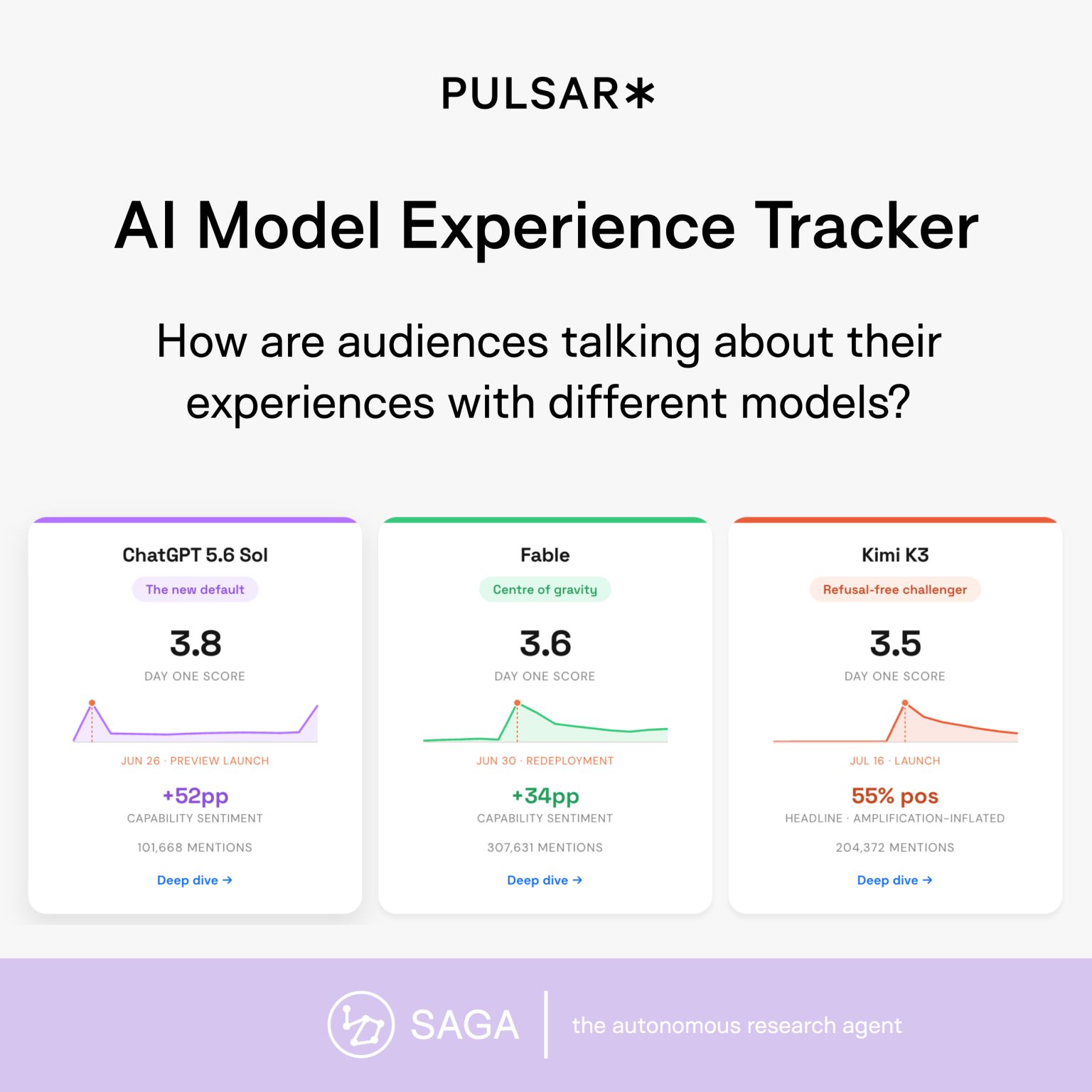
Yet the more meaningful signal comes from users: endorsements, frustrations, cancellations, and quiet default switches. Individually, they're anecdotal. Collectively, they reveal which models people continue to trust once the launch hype fades.
Every AI launch creates a wave of attention. The harder question is what remains once that attention fades. Which models become trusted tools? Which ones lose momentum? Which capabilities matter most to users?
That's why we introduced Day One: an AI model experience tracker that reveals how frontier models are being used, discussed and evaluated by early adopters from launch day onwards.
What Day One AI experience tracker tracks
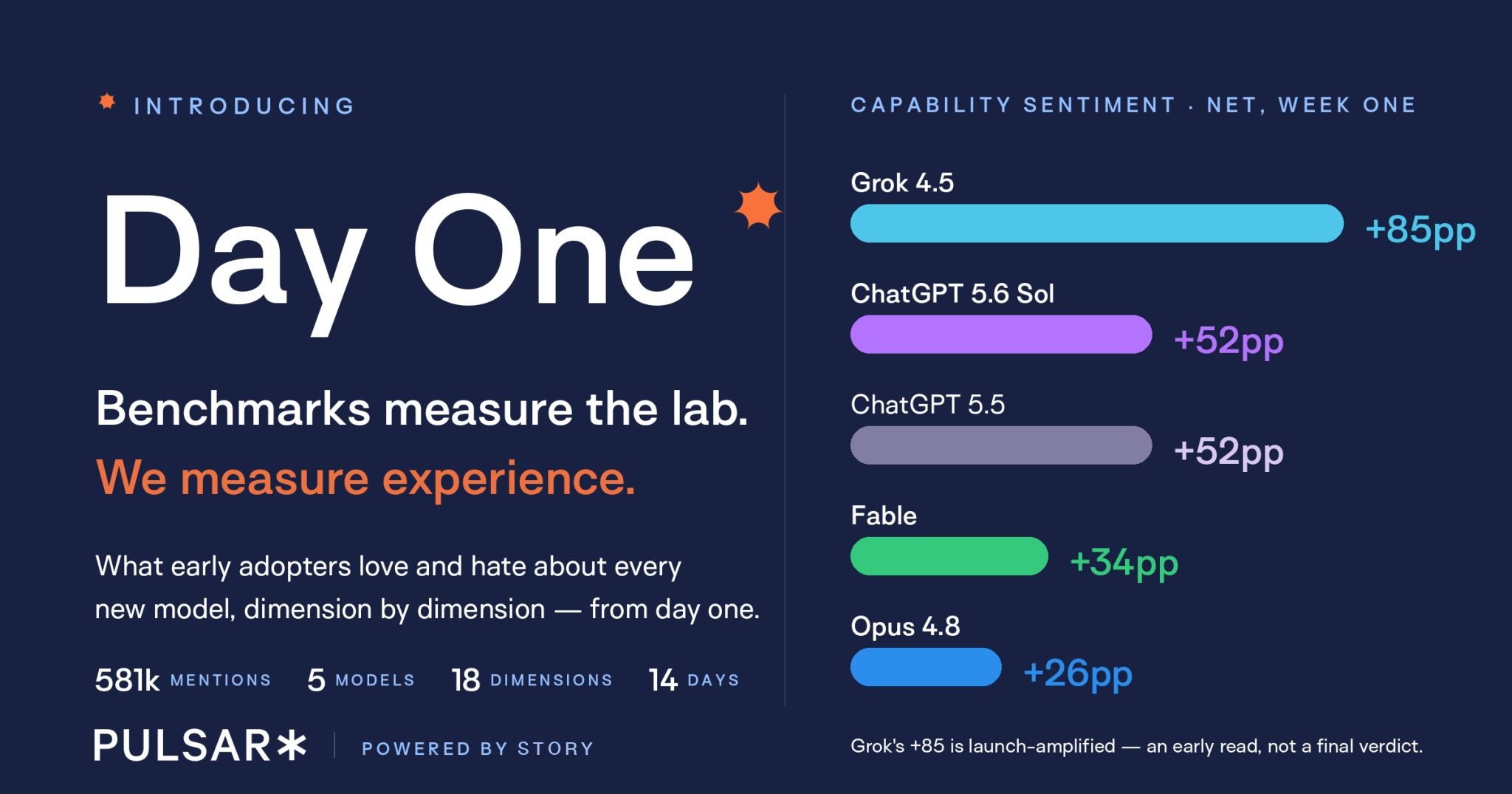 Early-adopter capability sentiment in week one across five models, from 581k mentions: Grok 4.5 (+85pp) down to Opus 4.8 (+26pp). Source: Pulsar Day One.
- User experience across 18 dimensions: from reasoning and coding to writing quality and model behavior.
- Conversation volume and sentiment: separating sustained engagement from launch-day excitement.
- Market positioning: mapping capability against efficiency to understand where models are gaining traction.
Day One reveals the difference between visibility and staying power: which models are becoming part of people's workflows, and which are simply generating attention.
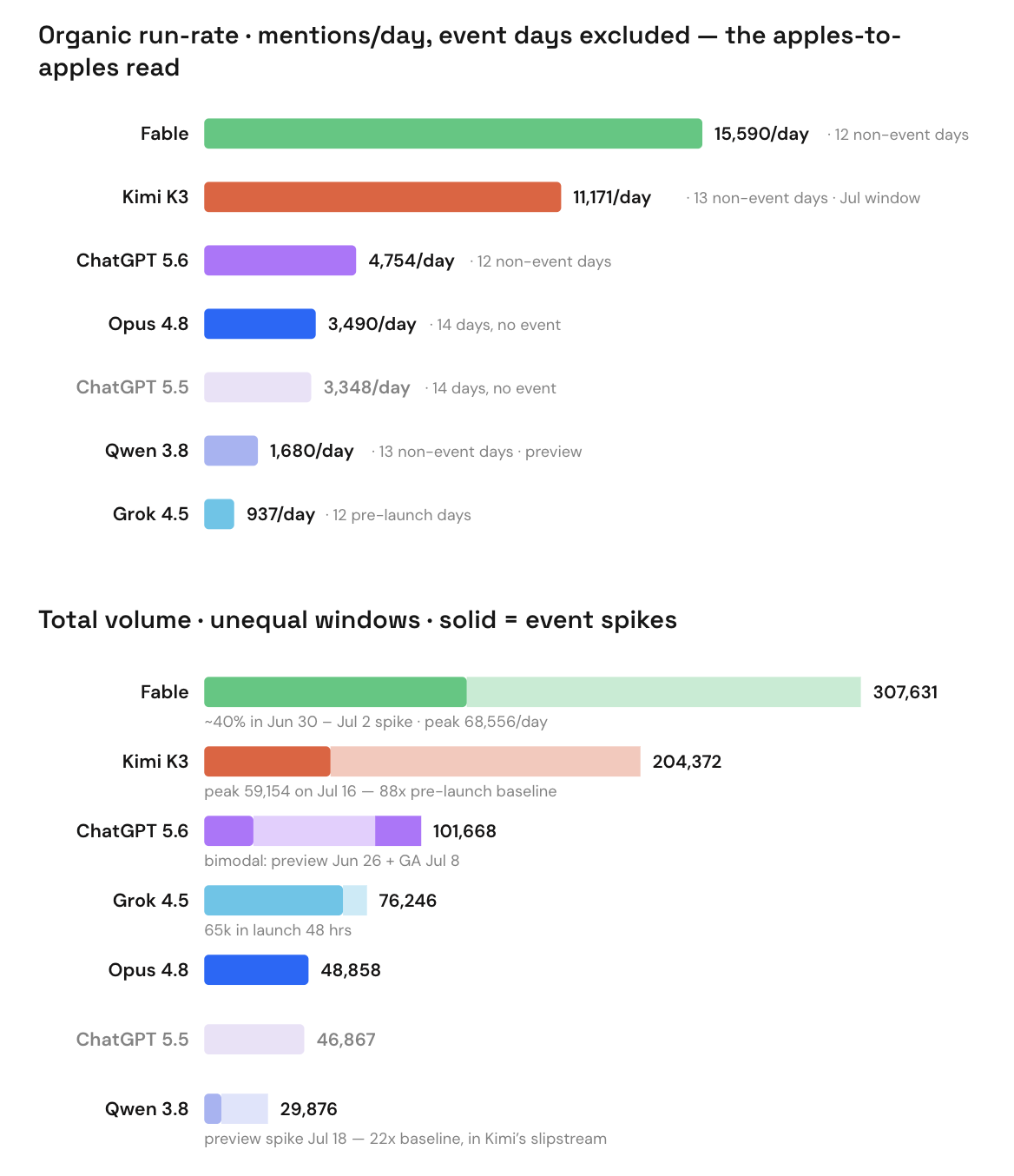
The first release tracks OpenAI's ChatGPT 5.6, xAI's Grok 4.5, Anthropic's Fable and Opus 4.8, alongside Moonshot AI's Kimi K3.
Early signals, continuously updated as the conversation evolves.
Frequently asked questions
+What is Kimi K3?
Kimi K3 is a 2.8 trillion-parameter open-weight AI model developed by China's Moonshot AI and released in July 2026. It is the largest open-weight model built to date, and it competes with leading proprietary systems at roughly a third of their cost.
+How is Kimi K3 perceived by users?
Early reactions describe Kimi K3 as an exceptional pair programmer rather than an autonomous engineer. Users praise its million-token context window and its ability to navigate large codebases, while noting that the most demanding reasoning tasks still favor leading proprietary models.
+Is Kimi K3 good for coding?
Kimi K3 leads the Frontend Code Arena benchmark ahead of Fable 5 and tops the SWE Marathon and Program Bench coding tests. Testers highlight how well it handles large codebases, though the hardest reasoning tasks still favor the top proprietary models.
+How much does Kimi K3 cost?
Kimi K3's API costs $3 per million input tokens and $15 per million output tokens, roughly a third of comparable proprietary models. It is also free to try through Moonshot's Kimi web chat, subject to usage limits.
+How does Kimi K3 compare to Claude Fable 5?
Kimi K3 leads Claude Fable 5 on frontend and long-horizon coding benchmarks such as Frontend Code Arena and SWE Marathon, while Fable 5 stays ahead on the hardest logic and reasoning tasks. Kimi K3 delivers this at roughly a third of the cost.
+What is Pulsar Day One?
Day One is an AI model experience tracker that reveals how frontier models are being used, discussed and evaluated by early adopters from launch day onwards. It measures user experience across 18 dimensions, conversation volume and sentiment, and market positioning.
+Which AI models does Day One track?
The first release tracks OpenAI's ChatGPT 5.6, xAI's Grok 4.5, Anthropic's Fable and Opus 4.8, alongside Moonshot AI's Kimi K3.
To stay up to date with our latest insights and releases, sign up to our newsletter below:
This article was created using data from TRAC