
Mounjaro vs Ozempic: Who is winning the GLP-1 brand narrative battle?
- Health

TL;DR
Between March and June 2026, Pulsar used Narratives AI to score the public brand narratives around two leading GLP-1 drugs. Mounjaro (tirzepatide, Eli Lilly) leads Ozempic (semaglutide, Novo Nordisk) on brand positivity, 52.8 to 47.2, winning four of five dimensions. The brand that pioneered the category is no longer the one leading on perceived trust.
- ▸Mounjaro leads overall brand positivity 52.8 to 47.2, winning four of the five dimensions analyzed.
- ▸Trust is the widest gap: 79.7 vs 63.2 (+16.5), anchored in diabetes remission and durable weight-loss outcomes.
- ▸Ozempic leads only on price and access (35.1 vs 14.7), driven by early generic semaglutide in Brazil and Canada.
- ▸Different crowds drive each brand: Mounjaro by expressive fandoms, Ozempic by news-led audiences primed for criticism.
Ozempic reached a level of cultural saturation rarely seen for a prescription drug. It moved from clinics into celebrity culture, social feeds, and everyday conversation, reshaping how weight loss, food behavior on social media, and self-optimization are understood at scale.
@leighannhealeyhit follow if you need more of this in your feed!! ilysm!! 🥹🌸🩷
That visibility is now evolving as the category becomes more competitive, with GLP-1 drugs emerging as one of the most commercially significant pharmaceutical stories in decades, at times outpacing the AI industry in revenue.
A weekly jab in the belly is generating more revenue than the entire AI industry.
Ozempic + Mounjaro: $71B in 2025.
OpenAI + Anthropic: $29B.And they've barely started. ~2% of the 800 million eligible patients can currently access them.
h/t @DrSamuelBHume pic.twitter.com/4bYdXxRajb
— Avi Roy (@agingroy) April 24, 2026
To understand how public perception is shifting, Pulsar used Narratives AI to analyze the brand narratives around Mounjaro and Ozempic between March and June 2026, weighted by sentiment and conversation share across five dimensions: Trust, Efficacy, Culture, Ethics, and Access. The results point to a clear narrative divergence. Being the most famous drug in the category is not the same as being the most trusted one.
In This Article
Who is winning the GLP-1 brand narrative, Mounjaro or Ozempic?
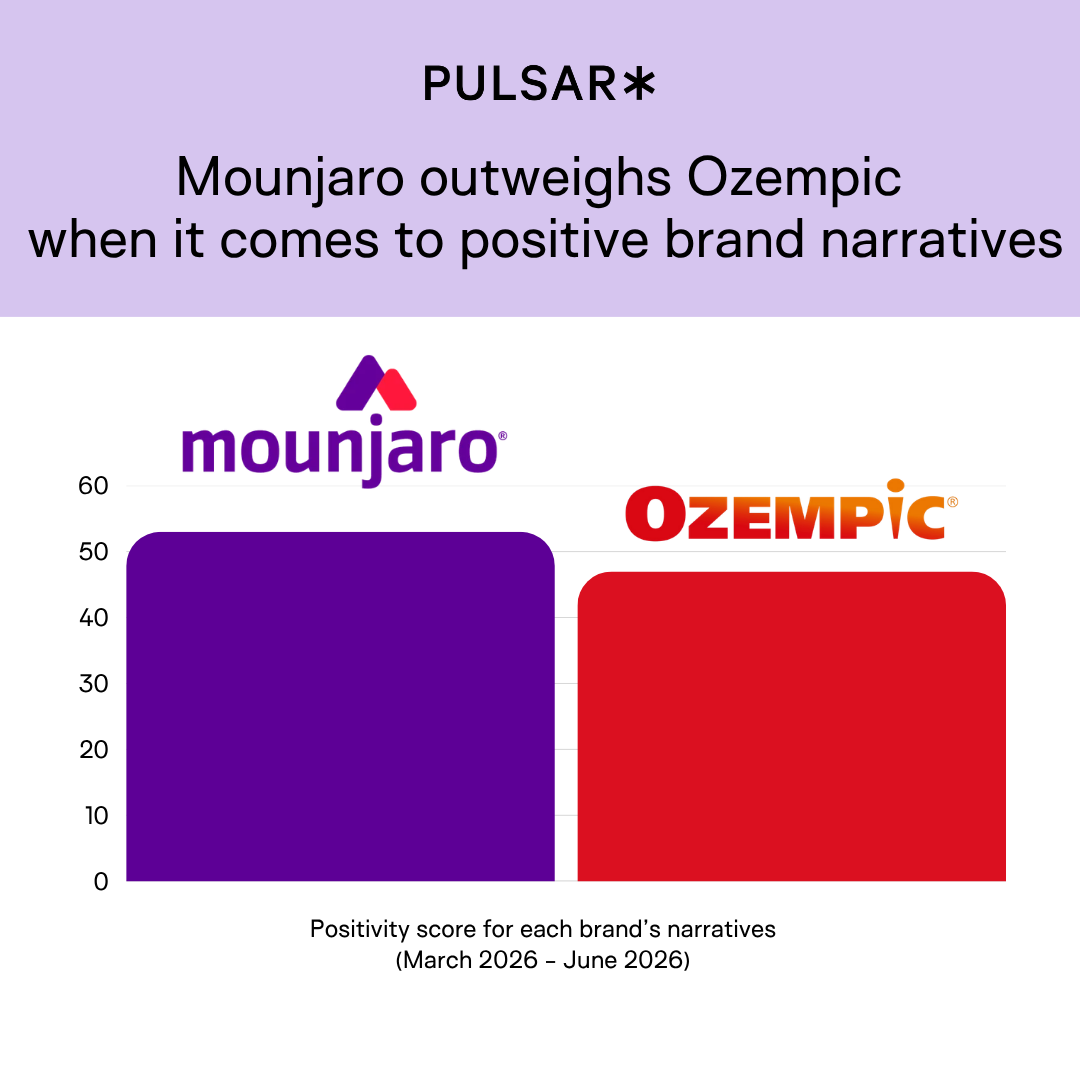
Mounjaro is winning the GLP-1 brand narrative. It scores 52.8 on Pulsar's brand positivity scale, compared with 47.2 for Ozempic, and leads on four of the five dimensions analyzed. Ozempic leads on only one: price and access. The Brand Positivity Score is a net-positive narrative score from 0 to 100, weighted by sentiment and share of conversation.
The five dimensions are defined as follows:
- Trust: confidence among patients and healthcare professionals in the prescribing pathway and clinical relationship.
- Efficacy: how well the drug delivers on expected outcomes and the acceptability of its side-effect profile.
- Culture: the brand's presence in internet culture, media coverage, and wider pop-cultural conversation.
- Ethics: perceptions of the manufacturer's corporate conduct, including pricing ethics and accountability.
- Access: the extent to which patients can realistically obtain and afford the treatment.
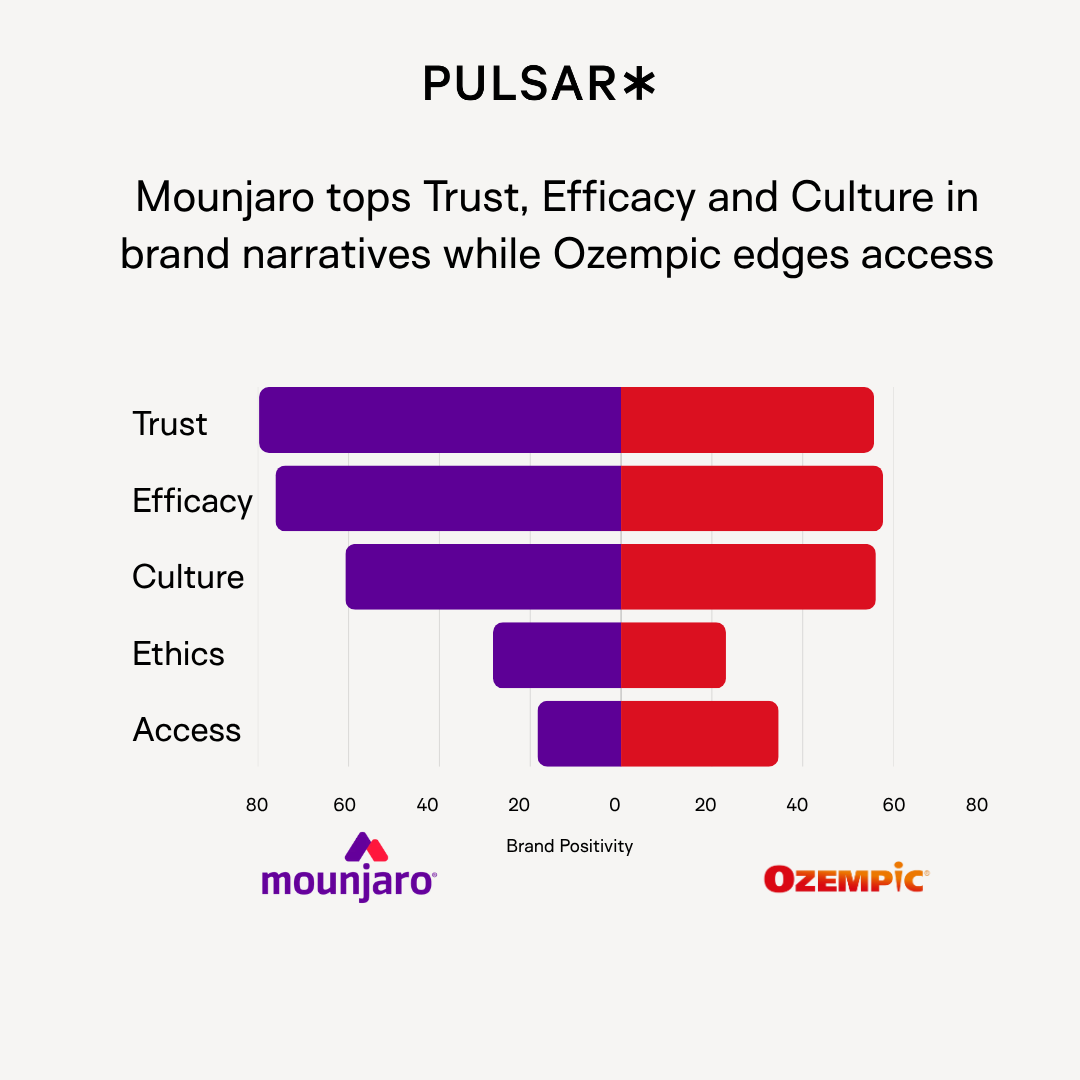
| Dimension | Mounjaro | Ozempic | Narrative leader |
|---|---|---|---|
| Overall brand positivity | 52.8 | 47.2 | Mounjaro (+5.6) |
| Trust | 79.7 | 63.2 | Mounjaro (+16.5) |
| Efficacy | Leads | Trails | Mounjaro |
| Culture | Leads | Trails | Mounjaro |
| Ethics | Leads | Trails | Mounjaro |
| Price & access | 14.7 | 35.1 | Ozempic (+20.4) |
Brand Positivity Score (0 to 100): net-positive narrative weighted by sentiment and conversation share. Source: Pulsar Narratives AI, March to June 2026. Efficacy, Culture, and Ethics are shown directionally; Mounjaro holds the lead on each.
Why does Mounjaro lead Ozempic on medical trust?
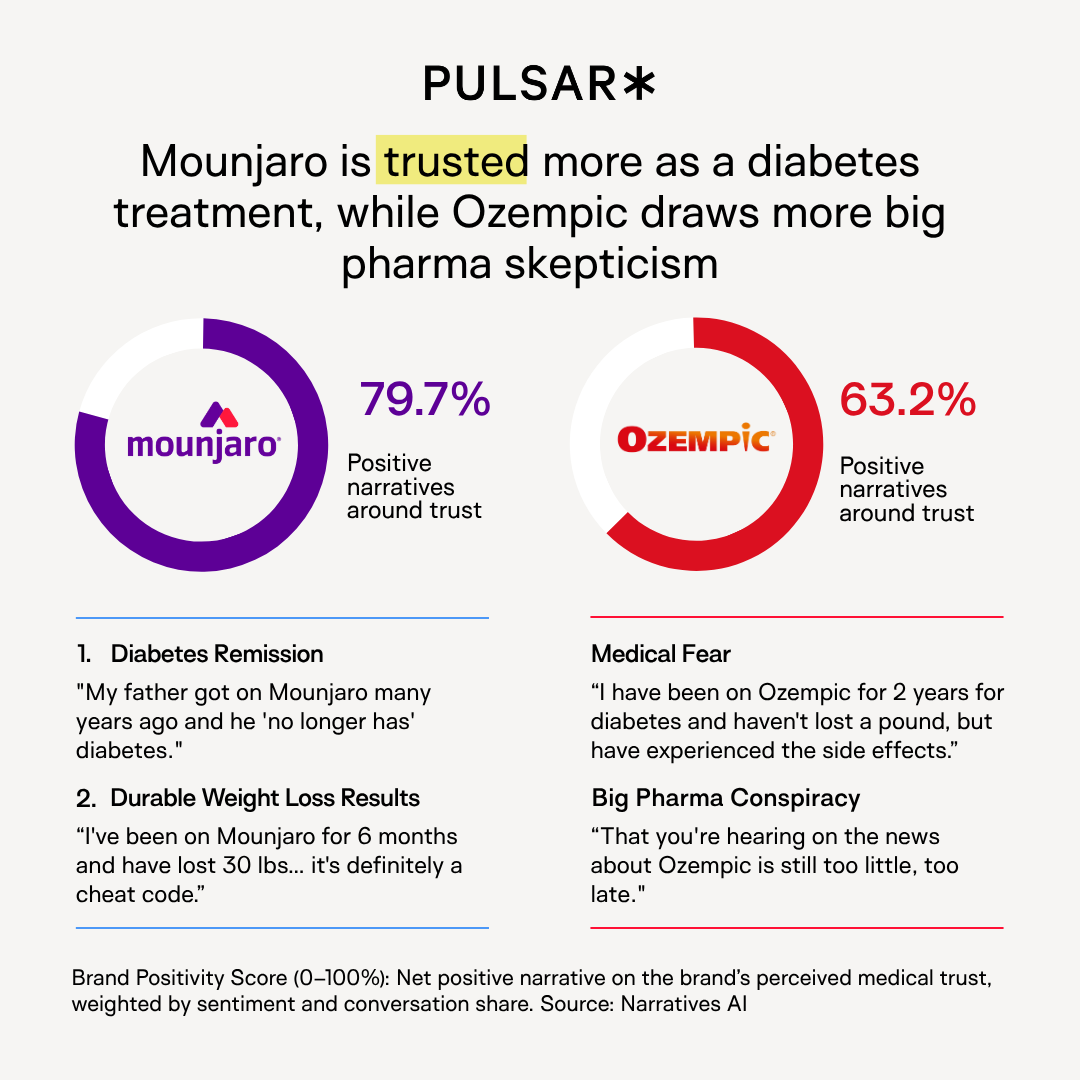
Medical trust is where the gap becomes most commercially significant, and it is where Mounjaro shows its largest lead. Mounjaro scores 79.7 compared with Ozempic's 63.2, a 16.5-point difference that reflects how differently the two drugs have evolved in public consciousness.
Mounjaro's trust narrative is anchored in strong outcomes in diabetes remission and durable weight loss, alongside its use in patients with multiple comorbidities, post-surgical recovery, and long-term A1C management. This reinforces its position within the clinical prescribing environment and keeps the narrative firmly grounded in medical trust.
View on Threads
Ozempic's trust picture, meanwhile, is more fractured. The drug's cultural crossover from diabetes treatment to cosmetic weight loss has introduced a parallel set of users who are not perceived as following a medically prescribed pathway.
Ozempic face is not the only side effect of larger doses of GLP-1s.
Here are other clinical observations comparing regular and microdoses of GLP-1:https://t.co/ax58ToiGna pic.twitter.com/avnXRJInLf
— Aurelius Health Group (@Aurelius_Health) May 20, 2026
How many people do you know were put on Ozempic, had their dose escalated and maxed out, only to then quit entirely because they couldn’t handle the side effects?
I’m beating a dead horse but slow escalation of doses is essential.
Oh, and ditch Ozempic.
Ozempic is the bar…
— kalos (@kalospepgod) May 2, 2026
As Ozempic becomes the category leader and remains tied to side-effect lawsuits and wider negative scrutiny, it is increasingly absorbed into the broader "big pharma" narrative, reinforcing perceptions of distrust.
🚨 THE BIG OZEMPIC SCAM THEY’RE NOT TELLING YOU ABOUT
Everyone’s calling it the “miracle weight loss shot. ”Big Pharma is laughing while raking in billions. But a respected doctor just dropped the truth bomb that should make you delete that prescription: “Ozempic should NOT be… pic.twitter.com/K0BK1jI9iu
— Dr. Dawn Michael (@DawnsMission) May 27, 2026
Why is Ozempic ahead on price and access?
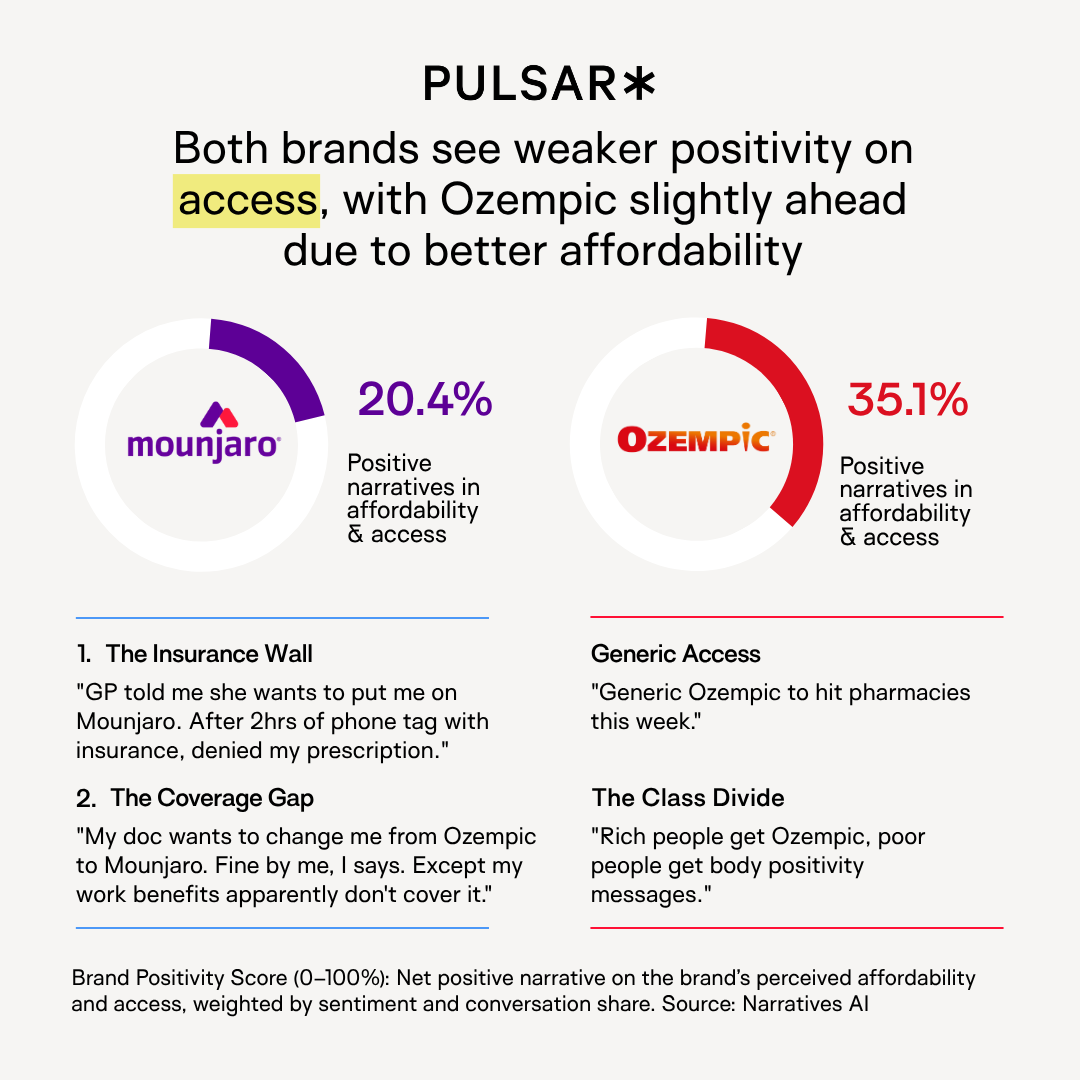
Price and access is the only dimension where Ozempic outperforms Mounjaro, scoring 35.1 vs 14.7. The gap reflects perceptions around how hard it is for patients to get their hands on the drug, with both brands still facing criticism over high costs and limited insurance coverage that leave many patients excluded.
Ozempic's advantage is driven by uneven regulatory timing across markets as well as underlying price. In Brazil, regulators have approved the country's first domestic generic semaglutide, opening the door to lower-cost versions of Ozempic. Canada is also beginning to see early generic entry, while the United States remains constrained by longer patent protection that delays meaningful competition.
As a result, affordability is improving in some markets while remaining tightly tied to branded pricing in others. Markets with early generic availability tend to view GLP-1 drugs more positively, reflecting a stronger sense of accessibility and openness in the category. The takeaway for brand teams is that access perception is now a regulatory and geographic story as much as a pricing one.
Which audiences are driving each brand's narrative?
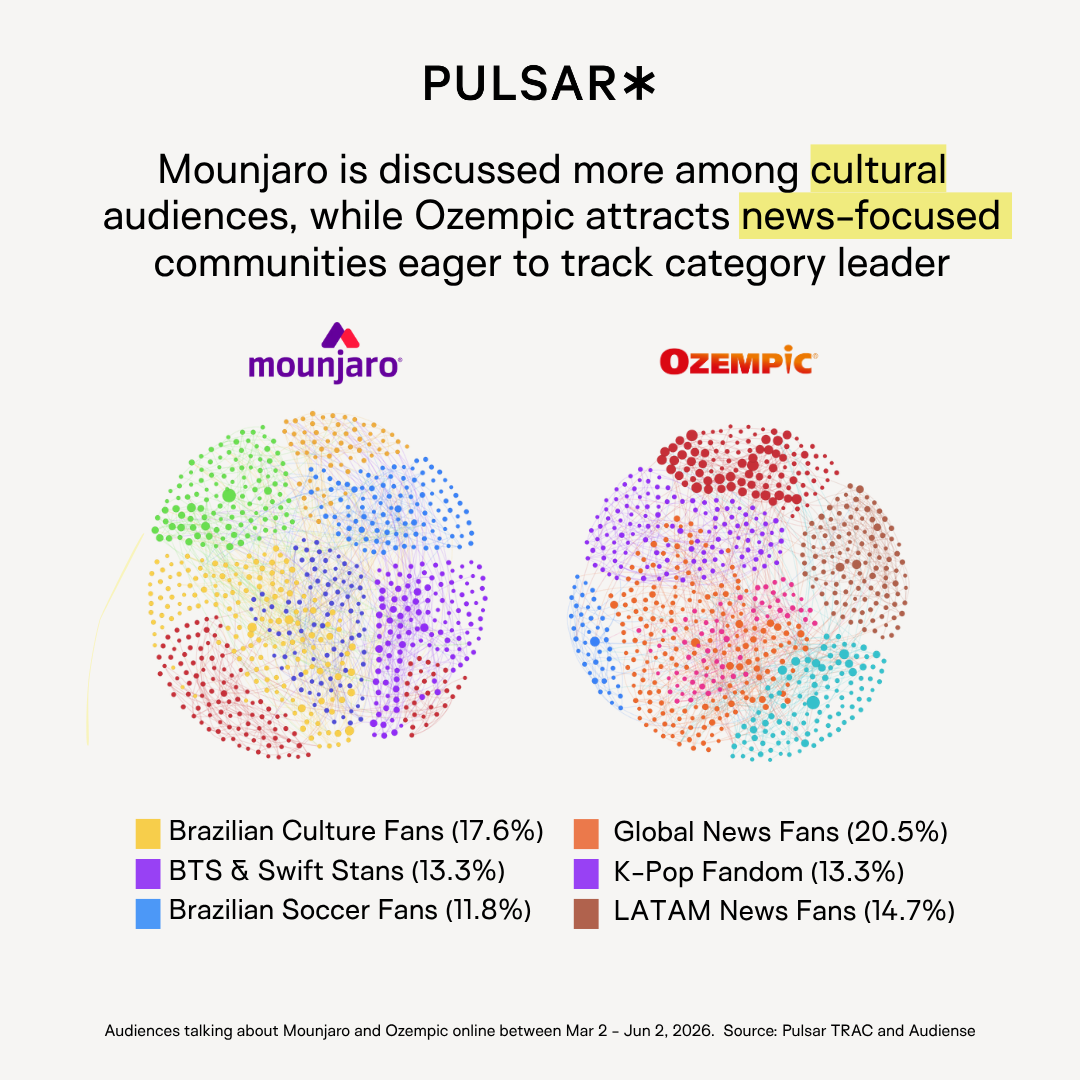
When you segment and map the audiences behind the two brands using Pulsar TRAC and Audiense, the same audience intelligence approach Pulsar applies across health and pharma, a clear divergence emerges in the types of communities shaping conversation.
| Rank | Mounjaro top communities | Share | Ozempic top communities | Share |
|---|---|---|---|---|
| 1 | Brazilian culture fans | 17.6% | Global news fans | 20.5% |
| 2 | BTS and Taylor Swift fans | 13.3% | LATAM news fans | 14.7% |
| 3 | Brazilian football fans | 11.8% | K-pop fandom communities | 13.3% |
Mounjaro over-indexes in culturally expressive and fandom-led communities in Brazil. These audiences are identity-driven and highly emotive, which helps explain why Mounjaro mentions in these spaces skew more celebratory and lifestyle-oriented. Its conversation is still relatively open to being shaped by transformation, wellness, and social identity narratives, rather than being dominated by regulatory or medical controversy. In Brazil, where fan culture is especially active and digitally organized, that dynamic is amplified.
Ozempic is now deeply embedded in news-led discourse shaped by regulation, safety, pricing, supply, and corporate developments. Its audience is led by global and LATAM news communities, which makes it especially receptive to risk-led and critical narratives. In that context, stories around Novo Nordisk layoffs, FDA warnings, and broader criticism gain traction. Ozempic's biggest challenge may be that it has become bigger than the brand itself. As the face of the GLP-1 boom, it attracts scrutiny across earnings, market share, "Ozempic face," body-positivity debates, and side-effect headlines.
What does this mean for pharma brand teams?
The gap between Mounjaro and Ozempic comes from the different identities they have developed in the minds of consumers. Ozempic built its brand on cultural ubiquity, and cultural ubiquity delivered enormous commercial success. But in a category where trust, clinical identity, and prescriber confidence shape long-term market share, being the most famous drug is not the same as being the most trusted one.
Mounjaro's lead on Trust and Efficacy is built on something harder to manufacture than a campaign: a patient community that speaks specifically and enthusiastically about clinical outcomes. "No longer has diabetes." "Changed my life." "Psoriasis cleared up." These signals are not the result of brand investment. They are the result of a drug doing what it is supposed to do, in the right clinical context, for patients who were being treated for the right condition.
For Ozempic, the strategic challenge is not the Novo Nordisk layoff story or the patent expiry. Those are reversible. The harder challenge is cultural drift: the accumulation of named negative cultural terms, off-label usage signals, and elderly patient care failures that are structurally harder to correct once they are embedded in the public conversation.
For both brands, the access dimension signals where the next phase of the category battle will be fought. The drug that is first to generate a credible, patient-level affordability narrative, not just analyst signals about generics and competitive pricing, will own the most politically significant dimension in the GLP-1 conversation. Right now, neither brand is winning it. Tracking these shifts in near real time is exactly the work that brand narrative monitoring and brand sentiment measurement are designed to support. Teams evaluating where to run that work can compare the best social listening tools for pharma brands in 2026.
How was this analysis conducted?
This analysis used Pulsar Narratives AI to examine 100 narratives per brand, ranked by relevance across a three-month window from March to June 2026. Narratives were tagged sentence by sentence across five dimensions (Trust, Efficacy, Culture, Ethics, and Access) with a positivity score ranging from +2 (very positive) to -2 (very negative), weighted by share of conversation (0.0 to 1.0) and a relevance factor (0.1 to 1.0) reflecting how directly each narrative targets each brand.
Aggregated weighted scores per dimension were normalized to a 0 to 100 scale using a sigmoid function, preserving proportional gaps without forcing artificial floor and ceiling values. Cross-brand normalization uses a shared population of all dimension and overall scores from both brands. Audience data is sourced from Pulsar TRAC and Audiense, identifying the top community clusters by share of conversation for each brand across the same analysis period. AI narrative analysis covers the underlying technique in more depth.
Related reading
- What is narrative intelligence?
- What is Pulsar Narratives AI?
- How to monitor your brand narrative
- How to measure brand sentiment shift
- Social listening for competitive analysis
- Community-based audience intelligence
- How GLP-1 weight-loss drugs are reshaping food behavior on social media
- Social listening and audience intelligence guide for health and pharma
- Best social listening tools for pharma brands in 2026
Frequently Asked Questions
+Is Mounjaro or Ozempic more trusted by patients?
Based on Pulsar's Narratives AI analysis from March to June 2026, Mounjaro is more trusted. It scores 79.7 on medical trust versus 63.2 for Ozempic, a 16.5-point lead. Mounjaro's trust narrative is anchored in diabetes remission and durable weight-loss outcomes, while Ozempic's trust signal is more fractured because of its crossover into cosmetic weight loss and its association with side-effect lawsuits.
+What is the difference between Mounjaro and Ozempic?
Mounjaro is tirzepatide, made by Eli Lilly. Ozempic is semaglutide, made by Novo Nordisk. Both are GLP-1 receptor agonists prescribed for type 2 diabetes and used for weight management. In brand-narrative terms, Mounjaro currently leads on overall positivity (52.8 vs 47.2) and on medical trust, while Ozempic leads only on perceived price and access.
+Why is Ozempic perceived more negatively despite being more famous?
Ozempic's fame is the source of its narrative risk. As the face of the GLP-1 boom, it attracts scrutiny across earnings, market share, off-label cosmetic use, side-effect headlines, and "big pharma" criticism. Its audience is led by news-driven communities receptive to risk and critical framing, so corporate and safety stories gain traction quickly. Cultural ubiquity drove commercial success but also made the brand a magnet for negative coverage.
+Why does Ozempic lead on price and access?
Ozempic scores 35.1 on price and access versus 14.7 for Mounjaro, the only dimension where it leads. The advantage is driven mainly by regulatory timing. Brazil has approved its first domestic generic semaglutide and Canada is seeing early generic entry, both lowering perceived cost for Ozempic, while the United States remains constrained by longer patent protection. Both brands still face broad criticism over high prices and limited insurance coverage.
+How were the brand positivity scores calculated?
Pulsar used Narratives AI to analyze 100 narratives per brand, ranked by relevance, from March to June 2026. Each narrative was tagged sentence by sentence across five dimensions with a positivity score from +2 to -2, weighted by share of conversation and a relevance factor. Dimension scores were normalized to a 0 to 100 scale using a sigmoid function across a shared population of both brands' scores. Audience data came from Pulsar TRAC and Audiense.
Explore more brand narrative analysis on the Pulsar blog, or see how Narratives AI turns millions of conversations into measurable brand narratives.
To stay up to date with our latest insights and releases, sign up to our newsletter below:
This article was created using data from TRAC