Social Listening for the Retail Sector: A Practical Guide to Audience and Narrative Intelligence
The retail landscape has undergone a tectonic shift from traditional social monitoring to the more sophisticated disciplines of social intelligence and narrative management. While the industry has historically utilized social media monitoring to track specific brand mentions, hashtags, or keywords to react to immediate customer service needs, the current era demands a proactive, intelligence-led approach. Social listening, in its modern iteration, is defined as the process of tracking, analyzing, and responding to conversations across the digital ecosystem to uncover actionable business insights. However, for a retail brand to achieve true market leadership, it must transition toward audience intelligence—a holistic view of audience behavior that incorporates declared interests, beliefs, and sentiments across multiple social, search, and news platforms.
At its core, audience intelligence distinguishes itself by answering the "why" behind consumer behavior, rather than just the "what" of a mention. This distinction is critical in retail, where purchasing decisions are increasingly driven by cultural affinity rather than just product utility. Social intelligence projects operate as a research practice, often existing as a strategic business function that informs product innovation, market positioning, and long-term forecasting. Narrative intelligence, a specialized subset of this field, involves the use of artificial intelligence to detect and cluster the underlying stories shaping public opinion. Instead of relying on pre-defined keywords—which can act as a restrictive "aquarium" of data—narrative intelligence captures a "firehose" of public data to identify clusters of topics that travel together, mapping how they evolve and connect over time.
The technical distinction between different layers of intelligence is represented in the various tools utilized by leading retail organizations. While general social listening might focus on real-time engagement and crisis management, narrative intelligence provides the historical context and cultural meaning behind those trends. For instance, Pulsar TRAC focuses on granular audience segmentation and the "blips" of daily conversation, while Pulsar Narratives AI investigates how ideas and opinions circulate across vast networks over months or years. This comprehensive view is essential because according to National Retail Foundation (NRF), digitally influenced sales now exceed 60% of total retail transactions, making the online conversation the primary driver of the bottom line.Critical Insights into the 2025 Retail Consumer Environment.
Contents
- Trends at a Glance
- Why Social Listening is Essential for Modern Retail Resilience
- Strategic Use Cases: Decoding Cultural and Operational Signals
- Strategic Framework: The Listen, Map, Activate Methodology
- Audience Discovery: From Mass Targeting to Micro-Communities
- Conclusion: The Attentive Ear as a Strategic Mindset
Trends at a glance
Vibecession
The retail industry in 2025 is defined by a "vibecession," where a disconnect exists between generally positive economic data—such as a 2.0% to 2.8% GDP growth in the US—and a pervasive sense of consumer anxiety and dissatisfaction. This sentiment is largely driven by persistent price increases, with Deloitte reporting that grocery prices in some regions remain 20% higher than they were four years ago. Consequently, PMG reports that 74% of consumers across all income levels are now "trading down," actively seeking lower-cost alternatives, private label goods, or "dupe" products that offer similar quality at a fraction of the cost. This shift has transformed value-driven behavior from a niche strategy for low-income households into a mainstream standard for even middle- and high-income shoppers.
Artificial Intelligence
Artificial Intelligence has moved from the back office to the front of the customer experience. According to research from Deloitte, roughly 93% of consumers now expect brands to keep up with online culture, and 71% of shoppers are increasingly using generative AI tools like ChatGPT or Gemini to compare prices, track deals, and plan their purchases. This means retailers are no longer just competing with each other; they are competing with algorithms that prioritize value and logic over brand loyalty. Nearly 6 in 10 retail executives expect consumers to value lower prices over brand loyalty in the coming year, a trend that necessitates a radical rethink of loyalty programs and personalized marketing.
Gen Z Wealth Gap
Furthermore, generational shifts are concentrating wealth and influence in ways that demand nuanced audience segmentation. While PMG states that Gen Z and Millennials are the primary drivers of social commerce, "silver" consumers (aged 55+) now control 73% of US wealth, representing a massive but often overlooked market for high-value goods and services. Retailers that fail to understand the distinct emotional and functional drivers of these disparate groups risk being drowned out in a fragmented media environment where consumers watch hours of content daily but are increasingly selective about the brands they trust.
Why Social Listening is Essential for Modern Retail Resilience
Social listening is no longer an optional "nice-to-have" function; it is the cornerstone of brand resilience and operational excellence in a volatile market. Jeff Bezos famously noted that an unhappy customer in the physical world might tell six friends, but an unhappy customer online can tell thousands. In the age of viral "de-influencing" and rapid-fire social discourse, the stakes for customer experience (CX) and brand reputation have never been higher. Social listening serves as a "crisis radar," detecting potential PR threats or spikes in negative sentiment at 2:00 AM, long before they reach the morning news cycle.
Beyond risk mitigation, social listening provides three core strategic advantages. First, it enables "hyper-personalization" at scale. By understanding the specific topics that interest an audience, brands can craft content that resonates deeply with their values rather than relying on generic messaging. Second, it provides a competitive edge through gap analysis. By tracking what audiences say about competitors, retailers can identify exploitable weaknesses—such as frustration with a rival's shipping delays or product quality—and position themselves as the better alternative. Third, social listening is a significant driver of revenue. It allows brands to identify "high-intent" conversations early, such as a user asking for a product recommendation on a forum, and engage at the right moment with a relevant solution.
The essential nature of this practice is also rooted in the rise of the "purpose-driven" consumer. Over 70% of buyers now prefer companies that prioritize socio-political issues and are willing to pay a premium for responsible business practices. Social listening allows brands to monitor whether their sustainability or inclusivity claims are perceived as authentic or as "performative activism". Authenticity is the non-negotiable currency of 2025, and listening is the only way to verify if a brand's narrative aligns with its audience's reality.
Strategic Use Cases: Decoding Cultural and Operational Signals
The practical application of social intelligence is best understood through a series of thematic use cases that demonstrate how data transforms into retail strategy.
The No-Buy Movement and the De-influencing Backlash
The "no-buy" and "de-influencing" trends represent a profound cultural shift toward anti-consumption, largely fueled by the intersection of economic hardship and environmental anxiety. In our research into No-and Low-Buy trends, we found de-influencing saw a 106% surge in popularity, involving creators providing honest, often critical reviews that discourage followers from buying unnecessary or overhyped products. This trend is a direct rejection of "haul culture" and the "TikTok Made Me Buy It" narrative, favoring community-driven authenticity over polished influencer endorsements.
Retailers in the fashion and food sectors are particularly impacted, as these industries are subject to frequent, habitual purchasing where unsustainable behavior "creeps" in. Fast-fashion giants like Temu and Shein are increasingly discussed through a lens of climate negativity, while frugal-minded audiences view discount supermarkets like Aldi and Costco in a positive light for alleviating economic pressure. Social listening reveals a growing "cultural cache" in repair, upcycling, and peer-to-peer resale. Progressive communities are embracing challenges like the #75Hard Style Challenge, where users document outfits for 75 days without purchasing anything new, signaling a shift in status from owning "new" items to possessing "durable" and "repaired" items.
Buy Now, Pay Later: From Luxury Treat to Financial Lifeline
We researched the narrative around Buy Now, Pay Later (BNPL) - and it’s undergone a dramatic evolution. Originally marketed to younger consumers as a way to afford fashion and lifestyle items, it has increasingly become a "lifeline" for everyday survival. Pulsar's BNPL report highlights a shift where consumers are using these tools for supermarkets, healthcare, utilities, and automotive repairs. While social media is often filled with jokes about shopping habits, there is an underlying current of anxiety regarding "phantom debt" and the psychological impact of being in a constant "payback cycle" for basic necessities.

Brand associations in this space are dominated by Klarna and Afterpay. Klarna often leads the media narrative in Europe regarding AI experiments and regulation, while Afterpay is more centrally linked to brand deals and the modern version of "layaway".
| Platform | Conversational Focus | Audience Behavior |
| Forums | Rights, obligations, debt strategy | Sharing personal experiences and advice |
| Business promotion, aesthetics | Sellers conducting commerce | |
| X (Twitter) | Fintech innovation, regulation, politics | Industry news and policy debate |
| Group buying, seller communities | Local business engagement |
Retailers like Walmart and IKEA have seen significant conversation spikes following their adoption of BNPL, signaling the sector's move into the household-name mainstream. For retailers, the takeaway is clear: BNPL is no longer just a conversion tool; it is a critical component of the consumer's financial ecosystem that requires careful narrative management to avoid being associated with "predatory" spending.
Tackling Trends: Gorpcore and Utilitarianism
"Gorpcore"—the everyday use of functional, outdoor-inspired gear in urban settings—demonstrates how a niche functional requirement can morph into a global status symbol. We researched the rise of Gorpcore and brands like Patagonia, The North Face, and Arc’teryx, which are the primary beneficiaries of this trend, where puffer jackets and technical footwear act as statement signifiers of identity. The trend is driven by a mixture of cultural anxiety—a shift toward utilitarian gear in an uncertain world—and wealth signaling, particularly in the South Korean student market where high-cost technical gear is a marker of status.
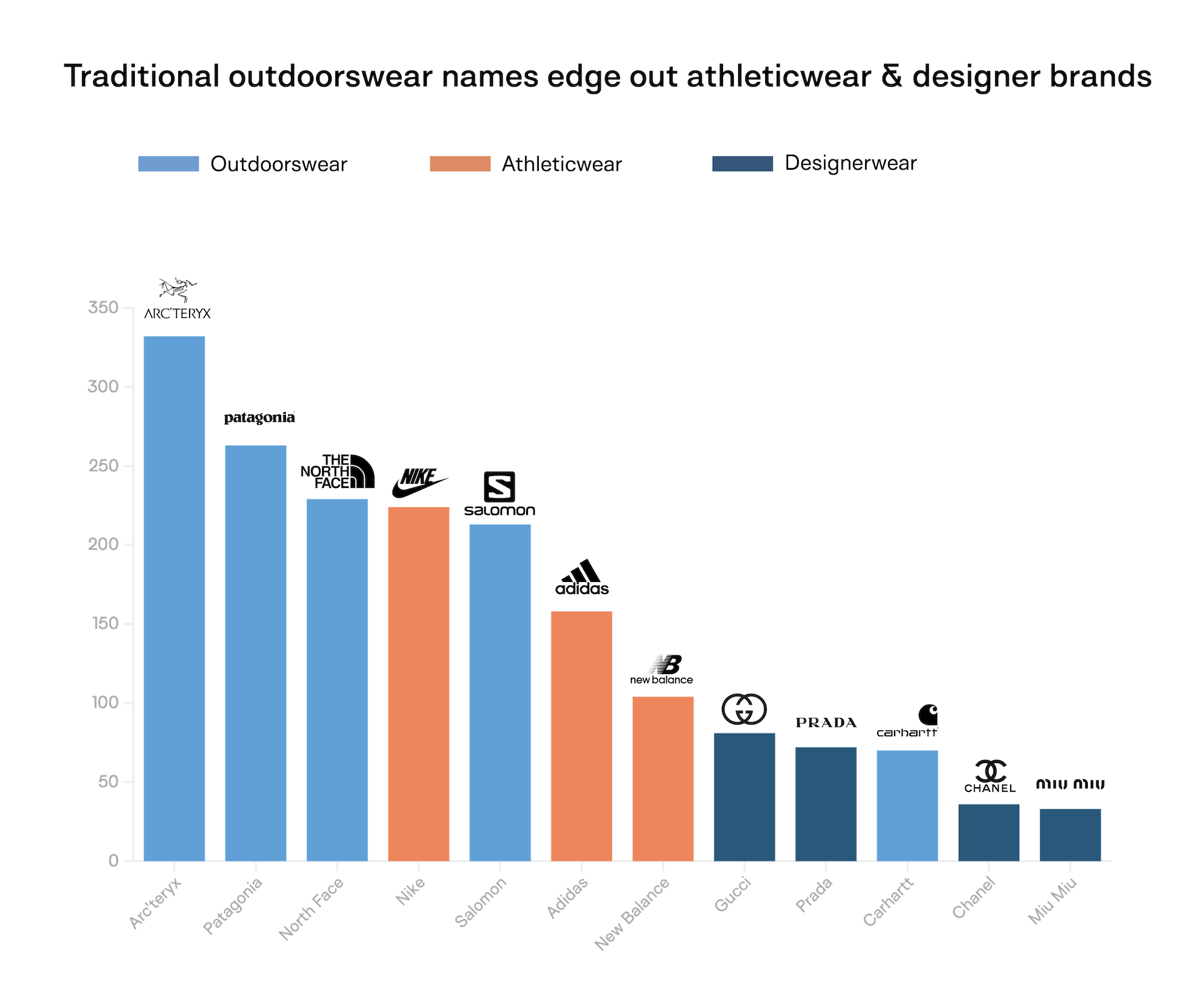
Audience intelligence allows retailers to map the distinct communities driving this trend. "Manchesterphiles" gravitate toward technical jackets linked to specific music and football subcultures, while "K-Pop Fandoms" discuss the trend through the lens of celebrity styles. Menswear enthusiasts, the earliest adopters, now exhibit "gatekeeping" behaviors, mocking newcomers for prioritizing aesthetics over rugged utility. This granular mapping helps brands like Adidas or New Balance understand why they are viewed as "purely aesthetic" compared to the "practical authenticity" of Patagonia, allowing them to refine their marketing messages accordingly.
Reputation Risk and Supply Chain Scrutiny: The LVMH Case
The luxury sector is currently facing a reputation crisis centered on supply chain ethics. In our report, Some Scoops Travel Further Than Others, we found investigations into labor abuses in Italy's high-end garment industry have targeted major brands, including Dior, Armani, and Loro Piana. Probes by Milan prosecutors revealed worker exploitation, illegal subcontracting, and "degrading" labor environments where workers were paid as little as €2.75 per hour. This has "tainted" the prestigious "Made in Italy" label, which was previously a source of immense pride and value for luxury consumers.
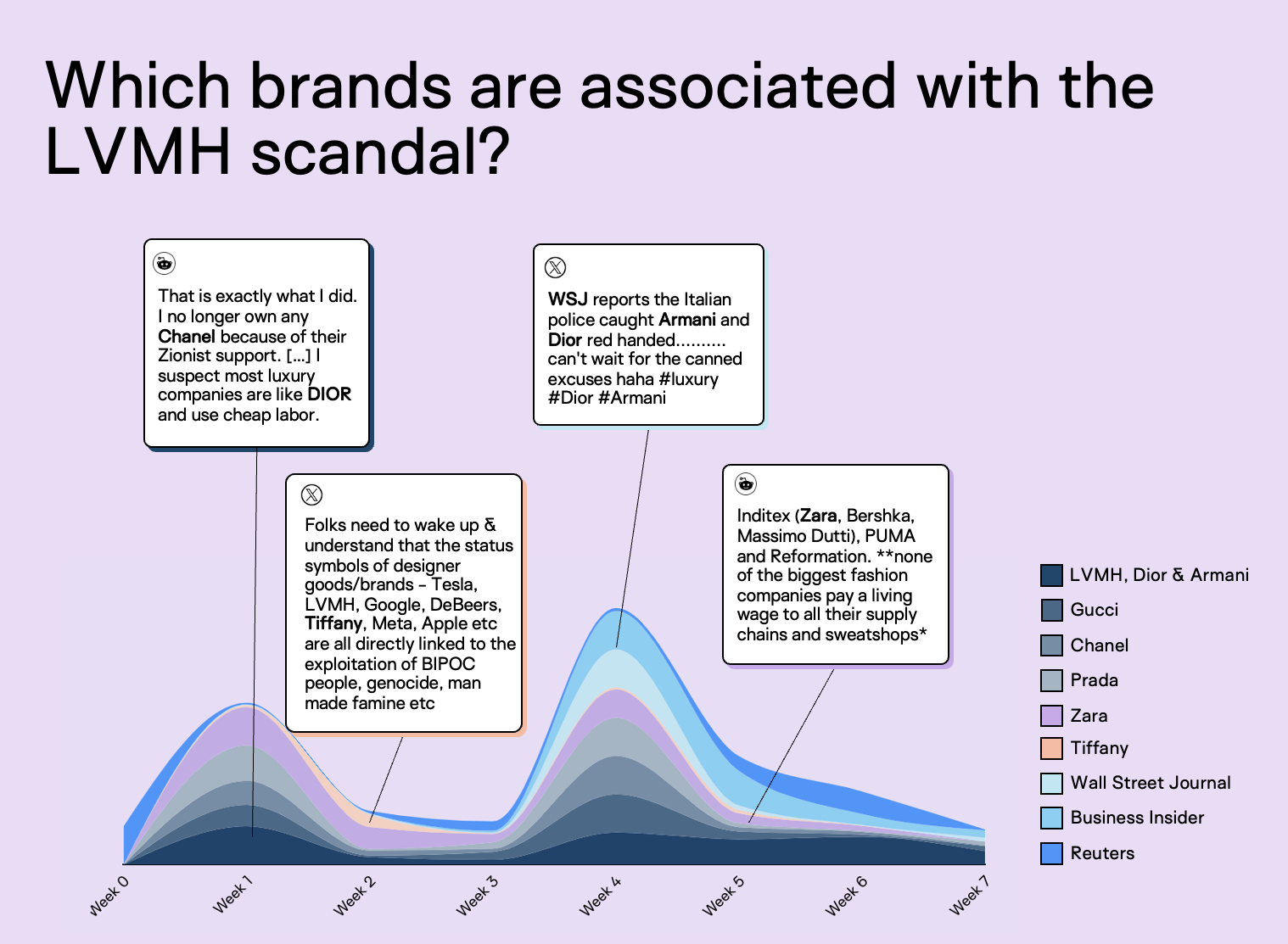
Narrative intelligence is vital in this context to track how such "scoops" travel through different communities. News of these investigations often moves from investigative journalism to fintech and legal communities on X, then to luxury fashion communities on forums and Instagram, where it challenges the sustainability and ethics claims made by the brands. Brands like Prada have responded by inviting journalists to inspect their factories, leveraging transparency as a reputational shield. For a brand like LVMH, monitoring these narrative shifts is essential for managing the "climate" of trust, ensuring they can respond with transparency and concrete action before a local investigation becomes a global boycott.
Operational Excellence and CX: The Thinx Experience
Social listening also serves as a critical operational tool, as seen in the case of Thinx. By utilizing Pulsar TRAC to monitor for non-tagged mentions of delivery delays and stock shortages, Thinx can proactively address customer anxieties before they escalate into a PR crisis. This approach transforms social listening from a marketing function into a customer experience (CX) function.
Analyzing everyday exchanges allows a brand to surface the "why" behind consumer sentiment that traditional surveys often miss. For instance, if a specific region is experiencing a surge in complaints about late orders, the brand can identify the cause (e.g., a specific logistics partner) and communicate directly with affected customers, providing updates and solutions in real-time. This proactive "early-warning system" is essential for reducing customer churn and building long-term loyalty in a market where 73% of buyers will switch to a competitor if a brand fails to respond to their needs.
Strategic Framework: The Listen, Map, Activate Methodology
To turn raw social data into a strategic edge, Pulsar employs the "Listen, Map, Activate" framework, which ensures that insights are translated into tangible business improvements.
Step 1: Listen – Capturing the Unfiltered Voice
The foundation of a successful strategy is a robust listening infrastructure that goes beyond branded mentions. This involves monitoring a diverse range of signals:
- Omnichannel Monitoring: Tracking data across social media (X, Pinterest, TikTok), news (online, print, TV, radio), search data, and first-party website browsing behavior.
- Visual Listening: Utilizing AI logo recognition to track brand mentions in images and videos, as a significant portion of social discourse is now visual.
- Global Intelligence: Monitoring conversations across 195 countries and in all languages to understand territory-specific sentiment, such as tracking Weibo or WeChat for the Chinese market.
Step 2: Map – Synthesizing Data into Narratives
Once data is captured, it must be synthesized into meaningful narratives and community segments.
- Audience Segmentation: Instantly segmenting the audiences participating in a conversation to understand how different communities talk about the same topic differently. For example, segmenting food delivery consumers by "affinity" (shared likes and influencers) rather than simple demographics.
- Narrative Detection: Using AI-powered clustering to identify the dominant themes in a conversation. This helps distinguish between the "weather" (short-term news spikes) and the "climate" (long-term reputational shifts).
- Sentiment and Emotion AI: Going beyond generic positive/negative sentiment to detect specific emotions like frustration, sarcasm, or genuine excitement, providing a more accurate picture of consumer psychology.
Step 3: Activate – Translating Insight into Action
The final step is the application of these insights to provide a tangible return on investment (ROI).
- Campaign Optimization: Adjusting live marketing efforts based on real-time feedback on which messages are resonating and which are falling flat.
- Product Innovation: Turning the noise of online conversation into a roadmap for new product features or identifying unmet needs long before they appear in sales data.
- Partnership Management: Identifying the right influencers and brand partners based on their "cultural pull" and audience overlap rather than just their reach.
Audience Discovery: From Mass Targeting to Micro-Communities
Modern retail success requires a shift from "mass" targeting to "micro" understanding. Audiences are no longer static; they are fluid, fragmented, and constantly evolving. Traditional demographics like age and gender are increasingly less predictive of behavior than core motivations, values, and psychological profiles.
Audience intelligence platforms allow retailers to stitch together interactions across digital channels to build highly accurate personas based on self-declared interests and passions. This discovery process often reveals "unknown" audiences—communities that care about the brand but were previously off the radar. For instance, a luxury brand might discover a significant audience among "Crypto and Art Enthusiasts" who are interested in gorpcore-themed NFTs, opening up entirely new revenue streams.
In 2025, the retailer with the lowest "cost to serve" and the highest "cultural resonance" wins. Achieving this requires a deep dive into the traits of those engaging with the brand to target similar "lookalike" audiences effectively. By mapping influence networks and identifying the "trend-setters" within niche communities, retailers can move before their competitors even see the trend coming.
Conclusion: The Attentive Ear as a Strategic Mindset
The future of retail brand success lies not in the loudest voice, but in the most attentive ear. As the industry moves into 2026, the complexity of the global landscape—defined by economic "vibecessions," AI-assisted shopping, and heightened scrutiny of supply chains—demands a sophisticated approach to listening. Social listening is no longer a peripheral marketing tool; it is a strategic mindset that empowers brands to move from a reactive posture to a proactive one.
By harnessing audience and narrative intelligence, retail leaders can decode the "why" behind the "what," identifying the cultural undercurrents that guide consumer choice. Whether it is navigating the de-influencing backlash, adapting to the "luxury-to-lifeline" shift in BNPL, or managing the reputational risks of a global supply chain, the ability to turn digital "vibes" into actionable insights is the ultimate differentiator. The "Listen, Map, Activate" framework provides the necessary roadmap for this journey, ensuring that every marketing dollar, product innovation, and customer interaction is rooted in the authentic voice of the consumer. In the attention economy, those who listen most effectively will be the ones who lead.
To stay up to date with our latest insights and releases, sign up to our newsletter below: