Platform-Hopping and Social Media Fatigue: Why People Are Moving Between Platforms in 2026
- Media
Social media is increasingly described as exhausting.
Across platforms, users talk about feeds saturated with optimization, branding, and visibility plays. Posting feels strategic. Scrolling feels effortful. Even personal updates are framed as content competing for attention. What once felt casual now carries the emotional weight of performance.
This shift is reshaping behavior. Rather than disengaging entirely, audiences are redistributing their attention across platforms. Platform-hopping has emerged as a way to manage exposure, regulate effort, and adjust how visible, responsive, and present people feel they need to be at different moments.
What we're covering:
Anti-algorithmic spaces and attention relief
Discord as Community Infrastructure
Tumblr, Substack, and the Return of Blogging
Why are people moving from to Bluesky?
Anti-algorithmic spaces and attention relief
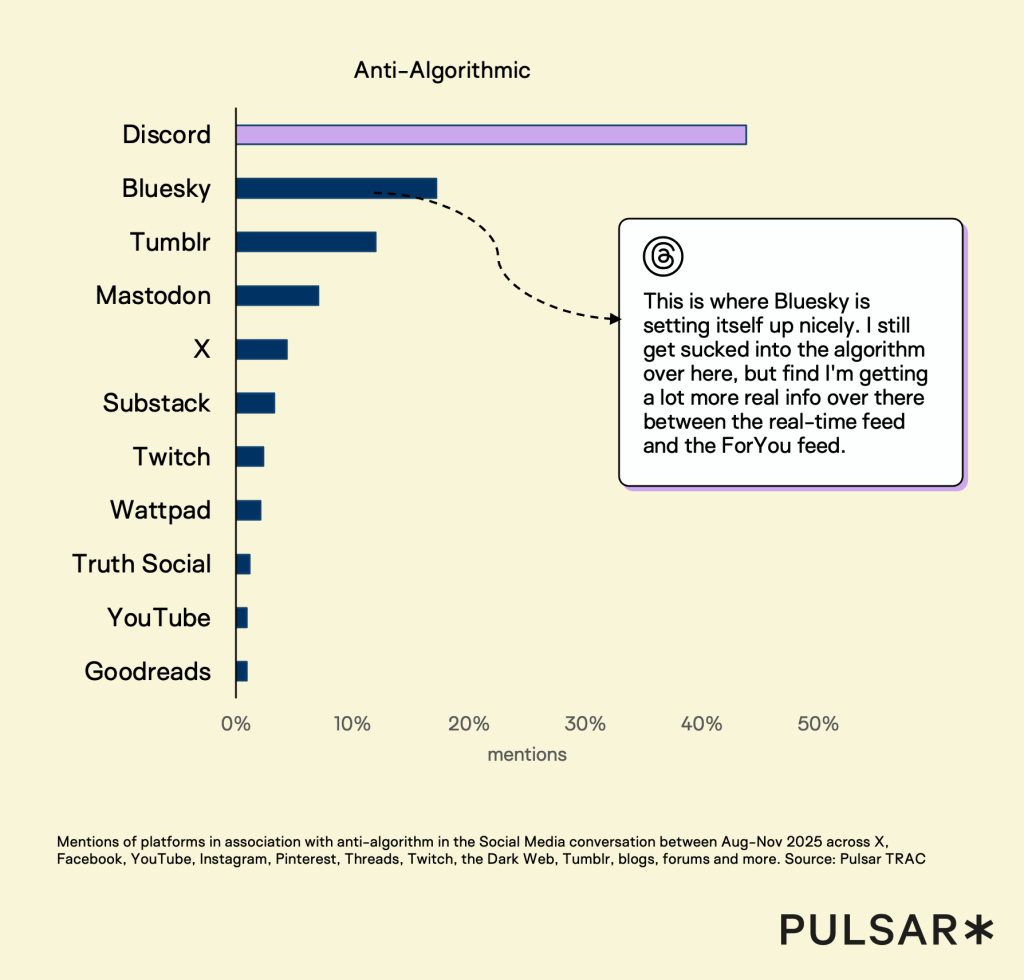
Algorithmic pressure has become one of the most consistent sources of friction across social media. As feeds increasingly optimise for scale and engagement, many users describe fatigue and a growing sense of lost control over how their attention is directed. In response, platforms that reduce reliance on broadcast-style algorithmic feeds are gaining renewed relevance.
These spaces attract users by offering relief from constant optimisation. They emphasise choice, structure, and more deliberate forms of participation, creating environments where engagement feels less extractive and more intentional.
Discord as Community Infrastructure
Originally a gamer tool, Discord has evolved into essential Community Infrastructure, functioning as a default social layer where interaction is anchored in shared purpose rather than viral reach. This structure scaled rapidly during the pandemic, when schools, fandoms, creative communities, and workplaces adopted Discord as shared social infrastructure.
View on Threads
Since then, growth has become more incremental, yet usage remains deeply embedded. Discord now functions as a default community layer across the internet. Without a central discovery feed, interaction stays anchored in shared purpose. Participation is shaped by presence, and discovery feels adjustable, creating a collaborative relationship with the system.
Tumblr, Substack, and the Return of Blogging
Tumblr and Substack also feature prominently in conversations about anti-algorithm spaces, highlighting renewed interest in blogging and text-led platforms.
Substack has grown into a major subscription ecosystem, reaching over 20 million monthly active subscribers and more than 5 million paid subscriptions by late 2025. Its expansion into video and multimedia publishing reflects a broader role in creator-led content beyond newsletters.
Tumblr remains a vibrant blogging platform with approximately 135–142 million monthly active users and more than 620 million blogs worldwide. Its rebound reflects renewed appetite for slower social rhythms. Looser discovery, reblog culture, and support for niche communities shape participation around identity and subculture rather than continuous optimization.
Across these platforms, similar dynamics take hold: irregular posting, reduced discovery pressure, and lower performance incentives. These shifts point to social environments where users exercise greater control over participation and attention.
The rebound of Tumblr and the rise of Substack reflect a collective desire for slower social rhythms. These platforms prioritize deep-dive reading and niche subcultures over the high-velocity, high-stress cycle of the mainstream feed.
Why are people moving to Bluesky?
Bluesky’s growth reflects demand for greater influence over how content appears. Its visibility increased sharply during periods of political and cultural disruption, particularly following changes at X.
Mashable reports that Bluesky added more than 700,000 new users immediately after the 2024 U.S. election, often framed as people seeking an alternative social environment with different expectations around participation.
As usage settled, Bluesky’s appeal became clearer through its approach to feeds. On Bluesky, the experience is defined by negotiable algorithms. Unlike the 'black box' feeds of legacy platforms, users here have the agency to choose, modify, and even build their own discovery rules.
Bluesky algorithm simply tends to show up what gets shared more... but you can customize it too, with skyfeed.
Yeah it doesn't suggest new people like X (premium feature btw) but again... one doesn't need that
— Fox Popvli (@foxpopvli.bsky.social) 11 February 2025 at 14:47
Algorithms remain part of the experience, though they feel more transparent and adjustable. This fosters a sense of shared control between platform and user.
How platforms accumulate fatigue
Platform-hopping reflects a fundamental shift from social performance—the exhausting need to 'brand' one’s life for an audience—toward social presence, where the goal is simply being with others in a shared digital space.
Switching behavior reveals how platforms are emotionally ranked.
Mentions of doomscrolling, lurking, switching, cutting back, and quitting closely track how much pressure users associate with each platform. Platforms where participation feels highly visible, reactive, or emotionally demanding show higher levels of switching behavior.
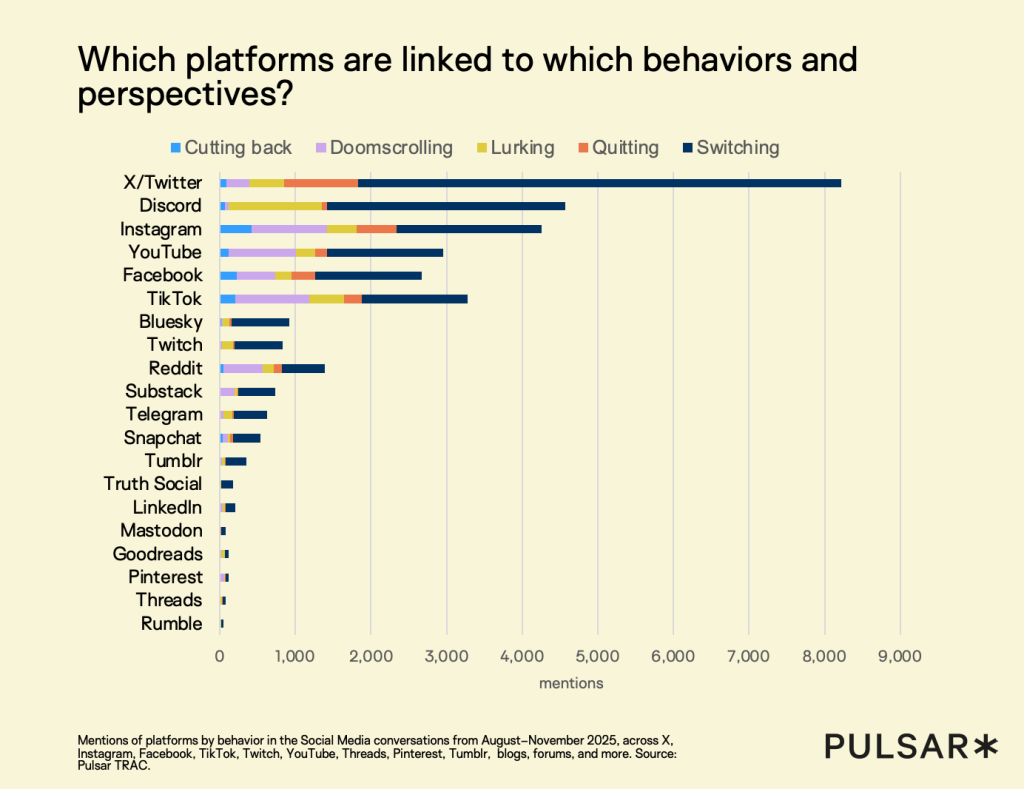
X and Instagram consistently surface as high-pressure environments. Participation feels exposed and difficult to disengage from, which helps explain why cutting back appears frequently in conversations around both platforms.
By contrast, Discord and Bluesky are discussed as lower-risk destinations. Smaller audiences, clearer boundaries, and more controllable modes of participation reduce performance pressure, making these spaces feel easier to inhabit without constant vigilance.
Doomscrolling clusters most strongly around TikTok and Instagram, where discovery-driven feeds continue to pull users into extended sessions even as enjoyment fades. YouTube sits apart in these discussions, remaining associated with intentional viewing and sustained attention rather than habitual scrolling.
Elsewhere, forums and Facebook skew toward observation. Users describe watching far more than posting, reinforcing a sense of distance rather than active connection.
| Platform | Fatigue Level | Primary User Sentiment |
| TikTok | High | Doomscrolling / Habitual |
| High | Performance / Comparison | |
| Bluesky | Low | Agency / Control |
| Discord | Low | Presence / Purpose |
Overall, the pattern shows that audience movement is shaped by self-regulation rather than novelty. Social media use persists, but attention shifts toward platforms that better match the level of energy, visibility, and emotional investment people are willing to give.
Why this matters
Platform-hopping reflects how people manage effort, exposure, and emotional load across a fragmented social media landscape.
Audience movement increasingly reflects self-regulation. Social media use continues, while attention concentrates in spaces that feel sustainable. Platforms function as distinct environments with different emotional costs, rather than universal destinations.
In an attention economy defined by algorithmic intensity, platform-hopping signals a more deliberate relationship with social media. The defining question is how people move between platforms in ways that feel manageable, intentional, and sustainable over time.
For a deeper dive into the full Great Fragmentation study, read it here.
To stay up to date with our latest insights and releases, sign up to our newsletter below:
This article was created using data from TRAC