
From Interest to Identity: Why Communities Are Changing Shape
- Media

Online communities are becoming less useful and more personal.
For years, digital communities were organized around shared interests: hobbies, fandoms, skills, problems to solve. People gathered to learn, ask questions, trade recommendations, and improve at something. That model is weakening.
As search, recommendation engines, and now AI absorb much of the functional value these spaces once provided, audiences no longer need communities primarily for answers. What they are seeking instead is recognition, alignment, and belonging. This shift marks a move away from interest-based communities toward identity-based ones.
Community participation increasingly centers on inhabiting spaces that reflect identity, values, and belonging.
What we're covering
Why interest communities are losing ground
Identity communities absorb what interest communities lose
Inspiration, authenticity, and the return of the lived-in Internet
Why interest communities are losing ground
The decline of interest-based communities does not suggest fading curiosity.
It reflects a change in how people solve problems. Over the past five years, engagement across these spaces has dropped by 20–40%, as users increasingly turn to AI and instant answers.
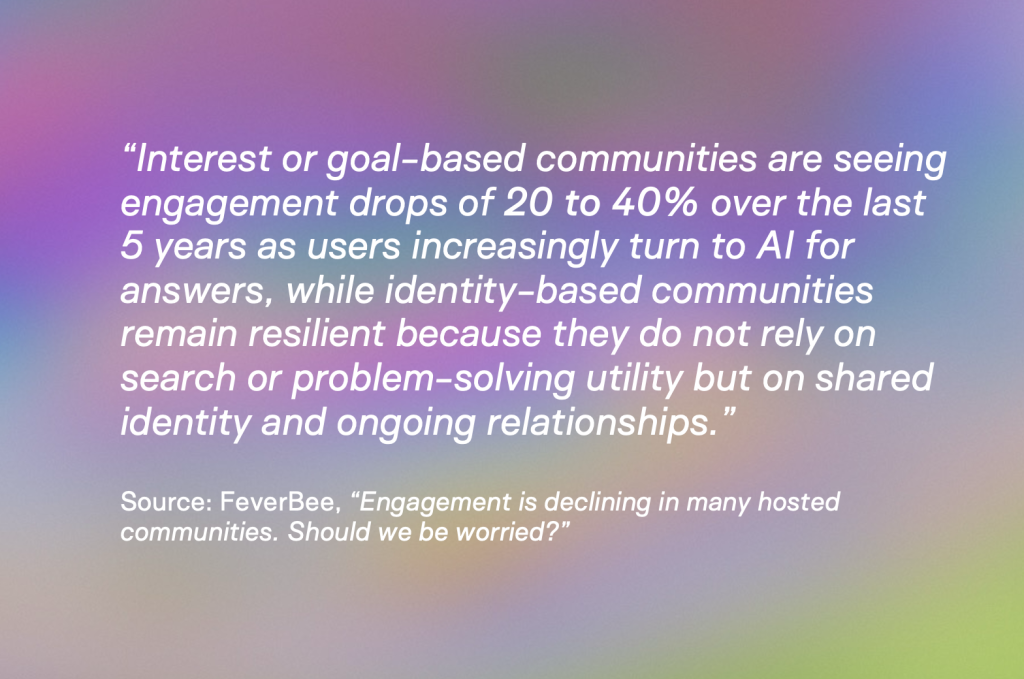
As a result, many interest communities experience thinning engagement. Users still visit, but they contribute less. Lurking replaces participation. Utility remains, but relational depth fades.
This does not mean communities are disappearing. It means their value proposition is shifting. Spaces that rely on transactional knowledge exchange struggle to sustain momentum once information is decoupled from social interaction.
Identity communities absorb what interest communities lose
At the same time, communities organised around identity remain resilient.
These spaces are defined less by what members are trying to achieve and more by who they understand themselves to be. Shared values, aesthetics, politics, humor, and emotional experience shape participation. Engagement is sustained through relationships rather than outcomes.
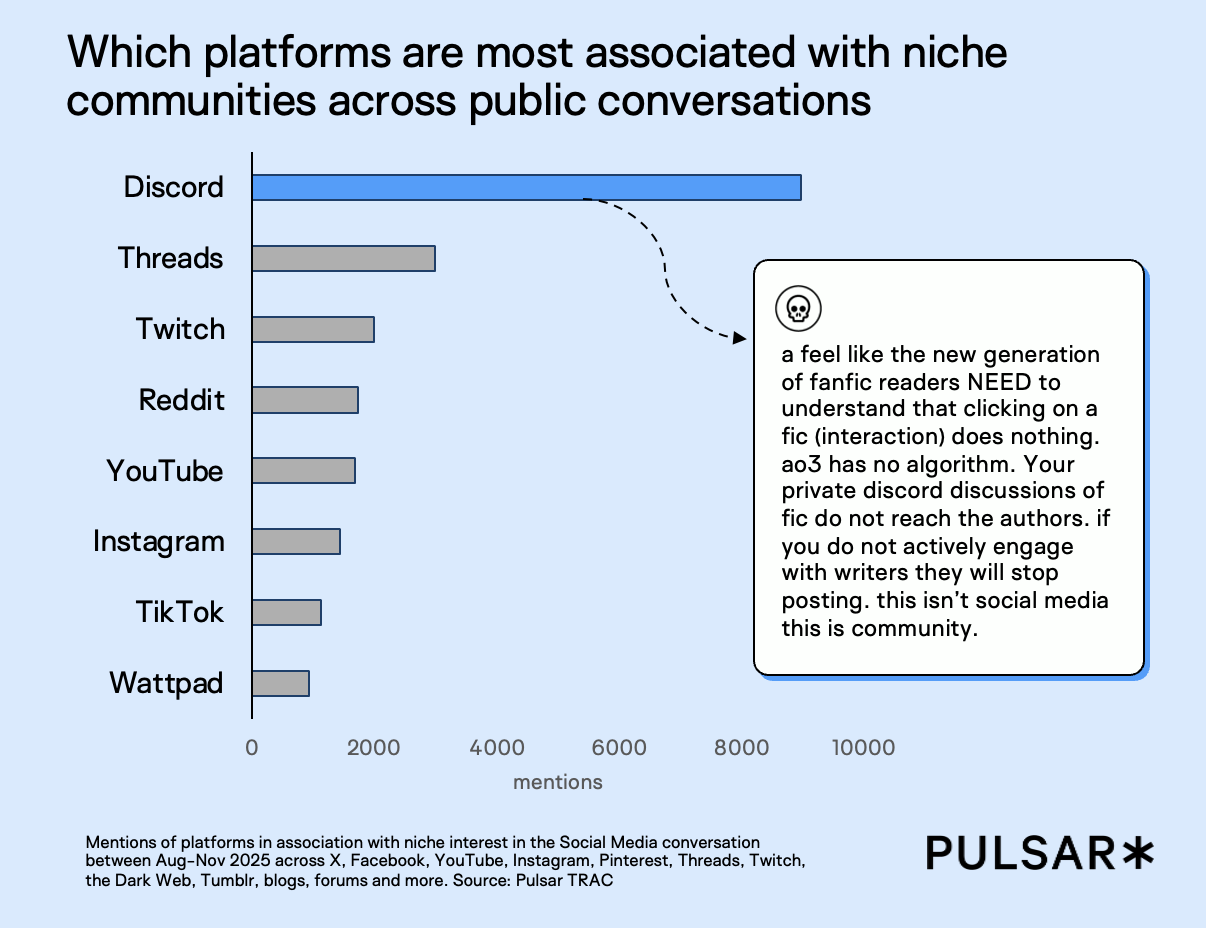
Platforms like Discord exemplify this shift. When we look at mentions associated with niche communities, Discord dominates the conversation by a wide margin, with almost 9k mentions over the period measured. This is almost triple the volume of the next closest platform and several times higher than forums, YouTube, Instagram, or TikTok. The scale of this gap signals where identity-led participation is concentrating.
Discord’s closed, opt-in structure allows people to express niche interests as lived identity rather than content. Participation feels safer, more curated, and more personal. Being present matters as much as posting.
Threads surfaces unexpectedly in this context, ranking second for niche community mentions and notably ahead of forums. This does not suggest that Threads is inherently more niche. Instead, it reflects forums' increasing scale and mainstream role, including its visibility as a source for LLM training data, which shifts how users talk about it. Forums remain useful infrastructure, though it is discussed less as an intimate home for niche audiences.
Threads’ position also speaks to its evolving perception. Initially framed as the more corporate entrant in the new wave of social platforms, partly due to its reliance on the Instagram social graph, it is now valued for feeling calmer and more contained than other mainstream spaces. Users describe it as a bridge between mass social platforms and identity-oriented communities, where participation carries lower emotional risk.
Twitch reinforces this pattern from a different angle. Its presence in niche community conversations reflects how live, interest-driven environments sustain identity through shared moments rather than persistent feeds. Participation centres on presence, co-experience, and ritual, making Twitch especially resonant for fandoms and creator-led subcultures.
Across Discord, Threads, and Twitch, a common thread emerges: safety and trust matter deeply to niche communities. Smaller audiences, clearer boundaries, and shared norms reduce performance pressure and support deeper forms of participation.
Influence increasingly accumulates within these trust-rich micro-communities. As attention fragments, brand advocacy and cultural relevance depend less on broad reach and more on engaging with, supporting, or enabling these tightly knit clusters where identity, rather than scale, drives connection.
Inspiration, authenticity, and the return of the lived-in Internet
The rise of identity communities is closely tied to how audiences define inspiration and authenticity as well.
Inspiration clusters around platforms that blend expression with intimacy.
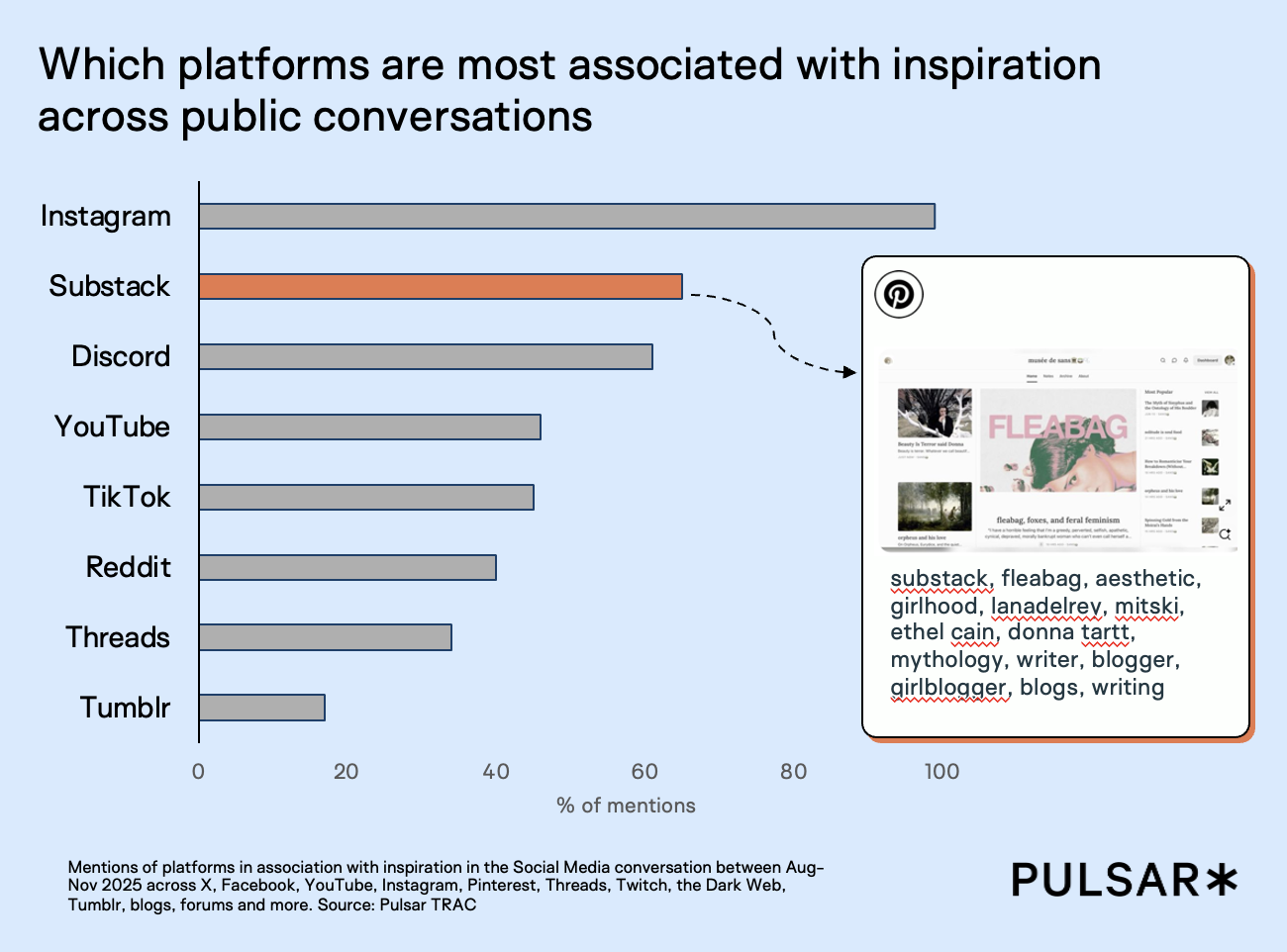
Instagram still dominates visually, but Discord and Substack appear alongside it as places where inspiration feels contextual rather than performative.
Substack, in particular, functions as a repository for taste, philosophy, and cultural identity, extending beyond writing into visual and aesthetic worlds.
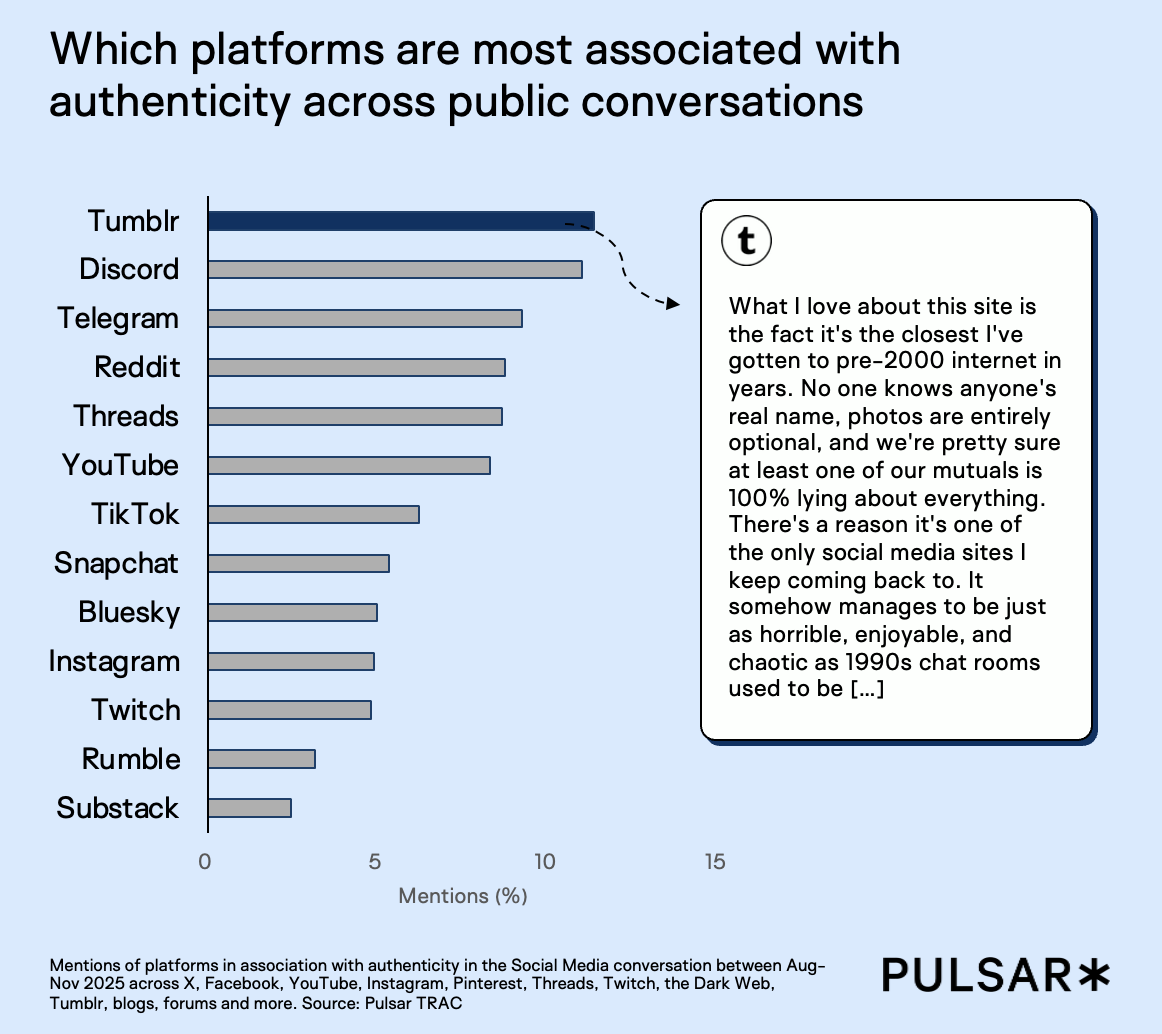
Authenticity follows a similar pattern. Audiences consistently associate it with platforms that feel messy, anonymous, or resistant to polish. Tumblr, Discord, Telegram, and forums surface as spaces where identity is expressed through shared culture rather than metrics. These environments reward continuity and presence instead of optimization.
Closed or “dark social” spaces play a crucial role here. Their limited visibility protects norms and relationships, making authenticity easier to sustain. As soon as these spaces feel extractive or overly visible, users become protective, guarding against perceived intrusion or inauthentic participation.
Identity communities endure because they feel lived in. They resemble older internet spaces, where participation was shaped by mutual recognition rather than reach.
What this shift signals
The movement from interest to identity communities reflects a deeper change in how people relate to being online.
As information becomes abundant and effortless, meaning becomes scarce. Communities now compete on emotional resonance, trust, and shared worldview rather than utility. Participation is driven by alignment rather than need.
For brands, creators, and platforms, this raises the bar. Influence flows through smaller, trust-rich clusters. Visibility alone is insufficient. Participation requires permission, fluency, and restraint.
Community strategy can no longer be built around scale or topical relevance. It depends on understanding which spaces people use to be themselves, not just to learn something new.
In an internet shaped by automation and abundance, identity becomes the anchor. Communities that recognise this are the ones that endure.
To stay up to date with our latest insights and releases, sign up to our newsletter below:
This article was created using data from TRAC