The audiences behind the success of Spider-Man: Brand New Day
- Media & Entertainment

Spider-Man is swinging back into theatres. So is the box office.
‘SPIDER-MAN: BRAND NEW DAY’ has surpassed $2B at the worldwide box office. pic.twitter.com/g54QouAKN7
— Film Updates (@FilmUpdates) August 16, 2026
The 2026 box office is enjoying a remarkable resurgence, surpassing even the highs of 2019. And once again, the biggest franchises are proving their power to pull audiences out of their homes and back into theatres.
As of this writing, Sony’s Spider-Man: Brand New Day has become the second-fastest film in history to cross the $2 billion mark worldwide. It trails only Avengers: Endgame (2019), which remains the record holder after crossing the mark in a mere five days.
For all the talk of superhero fatigue, audiences clearly still have an appetite for the right kind of event movie. So, we’re going a little deeper into the new Spidey movie with Pulsar research agent and TRAC to see what’s making it such a standout.
First, let’s look at the conversation around the new Spider-Man film from the moment its first trailer dropped.

The franchise hero film generated 2.3 times more conversation than The Odyssey across the entire pre-release period, with audience anticipation already building from the moment the first teaser landed in March.
The first trailer, released on March 18, immediately set the tone. It generated 8.1x more buzz than The Odyssey did on the day its main trailer launched online, May 5, pointing to a far more explosive, franchise-powered start.
The trailers that followed did not quite reach the same level of conversation, but they kept the momentum alive. Fans continued dissecting characters and lore, trading theories and speculating about what might be coming next. That steady stream of fan-driven conversation helped keep attention high right up until the film’s release at the end of July.
Meanwhile, Universal’s The Odyssey followed more of a prestige cinematic model, generating fewer yet larger spikes in conversation around key points of contention such as the director, cast, IMAX experience and critical response. Rather than sustaining a constant level of fan-driven discussion, its impact was more concentrated around the opening days, with reviews and opening-weekend conversation driving the biggest peaks.
Looking at who is driving conversation around each film offers a useful clue to its potential success: the stronger and more engaged the fandom, the greater a film’s ability to sustain attention and build momentum before, during and after its release.
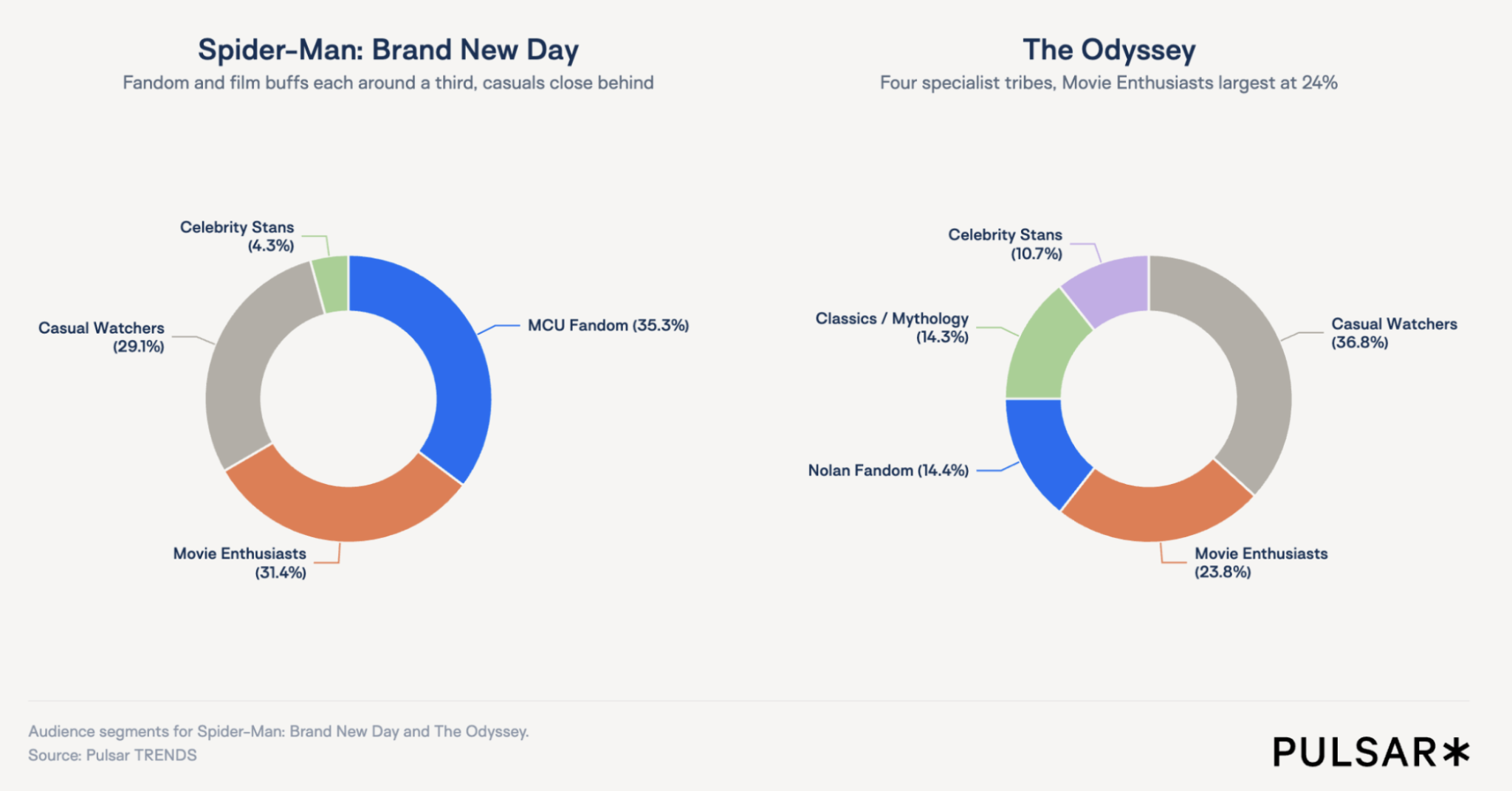
That strength also comes from the makeup of the audience itself. Spider-Man: Brand New Day is powered by a broad, mainstream franchise audience, with MCU fans forming the largest group, followed closely by casual and general movie audiences. The Odyssey, by contrast, has a more fragmented yet culturally richer audience, bringing together casual viewers with distinct communities built around Nolan, Greek mythology, cinema and celebrities.
For the Spider-Man movie, while established franchise fans form the largest segment, the narrow gap between these groups suggests that interest extends well beyond the core Marvel base. The film has clear potential to connect both with invested MCU audiences and with viewers simply looking for familiar, large-scale entertainment.
Its low share of Celebrity Stans (4.3%) also indicates that engagement is being driven chiefly by the Spider-Man and MCU brands, rather than the cast. Communications can therefore lean into franchise continuity, character appeal, action and event-film scale, while keeping messaging accessible enough to convert less committed viewers.
The Odyssey, by contrast, has a more varied and specialist audience composition. Casual Watchers (36.8%) make up the largest segment, followed by Movie Enthusiasts (23.8%), but almost a third of its audience is rooted in more specific cultural interests: Nolan Fandom (14.4%) and Classics / Mythology (14.3%). This points to several distinct routes into the film, including Christopher Nolan’s directorial reputation, the story’s mythological source material and its broader cinematic ambition.
The film also has a more substantial Celebrity Stans audience at 10.7%, suggesting that its cast is a more meaningful driver of conversation than it is for Spider-Man. Rather than relying on a single established franchise identity, The Odyssey can draw audiences from prestige cinema, mythology, auteur fandom and star power. The challenge, and perhaps the opportunity, would have been to bring these groups together around a shared sense of epic scale and cultural-event status, without allowing the campaign to become too fragmented or overly niche.
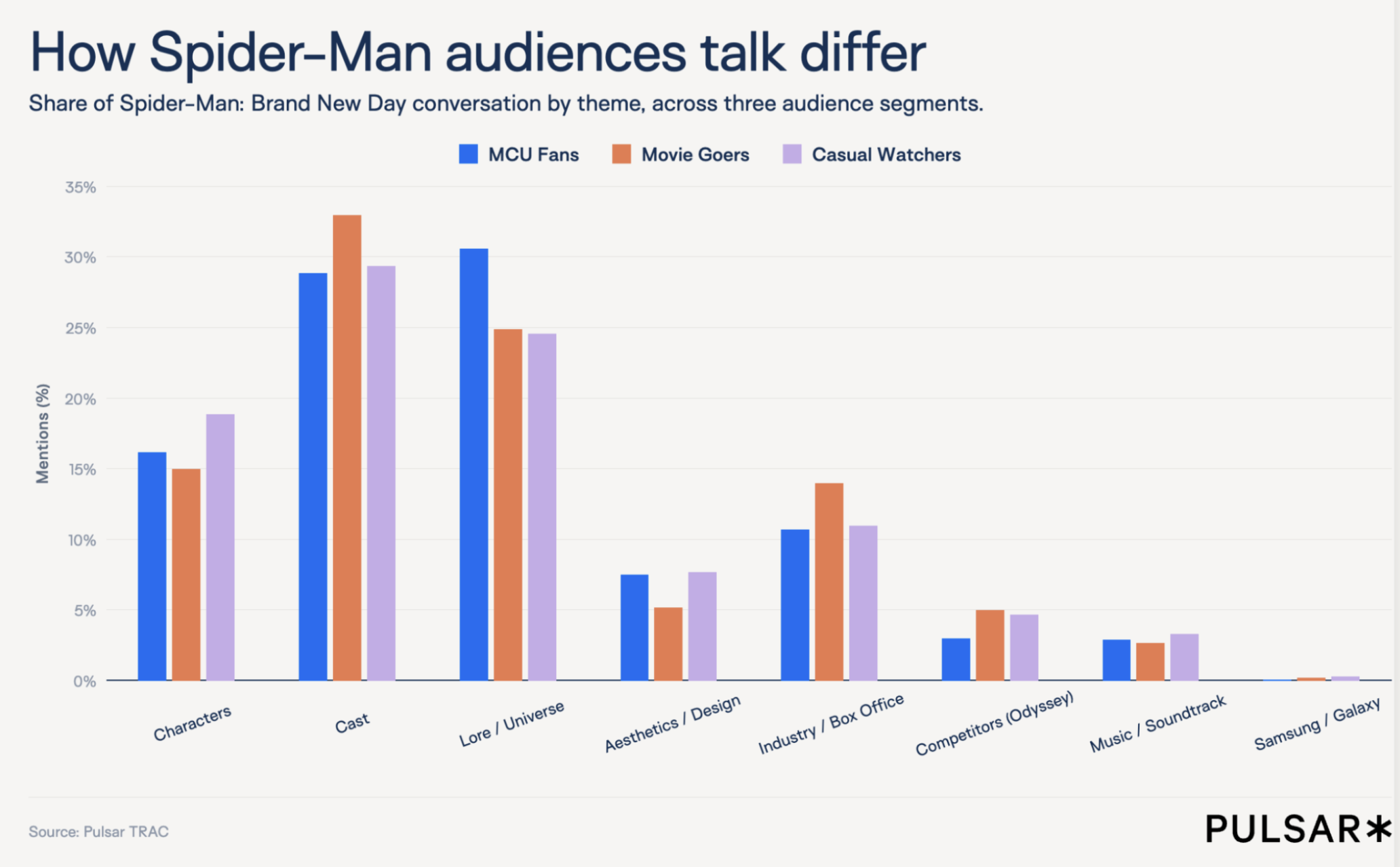
When it comes to the most-discussed topics, audiences also show clear differences in what draws them in. Spider-Man reaches well beyond its core fandom because there is more than one way into the franchise, from its wider universe and star power to its characters, stories and sheer spectacle.
If we look at this by audience:
MCU fans turn Spider-Man into an ongoing universe rather than a standalone film. Core fans devote the greatest share of their conversation to Lore / Universe (31%), using Brand New Day as a prompt to decode continuity, multiverse mechanics, timeline theories, Easter eggs and comic-source comparisons. This is where the knowledge gap between tribes is sharpest, and where fandom identity really lives.
However, that does not mean they are fully on board with the new franchise direction. A significant strand of the fandom is instead treating the film as a platform for what comes next, most visibly the rumored casting of Sadie Sink as Jean Grey, which fans are treating as the setup for the MCU's mutant era, alongside speculation about its place in the wider multiverse story.
Alongside this lore obsession, fans also show a strong attachment to Spider-Man’s aesthetics and design language, creating a natural opportunity to translate fandom into products and collectibles.
Movie Goers frame Spider-Man as a cultural and commercial moment. Their conversation over-indexes on Cast (33%) and Industry / Box Office (14%), showing that star power, performances, and theatrical success are central to how they make sense of the release.
For this group, talent-led storytelling and proof of scale matter almost as much as the superhero narrative itself. Notably, this group also registers the fewest detractors of the three cohorts, though all three received the film similarly warmly, suggesting that its broader cultural appeal is landing particularly well beyond the core fandom.
Casual audiences keep the conversation human and visual. They are most character-led (19%) and engage with Aesthetics / Design at a similar rate to MCU Fans (around 8%), suggesting that recognisable characters, relationships and visual spectacle are the clearest entry points for audiences outside deep franchise culture.
Also, for Casual Watchers, there is also a small but interesting thread of conversation around the film’s ability to spark product desire. A handful of viewers explicitly connect watching Spider-Man: Brand New Day with wanting Samsung’s Galaxy devices, with some even describing the reaction as surprising or unexpected.
Others move from seeing Peter use the phone in the film to actively considering an upgrade, suggesting that the product placement can extend beyond awareness into real-world consideration.
Core fans, by contrast, appear more resistant to the introduction, or intervention, of the Galaxy Flip into the MCU universe. For these immersion-invested audiences, advertising can feel disruptive when it intrudes on the fictional world they are invested in protecting.
Sony gave up on Xperia product placement in their own movies
by
u/HR-Vex in
SonyXperia
At the same time, their constant exposure to MCU content, from trailers and press tours to fan theories and previous brand partnerships, may also give them a higher degree of ad immunity.
For an audience whose relationship with Marvel, comics, and superheroes is rooted in identity rather than passing interest, Samsung becomes just another brand in an already crowded ecosystem. Brand integration, in other words, has to work harder to cut through, particularly when it risks being seen as an intervention in the world fans are there to immerse themselves in.
This article was created using data from TRAC