
What narratives attached to Instagram’s first rebrand in a decade?
- Tech

Instagram has unveiled a major logo update, marking a significant moment for one of the world’s most recognisable visual identities.
View this post on Instagram
Adam Mosseri, Instagram’s head, shared the update on the platform itself, pointing to a wider redesign that introduces new typography, including Instagram Sans, the handwritten Instagram Pen and the monospace Instagram Mono, alongside refreshed motion and layouts.
The topline media response has been to paint the response as ‘mixed’, with individual criticisms brought to the fore. But the conversation has in fact continued to evolve, and ‘mixed’ is something of a get-out clause when it comes to capturing this complexity.
We used Pulsar’s autonomous research agent to trace this shift.
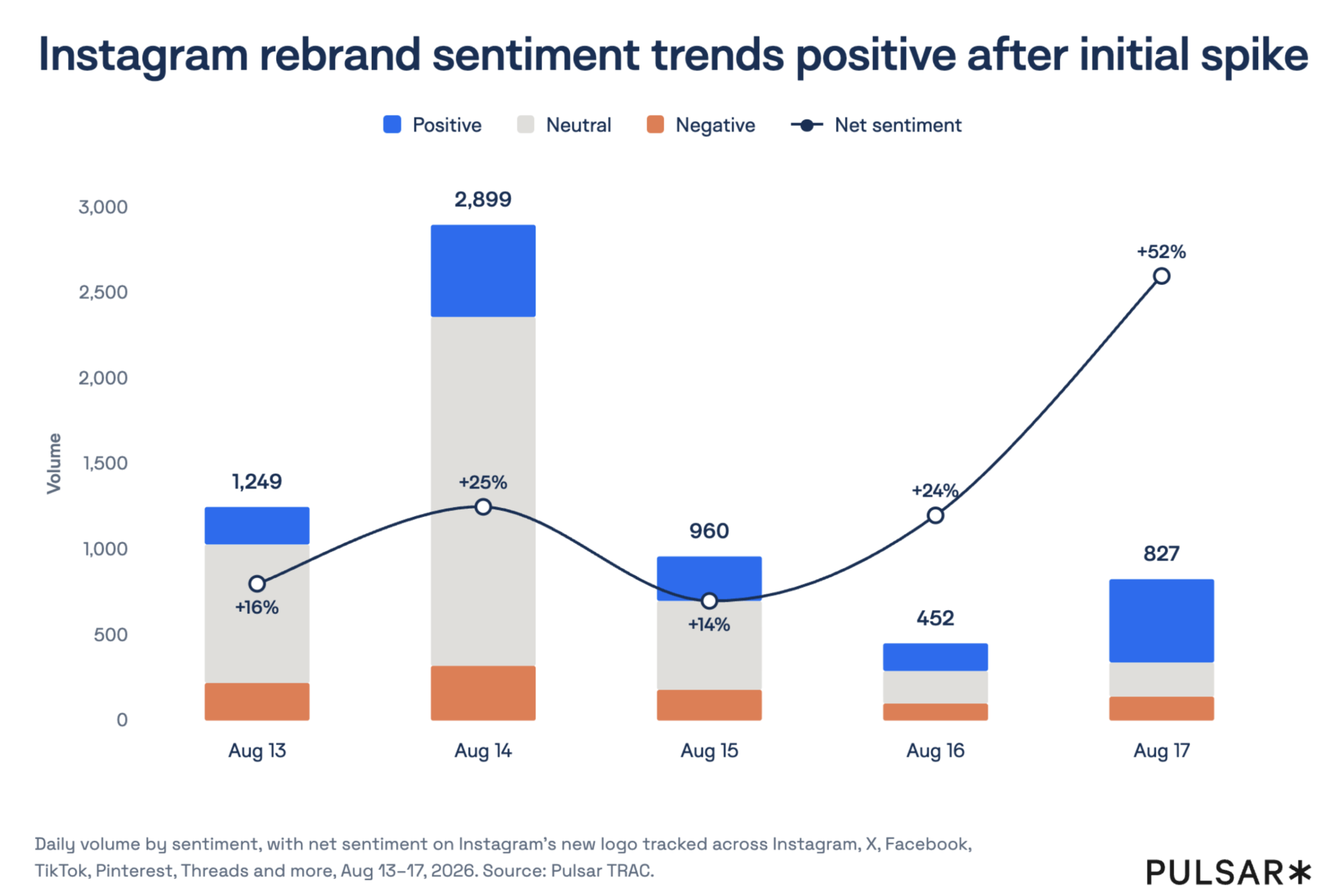
As mentioned, the assumption had been that Instagram’s rebrand had triggered something of a backlash. This was somewhat true, given how it was largely driven by jokes about the cursive “r” and “z”.
However, when we map sentiment towards the rebrand, the picture looks considerably less negative. Net sentiment never actually turned negative. What appeared to be a backlash was largely a period of scrutiny, as people shared, joked about and tried to make sense of the new identity.
That more neutral conversation dominated the first couple of days, while negative sentiment gradually burned off. By August 17, positive sentiment had become the largest share of the conversation. Negative and neutral reactions faded faster, shifting the conversation toward calmer, more positive voices. Some users also appeared to genuinely warm to the mark once the noise died down.
Love it or hate it, this is a great update.
Yes I am nostalgic for the old logotype but we have to move on and adapt for the new. https://t.co/lvWIhPGZle— Mihai Logo Brand Designer (@MihaiDolganiuc) August 20, 2026
However, that doesn’t mean rebrand did not necessarily become more popular because everyone suddenly started praising it. Instead, the conversation became more positive because criticism faded while approval held steady.
And when we break the conversation down by its top narratives, revealed using Narratives AI, we can see what was driving that shift in sentiment.
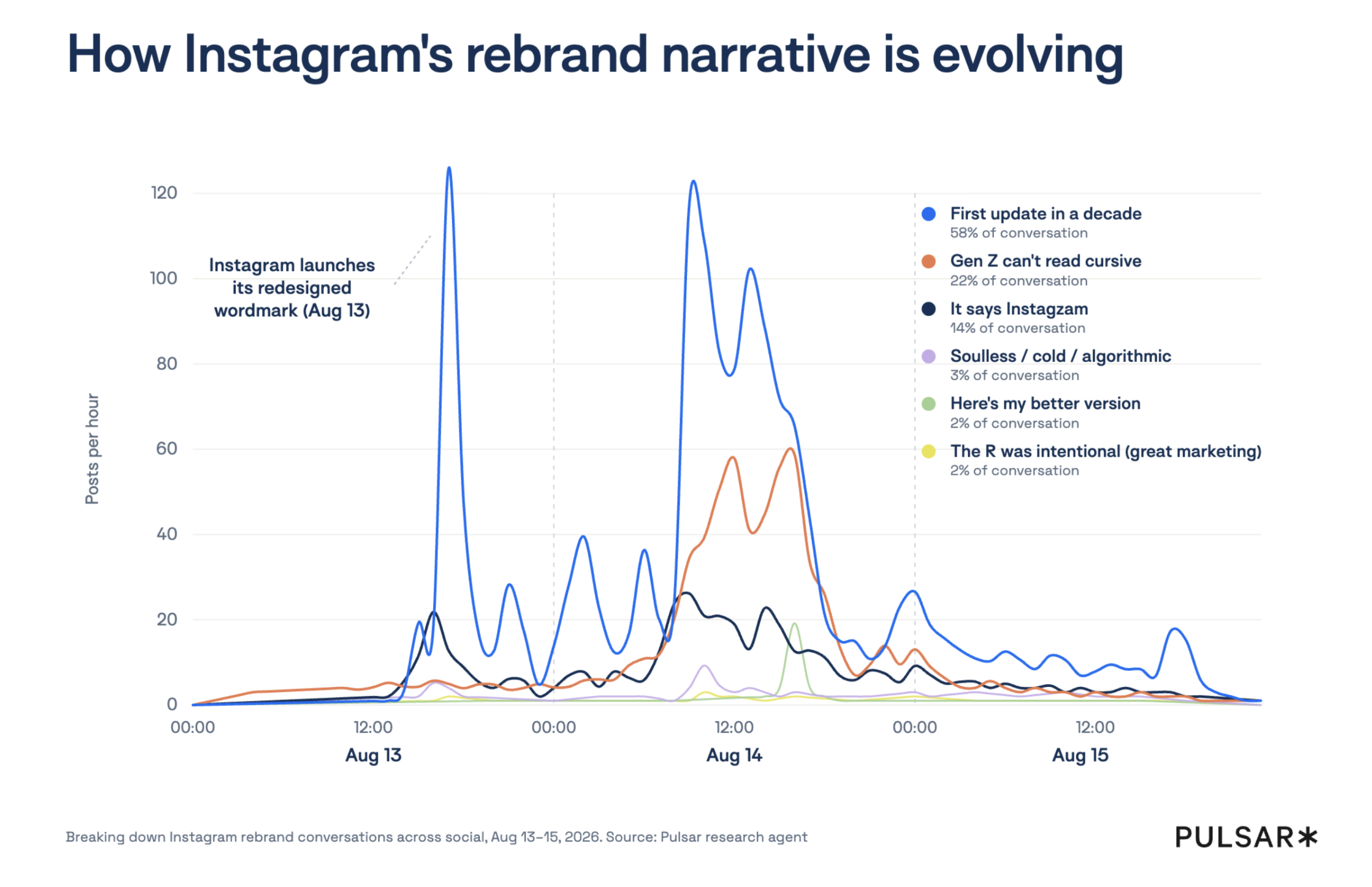
Following Instagram’s first wordmark update in a decade on August 13, the conversation was largely focused on the significance of the change itself, over 60% of the discussion. But that sense of novelty was short-lived.
As audiences looked more closely at the new wordmark, the conversation quickly shifted from the rebrand itself to whether anyone could actually read it. “Gen Z can’t read cursive” and “It says Instagzam” became defining reactions, turning what began as a brand update into a shared internet joke.
By midday Aug 14, the “Gen Z can’t read cursive” narrative had developed a life of its own, suggesting the conversation had moved beyond Instagram and into a broader cultural debate around typography, legibility and generational differences.
View on Threads
@carterpcs IG’s new logo?? #carterpcs #tech #ig ♬ Drama effect Mach - Don Nahum
The rebrand became a platform for people to debate whether the issue was the audience’s ability to read scripts or the design itself.
This dovetailed with a trend of designers using the negativity as a springboard for sharing their own designs and versions. It proved a useful way of advertising one’s creativity (and services) but perhaps helped perpetuate the idea the rebrand had been more negatively received than it was, and that it necessitated a ‘redesign’ at all.
Reimagining Instagram’s new wordmark with a seamless lowercase flow. ✍️
Official update vs. my custom take—which direction do you prefer? pic.twitter.com/fRnqx4HaIO— Daud Hasan (@daudhasandesign) August 14, 2026
At the same time, a more considered critique began to emerge. The “soulless / cold / algorithmic” narrative reflects a broader cultural unease with the increasingly polished and corporate aesthetic of modern brands.
View on Threads
Even as this was taking place, the smaller “the R was intentional” narrative—niche but popular among marketers—offers a different reading of the controversy, suggesting that element of design may have been deliberate, with the resulting debate ultimately serving as a form of cultural currency and effective marketing for Instagram. Whether one of the world’s largest brands would really seek to gain such an advantage at the cost of brand equity is another matter altogether…
Overall, Instagram’s rebrand narrative evolved from a significant brand milestone into a collective moment of humor, before opening up into a broader cultural conversation about legibility, design intent and the increasingly blurred boundaries between branding, controversy and internet culture.
To stay up to date with our latest insights and releases, sign up to our newsletter below:
This article was created using data from TRAC