From Fragmented Listening to Unified Intelligence: How Enterprise CMOs Can Build a Smarter Social Listening Stack

TL;DR & Key Takeaways
Social listening tech stack consolidation is the deliberate reduction of overlapping social and media intelligence tools into a single intelligence layer that feeds one shared workflow. For most enterprise CMOs the constraint is not a shortage of data. It is a coordination problem: monitoring, media intelligence, customer care, campaign analysis, and competitive tracking sit in separate systems, which produces duplication, inconsistent reporting, and slow response.
The fix is to rationalize the stack around a shared operating model, so signals reach the right teams and convert into decisions. The payoff goes beyond cost efficiency: unified intelligence is easier to govern and faster to activate.
Key Takeaways
- ▸Fragmentation is a coordination problem, not a data problem. The signals already exist; they are scattered across too many tools and teams to drive fast, consistent decisions.
- ▸Consolidate around a shared operating model, not a tool count. Listening should feed one workflow that serves brand, insights, comms, and leadership.
- ▸Mention volume is no longer the north star. Measure movement and impact: time-to-engage, intent signal volume, share of voice, and contribution to pipeline and response efficiency.
- ▸AI raises the value of analysts rather than removing them. It surfaces patterns fast, but human judgment filters noise, interprets nuance, and turns signals into actions leadership will trust.
- ▸The goal is one reliable path from social signal to business action. Less tooling, more alignment, sequenced around existing contract renewal dates so coverage is never lost.
Most enterprise CMOs do not have a social listening problem. They have a coordination problem. The data exists, often in abundance, but it is spread across too many tools, teams, and workflows to drive fast, consistent decisions. A brand team runs one listening platform, comms runs a media monitoring contract, customer care watches a third feed, and competitive tracking lives in a fourth. Each was a reasonable purchase on its own day. Together they produce three dashboards that disagree and a board update assembled by hand the night before.
That is why social listening has shifted from monitoring mentions to building a structured intelligence layer. In 2026 the strongest programs are not the ones with the most dashboards. They are the ones that connect signals to action, link insight to business outcomes, and get the right information to the right teams at the right time. The cost of staying fragmented is not mainly the software. It is the crisis spotted late, the demand signal acted on after a competitor, and the intelligence that arrives on the research team's cycle instead of the business's.
Social listening tech stack consolidation is the deliberate reduction of overlapping social and media intelligence tools into one intelligence layer that feeds a shared workflow. This guide explains why enterprise stacks fragment, what that fragmentation actually costs, what a unified operating model looks like, and how to execute the consolidation in six steps sequenced around your existing renewal dates. The throughline is simple: less tooling, more alignment.
In This Article
- What is social listening tech stack consolidation?
- Why do enterprise listening stacks fragment?
- What does fragmentation actually cost?
- What does a unified operating model look like?
- The six-step consolidation blueprint
- The fragmented stack vs the consolidated model
- How do you consolidate media monitoring without losing depth?
- How should you measure a consolidated program?
- Frequently asked questions
What Is Social Listening Tech Stack Consolidation?
Social listening tech stack consolidation is the deliberate reduction of overlapping social and media intelligence tools into a single unified platform that performs those jobs natively and feeds one shared workflow. Instead of separate monitoring, listening, audience, media, customer care, and competitive tools running in parallel, one audience intelligence layer ingests the same signals once and serves every team from a common source.
Consolidation is a rationalization, not a cancellation. The aim is the same or greater capability with less duplication, less reconciliation, and less integration overhead, plus a clear operating model on top. A well-run consolidation leaves the organization able to monitor, listen, segment audiences, map narratives, track earned media, and escalate risk from one environment, and it does so through a defined path from signal to decision rather than a wall of dashboards each team reads differently.
"The strongest listening programs are not the ones with the most dashboards. They are the ones that turn signals into decisions the right teams can act on."
Editorial framing, Pulsar Platform
Why Do Enterprise Listening Stacks Fragment?
Enterprise listening stacks fragment because tools are bought by function and by moment, not by architecture. Fragmentation is the default outcome of a decade of decentralized buying, and it happens for four predictable reasons.
Decentralized budgets
Brand, comms, social, insights, customer care, and regional teams each hold budget and each buy the tool that solves their immediate problem. Nobody owns the total picture, so overlap stays invisible until someone adds up the invoices. A CMO often discovers that three teams pay three vendors for what is functionally the same social feed.
Point solutions bought under pressure
A crisis, a campaign, or a new channel prompts an urgent purchase. The tool solves the moment and then persists, because cancelling it feels riskier than the modest annual fee. Over a few years the organization collects a museum of tools that each answered a question nobody is asking anymore.
Category confusion
The market itself blurs the lines. A monitoring tool calls itself listening, a listening tool calls itself intelligence, and a media monitoring service adds a social module. Buyers reasonably conclude they need one of each. In practice the categories are layered rather than separate: real-time monitoring, social listening, and audience intelligence build on one another.
Frankenstacks inside your own vendors
Several large incumbents are themselves collections of acquired products that never fully merged. When a vendor's social listening and news monitoring run as separate systems with separate logins, that fragmentation passes straight through to you. Consolidating your stack means favoring platforms where the capabilities were built together rather than acquired and stapled.
What Does Fragmentation Actually Cost?
Fragmentation costs far more than the total of its subscriptions. The license fees are the visible layer. Underneath sit four costs that rarely appear in a procurement review but consistently outweigh the software itself.
The four hidden costs of fragmentation
- ▸Reconciliation labor. Analysts spend hours normalizing figures across tools that count mentions, sentiment, and reach differently. That is skilled time spent making numbers agree instead of interpreting them.
- ▸Low utilization. With capacity split across tools, no single platform is learned deeply. Gartner's 2023 Marketing Technology Survey puts martech utilization at 33%, down from 42% a year earlier. Duplicative listening tools sit at the low end of that range.
- ▸Decision latency. When the picture lives in five places, assembling it takes days. Slow intelligence is the cost a CMO feels most: the crisis spotted late, the trend acted on after competitors have moved.
- ▸Governance and admin overhead. Every vendor adds a renewal to track, a security review to run, a data processing agreement to maintain, and a relationship to manage. Procurement carries this load quarterly.
Together these are why consolidation usually pays for itself on operating efficiency alone, before any license saving. The audience intelligence market was valued at $5.52 billion in 2025 and is projected to reach $15.54 billion by 2033 (Grand View Research, 2025), and much of that growth is enterprise teams collapsing point tools into unified platforms precisely to escape these costs.
What Does a Unified Operating Model Look Like?
A unified operating model is a defined path from social signal to business action, with clear ownership of who sees what, who escalates, and what gets automated. Technology alone does not deliver this. Two organizations can run the same platform and get very different results, because the differentiator is whether there is a process for turning signals into decisions the business trusts.
That is where the CMO agenda has changed. The question is no longer "what are people saying about us?" It is "what do these conversations tell us about risk, demand, product friction, and market shifts?" The best teams use listening to spot emerging issues early, find content opportunities, read audience sentiment, and support commercial decisions. Designing the operating model means answering four questions before choosing any tool.
- Where does listening sit? Inside marketing, or as a shared intelligence function serving brand, comms, insights, and leadership. A shared function is what stops duplication returning.
- Who owns escalation? When a signal crosses a threshold, someone must own the handoff to comms, care, or the executive team, with a defined route and response time.
- Which metrics matter? Agree the outcome measures up front so every team reports movement and impact rather than raw volume.
- What is automated, and what needs analyst review? Draw the line between machine-surfaced patterns and the interpretation a human has to sign off before it reaches leadership.
AI is accelerating this shift, which raises the value of human analysts rather than lowering it. AI-assisted summarization, predictive signals, and real-time alerting surface patterns quickly across huge volumes, but enterprise teams still need judgment to filter noise, interpret nuance, and translate insight into actions leadership will act on. Pulsar frames this as the move from analyst to architect: agentic tools such as Pulsar TeamMates run the continuous, repetitive work, while analysts design the workflows and own the interpretation. The operating model is what keeps the human in the loop where it counts.
The Six-Step Consolidation Blueprint
Consolidation fails when it starts with a tool decision. It succeeds when it starts with an audit and an operating model, and ends at a renewal date. The six steps below are sequenced so you never lose coverage and never double-pay during the transition.
Step 1: Audit the stack and map every tool to a job
List every social and media intelligence contract across all teams and regions. For each one, record annual cost, number of seats, actual active users, renewal date, and cancellation-notice period. This single inventory usually surfaces the redundancy on its own and gives procurement the leverage it needs.
Step 2: Design the operating model before choosing a tool
Decide where listening sits, who owns escalation, which outcome metrics matter, and what is automated versus analyst-reviewed. Sketch the path a signal travels from detection to decision. Fixing the operating model first is what prevents a new platform from simply inheriting the old fragmentation.
Step 3: Separate the jobs from the tools
Write down the intelligence jobs the organization actually needs done: real-time monitoring, social listening, audience segmentation, narrative and reputation analysis, earned-media monitoring, influencer mapping, crisis early warning, and reporting. Jobs are stable; tools are how you happen to do them today. This list becomes the specification you consolidate against.
Step 4: Choose the unifying intelligence layer
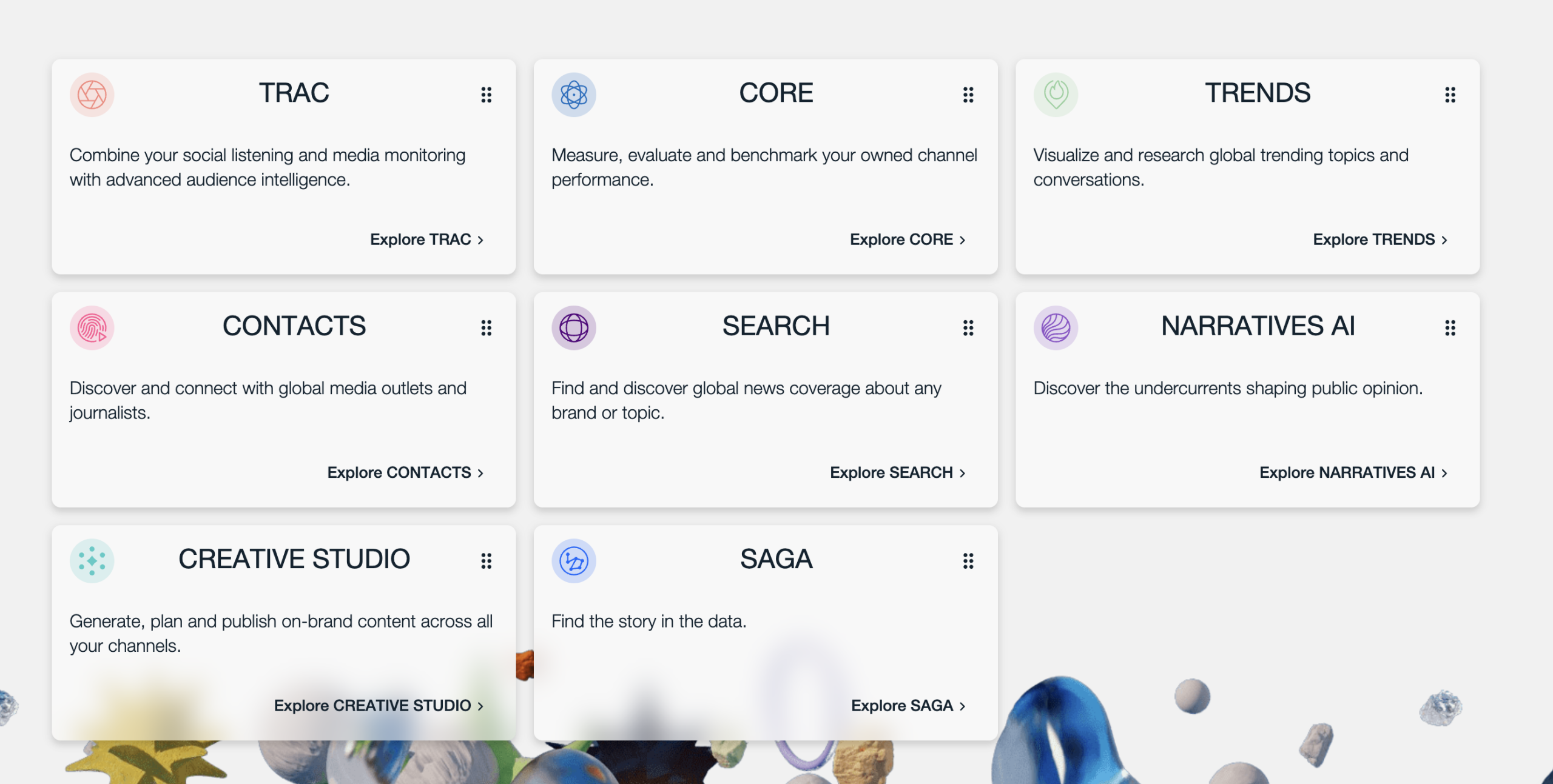
Find the platform that performs the most jobs natively in one environment, with the broader source coverage, faster alerting, AI-assisted summarization, and integrations into CRM, dashboards, and collaboration tools that enterprise teams now expect. The decisive test is whether listening, audience segmentation, and narrative analysis share one data layer. On Pulsar TRAC, audience segmentation is built into the listening engine rather than applied as a filter after collection, which is what lets one platform replace several.
Step 5: Consolidate media monitoring through the group
Earned-media monitoring is the job most CMOs assume requires a dedicated legacy contract. Pulsar covers the social and narrative layers, and its parent Pulsar Group provides market-leading media intelligence through Vuelio in EMEA and Isentia across APAC. That means you can retire a standalone media monitoring subscription without ceding coverage, keeping the earned-media job inside one commercial relationship.
Step 6: Sequence the migration around renewals and re-baseline on outcomes
Order your retirements by contract expiry. Stand up the unified platform first, run it in parallel with the incumbent for one renewal cycle, then let each redundant tool lapse on its own date. Once the redundancy is gone, re-baseline on outcome metrics: time-to-engage, intent signal volume, share of voice, utilization, and contribution to response efficiency. Those numbers, not the license count, are what prove the decision to the board.
The Fragmented Stack vs the Consolidated Model
This map shows the eight intelligence jobs most enterprise stacks perform, the typical point tool each is bought as, and how a unified platform absorbs them into one environment and one workflow.
| Job to be done | Typical point tool | Consolidated in a unified platform |
|---|---|---|
| Real-time monitoring | Standalone alerting tool | ✓ Pulsar TRAC |
| Social listening | Dedicated listening platform | ✓ Native listening layer |
| Audience segmentation | Separate audience or survey tool | ✓ Native community segmentation |
| Narrative and reputation | Reputation or PR analytics tool | ✓ Narratives AI |
| Earned-media monitoring | Legacy media monitoring contract | ~ Pulsar Group (Vuelio / Isentia) |
| Influencer mapping | Influencer discovery tool | ✓ Network-science mapping |
| Crisis early warning | Crisis alerting subscription | ✓ Crisis Oracle |
| Reporting and activation | External BI or slideware | ✓ Native reporting into one workflow |
Legend: ✓ means the job is handled natively within Pulsar. ~ means the job is handled inside the wider Pulsar Group through Vuelio and Isentia rather than the Pulsar platform itself.
How Do You Consolidate Media Monitoring Without Losing Depth?
You consolidate media monitoring by treating it as a job that can move inside your intelligence group rather than a permanent standalone vendor. This is the step CMOs most often flinch at, because earned-media coverage feels too specialized to fold in. The concern is fair, and the answer is structural.
Pulsar is a full-spectrum social and media intelligence platform. Its own strength runs across advanced social listening on social platforms, forums, and broadcast sources, audience intelligence, and narrative analysis. Dedicated media monitoring, journalist and outlet databases, and PR measurement are covered by Pulsar Group's sibling brands: Vuelio, a leading media intelligence and PR platform in EMEA, and Isentia, the major media intelligence player across APAC. The practical framing is group versus point tool on media, and platform versus platform on audience, where Pulsar is purpose-built and the standalone legacy vendor is not.
That reframes the media monitoring renewal. Rather than defending a separate legacy contract, you consolidate the earned-media job into one commercial relationship that also gives you the social, audience, and narrative layers a pure media monitoring tool never had. You keep the depth and lose the duplication.
How Should You Measure a Consolidated Program?
You measure a consolidated program by movement and impact, not by raw mention volume. Volume alone tells a CMO almost nothing about risk, demand, or return, and if a stack can only report volume it is probably still too fragmented. Consolidation should let you baseline five outcome measures and track them over time.
- Time-to-engage. How fast the organization moves from a signal appearing to a team acting on it. This is the clearest proxy for whether fragmentation is gone.
- Intent signal volume. The count of conversations carrying purchase, churn, or complaint intent rather than brand mentions alone, so the program connects to demand and retention.
- Share of voice. Your presence in the conversation relative to competitors, read as a trend rather than a snapshot.
- Contribution to pipeline and response efficiency. The link between listening-driven actions and commercial or operational outcomes, which is what earns the program its budget.
- Tool utilization. Active users against seats. A single well-learned platform should climb well above the 33% martech average that duplicative tools drag down.
Frame the outcome to the board as capability gained, not tools cut. The story is that the organization can now answer the questions that matter in hours, from one source, through a workflow that reaches the right teams, and it spends less doing it.
Frequently Asked Questions
+What is social listening tech stack consolidation?
Social listening tech stack consolidation is the deliberate reduction of overlapping social and media intelligence tools into a single unified platform that performs those jobs natively and feeds one shared workflow. Instead of separate monitoring, listening, audience, media, and customer care products running in parallel, one audience intelligence layer ingests the signals once and serves every team from a common source, usually for less total cost.
+Is stack consolidation only about cutting cost?
No. Cost efficiency is a byproduct. The larger value is that unified intelligence is easier to govern and faster to activate. Consolidation removes duplication and reconciliation, but its real purpose is to create one reliable path from social signal to business action, so the right teams see the right information at the right time and can act on it with confidence.
+Where should social listening sit in the organization?
Increasingly, as a shared intelligence function rather than a capability locked inside one team. When listening sits inside marketing alone, other teams rebuild their own versions and fragmentation returns. A shared function that serves brand, insights, comms, customer care, and leadership, with clear ownership of escalation, is what keeps the stack consolidated and the reporting consistent.
+Does consolidating media monitoring mean losing earned-media coverage?
Not with the Pulsar Group model. Pulsar covers social listening, audience, and narrative intelligence, while its parent Pulsar Group provides dedicated media monitoring and PR measurement through Vuelio in EMEA and Isentia across APAC. That lets a comms team retire a separate media monitoring subscription without losing earned-media depth, keeping the job inside one commercial relationship.
+What metrics show a consolidated listening program is working?
Movement and impact metrics rather than raw mention volume: time-to-engage, intent signal volume, share of voice as a trend, contribution to pipeline and response efficiency, and tool utilization. Baseline these before consolidation and re-measure after. If a stack can only report volume, it is probably still too fragmented to support outcome-based measurement.
+Does AI replace analysts in a consolidated stack?
No. AI-assisted summarization, predictive signals, and real-time alerting surface patterns quickly across large volumes, which makes human judgment more important, not less. Analysts filter noise, interpret nuance, and translate insight into actions leadership will trust. The shift is from analyst to architect: agentic tools run the repetitive work while people design the workflows and own the interpretation.
About Pulsar
Pulsar is an enterprise audience intelligence and narrative analytics platform used by global brands, governments, and agency groups to understand audiences and the narratives shaping public conversation across social media, news, forums, and broadcast media. Pulsar is part of Pulsar Group Plc, whose sibling media intelligence brands Vuelio and Isentia lead the EMEA and APAC markets. Pulsar holds a rating of 4.3 out of 5 on G2.
Sources
- Grand View Research, Audience Intelligence Market size and forecast (2025), $5.52B in 2025 projected to $15.54B by 2033.
- Pulsar Platform, Audience Insights and Social Listening solution documentation.
- Pulsar Platform, Insight Agents on Pulsar TeamMates.
- Pulsar Group brands: Vuelio (EMEA media intelligence) and Isentia (APAC media intelligence).
- Pulsar G2 rating: g2.com/products/pulsar-platform/reviews (4.3/5).
Methodology and Disclosure
This guide synthesizes publicly available market research with Pulsar's own product documentation and category experience. The consolidation blueprint and operating model are practitioner frameworks, not a guarantee of specific savings, which depend on an organization's existing contracts, team structure, and utilization. Pulsar is an audience intelligence platform and is part of Pulsar Group Plc; this article reflects that commercial relationship and should be read as vendor thought leadership rather than independent analyst research. Third-party figures are attributed to their sources and were accurate as of publication.
If you're interested in how Pulsar Tools can support your brand and strategy, simply fill out the form below and one of our specialists will contact you!