
The Audiences of Sustainability: the full Pulsar report
Contents:
Sustainability might be a global concern, but the conversation about it is anything but uniform. Across social media, news, broadcast, and search, people are grappling with what sustainability means, who it’s for, and how it should be put into practice. That’s why we revisited our 2021 report with a new, data-rich investigation into the language, tone, behaviours and communities shaping the sustainability conversation today.
Based on over 23 million datapoints from platforms including X, TikTok, Pinterest, Facebook, Instagram, Google Search, online news, broadcast, forums and blogs, this flagship study reveals how the climate conversation is shifting - from corporate jargon to community action, from abstract ideals to practical behaviour.
Download the full report below👇
The report includes nearly 40 data visualisations, original audience segmentation, brand analysis and trend mapping, all aimed at helping brands and organisations understand the cultural and emotional context around sustainability today.
Four dimensions, one evolving idea
We mapped the sustainability conversation across four key narrative territories: Ecology, Society, Product, and Business. Each of these quadrants captures a different dominant meaning of the term:
- Ecology refers to environmental protection, climate science, and biodiversity
- Society includes social equity, community resilience, and public wellbeing
- Product focuses on sustainable materials, production, and packaging
- Business deals with ESG, reporting frameworks, and corporate commitments
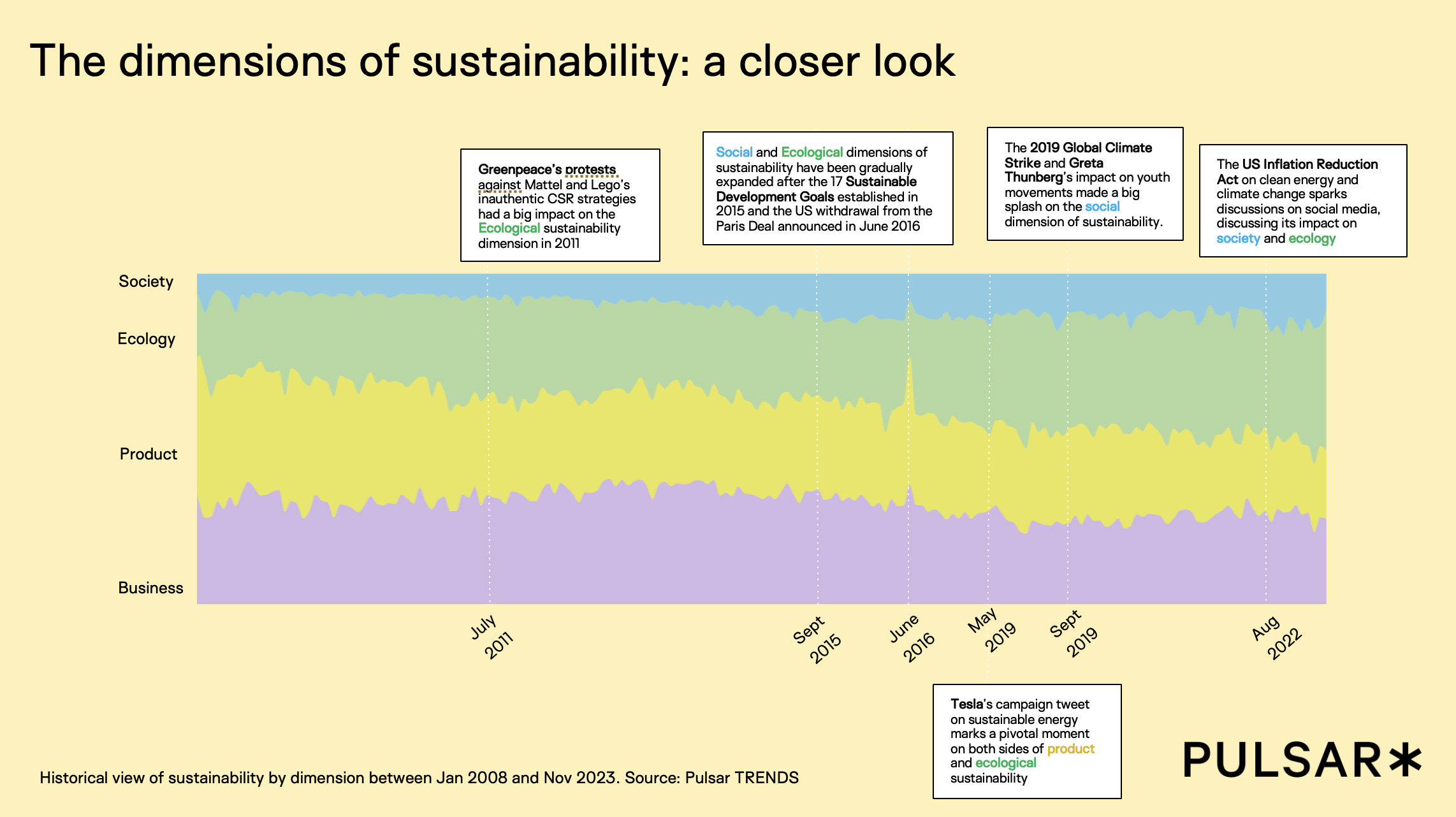
All four have grown significantly since 2008, but Society and Ecology now dominate, driven by activist awareness and the intersection of sustainability with broader societal concerns. Events like Greta Thunberg’s activism, COP summits, and major government policies have amplified this growth.
Audiences want meaning, not marketing
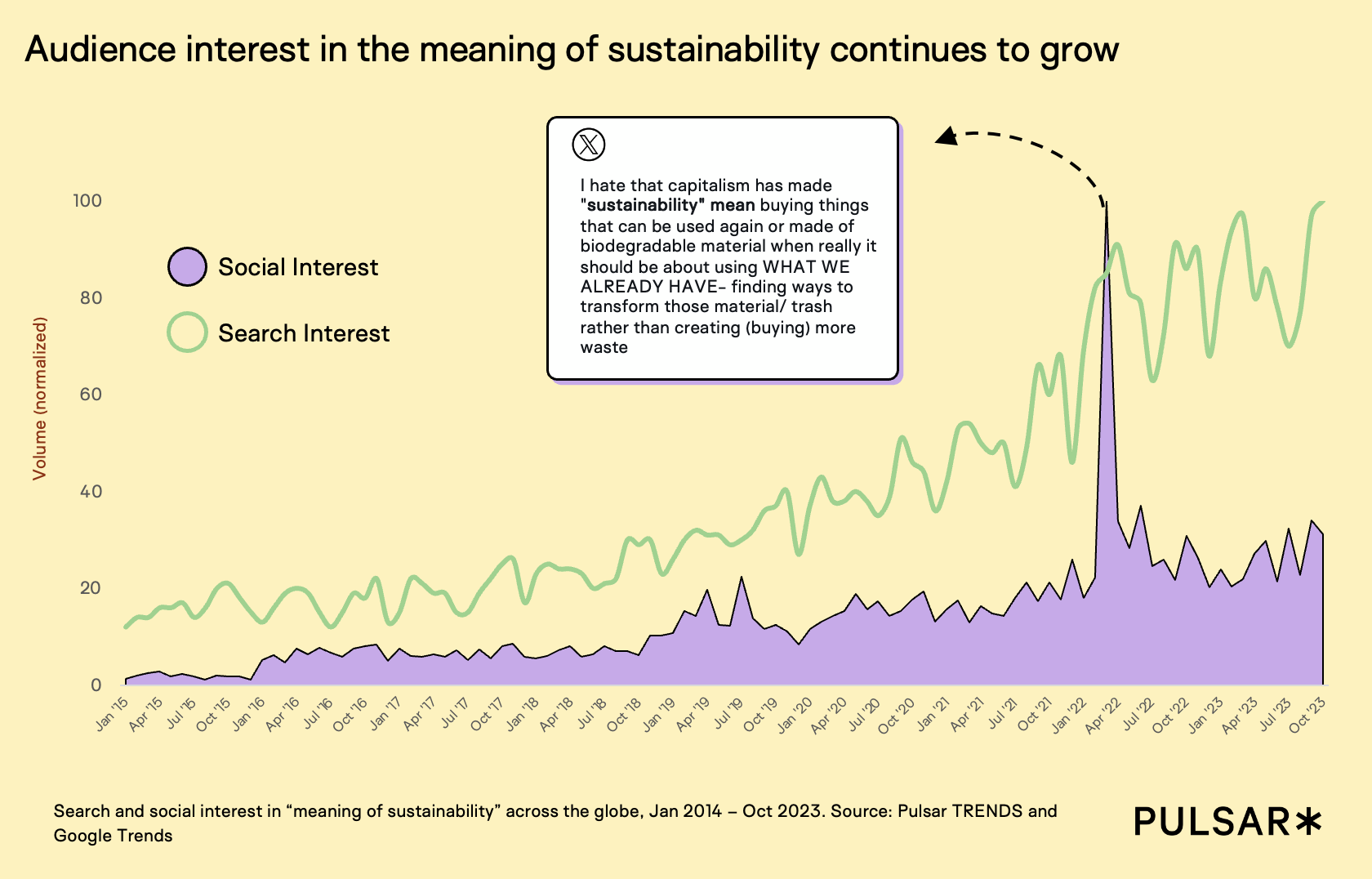
One of the clearest trends in our study is the rising search volume around the definition of sustainability. Across global Google data, queries like "What does sustainability mean?" and "Why is sustainability important?" have surged. This signals not just growing concern, but also confusion and contention over what the term actually stands for.
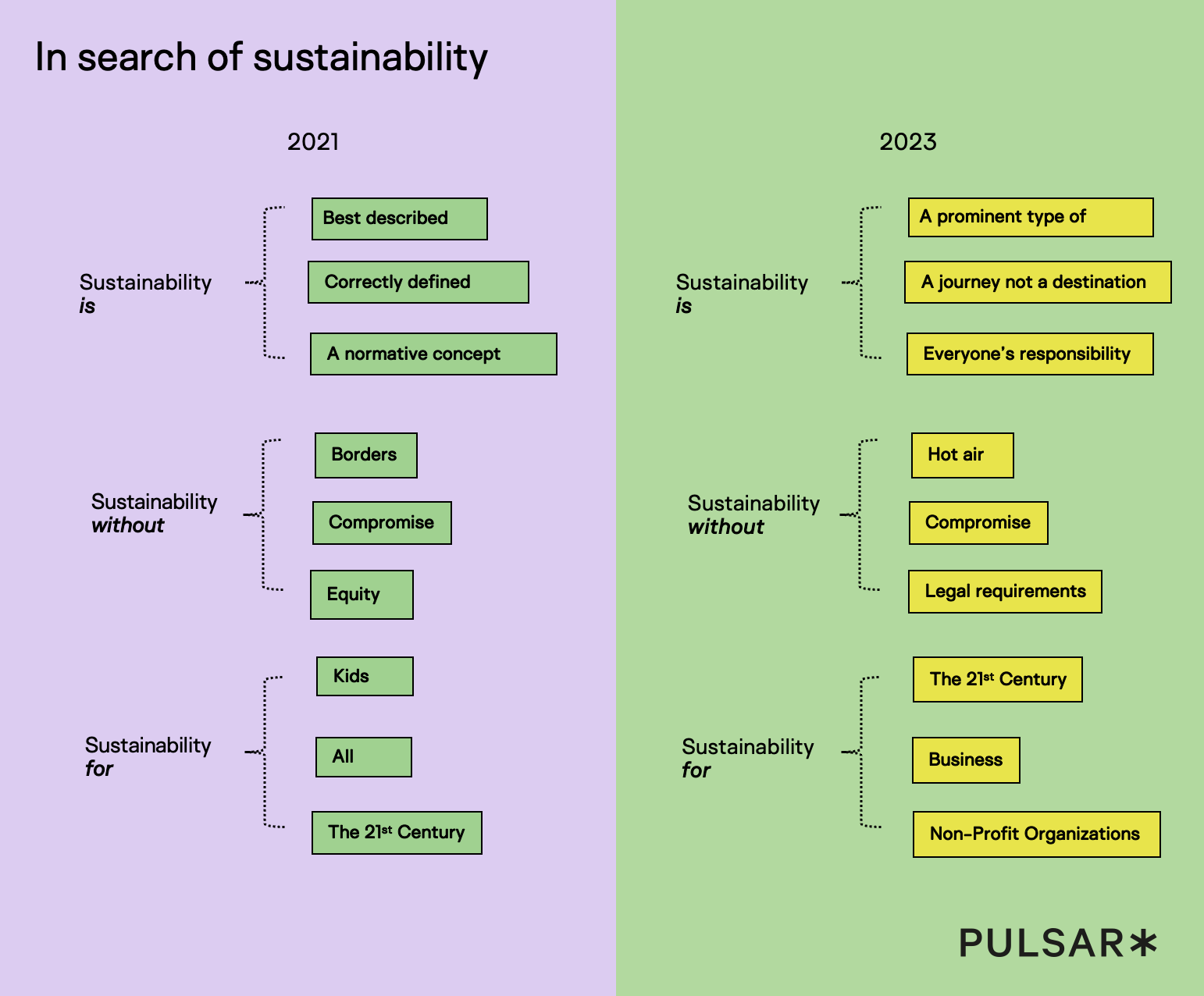
For some, sustainability is a moral compass. For others, it’s a branding tool. And for many, it’s a vague promise. As this contest over meaning plays out across platforms, it’s clear that no single institution or industry controls the narrative.
This fluidity makes it more important than ever for communicators to meet audiences where they are - not just in terms of platform, but in tone, language and emotional framing.
Who’s driving the conversation?
Using Pulsar’s advanced audience intelligence tools, we surfaced and segmented a wide spectrum of communities engaging with sustainability.
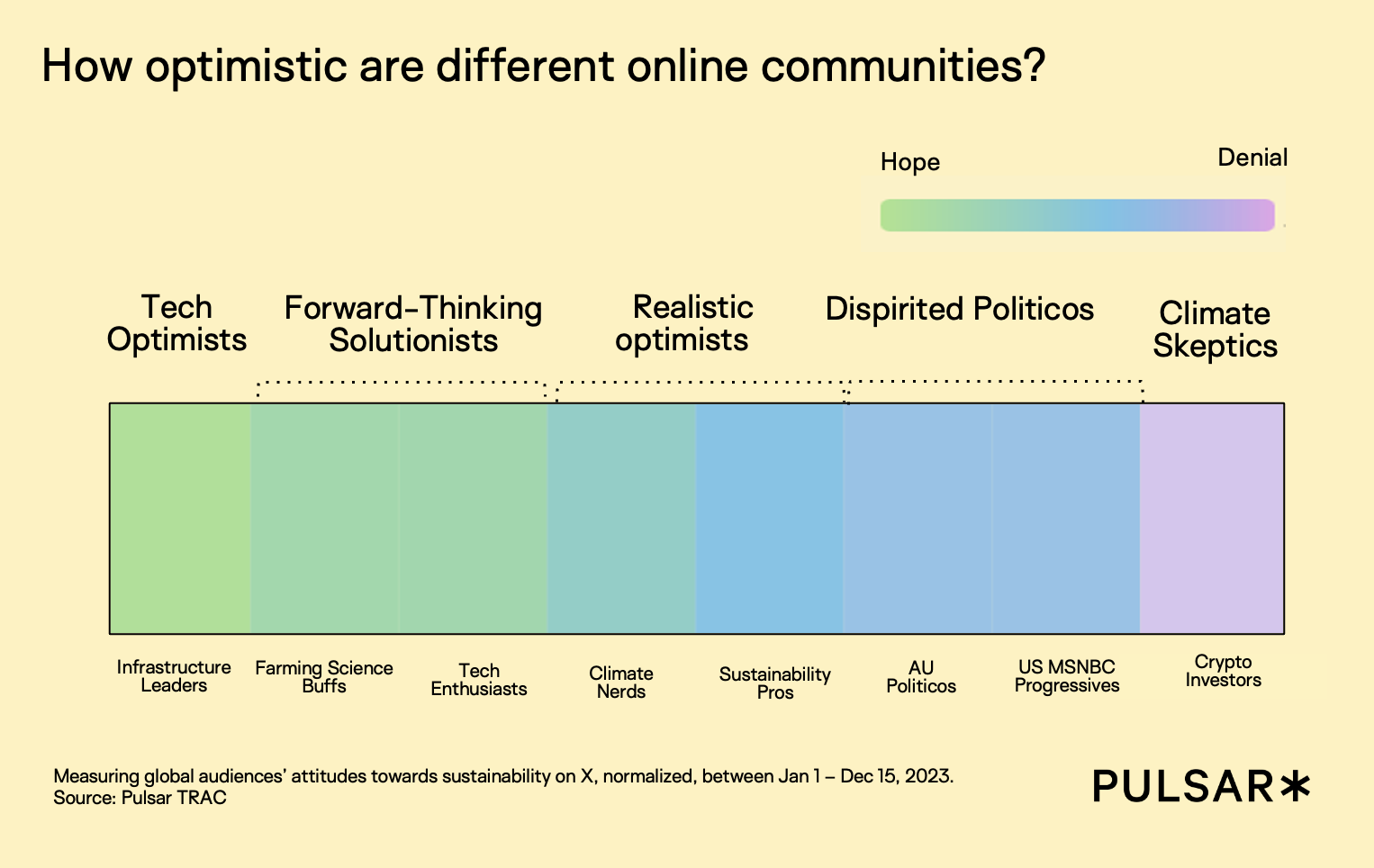
These include:
- Climate Progressives: Younger audiences active on TikTok and forums who link sustainability to lifestyle, identity and digital culture
- Infrastructure Leaders: A professional class engaged with logistics, engineering and energy supply who talk about systemic transformation
- Rural Conservatives: A group with sceptical or conflicted views, often linking sustainability to government overreach
- Buy Nothing Sharers: Values-led communities focused on mutual aid, low-buy lifestyles and circular economy behaviours
- Crypto Tech Optimists: Innovators who see technology, decentralisation and entrepreneurialism as the key to sustainability
These communities don’t just differ in what they say—they differ in how they say it. Levels of optimism, urgency, trust and tone vary widely, offering critical insight for anyone hoping to engage a specific segment.
Greenwashing, misinformation and the risk of cynicism
As sustainability becomes more mainstream, the backlash is growing. Accusations of greenwashing are widespread - and the brands most associated with sustainability are often the ones most scrutinised. Our analysis tracks the rise of greenwashing mentions since 2021, alongside terms like "ethical," "eco-friendly," and "circular", many of which have now been semiotically contaminated by audience scepticism.
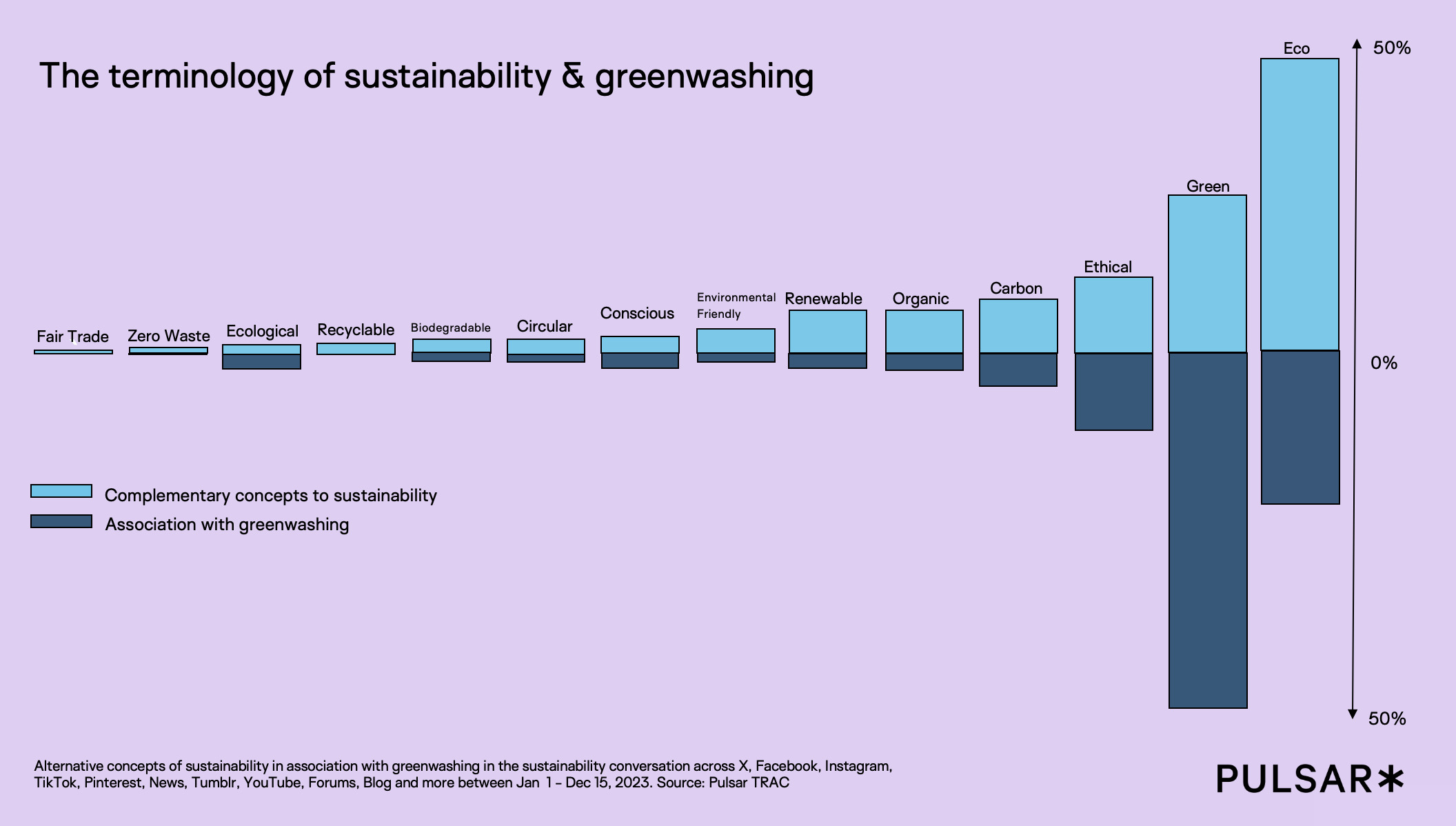
Tech brands like Tesla occupy a unique space: considered inherently sustainable by some, and deeply problematic by others. Meanwhile, companies like Apple and Coca-Cola receive high volumes of criticism, especially around carbon-neutrality claims or plastic usage.
From Ambition to Action: What Behavioural Data Tells Us
Sustainability used to be dominated by aspiration. But today, people are searching for and talking about action. Search and social data show surging interest in topics like low-buy and no-buy trends, sustainable transport (train travel, electric vehicles), dietary change (plant-based, meat reduction), repair, reuse and local production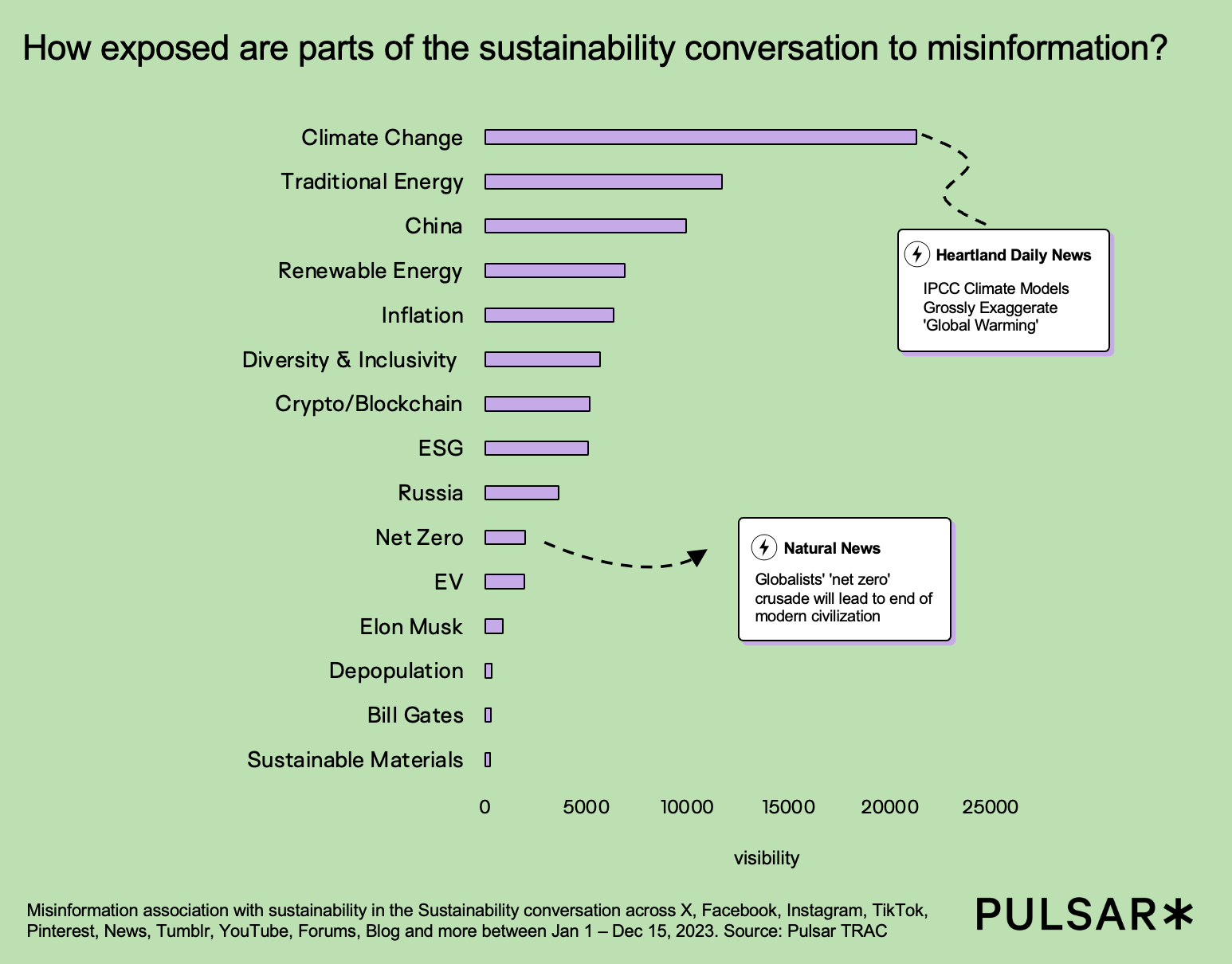
This rise in "solution-seeking" language suggests that audiences want to do something—but they’re also aware of trade-offs. From our panel sessions, we learned that compromise is often necessary. People are willing to sacrifice convenience, but only when they feel it leads to meaningful change.
The dominant motivator in 2023? Money-saving. Compared to 2021, duty and guilt have declined as primary drivers, while habit and financial logic have surged. Sustainability is increasingly framed as a smart, frugal choice - not just a virtuous one.
Why Audience Intelligence Matters Now More Than Ever
Across every platform we analysed - X, Instagarm, TikTok, Pinterest, forums, Google, news and more—one thing stood out: sustainability is being co-created in real time. It’s no longer a top-down narrative handed to audiences by brands or governments. It’s a live, dynamic conversation.
Audience intelligence doesn’t just reveal what people are saying. It shows why they’re saying it, how those meanings shift over time, and where your message will resonate (or fall flat). This makes it essential for:
- Communicators shaping messaging and campaigns
- Sustainability leads responsible for ESG reporting
- Researchers looking to track behaviour change
- Brands hoping to avoid backlash and earn trust
Download the full report now
If you want to understand the future of sustainability, start by understanding the people talking about it.
Fill out the form below to download the full report.
To go back to the Sustainability Hub home, click here.