ChatGPT vs Gemini: who is winning the narrative battle in 2026?
- Tech

ChatGPT has long been the reference point for conversational AI. Yet the company’s recent "code red"suggests that audience attention is beginning to redistribute. Google’s launch of Gemini, positioned as its most advanced AI model to date, coincided with a sharp increase in interest. Indeed, in December 2025, Gemini traffic grew by 28.4% month over month, while ChatGPT traffic declined by 5.6%.
At the same time, public conversation is shifting. Rather than focusing solely on what these systems can do, audiences are debating what kind of AI they want to live with. Questions of direction, integration, and long-term impact are becoming central.
Using Narratives AI and Pulsar TRAC, we analyzed online conversation around ChatGPT and Gemini between October 2025 and January 2026. By mapping the narratives forming around each brand, rather than sentiment in isolation, we can see how different audiences are beginning to define the role of AI today and the direction they expect it to take.
What we're covering:
Gemini is increasingly winning the narrative over ChatGPT
Creativity: Gemini becomes the preferred partner
Product Future: ecosystem vs Wild West
Gemini is increasingly winning the narrative over ChatGPT
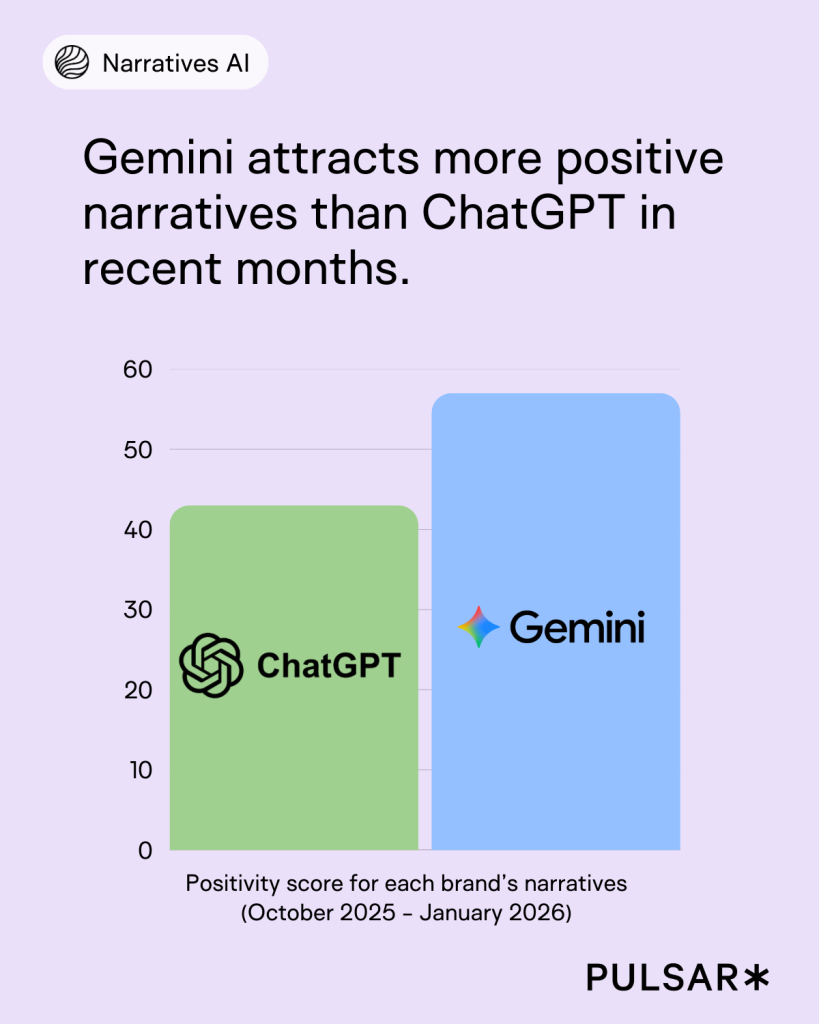
When we mapped the narratives surrounding each brand between October 2025 and January 2026, a clear gap emerged. Gemini attracts higher overall positivity at 57.7%, compared to 43.5% for ChatGPT.
This positivity is not driven by a single factor. It is built across multiple narrative dimensions, including reliability, creativity, intelligence, speed, UX, versatility, tone, and product future. What stands out is that traditional performance markers such as intelligence and speed show little meaningful difference between the two. On capability alone, audiences see them as broadly comparable.
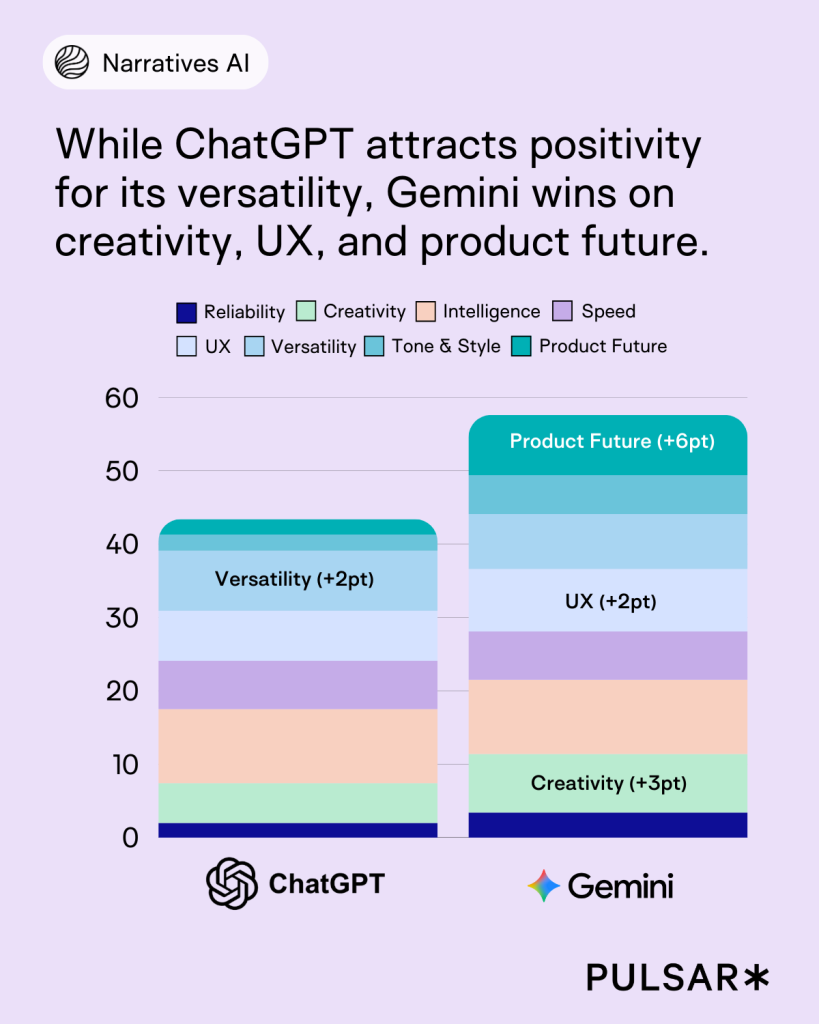
The divergence appears elsewhere. ChatGPT vs Gemini has become less a contest of technical benchmarks and more a narrative struggle over meaning. It is about which AI feels more aligned with the future, which feels more trustworthy at scale, and which fits most comfortably into everyday life.
Gemini is not universally preferred, but it is increasingly associated with direction rather than utility. Audiences talk about it as a system taking shape, not just a tool being used. Its close ties to Google’s ecosystem give it narrative weight as infrastructure. Gmail, Search, Docs, and multimodal integration signal continuity, coherence, and intent.
View on Threads
ChatGPT, by contrast, remains deeply embedded in daily workflows. It is familiar, versatile, and widely relied upon. Yet that familiarity brings a more settled narrative, one that is increasingly debated and, in some places, questioned.
As a result, positivity around Gemini clusters around product future, system-level creativity, and long-term direction. It is discussed as something still forming, but forming with intent.
Creativity: Gemini becomes the preferred partner
Creativity has become one of the sharpest points of separation. When people discuss “creativity” in connection with these tools, Gemini now leads: 65.1% of creativity‑related narratives are positive for Gemini, compared with 43.4% for ChatGPT.
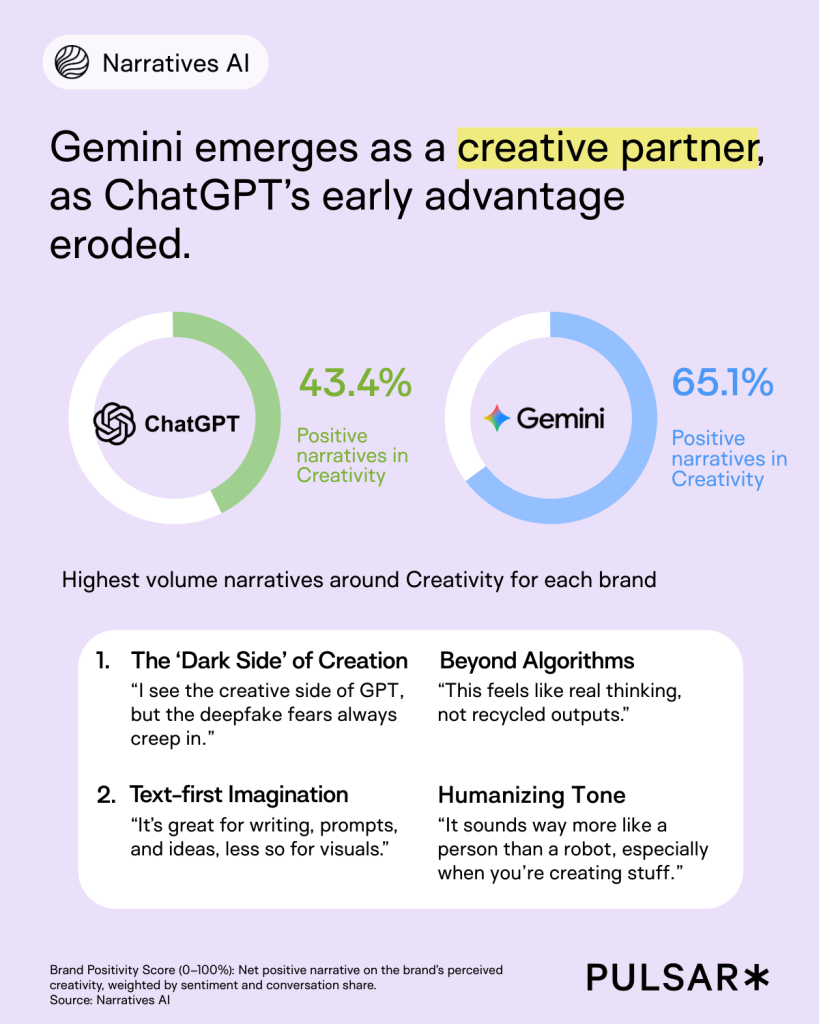
On Gemini’s side, the story is anchored in two recurring ideas. First, a humanizing tone: users say it sounds more like a person than a robot when they are making things, which makes it easier to treat as a collaborator rather than a rigid tool. Second, a sense of going beyond the obvious: outputs are described as feeling like “real thinking” rather than stitched‑together fragments, especially when people are exploring concepts, styles, or mixed media.
ChatGPT’s creative narrative looks different. It still carries a strong reputation for text‑first imagination such as writing prompts, drafting ideas, shaping copy and remains many people’s default for getting words out of their head and onto a page. But this is increasingly offset by what users are calling the darker edge of creation. Concerns around deepfakes, repetition, and the sheer volume of AI‑generated content circulating in feeds are starting to attach themselves to ChatGPT more visibly. It is seen as powerful, but also as a primary vector for creative saturation and synthetic media anxiety.
Product Future: ecosystem vs Wild West
The widest narrative gap appears when people talk about the future of these products. On “product future” as a dimension, Gemini records 65.5% positive narratives, while ChatGPT sits at 16.8%.
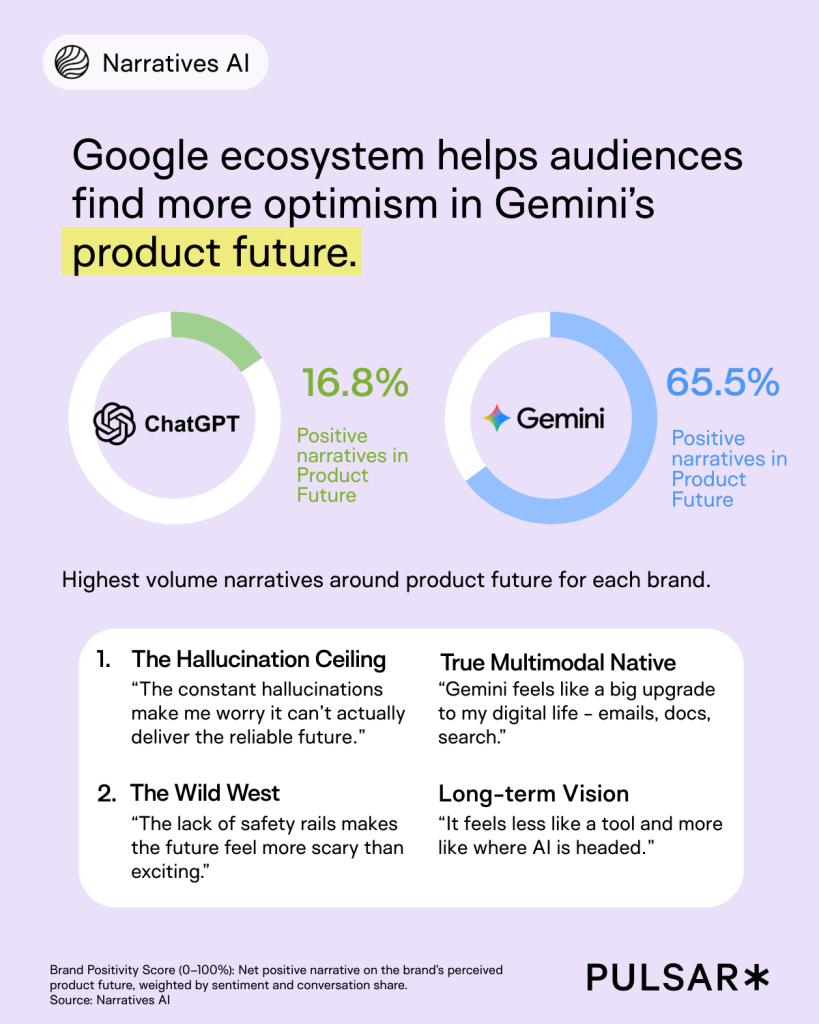
Gemini’s forward‑looking story is heavily ecosystem‑driven. The Google stack is doing narrative work on its behalf. People point to Gmail, Docs, Search and YouTube integrations as evidence that Gemini is being built as part of a coherent system. It is described as a true multimodal native—something that improves email, documents, and information retrieval at the same time—and as a vehicle for a longer‑term vision about how AI will be threaded through everyday work and communication.
ChatGPT’s future story is more volatile. Users still see it as important and innovative, but the narratives around reliability and control are noisier. Hallucinations feed into a sense of a “ceiling”: no matter how impressive the model gets, errors and unpredictability make some people reluctant to imagine it as core infrastructure. Add to that a “wild west” framing—powerful capabilities, uneven safety rails, fast‑moving experimentation—and the future can feel more dramatic than dependable.
Versatility still belongs to ChatGPT
Despite Gemini’s momentum, ChatGPT retains a critical advantage. It leads on versatility, with 65.9% positive narratives compared with Gemini’s 59.9%.
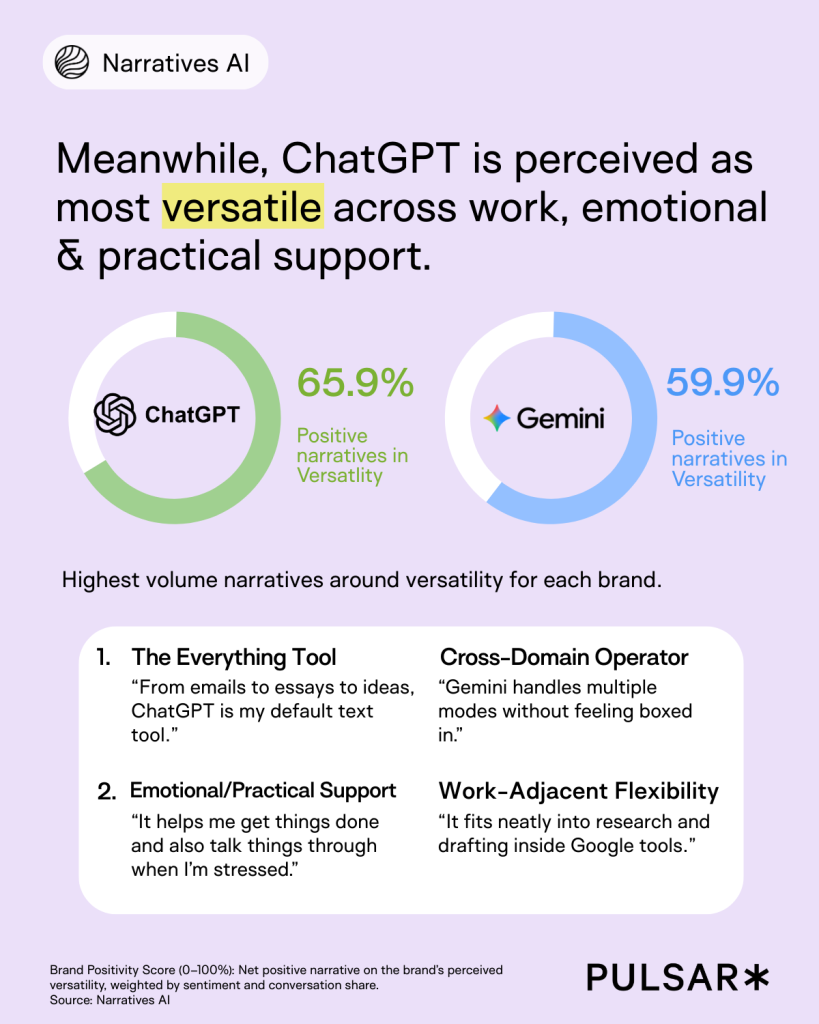
ChatGPT is widely described as the default tool for everyday needs. Audiences reference it for emails, studying, brainstorming, journaling, and decision-making. Importantly, it occupies both practical and emotional space. Users describe switching seamlessly between productivity and personal support, sometimes within the same interaction.
Gemini’s versatility is recognized, particularly in research, drafting, and multimodal work within the Google suite. Yet it is framed as work-adjacent, whereas ChatGPT’s versatility feels personal.
Who is shaping these stories?
Behind the topline narrative scores sit very different audience structures. When viewed through Pulsar TRAC and Audiense, it becomes clear that the divergence between ChatGPT and Gemini is as much about who is speaking as what they are saying.
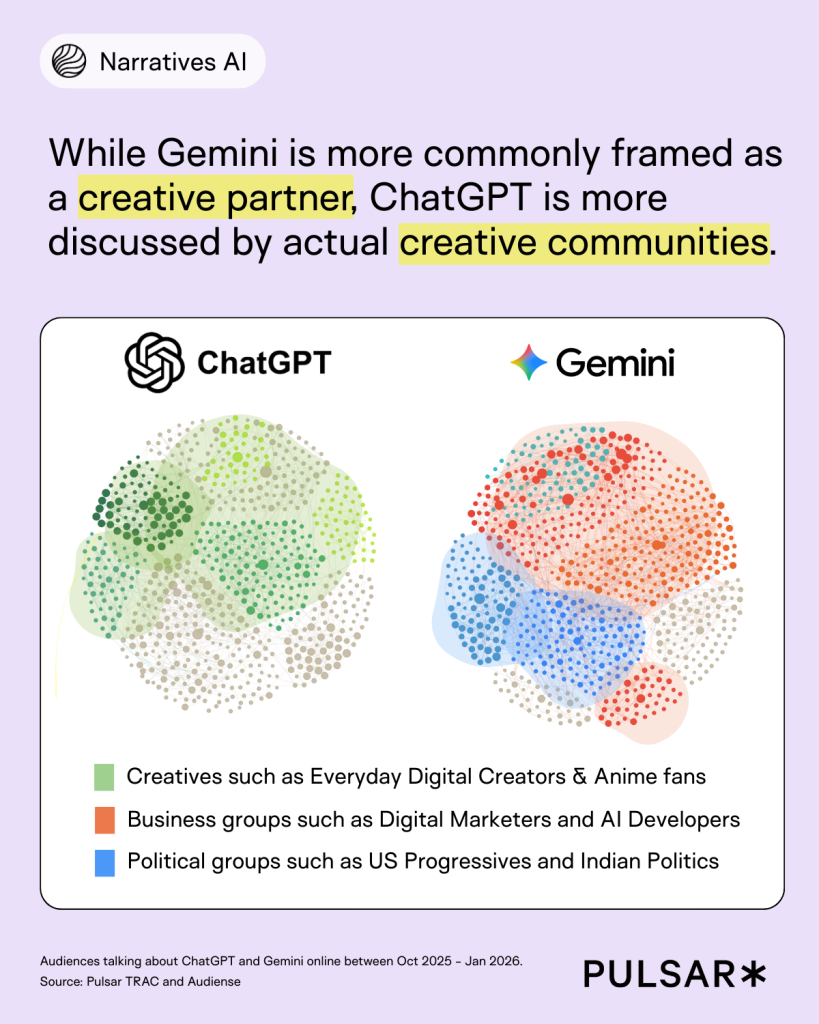
Gemini’s creativity narrative overindexes at a thematic level, yet the people most actively creating, remixing, and debating AI-made work are concentrated around ChatGPT. Everyday digital creators and fan communities treat ChatGPT as a space for hands-on experimentation, where creativity is negotiated in public and shaped through use.
chatgpt generate me a helmet design that can fit as many sponsors as humanly possible https://t.co/N9dKROTul5
— essie (@essienelli) January 19, 2026
Gemini’s creativity narrative is shaped elsewhere. Its conversation is dominated by business and political audiences who talk about creativity in terms of system-level intelligence, multimodality, and long-term capability. Creativity becomes a signal of direction rather than a site of everyday use.
This gap between creative talk and creative participation explains much of the narrative tension between the two brands.
What this means
As 2026 unfolds, the AI race is clearly moving beyond performance metrics and toward questions of direction. The conversation is shifting from what AI can do to where it is taking us, and audiences are beginning to draw clearer distinctions between the category’s leaders.
ChatGPT remains the versatile default, embedded in everyday creativity, work, and moments of emotional support. Its strength lies in familiarity and breadth of use. Gemini, meanwhile, is steadily reshaping its narrative, earning advantage around quality, perceived humanity, and confidence in a more integrated and legible product future.
Pulsar’s Narratives AI shows how these perceptions take shape, cluster, and gain momentum around brand activity. Pulsar TRAC reveals which audiences are driving them and how they spread through culture. In a world where awareness of AI is already universal, advantage increasingly belongs to the brands and advertisers that understand not just how their models perform, but how their narratives land as AI becomes part of everyday life.
To stay up to date with our latest insights and releases, sign up to our newsletter below:
This article was created using data from TRAC