
Sustainability & Meaning: why one word holds so many conversations
Contents:
With Davide Berretta, Global VP, Brand & Content Marketing, Pulsar, Alex Bryson, Global Head of Content Marketing, Pulsar and Dahye Lee, Marketing Research Lead, Pulsar
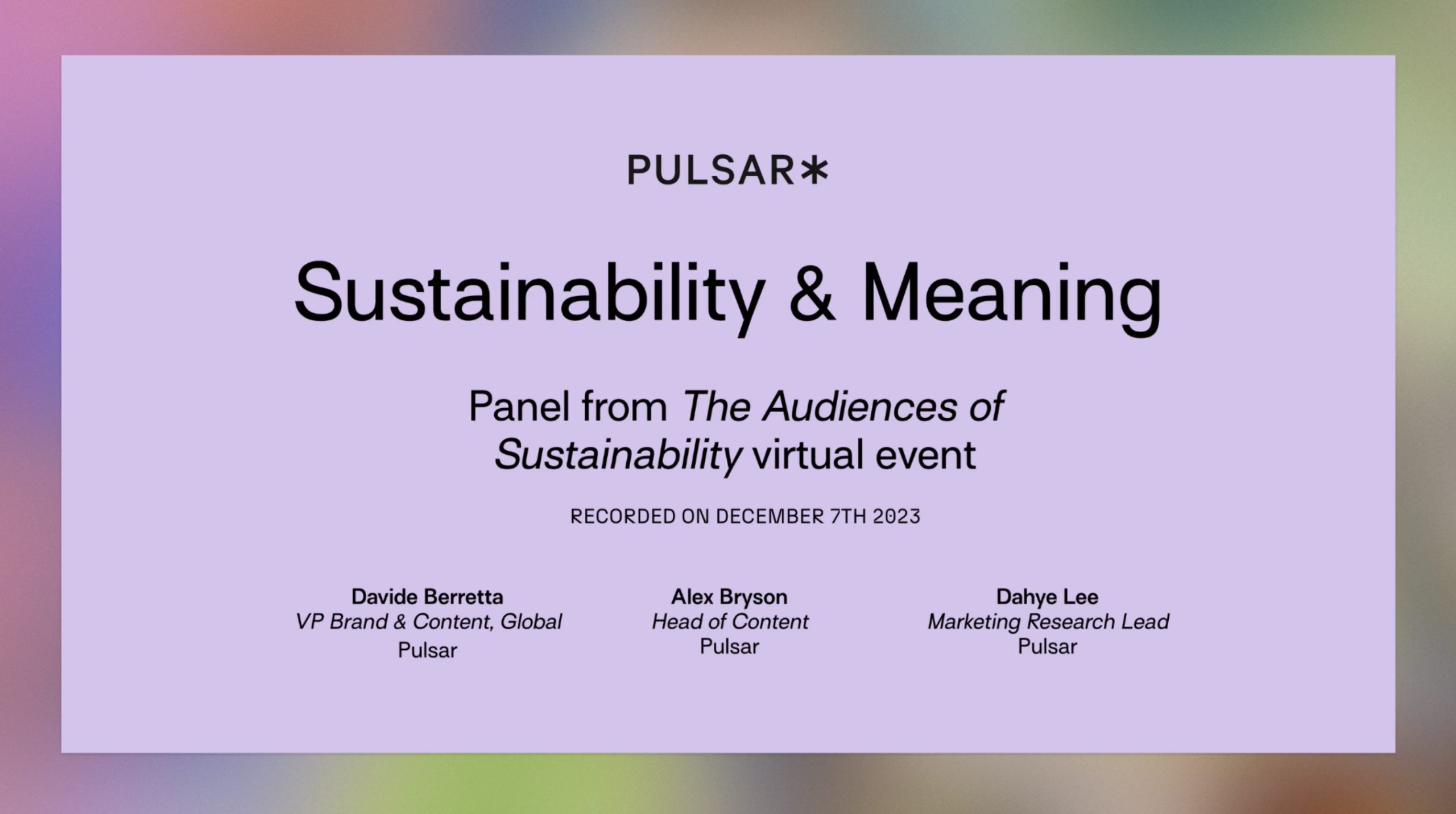
What meaning does the word ‘sustainability’ hold? As Davide Berretta opened this session of Pulsar’s Audiences of Sustainability digital event, he poses a challenge central to the work of marketers, researchers and communicators, noting that "it is a contested meaning - folks are competing for different narratives around sustainability."
This opening session offered an overview of how the meaning of sustainability has evolved since Pulsar’s 2021 research report that dove deep into Sustainability, and what the data tells us about how different audiences interpret and use the word today. The team unpacked shifts in language, explored the contrast between sectors, and revealed how hope, cynicism and curiosity all play a role in shaping the conversation.
What we explored:
The meaning of sustainability is fragmented and expanding
Since Pulsar first explored the topic in 2021, interest in the meaning of sustainability has grown. But the term itself has become increasingly fluid, with meanings that differ depending on who’s using it and why. As Dahye explains, there's been a "discernible trend where individuals define sustainable as a close alignment with transforming existing projections, rather than opting for new acquisition."
Pulsar’s search data shows rising queries around definitions: what sustainability means, how it is applied, and where people feel it no longer fits. "Does it even mean anything anymore?" Davide asks. This rhetorical question echoed a wider cultural fatigue with the word’s overuse, even as the underlying topic becomes more urgent.
Four main meanings are emerging
To bring structure to the sprawling conversation, the team segmented the data into four key narrative clusters:
- Ecology: Environmental concern and climate change, still the most dominant theme
- Societal concern: A broader, intersectional framing that links sustainability with quality of life, social justice and resilience
- Product: Sustainability as a product feature, linked to fashion, food, furniture and other sectors
- Business: A more corporate interpretation, where organisations use sustainability as a value or proof point
These buckets help explain how the same word appears across very different conversations, from TikTok tips on food waste to COP28 coverage. Davide notes that "ecology and society are the ones that are growing the fastest" in terms of volume - while product and business discussions remain active, they are relatively shrinking.
Audiences bring distinct values to the table
Unsurprisingly, different communities cluster around different meanings. Pulsar’s audience mapping shows how groups like climate campaigners, farmers, infrastructure pros and tech bros all engage with sustainability through their own lens. What counts as sustainable to one group may be irrelevant or even regressive to another.
A new way of visualising this is Pulsar’s spectrum of audience outlooks, from optimism to eco-denial. Dahye describes how this innovation adds depth: "This comprehensive audience analysis helps businesses and institutions with actionable insights," by showing not just what people talk about, but how they feel.
Some audiences embrace sustainability as a moral imperative. Others see it as a commercial risk, or a political flashpoint. Still others are trying to reclaim it as a term grounded in action rather than abstraction. As Alex puts it, "we tend to say that different people talk about the same topic differently, and that's something that we've seen over and over throughout the years at Pulsar."
Different platforms, different meanings
To illustrate this diversity, the team walked through examples from X, Instagram, Pinterest, TikTok and major news outlets. Each platform revealed different kinds of content and priorities:
- A Pinterest post discussed packaging innovation for small businesses
- A TikTok showed urgent, cost-effective tips for sustainable living
- News stories around COP28 surfaced top-down political framing
These microcosms reveal how audiences bring their own semiotics, tone, and expectations to the word. Dahye pointed out that while brands and institutions may try to steer the conversation, meaning is ultimately co-created.
From aspiration to action
The team compared data from 2021 to 2023, showing a shift from abstract definitions to practical, adaptable actions. Sustainability today is more often linked to individual choices - like reusing, reducing meat, or avoiding fast fashion - that feel achievable and meaningful.
"The narrative evolved from broad definition to a focus on practical and adaptable actions at the individual level," says Dahye. This has also led to a growing emphasis on compromise, as people balance convenience and ethics in everyday life.
This is a signal to brands and policymakers alike: vague pledges or top-level narratives are increasingly out of sync with how people want to talk about - and act on - sustainability.
Watch the full recording
Find the full recording of Sustainability & Meaning below.
Click here to go back to the Audiences of Sustainability Hub homepage.