
Sustainability & Marketing: the tension between progress and pressure
Contents:

With Jess Francis (Senior Global Strategist & Sustainability Practice Co-Lead, McCann Worldgroup), Jessica Marati Radparvar (Founder, Reconsidered), Eva Taylor (Director of Social Impact, Hootsuite) and Michael Hanbury-Williams (Head of Sustainability & Purpose, EMEA, UM London). Moderated by Davide Berretta (Global VP, Brand & Content Marketing, Pulsar).
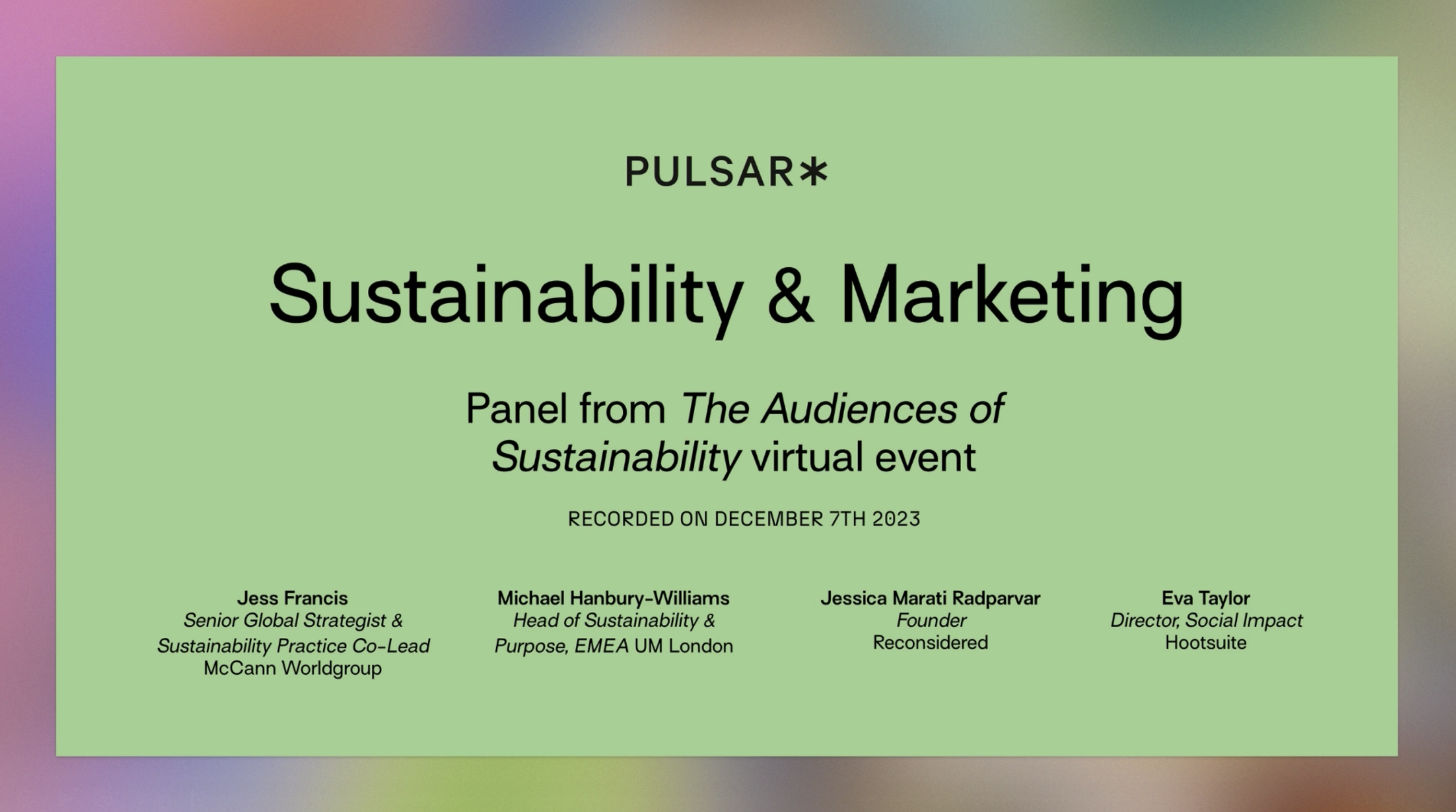
As marketers face growing pressure to deliver short-term results, how can they also contribute to long-term sustainability goals? That was the central tension explored in this panel from Pulsar’s Audiences of Sustainability digital event, where experts in marketing, strategy and purpose-led business explored the changing role of marketing in the climate conversation.
What we explored:
This session unpacked the increasingly high-stakes role that marketing plays in the sustainability conversation. It explored the pressure marketers face from both internal and external forces, the need to evolve how we think and talk about impact, and how audience intelligence can play a critical role in driving change. Through real-world insights, strategic reflections and grounded examples, the panelists offered a roadmap for how marketing can avoid missteps and lead responsibly.
Marketing is under pressure from both sides
Marketers are caught between competing timelines. "Marketers in general are under a lot of pressure to deliver growth," said Davide, "especially in this financial environment. And that pressure is very, very short term. Whereas the long-term changes that are required to achieve some true sustainability take years, if not decades."
Eva agreed: "It's certainly one of the first things that comes to mind for me when I think about sustainability in marketing. It's this natural tension between short-term growth and long-term relationship building and impact."
The risk of greenwashing is real and rising
Many marketers feel ill-equipped to tackle sustainability without first reinventing their approach. Jess Francis explained, "we've gone through a ton of upskilling and retraining” - she went to the Columbia Climate School even though she’s a strategist and researcher by trade. Marketers are being asked to ask better questions, evaluate claims more critically, and understand the regulations that increasingly govern green communications. Jessica Marati Radparvar noted, "the reputational risk of getting it wrong is becoming significantly higher - the regulatory landscape is changing really quickly."
She added that marketers must shift from a mindset of branding to one of transparency: "How are we helping organizations be transparent and open, not just stamp something with the sustainability or green logo?" As marketing gets more involved in sustainability, so too does its exposure to greenwashing claims. Jess Francis explained the paradox: "You've got more to lose when you start to play in the sustainability space."
Jessica Marati Radparvar added, "Greenwashing has become as broad and possibly diluted as the word sustainability... One of the biggest risks is not having that attention to precision or rigor or evidence behind the scenes." Pulsar's own data confirms the pressure marketers are under. In our analysis of over 2.3M conversations about sustainability, marketing was one of the industries most associated with problem-language. As Davide put it, "Marketing is really not doing very well in this sense."
Can marketing be a force for good?
For all the challenges, there was a shared sense of optimism in the conversation. Marketing isn’t just a megaphone - it’s a tool for shaping behaviour, challenging norms and reframing what people aspire to. When wielded well, it can drive widespread cultural shifts. Campaigns don’t have to be perfect to have impact, and as several panellists reminded us, there is more value in consistency and honesty than perfection.
Despite this, the panelists saw a huge opportunity for marketing to contribute positively. As long as it's done with care. "Our superpower as the advertising industry is to change behaviours," said Michael. "We need to use our skills to change behaviours, to make societal changes happen faster than they've ever happened before." Eva added, "don't let that pursuit of perfection get in the way... Small incremental changes can add up over time."
Transparency beats perfection
Rather than pretending to have all the answers, brands and marketers should embrace transparency. Jessica Marati Radparvar shared examples from Tony’s Chocolonely, Oatly, and Vivobarefoot - all of which have publicly acknowledged their missteps in the interest of building trust. Eva agreed: "I think people are open to companies making mistakes if they're transparent about it. What did they learn from it? How are they going to do it differently?"
Jess Francis described how her team trains internally to spot greenwashing risks before campaigns go live: "We have an internal anti-greenwashing training that we upskill not just creatives on, but strategy leads, account leads - it's quite an embarrassing look when you build a piece of creative and then it gets called out."
Change starts inside the agency and brand
Many panelists stressed that sustainability work can’t just live in marketing departments, it has to be baked into the organisation. "You can't out-sustainability your client," said Jess. "Get your own house in order." Jessica Marati Radparvar advocated for what she called "consulting activism": "As a consultant, you're being invited in as a different point of view. You probably have more leeway to make bold statements than your counterparts who are working internally."
Davide noted that audience intelligence can help make the case: "A deep understanding of your audience and the data to back up the intuition that your customers have these concerns can really help articulate that choice."
The ultimate takeaway from the session was this: sustainability should no longer be seen as a one-off campaign or CSR initiative. Ultimately, sustainability needs to be integrated across every brief. "We probably started at a place where we saw it as an add-on - something we thought about later on," Jess Francis said. "But sustainability is as foundational as health and wellness, social good, or wellbeing." That includes research, language, partnerships, product framing, creative messaging and beyond. For that shift to happen, internal education, cultural fluency, and executive buy-in are all necessary.
But above all, it starts with listening to audiences who are already driving this change in their everyday decisions and conversations. Embedding sustainability into every stage of marketing strategy means better client conversations, more rigour around claims, and the willingness to push back when a brand isn’t ready to communicate.
Watch the full recording
Find the full recording of Sustainability & Marketing below.
Click here to go back to the Audiences of Sustainability Hub homepage.