
Skincare as the solution and the problem: how users talk about skin barrier repair online
- FMCG

Skincare enthusiast communities online are talking about the complications that come from scrubbing off layers of our skin - and refocusing on letting the body’s biggest organ do its own thing.
Let’s talk about the skin barrier. With the rise of chemical exfoliants, physical exfoliants and retinols in 2020, skincare enthusiasts experienced an increase in irritated, burning skin - not exactly the glazed doughnut, glass skin glow they were seeking. In this aftermath, skin barrier-focused skincare overtook exfoliating products. These products focus on healing, protecting, and simply maintaining the skin with soothing, protective ingredients like emollients such as those found in trusted Vaseline.
While exfoliation continues to be of high-interest and is mentioned heavily in relation to the skin barrier, with skincare enthusiasts asking how to exfoliate without damaging their skin barrier, it is declining in popularity into 2023, giving way to skincare barrier support.
Let’s look at how users posit to fix their skin barriers using different ingredients.
While niacinamide is the most popular ingredient in the overall skincare conversation, it is second to ceramides when consumers discuss their skin barriers. Ceramides are the most important ingredient in healing the skin barrier.
Snail mucin is one ingredient associated much more with the skin barrier than overall skincare conversations, while Glycerin gets just as much attention in and outside the general skincare conversation.
As ceramides are the most important ingredient in healing the skin barrier, CeraVe naturally takes the top spot as the most trusted brand to heal the skin barrier.
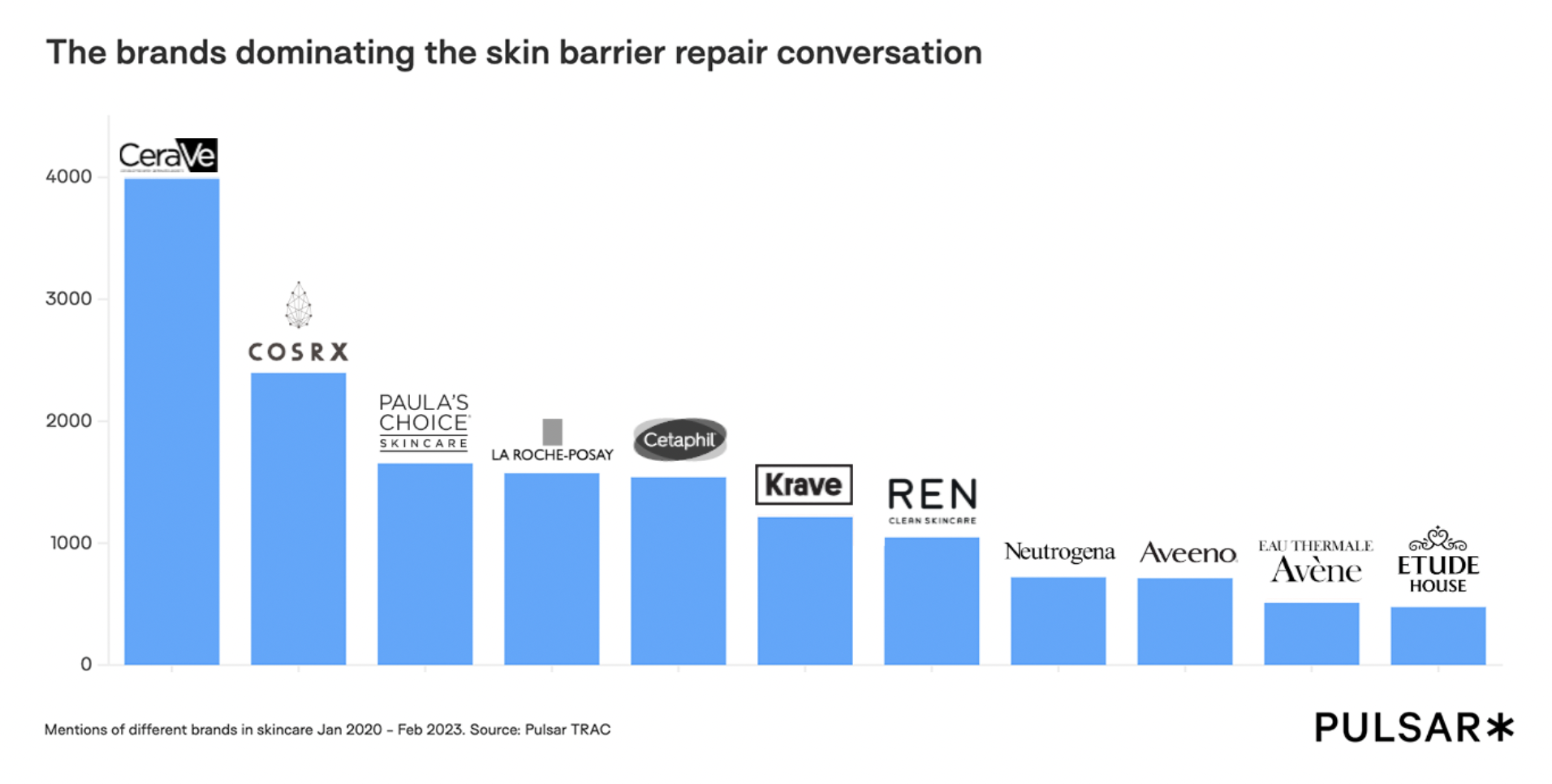
Brands are discussed in relation to different skin barrier repair techniques, with users becoming extremely loyal to specific brands or products.
As the skin barrier trend has skyrocketed, it has led to more niche sub-trends. Within these, slugging has become key. Slugging sees skincare enthusiasts use these skin barrier-healing ingredients like ceramides in abundance. Faces are enveloped in these products, creating a super-thick layer to prevent water-loss and to protect the skin overnight. Typically using heavy products, such as Vaseline, this makes the skin appear as though a slug has visited it, leaving behind their thick, slimy residue. In direct contrast to earlier skincare trends, like exfoliation which prioritized the look of the skin, this trend is resolutely about health and not aesthetics.
Other sub-trends, while less sticky and off-putting, also prioritize skin health. Skin cycling involves creating a schedule for skincare, choosing carefully which days to exfoliate and which days to give the skin a ‘rest day’, ensuring that the skin isn’t over-exfoliated and the skin barrier remains healthy. While ‘glass skin’ is still popular, which does prioritize the look of the skin, it is outweighed by microbiome care whereby the skin is treated with pro- and prebiotics to aid its healthy bacteria production, rather than stripping away all bacteria with harsh cleansers.
This article was created using data from TRAC