
Social Listening Asia: Reputation and Audience Intelligence in Practice
- Agencies

Social listening for reputation in Asia has become a strategic priority as the region’s cultural influence and geopolitical significance reshape how global audiences form trust. From the global rise of K-pop. the mainstreaming of matcha, and viral luxury trends such as Dubai chocolate to the companies that move trillions of dollars around the world - Asia’s cultural exports now sit at the centre of global taste-making. Visibility at this scale creates opportunity—but it also introduces new reputational risk.
Cultural influence and reputation risk now travel together. The same digital ecosystems that accelerate admiration can rapidly amplify scrutiny, backlash, and nationalist or geopolitical sensitivity. For brands, institutions, and governments operating in or alongside Asia, reputation is shaped not only by diplomatic relationships and regional events, but by cultural narratives circulating inside highly networked online communities.
What Social Listening Reveals About Reputation in Asia Right Now
Social listening for reputation in Asia is the strategic discipline of using high-velocity digital conversation data to monitor, interpret, and influence how brands, institutions, and nations are perceived across a fragmented digital landscape. It moves beyond keyword monitoring by integrating Audience Intelligence, which maps communities by behaviour and identity, and Narrative Intelligence, which surfaces the stories and beliefs driving opinion formation. In mobile-first markets with near-saturated social media penetration, reputation is increasingly negotiated by digital audiences rather than mediated by traditional gatekeepers.
This shift matters because the architecture of trust in Asia is changing. While institutional trust often remains higher than in Western markets, it is increasingly uneven and vulnerable to rapid digital mobilisation. Organisations relying on lagging research miss the weak signals that precede reputational crises. Strategic social listening enables leaders to anticipate cultural and geopolitical pressure points early—before they translate into commercial, regulatory, or long-term brand risk.
To learn more about social listening for reputation intelligence, visit our comprehensive Reputation Intelligence guide.
How Audience & Narrative Intelligence Apply to Reputation in Asia
To build a high-authority framework for reputation, we must apply Pulsar’s specific methods and findings to the real-world challenges organizations face in the region. This involves moving from data points to actionable intelligence across several key domains: nation branding, crisis management, geopolitical risk, consumer values, and product-specific localized feedback.
Nation Branding: The "Singapore" Paradox
In our analysis of Singapore’s global brand perception, we examined over 720,000 data points to understand how the world talks about the city-state. The research utilized Pulsar TRAC to segment audiences into four macro groups: Conservatives, Progressive Politicos, Technophiles, and Sports Enthusiasts. The findings revealed a profound "Singapore Paradox": while the nation is praised globally as a "transit mecca" and a model of efficiency, it faces a reputational challenge of being perceived as "sterile" or risk-averse compared to neighbors like South Korea and Japan.
For instance, while the Singaporean government pushes "innovation" and "risk-taking" through initiatives like "Smart Nation" and "Forward SG," global social conversations still heavily feature narratives of "rigidity" and "excessive rules". This gap between policy and perception is a critical reputational risk.
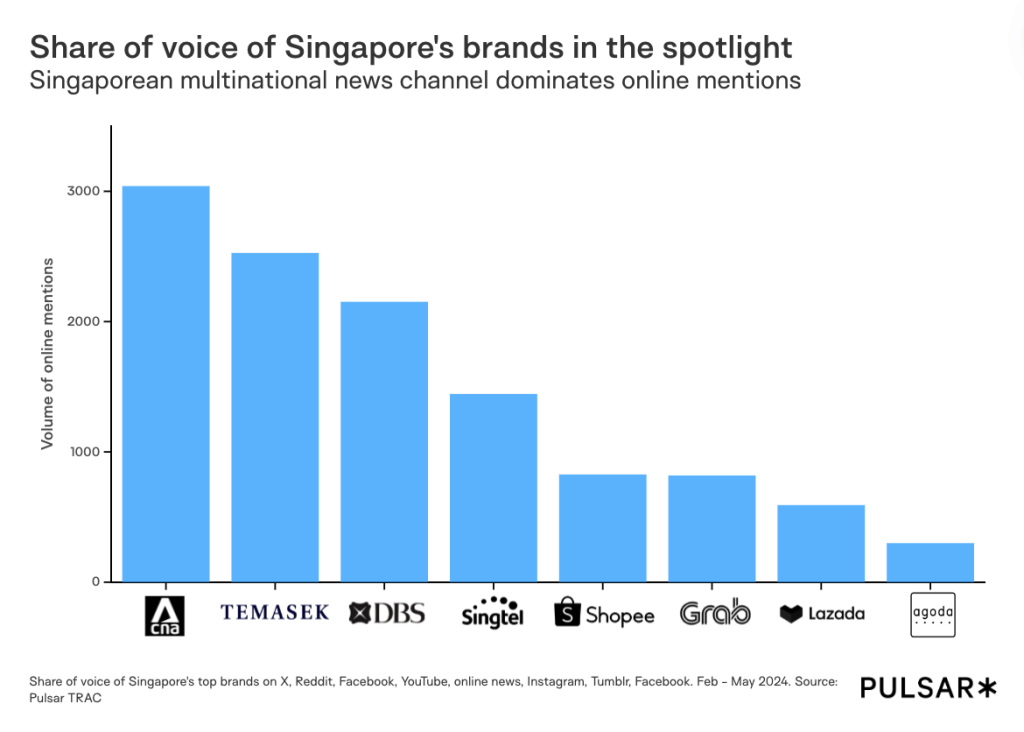
Implication for Brands: Reputation management in Asia requires balancing efficiency narratives with "human" or cultural vibrancy. Organizations associated with "efficient but sterile" nation brands must consciously inject creativity and human-centric storytelling into their communications to compete with the soft-power giants of the region. Social listening allows these brands to measure the "sterility gap" and adjust their narrative strategy in real-time to avoid being viewed as a mere utility.
Crisis Management & Pop Culture: The K-Pop "Burning Sun" Scandal
In our Some Scoops Travel Further Than Others report, we tracked the global spread of the BBC documentary exposing the "Burning Sun" sex scandal involving K-pop stars. A key finding was the role of Southeast Asian (SEA) fan communities as the critical engine in keeping the story alive. While Korean media coverage was initially muted or focused on police procedures, Thai and other SEA fans translated the documentary and shared summaries, reframing the narrative around "misogyny" and "justice for women" rather than just celebrity gossip.
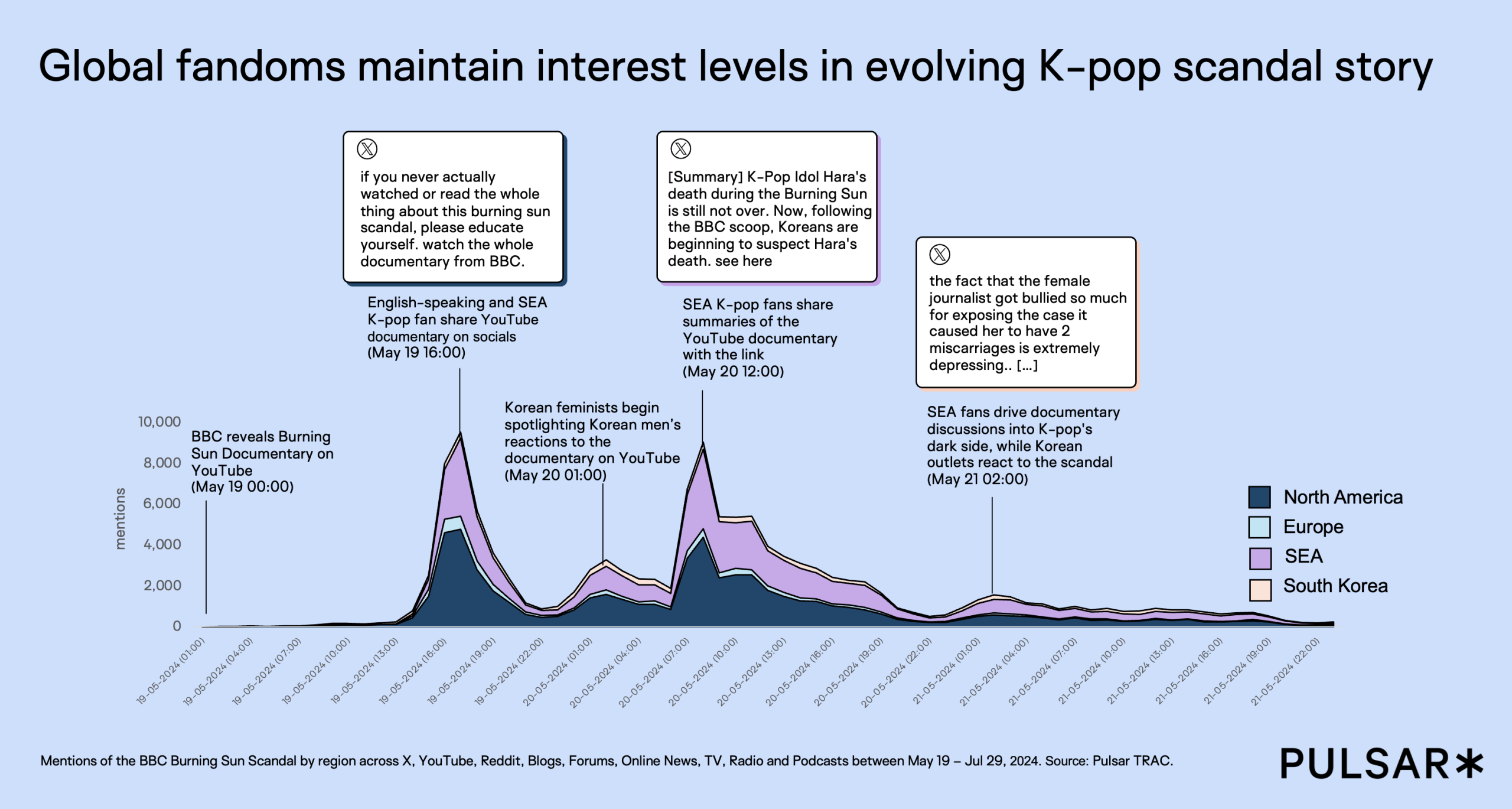
This illustrates the power of "fan activism" in Asia. Digital communities in the region act as "bridges," translating local scandals for a global audience. A reputation crisis in one capital (like Seoul) can become a global human rights conversation within 48 hours due to the organized nature of these communities.
Implication for Decision-Makers: Brands cannot rely on domestic media control to contain a crisis in Asia. Social listening must include "bridge communities" outside the immediate market of the crisis. Reputation leaders must monitor how niche narratives are being translated and reframed by regional activists, as these groups often determine whether a story fades or becomes a global crisis.
Geopolitics & Corporate Risk: Samsung and the Chip Wars
In our analysis for the Brand Misinformation Index, we tracked how Samsung’s reputation was impacted by US-China tensions. Following the US Inflation Reduction Act and Nancy Pelosi’s visit to Taiwan, Samsung’s misinformation risk score leaped by 553.4%. Chinese state-aligned publishers began framing Samsung as an "accomplice" to US monopolies, trying to exclude China from the global chip market.
This is a perfect example of "geopolitical collateral damage." In Asia, tech giants operate in a hyper-politicized environment where reputation isn't just about product quality, but political allegiance. Samsung was weaponized in state-level narratives, labeled as "anti-China" on platforms like Weibo.
Implication for Decision-Makers: For tech and infrastructure brands in Asia, reputation management is inseparable from geopolitical monitoring. Organizations must use social listening to detect when they are being drawn into nationalist or state-aligned narratives. Preemptive PR maneuvering—such as reinforcing local commitment or neutrality—must be data-led to counter misinformation spikes before they affect market access or consumer sentiment.
Consumer Values: The "Tech Paradox" in Ascending Asia
In a study covering multiple Asian markets, Pulsar and McCann Worldgroup APAC identified a distinct "Tech Paradox". While 67% of Asians believe tech benefits outweigh risks, 50% express a desire for "less tech" in their lives. The research found that "ethics" and "job/AI replacement" were the top media concerns uniting audiences across the region. There was a notable "turn off" among users toward AI-generated content that lacked a "human touch".
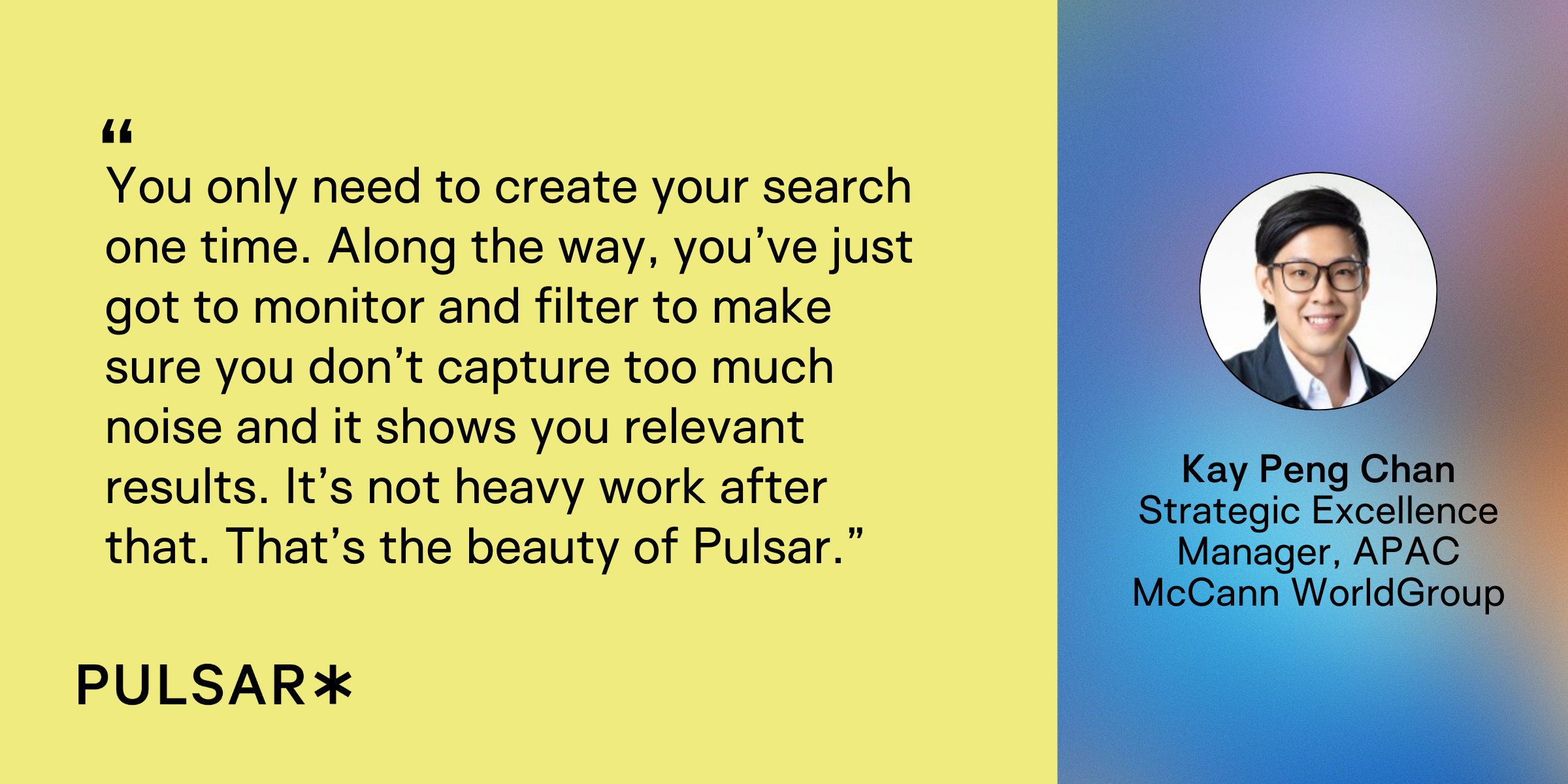
This suggests that in "Ascending Asia," reputation is increasingly tied to the responsibility of tech usage. High optimism is being met by growing fatigue and fear of replacement.
Implication for Decision-Makers: To build a sustainable reputation in Asia, tech companies should move beyond marketing "more innovation" and instead focus on "ethical technology" or "tech for well-being." Addressing the 50% of the market feeling overwhelmed requires narratives that emphasize human potential over mere automation. Social listening helps brands identify the specific points of "tech fatigue" within their audience segments, allowing for more empathetic positioning.
Narrative Intelligence: Geopolitics Means it’s China vs the World
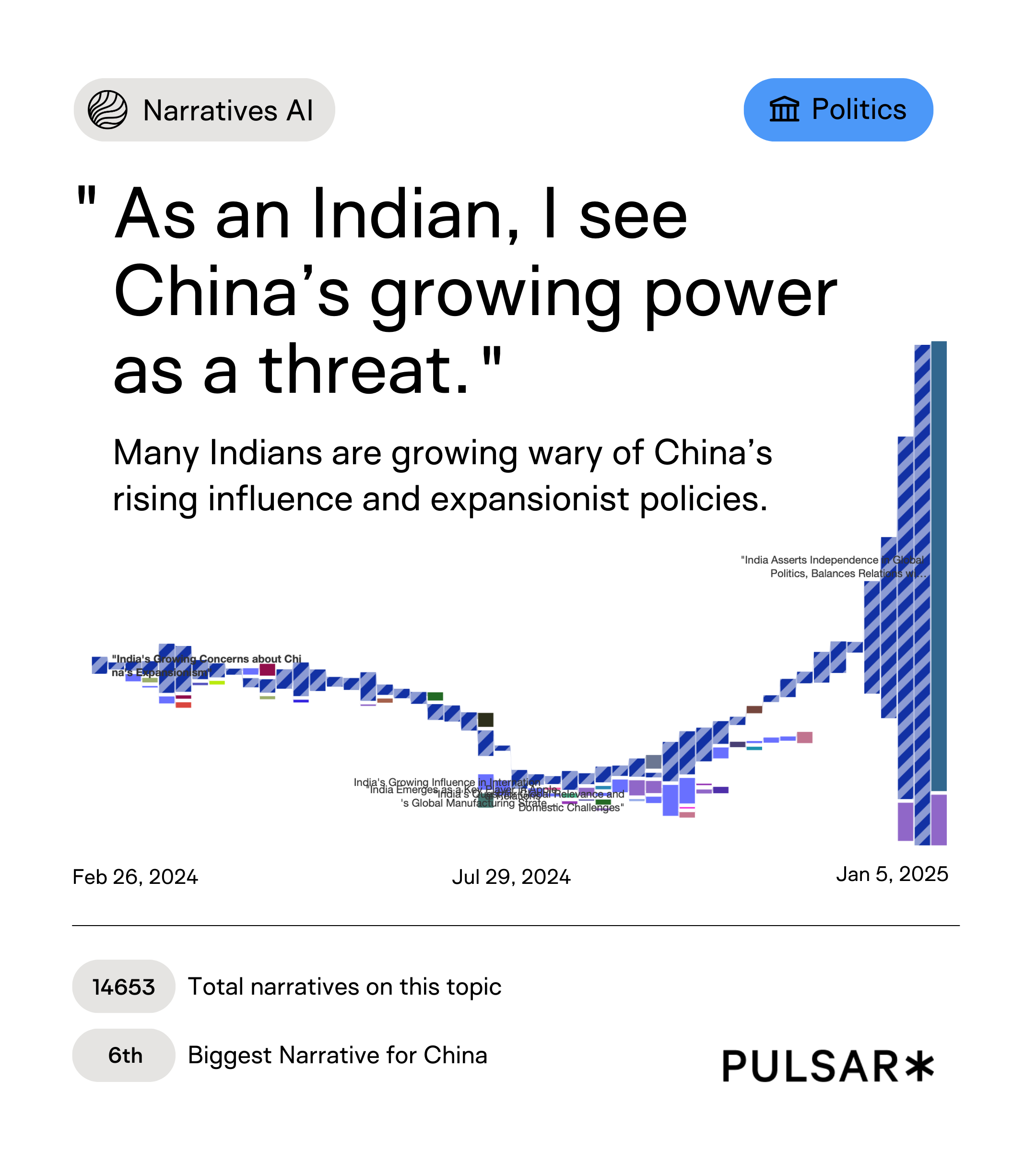
Using Pulsar’s Narratives AI, we identified a prominent geopolitical reputation narrative emerging within Indian social discourse: “As an Indian, I see China’s growing power as a threat.” During the analysis period, this ranked as the sixth-largest narrative relating to China. The conversation is driven by nationalist communities and frequently intersects with concerns around sovereignty, foreign ownership, and dependence on Chinese supply chains. In reputation terms, this narrative creates a high-sensitivity environment in which perceived proximity to China can rapidly undermine brand trust.
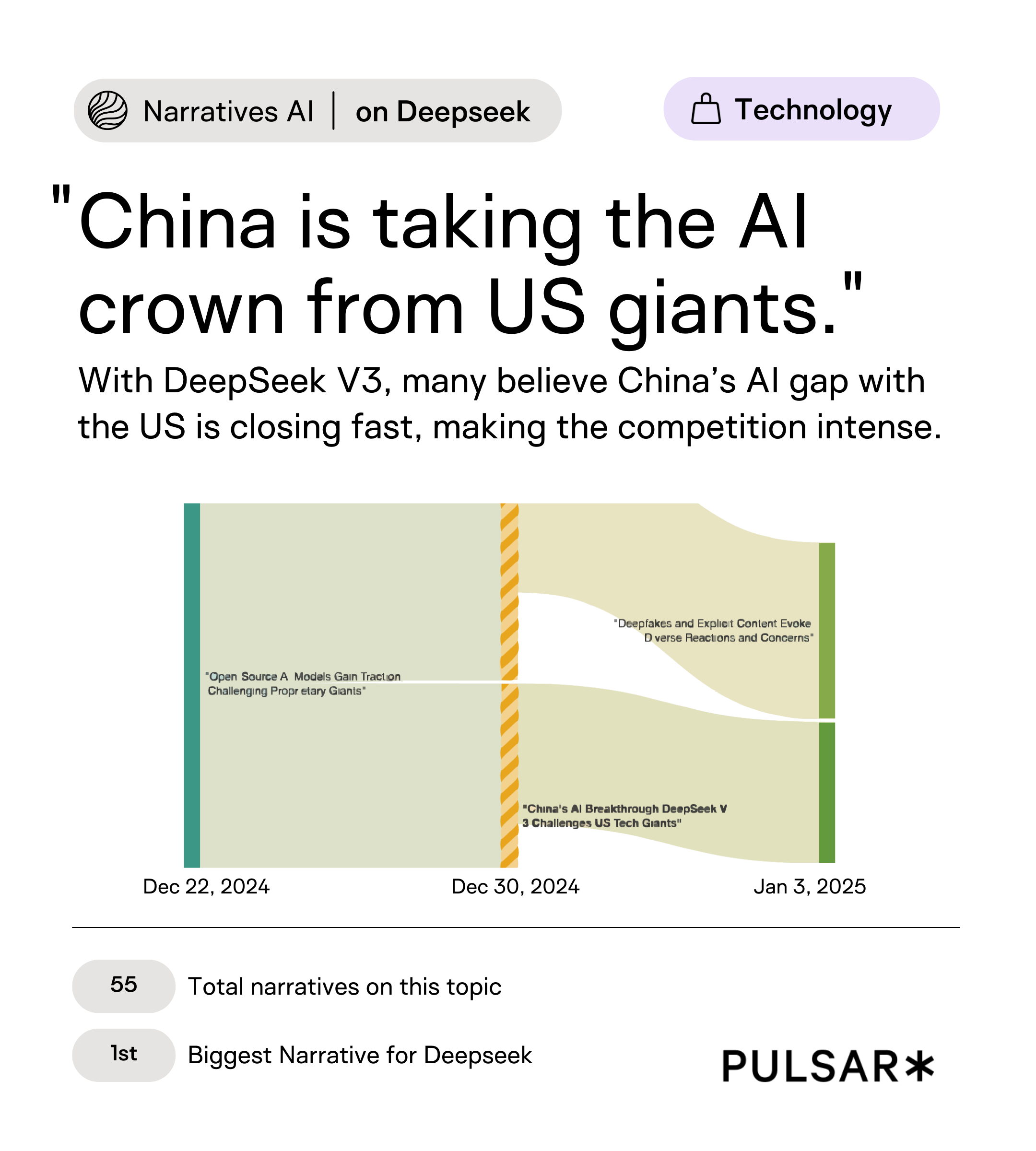
 Alongside this sits a second, distinct narrative shaping reputational perceptions across Asia: China as a global AI frontrunner. Discussions increasingly frame China as overtaking US technology giants, with models such as DeepSeek V3 cited as evidence that the AI capability gap is closing quickly. This narrative positions China not only as a geopolitical actor but as a technological benchmark—reshaping how audiences assess innovation leadership, credibility, and future readiness across global brands.
To read more about Narratives Intelligence, check out our Narrative Intelligence Hub.
For organisations managing reputation in Asian markets, these narratives illustrate why social listening must move beyond sentiment tracking to narrative intelligence. Brands entering or operating in India and neighbouring markets face compounded reputation risk: nationalist backlash linked to origin narratives, and strategic scrutiny tied to technological alignment. Audience and narrative intelligence enables teams to detect these macro-narratives early, understand which communities are driving them, and proactively manage brand positioning before reputational pressure escalates into commercial or regulatory consequences.
To learn more about social listening for reputation intelligence, visit our comprehensive Reputation Intelligence guide.
Why Social Listening Is Strategic for Reputation in Asia
Cultural Acceleration and Reputation Risk
Across Asia, social listening has become a strategic reputation capability rather than a tactical marketing tool. Rapid cultural change and complex digital behaviours mean traditional research often lags behind. Reputation now forms in closed messaging apps such as LINE and KakaoTalk as well as on public platforms like X or Weibo, making basic keyword monitoring insufficient.
Real-Time Narratives in High-Engagement Markets
High daily social media usage accelerates reputational risk. In markets such as the Philippines, audiences spend more than three hours per day on social platforms, allowing small incidents to escalate into regional narratives within hours. Social listening enables organisations to detect these shifts in real time and move from reactive crisis response to proactive narrative management.
Platform Fragmentation Across Asian Markets
Asia’s digital landscape is highly fragmented, with domestic platforms dominating many markets. WeChat and Weibo in China, KakaoTalk in South Korea, and LINE in Thailand create siloed conversation spaces. Audience intelligence allows teams to map communities and influence across platforms rather than relying on channel-specific metrics.
Moving Beyond Sentiment to Narrative Intelligence
Generic sentiment analysis lacks the cultural nuance required for reputation management in Asia. Expressions of criticism or concern vary by market and are often indirect. Narrative-led social listening surfaces the underlying cultural frames shaping conversation, enabling more empathetic and strategically grounded responses.
Conclusion & Next Steps
Reputation management in Asia has entered an era of radical transparency and community-driven power. Pulsar’s regional analyses confirm that institutional trust is fragile. Organizations can no longer rely on top-down communication; they must become active participants in the narratives that define their industry.
The "Singapore Paradox," the "Tech Paradox," and the "Burning Sun" scandal all point to a single truth: reputation in Asia is co-authored by the audience. By shifting from simple social listening to the advanced disciplines of audience and narrative intelligence, brands can move from being "sterile" utilities to becoming "vibrant" cultural participants.
Key Takeaways
- Reputation is Hyper-local: National brand perceptions (e.g., Singapore) and climatic realities (e.g., humidity in SEA) dictate product-level reputation.
- Fan Communities are Narrative Bridges: Regional activists can turn local scandals into global crises in less than 48 hours.
- Geopolitics is a Corporate Risk: Brands are collateral damage in trade wars, requiring constant monitoring of misinformation risk scores.
- Ethics is the New Innovation: As tech fatigue grows, a reputation for "responsibility" and "human touch" becomes a competitive advantage.
- Trust is Unequal: Reputation strategies must be tailored to the specific trust profiles of each market, from the high-trust environment of India to the skeptical landscape of Japan.
To navigate these complexities, organizations should leverage Pulsar TRAC for deep audience segmentation and Pulsar Narratives for real-time tracking of the stories shaping public opinion. By turning "vibes into insight," leaders can build a reputation that is not just resilient, but truly aligned with the evolving values of Asian audiences.
To stay up to date with our latest insights and releases, sign up to our newsletter below: