How AI-Generated Memes Hijacked Ferrari Luce Launch
- Automotive

Ferrari's first electric car launched twice. First by Ferrari, and then by AI.
When the Luce was unveiled on May 25, 2026, it generated one of the most intense spikes in brand conversation Pulsar has ever tracked, a huge splash that was unsurprising for a brand the size of Ferrari.
The more interesting story is what happened the morning after, when a wave of AI-generated content took over and extended the conversation far beyond anything Ferrari's communications team had planned for.
TL;DR
- ▸AI gave the launch a second life. The reveal's 390x conversation spike would have faded within a day, but a morning-after wave of AI-generated content extended it into a second surge that peaked 24% higher than Ferrari's own launch event.
- ▸More content goes viral, but each piece engages less. Now that anyone can generate an image in seconds and for cents, far more posts compete to go viral, so total reach climbs while engagement per post falls.
- ▸And the crowd shifts. The meme wave pulled in tech, news, and culture-war audiences with little connection to Ferrari's core buyers.
In This Article
How big was the Ferrari Luce launch?
The Luce reveal was one of the most intense brand spikes Pulsar has tracked.
Across 29 days, Pulsar Narratives AI analyzed 182,500 Luce mentions drawn from a broader pool of 1.28 million Ferrari mentions, producing research that was featured by the leading Italian automobile magazine Quattroruote.
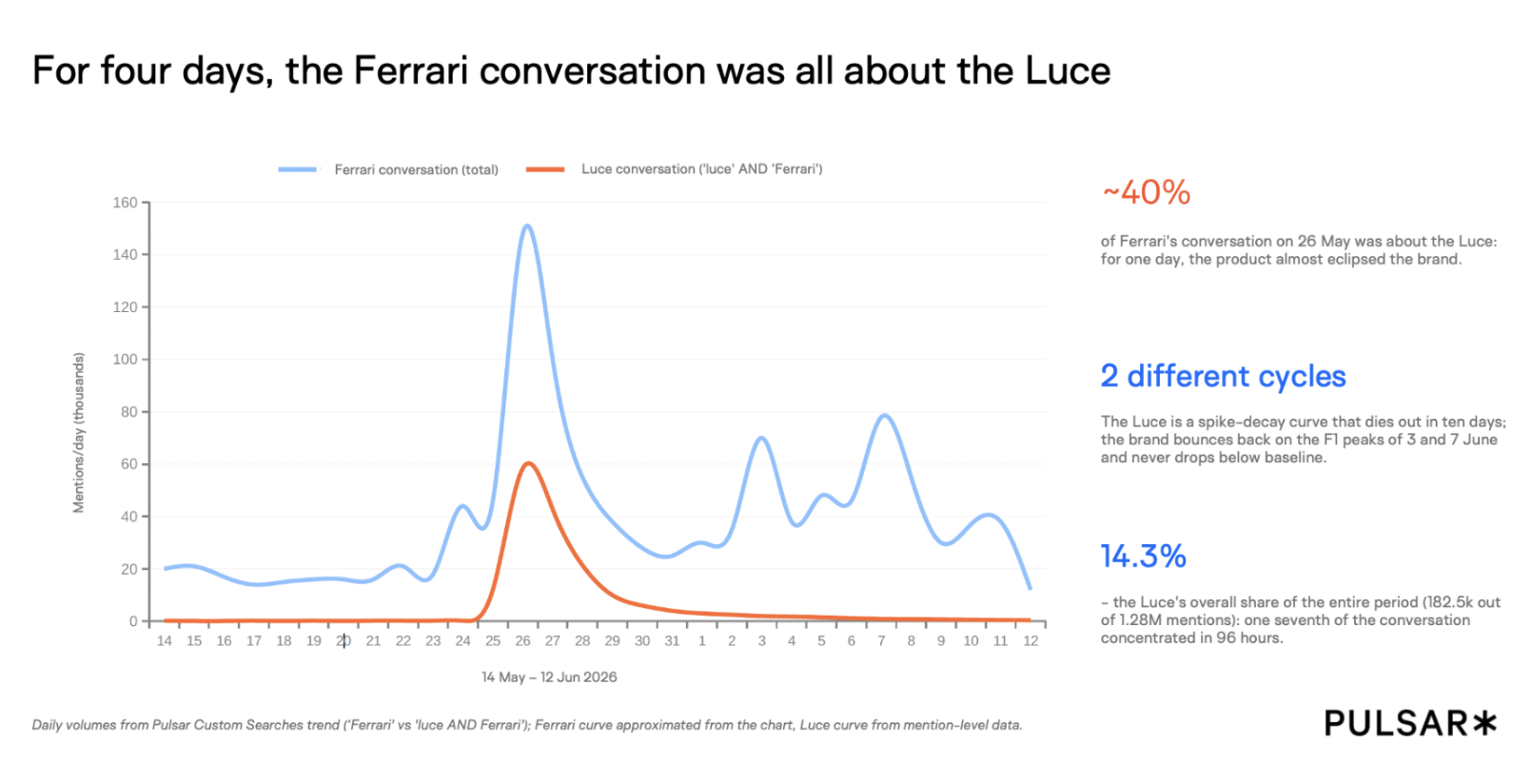
The launch ignited at 8pm UTC on May 25, accelerating 138x over baseline within two hours and peaking at a 390x spike overall.
For a single day, the Luce accounted for roughly 40% of all Ferrari conversation online.
Then came the second wave.
Source: Pulsar Narratives AI, Ferrari conversation analysis, May 14 to June 12, 2026.
When AI rewrote the launch
By 6am UTC on May 26, while much of Ferrari's European audience was still asleep, a new kind of content had begun to dominate the conversation.
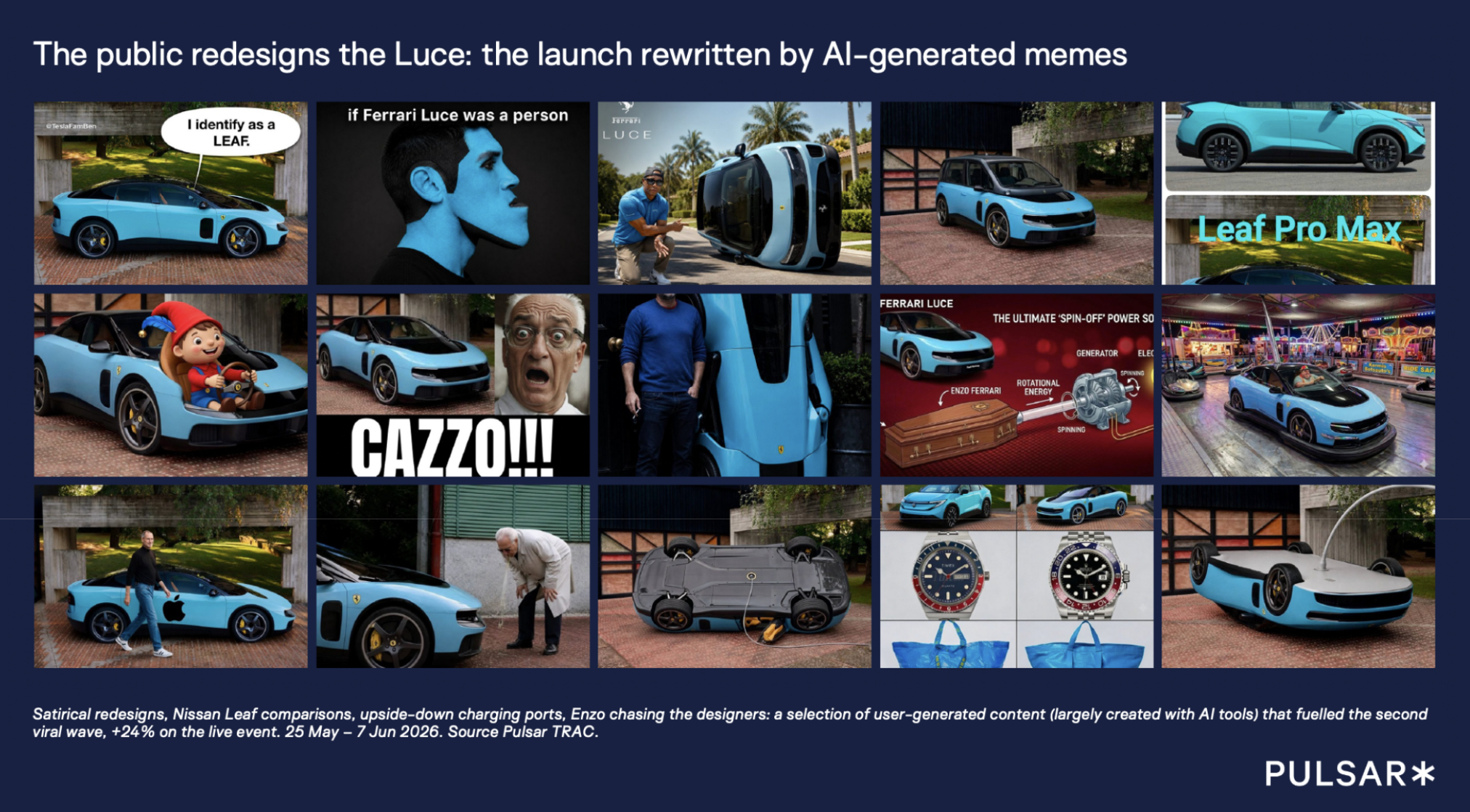
Satirical AI-generated redesigns, meme comparisons, and parody posts flooded X and forums.
The most-shared of these, a redesign captioned "designed by me and ChatGPT in 8 seconds at a cost of $0.10," collected more than 32,000 likes and became one of the most amplified pieces of content from the entire launch period.
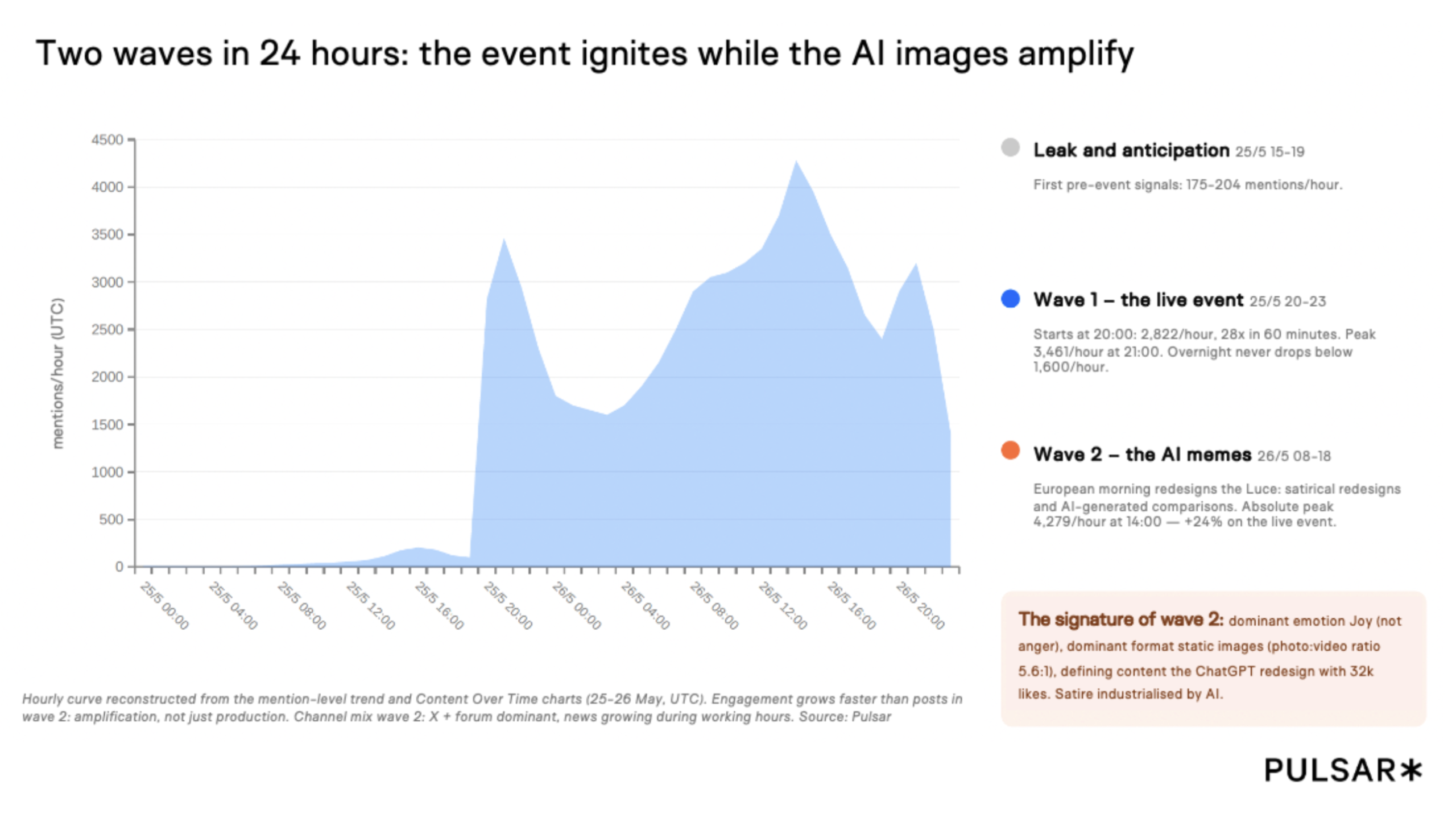
This second wave peaked at 4,279 mentions per hour at 2pm on May 26, which was 24% higher than the live launch event itself.
That is the new reality for high-profile product launches, especially ones with the potential to be controversial.
The reveal is no longer the ceiling it once was. The new ceiling is wherever the internet's creative response takes things the next morning.
Two waves in 24 hours
The launch event and the AI response behaved like two different cycles.
The first was driven by Ferrari; the second was driven by the public, using AI tools, and it reached a higher peak.
| Dimension | Wave 1: the live event | Wave 2: the AI memes |
|---|---|---|
| Timing | May 25, from 8pm UTC | May 26, from the European morning |
| Peak volume | 3,461 mentions/hour at 9pm | 4,279 mentions/hour at 2pm (+24%) |
| What drove it | Ferrari's official reveal | AI-generated redesigns and parody comparisons |
| Dominant format | Live coverage and reaction | Static images, photo to video around 5.6 to 1 |
| Audience | Core motorsport and passion communities | Tech audiences, news followers, culture-war-adjacent conversations |
| Engagement per post | Higher | Lower, spreading through irony and participation |
Source: Pulsar Narratives AI and Pulsar TRAC, Ferrari Luce launch, May 25 to 26, 2026 (UTC).
More chances to hit, but a different kind of engagement
This phenomenon is both an opportunity and a complication.
On one hand, AI-generated content gives launches a second life.
The conversation window extends, new audiences are reached, and the brand stays in the cultural conversation longer than a traditional news cycle would allow.
In fact, 73.8% of the Luce's entire 29-day conversation volume happened in the first four days, and without that second wave it would have been significantly more concentrated and significantly shorter.
On the other hand, the nature of engagement changes.
The second wave attracted a different response from the first. Individual engagement per post fell even as the total volume of content exploded, a pattern consistent with content that spreads through irony and participation rather than genuine enthusiasm or intent to purchase.
The audience composition shifted too: where the live launch pulled in Ferrari's core motorsport and passion communities, the meme wave brought in tech audiences, news followers, and culture-war-adjacent conversations that had little connection to the brand's existing fanbase.
More posts, more reach, more virality, but thinner engagement per unit, and a crowd that is not necessarily your crowd.
What this means for brands
Product launches now have two moments that matter: the reveal, and the AI-generated response that follows.
Brands that only prepare for the first are leaving the second, potentially the larger of the two, entirely to chance.
For Ferrari, the second wave was largely parodic, identity-driven, and organized around a handful of negative frames that the official communications response was not built to address.
The conversation that spread furthest was not about the car's 1,050 horsepower, its 530km range, or its engineering. It was about whether the Luce was a Ferrari at all. That is not what a brand wants to hear, and it is the kind of narrative risk that surfaces faster than a press office can respond.
The question for any brand planning a major launch has moved from "how do we maximize attention on the day?" toward a more nuanced framing: what do we want the second wave to look like, and do we have anything in place to shape it?
Frequently asked questions
+What is the "second wave" of a product launch?
The second wave is the surge of AI-generated content, satirical redesigns, memes, and parody posts, that follows a major product launch the morning after the official reveal. For the Ferrari Luce, the second wave peaked at 4,279 mentions per hour, 24% higher than the live launch event.
+How big was the Ferrari Luce launch conversation?
Pulsar Narratives AI analyzed 182,500 Luce mentions within a broader pool of 1.28 million Ferrari mentions over 29 days. The launch ignited at 8pm UTC on May 25, 2026, accelerated 138x over baseline within two hours, and peaked at a 390x spike. For one day, the Luce accounted for roughly 40% of all Ferrari conversation.
+What did the AI-generated content say about the Ferrari Luce?
The second wave was largely parodic and identity-driven. Satirical redesigns, Nissan Leaf comparisons, and parody posts spread furthest, and the dominant question was whether the Luce was a real Ferrari, rather than its 1,050 horsepower or 530km range.
+Did the second wave help or hurt Ferrari?
Both. It extended the conversation window and reached new audiences, but engagement per post fell and the crowd shifted toward tech, news, and culture-war-adjacent communities outside Ferrari's core fanbase. The dominant framing was negative, centered on whether the Luce was a real Ferrari.
+What tool produced this analysis?
The analysis was produced using Pulsar Narratives AI across 1.28 million Ferrari mentions from May 14 to June 12, 2026, and was featured by the Italian automobile magazine Quattroruote.
Related reading from Pulsar
- Narratives AI: the search engine for public opinion explained
- Bot noise, AI content, and the authenticity crisis: how to find real signal in 2026
- Narrative attacks and narrative risk: how to detect and prevent reputational threats
- AI narrative analysis: how AI reads public opinion at scale
- Social listening for crisis prevention: why the brands that win act before the story breaks
About this analysis
This analysis was produced using Pulsar Narratives AI across 1.28 million Ferrari mentions, May 14 to June 12, 2026. The research was featured by the leading Italian automobile magazine Quattroruote.
This article was created using data from TRAC