What makes the social media landscape different in 2026?
- Agencies
Social is changing, fast. Audiences are stepping away from standardized feeds and into games, group chats, forums and AI conversations. These spaces run on different social contracts, and meaning forms locally rather than at scale.
This is the Great Fragmentation.
Pulsar’s latest study maps how platforms and behaviors are diverging, revealing where attention now concentrates and how stories gain traction within today’s social landscape, shaped by spaces that matter most.
In the first of a new series, let’s start with a core question: how has the social landscape changed heading into 2026?
There are more platforms, and more users, than ever before
If the social media landscape of 2019 looked like a solar system with a few massive suns such as Facebook, YouTube, Instagram, 2025 resembles a “Big Bang.” The difference is immediately clear when we compare platform active users across these years: the ecosystem has exploded.
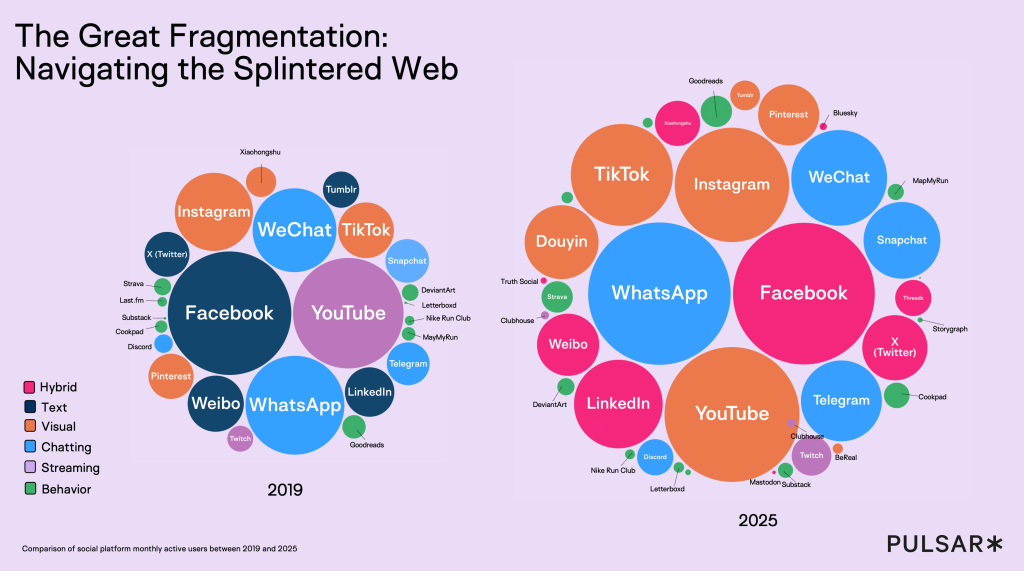
The growth of platforms has brought a wave of “same-fication.” Many apps now share overlapping core features. X (formerly Twitter) has evolved from text-only into hybrid formats, TikTok and Instagram continue blending video, commerce, and community, and new entrants like Threads mirror the giants’ features.
At the same time, while major players remain dominant, they are now surrounded by a dense nebula of specialised apps. Users are no longer choosing platforms solely for utility. They are choosing platforms to express identity and lifestyle within a rapidly fragmenting social media landscape.
Apps like Strava, Nike Run Club, and MapMyRun turn solitary habits into social signals. Platforms such as Discord and Bluesky reflect growing fatigue with algorithmic feeds, as users migrate toward spaces where community rules and shared interests matter more than viral reach.
What emerges is a social media landscape that is larger, more fragmented, and more identity-driven than ever before.
Each platform in increasingly understood to have a ‘vibe’
Features may be converging, but culture is diverging. Across the social media landscape, platforms now map onto distinct moods, needs, and “vibes”—and that’s where growth is happening.
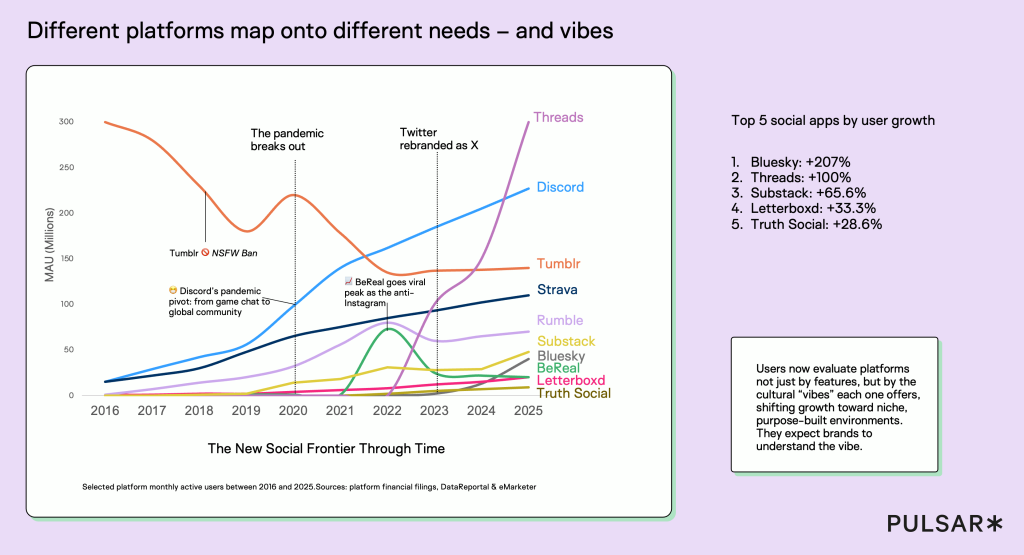
From 2019 to 2025, the fastest-growing platforms aren’t just the biggest. Bluesky (+207%), Threads (+100%), Substack (+65.6%), Letterboxd (+33.3%), and Truth Social (+28.6%) all offer clear cultural propositions within the evolving social media landscape.
Users now choose platforms not just for features, but for the “room” they’re entering. Bluesky and Threads shape public conversation differently. Substack fosters long-form thinking and creator-owned communities. Letterboxd channels cinephile obsession. Truth Social caters to a specific ideological group.
Growth is shifting toward niche, purpose-built spaces where vibe and unwritten rules matter as much as functionality—reshaping the wider social media landscape through moments like BeReal’s rise as the “anti-Instagram,” X’s rebrand, and Discord’s shift from game chat to global community.
The audiences are bigger – and their attention more fragmented
User growth on legacy platforms is slowing, yet total audiences continue to rise. The bigger shift is how attention is spent. Time on social media hasn’t disappeared. It is spreading across more corners of the digital world, changing where engagement actually happens within social media landscape.
The fight for eyeballs is moving beyond traditional social networks. Gaming worlds like Roblox and Minecraft have become social hangouts for younger audiences, while AI chatbots such as Character.AI are capturing time once reserved for messaging. In the social media landscape of 2026, friendship may include non-human participants.
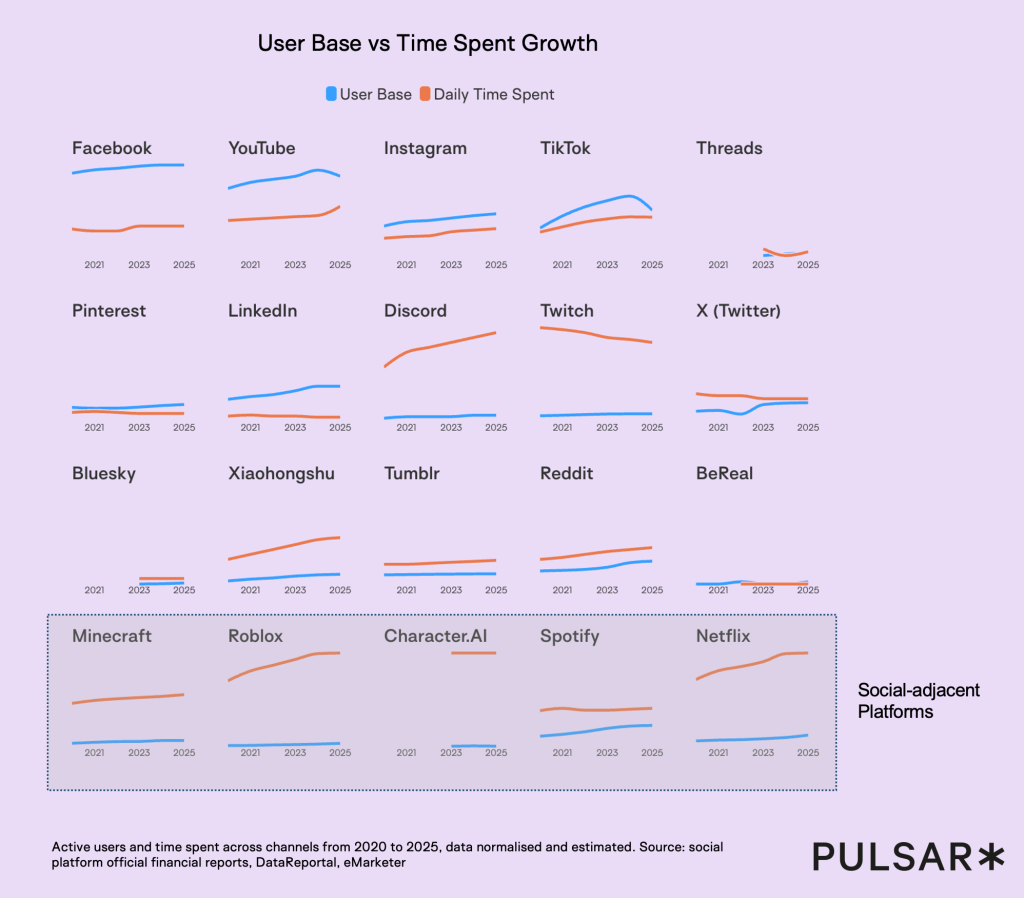
Two trends stand out:
- On legacy platforms, user growth continues but daily time spent rises slowly.
- On alternative platforms, engagement is climbing faster, showing that people are using social platforms differently. Legacy platforms are for casual scrolling, while alternative spaces encourage deeper interaction.
What this means for brands is pretty straightforward. Attention is most valuable where behaviour runs deepest. Gaming, streaming, and AI-driven platforms are where audiences spend immersive hours, and understanding the cultural rules of this social media landscape is essential for growth.
Brands are choosing where to spend their effort
As audiences fragment, brands follow—but not always to the same places. Mapping the most valuable interconnect brands from Interbrand’s Best Global Brands 2025 by followers across major social platforms reveals highly distinct media footprints. Apple, Microsoft, Amazon, Google, Samsung, Toyota, Coca‑Cola, McDonald’s, Mercedes Benz, Cisco, and Louis Vuitton each gravitate toward different home channels, showing where their social gravity currently sits.
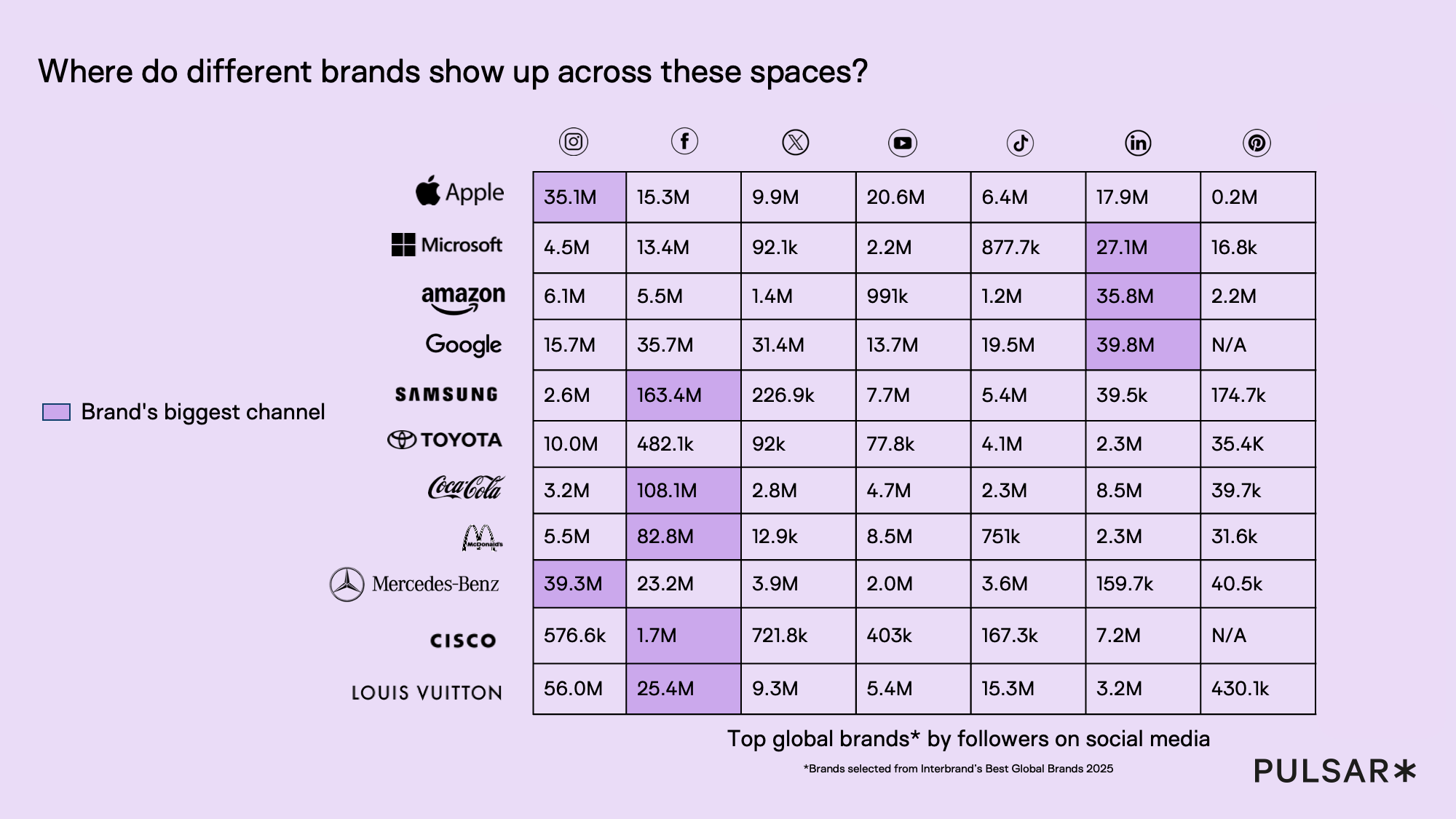
Some brands cluster on Instagram or YouTube, focusing on visually driven storytelling and lifestyle narratives. Others are strongest on Facebook or X, emphasizing reach, newsworthiness, or corporate and customer communications. LinkedIn remains central for B2B brands like Google, Amazon, and Microsoft, while TikTok and emerging platforms are often underrepresented relative to where culture, youth attention, and experimentation thrive.
Apple provides a useful example. Its biggest audience sits on Instagram, but it also has a meaningful following on forums, showing how top brands can maintain a presence in culturally relevant, discussion-driven spaces beyond their main channels.
This uneven distribution highlights a core tension of the fragmented social media landscape. Publishing does not equal cultural relevance. When forums, Roblox, or Substack can matter as much as Instagram for certain communities, brands must ask not only how many followers they have but where, within the social media landscape, they are actually shaping conversation.
For a deeper dive into the full Great Fragmentation study, read it here.
To stay up to date with our latest insights and releases, sign up to our newsletter below:
This article was created using data from TRAC