
The power struggle: what audiences are really saying about the renewable energy transition
- Government

The energy transition conversation is often framed in terms of reports and policy - but what happens when you look at how real communities are talking about renewables online? In this blog, we’ve collaborated with UN Climate Change to analyse audience narratives around the five heavyweights in the world of renewable energy: solar, wind, hydro/tidal, geothermal and biomass.
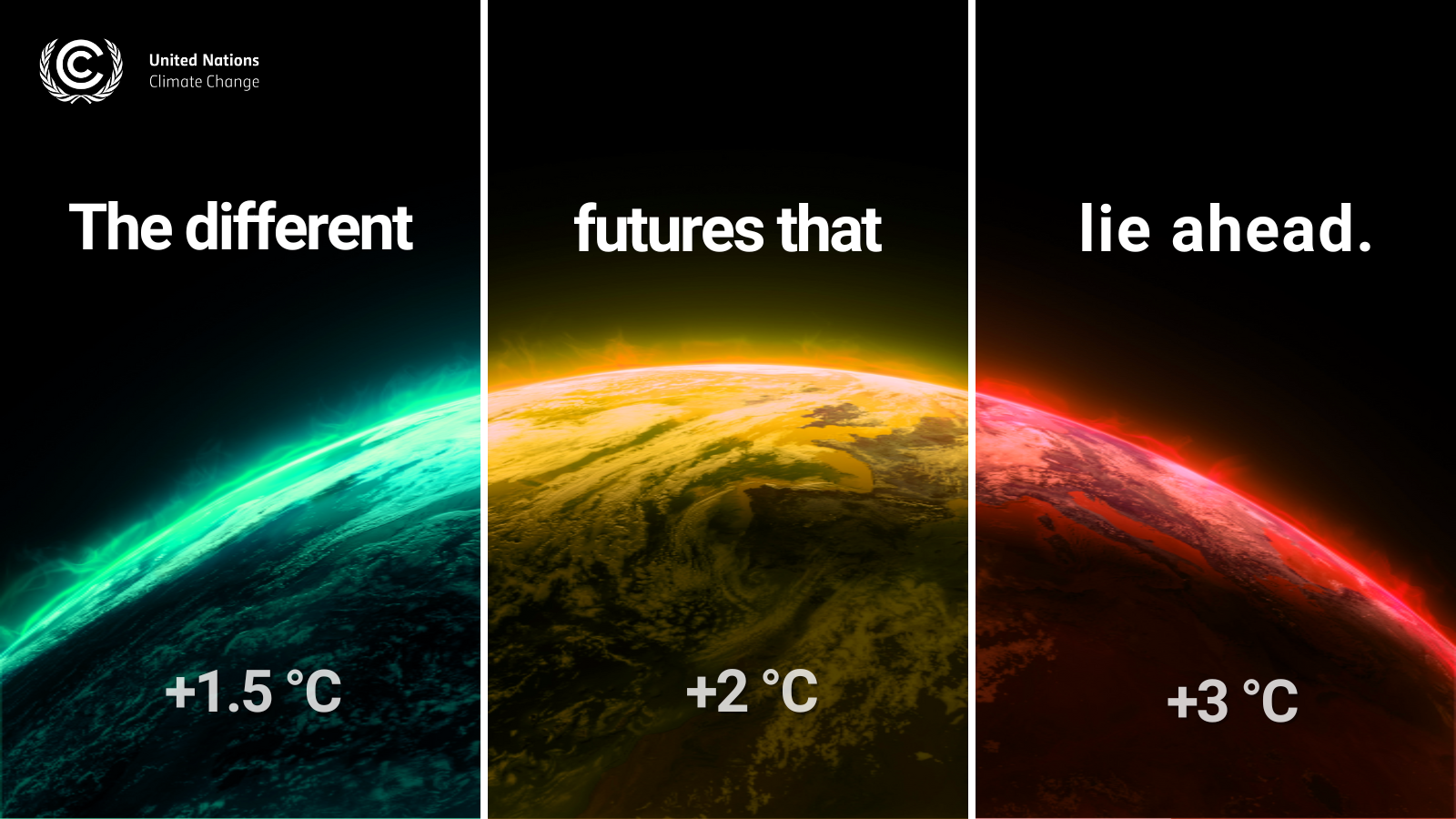
These conversations are emotionally loaded, often contradictory, and full of complexity. From worries about bills to deep conspiracy theories, they reflect how people feel about the future of energy. We explore this through three lenses: affordability & bills, jobs & economic security and reliability & misinformation. Join us as we plug into what audiences are talking about when it comes to renewable use - from blackouts & beluga whales - and dive into this highly charged conversation.
Differentiating between renewable energies
In this research, we examine five renewable technologies: solar, wind, hydro, biomass, and geothermal. Solar and wind are now widely deployed at scale and form the most established, cost-effective pillars of the clean energy transition. By contrast, hydro, geothermal, and biomass remain less fully scaled and face a range of environmental and implementation considerations.
Bills & affordability: “why isn’t this cheaper?”
What the evidence says: The International Energy Agency confirms that solar and onshore wind are now the cheapest forms of new electricity generation in most parts of the world. Countries like Portugal and Germany have seen record-low prices in renewable auctions, but outdated grid fees and legacy pricing systems still allow gas generation to set prices, which prevents the majority of savings from reaching consumers.
Affordability is unsurprisingly a very emotionally charged narrative around renewables. For many people, the energy transition isn’t about sustainability - it’s about what shows up on their bill. Online discourse is full of tension: if renewables are as cheap as governments and scientists say, why aren't the benefits and savings passed along to the public?
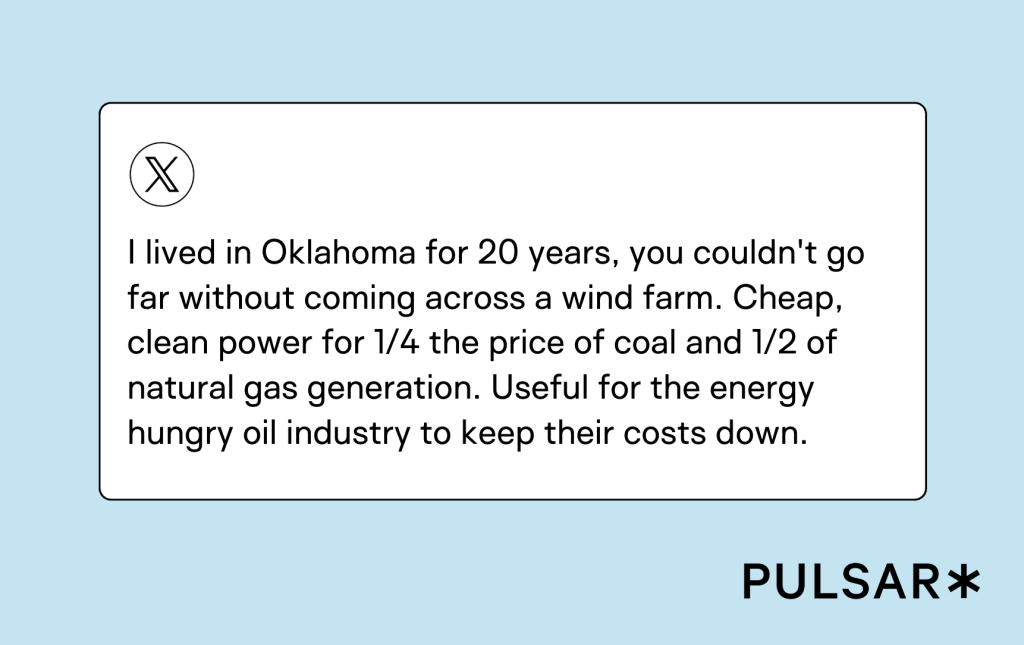
Solar comes out as having the most positive reputation when it comes to affordability - however, contradictory treatment. On TikTok and forums, solar panels are often praised as a smart personal investment to decrease bills. Other conversations spread false narratives, framing solar as a political grift where users share screenshots of their rising bills alongside unfounded accusations that the public has been misled. Wind is often celebrated when it’s local and visible (e.g. small-scale wind farms), but large-scale wind is falsely criticized as expensive to maintain and slow to pay off, despite evidence showing otherwise. Posts such as the one below are exemplary of the tone and messaging of the conversation, which totalled over 650k posts in our study.
Hydro and geothermal are discussed in more niche forums. Hydro is hyped by people in the context of using hydropower for energy independence - geothermal is shown as a solution to niche energy demand issues, but positioned as futuristic but expensive and inaccessible. However, the unaffordability of setting both these types of projects up (despite their relatively cheap running costs) sets these energy solutions back. Biomass is discussed largely in off-grid and rural contexts, with some seeing it as a practical local solution, and others questioning its true sustainability due to emissions and sourcing concerns.
Jobs & economic security: “where are these jobs going?”
What the evidence says: IRENA reports that the clean energy sector supported 16.2 million jobs globally in 2024, up from 13.7 million in 2023. Global green job increases are hard to predict - but the International Energy Agency estimates a net increase of 5.7 million new green jobs created by 2030. Yet in a YouGov poll, just 38% of UK adults believed that renewables create more jobs than they eliminate.
The promise of green jobs is everywhere - but when conversation hits social platforms, it gets personal. People aren’t just asking how many jobs will be created - they’re asking: who gets them? Where are they? And are they any good?
Many note that across all energy types, there’s a geographic luck of the draw when it comes to jobs in renewables.
Solar is seen as the biggest job driver, especially in the US and India. On X and Facebook, people celebrate government solar schemes that create employment - but also criticise them when the jobs go abroad or are temporary. Wind jobs often appear to be seen as adventurous, outdoorsy, and even cool. But when companies like Siemens announce wind job cuts, it becomes a flashpoint for anti-renewables sentiment.
Hydro job narratives are polarising. A large amount of the conversation takes place in Canada, where debates centre on indigenous land rights and whether jobs are going to local communities or outsourced to the US. Geothermal and biomass see a focus on a thriving jobs market in Kenya, Namibia and other developing African countries.
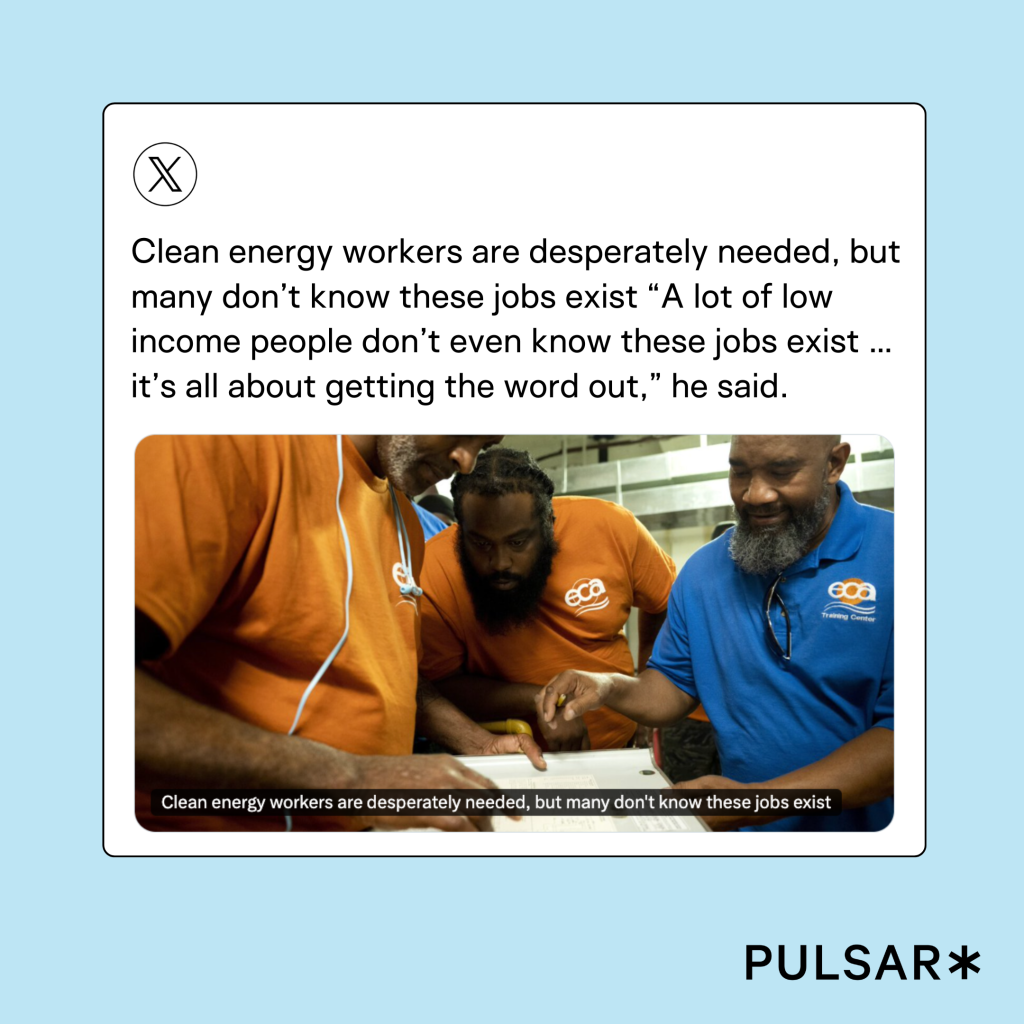
Here, there’s excitement, but also frustration that these solutions are expensive and require rare expertise. The tone is often sceptical. Many worry that green jobs are either low-paid or a smokescreen for cuts elsewhere.
Reliability & misinformation: “why does solar get all the blackout blame?”
What the evidence says: Studies have shown that renewables, when paired with storage and demand response, can enhance grid stability. South Australia, which now runs on over 70% renewable power, is a global model for clean energy reliability. In Texas’s 2021 blackout, regulators found that gas system failures - not frozen wind turbines - were the main cause.
When the lights go out, fingers point fast - and they usually point at renewable instability. In the wake of extreme weather or grid failures, social platforms light up with blame, conspiracy, and panic.
Misconceptions persist that solar and wind are unreliable, with memes and commentary falsely mocking them as only working when the sun shines or the wind blows. Hydropower appears in North American discussions, particularly during droughts or cold snaps, with claims that dam operations make grids unstable. Some users fight back, arguing that it’s not the renewables but the grid itself with outdated infrastructure and poor planning being the real issue.
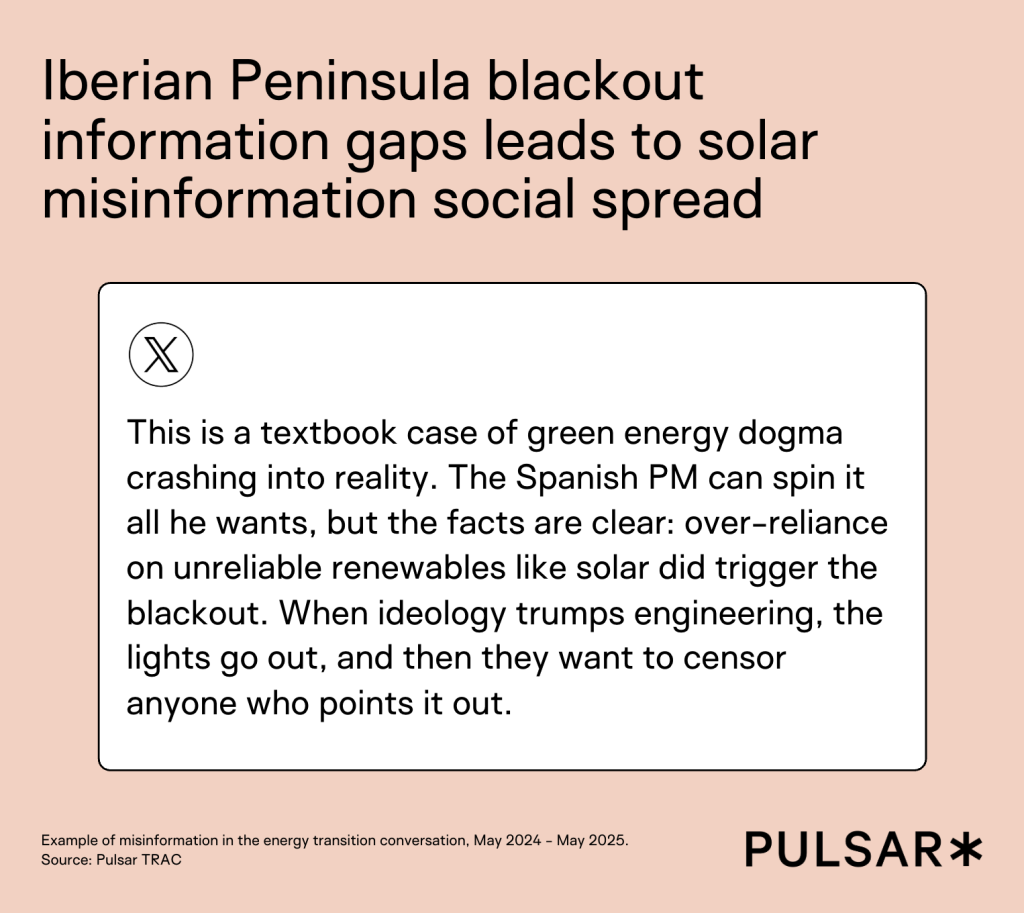
The conversation around renewable energy and reliability often skews towards alarming headlines, particularly following large incidents. While it's true that such events trigger intense public discourse, it's crucial for businesses and stakeholders in the energy sector to understand the underlying facts.
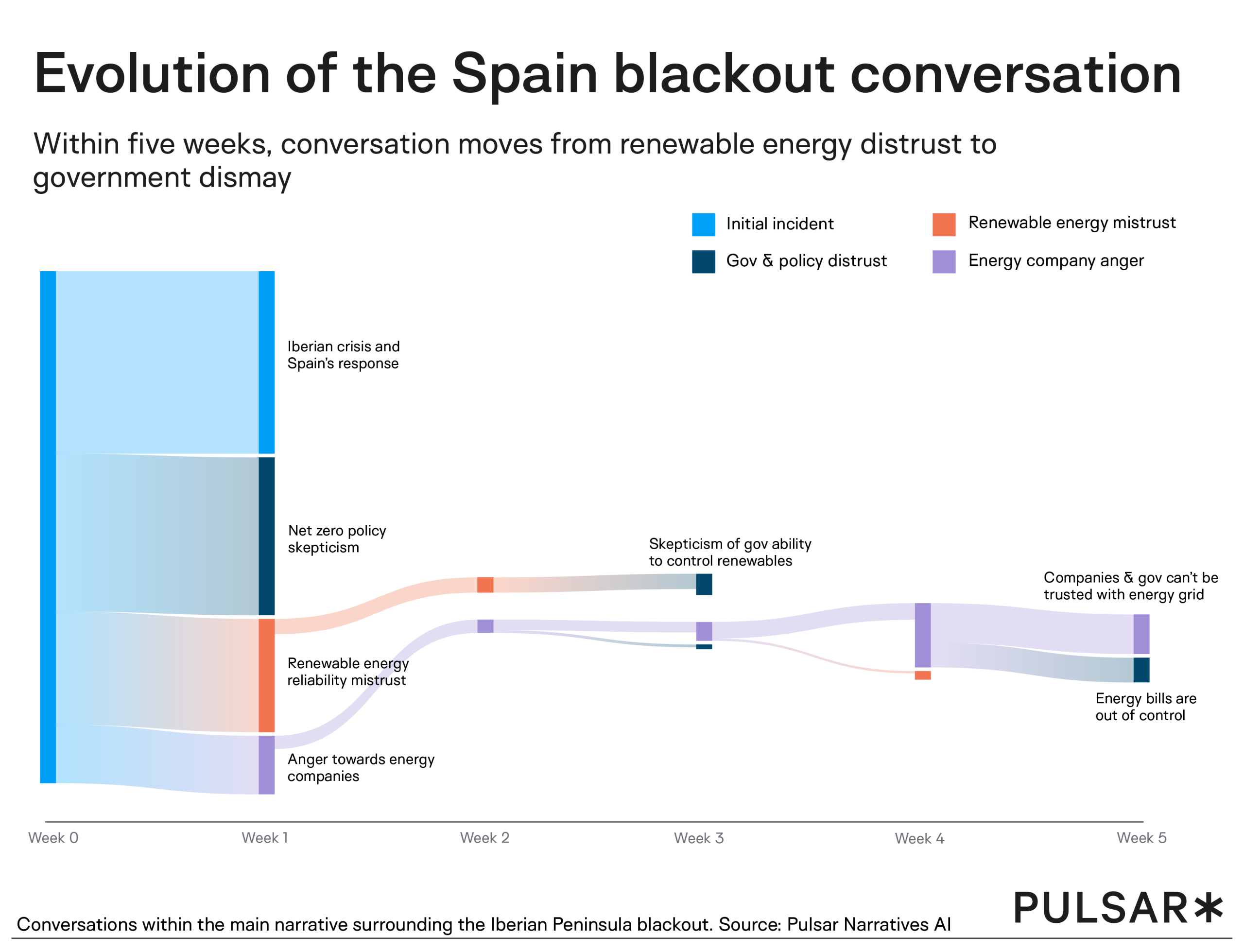
The above chart documents 72% of the conversation around the April 2025 Iberian Peninsula blackout. The incident generated an immediate response among some: solar and wind must be to blame. Posts went viral before any official information was released, as the Spanish government took the time to conduct a proper investigation. Eventually, Red Eléctrica de España confirmed the real cause - a transmission and regulation fault, not renewable generation itself.
We can see above that narratives surrounding energy mistrust turn towards government and corporate blame, especially once the real cause has been found. However, where gaps in knowledge and messaging from officials occur, it’s common to see inflammatory narratives rise in their place.
Escalation & rationalisation: “how much of this is true?”
We see many narratives in our reliability conversation having some degree of merit or being presented as an opinion - for example that green jobs shouldn’t be created at the expense of current workers’ jobs in today’s economy. Another example is the certain renewable use has been linked to blackouts. These ideological points of view generally dominate in reliability discourse.
However, these conversations get derailed and piggy-backed by people spreading pure misinformation. Here are a few key examples of that we found:
Magnetic field theorizing
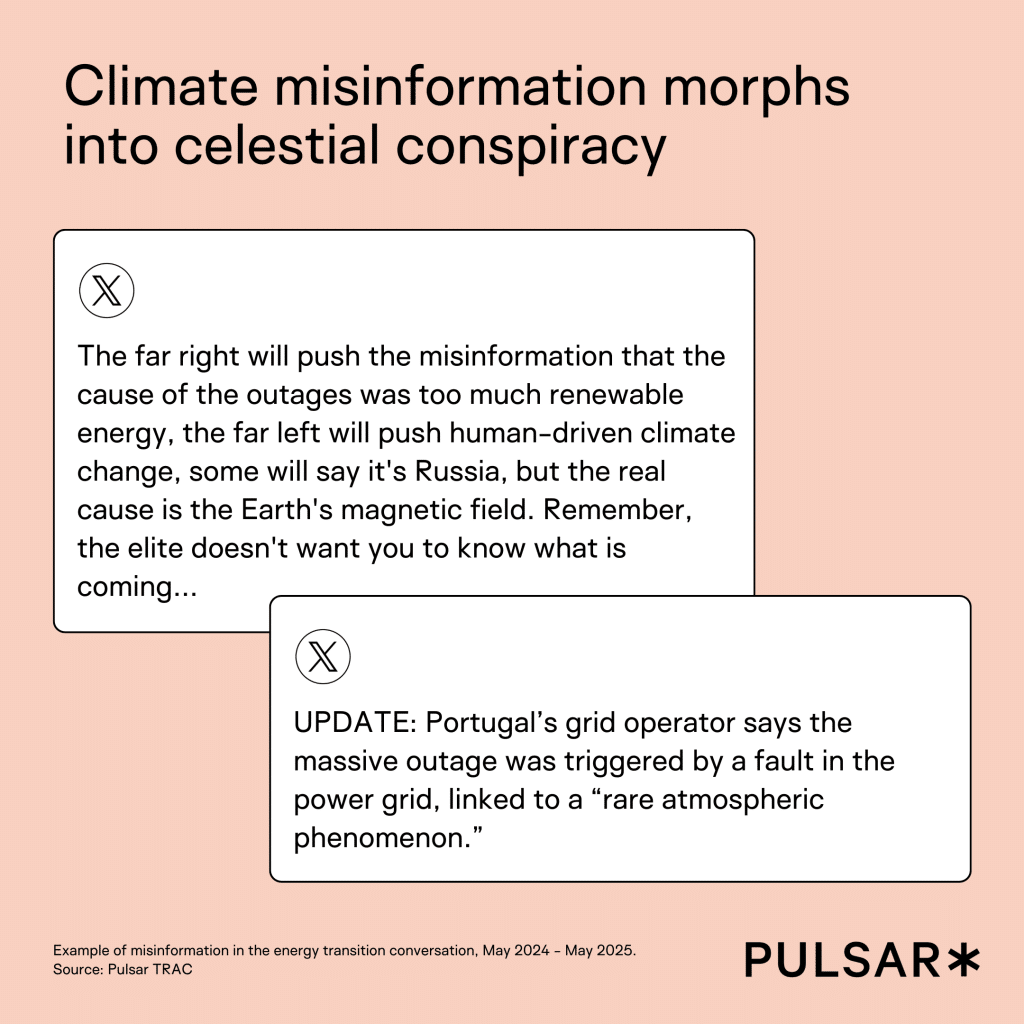
This top narrative in climate misinformation expands into celestial conspiracy theories. Here we see a melding of magnetic field conspiracies with climate misinformation resulting in some claiming blackouts in Spain were ‘proof’ of their conspiracy. This can be seen as a direct response to the delayed response and long investigation into a cause for the Iberian Peninsula blackout. This misinformation narrative lives adjacent to conspiracies that attribute global warming to celestial factors over human factors.
Loco whales from wind
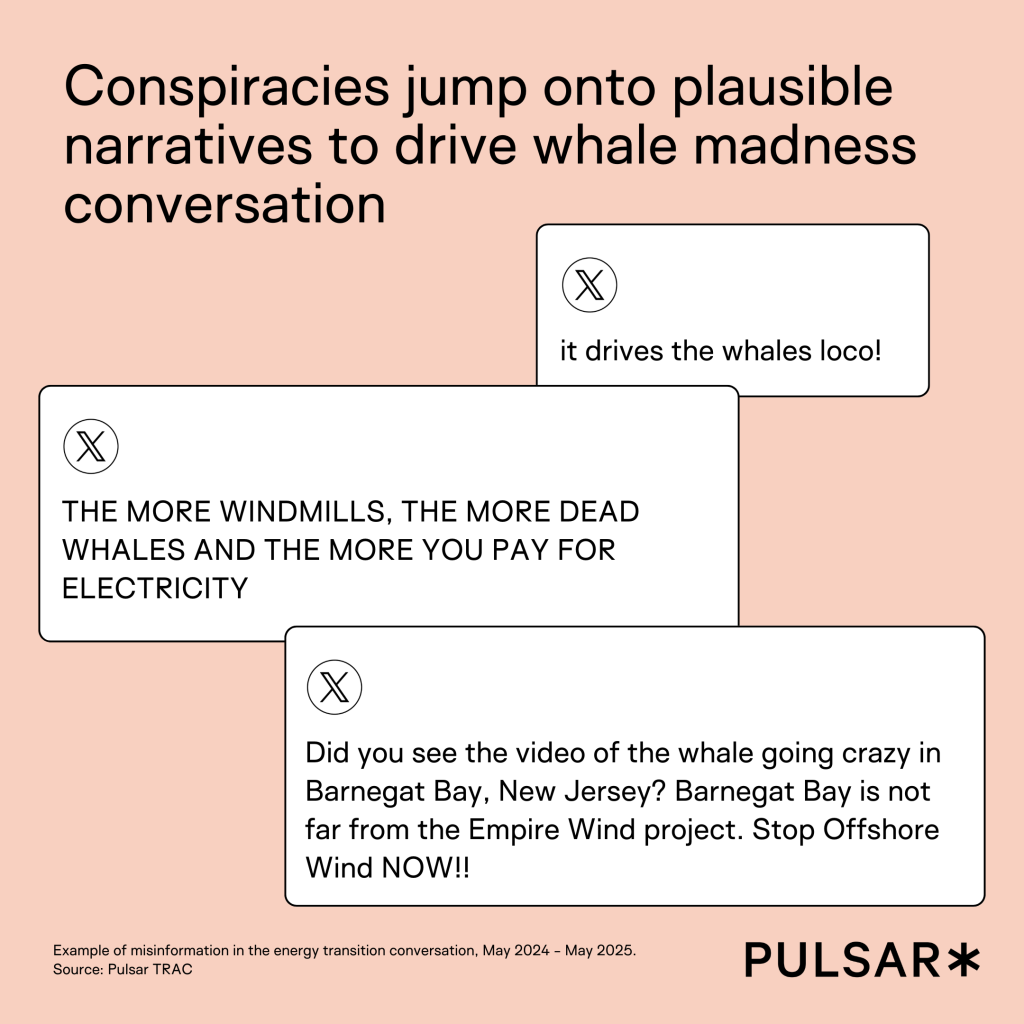
This claims that offshore wind farms & ecology are incompatible, particularly when it comes to the wellbeing of whales. It’s true that when creating offshore wind farms it’s imperative that ecological factors are taken into account to not disturb the local sealife and habitat. However, shareable narratives have led to the ‘loco whale’ misinformation where people claim that wind farms affect whales, leading them to go ‘crazy’ with narratives ranging from the whales being disoriented to being murderous. This is driven by a particular narrative in which an increased amount of whales are being beached in the US - some individuals spread misinformation by claiming this is caused by offshore wind farms rather than as a result of sudden weather and barometric pressure changes.
Uno reverse investment claims
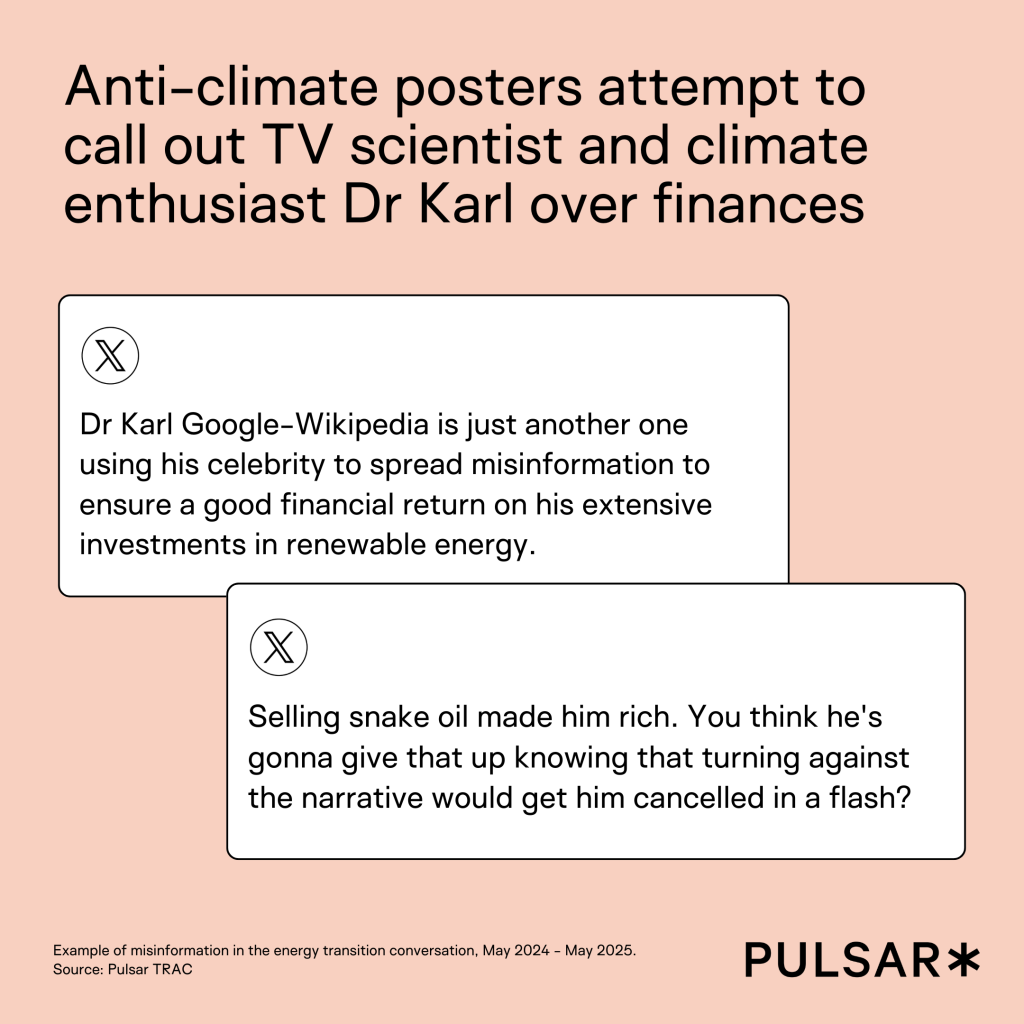
Here, people who are anti-renewables claim that scientists, environmentalists and other people who are pro-renewables are posting pro-renewable misinformation because of their personal investments. This follows the same narrative as pro-climate posters locating links between politicians and fossil fuel investments, but in an anti-renewables mirror image.
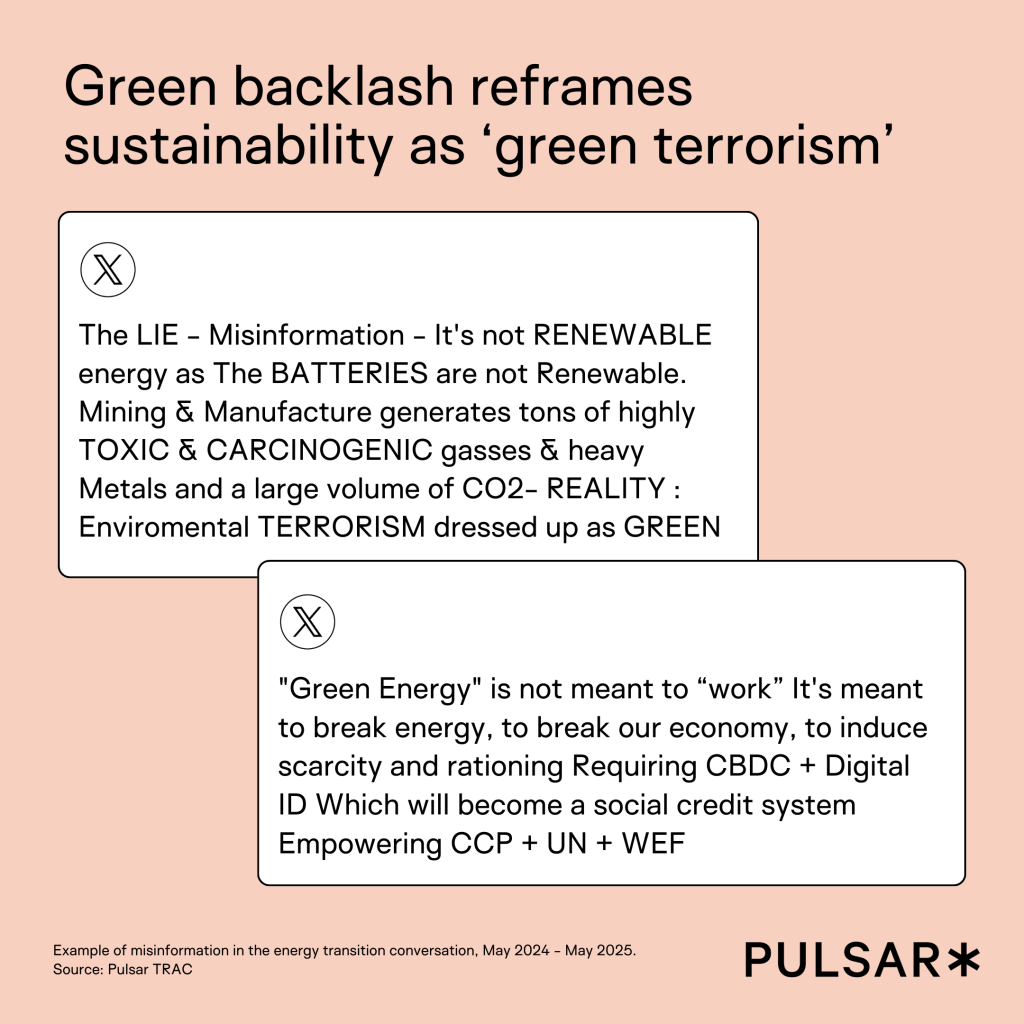
Green is disguised toxicity
Whilst it’s true that green products like electric vehicles may have an initial large carbon impact and use large amounts of natural resources, some audiences are claiming that sustainable initiatives are ‘green terrorism’. This claims that environmentalists ‘want to see the world burn’ and purposefully disrupt the world. The interesting thing here is that the nuance means that people from all over the political spectrum can engage with this narrative.
Shifting the narrative
The story of renewables online isn’t just centered around data, science and progress. It’s also about trust - and its absence. These conversations reveal that many people feel cut out of the benefits of the transition, suspicious of who profits, and unsure whether to believe what they’re told.
What we’re seeing isn’t just a transition of energy practices - it’s a transition of who has power over the narrative.
Social conversations based on scientific facts can greatly benefit from transparent and timely communication by institutions on events and potential arenas in which misinformation may fill the void. For brands, policymakers, and platforms, there’s an opportunity to counter and prevent misinformation by listening to the narratives and responding with clarity to meet audiences where they are.
How UN Climate Change uses Pulsar for impactful climate communication
The analysis and conclusions in this case study represent Pulsar's independent research. The following section describes UNFCCC's use of Pulsar's tools and does not constitute endorsement of the specific findings, interpretations or assumptions presented above.
The challenge for climate communications isn't just having accurate information, it's understanding how that information moves through public discourse. At UN Climate Change, we've used Pulsar for the past two years along with other tools to monitor narratives year-round, tracking not just what people are saying about the UN climate change negotiations, but the underlying concerns and misinformation patterns that shape public perception of climate action.
This is particularly crucial during the UN Climate Conference (COP) periods, when we use real-time monitoring to track the discourse and emerging misinformation narratives. This allows us to adapt our communication to the public in real time with the purpose of providing transparent and relevant information in engaging ways.
Looking for more?
To stay up to date with our latest insights and releases, sign up to our newsletter below:
This article was created using data from TRAC