
2. When journalism is the brand: how audiences perceive news outlets
Table of contents
News organisations are operating in a rapidly changing world—but journalism still carries weight.
In the face of declining trust, newsroom layoffs, algorithmic newsfeeds, and the rise of AI-generated content, audiences continue to see journalism as crucial. It remains core to how people make decisions, understand the world, and participate in democracy.
But trust isn’t distributed evenly. Some media brands are associated with authority, truth and integrity—others with scepticism, controversy, or cultural irrelevance. In this report, we explore how today’s media brands are navigating this reputational battleground, and which names are winning the fight for public credibility.
Using Pulsar TRAC, we analyzed thousands of conversations across social media and online news, tracking how audiences in the US and UK associate leading news brands with journalism.
For the full report, fill in the form at the bottom of the page.
Some media brands are the story
Even in today’s fragmented media ecosystem, journalism retains cultural power. Across both social media and traditional news coverage, audiences continue to talk about journalism as a symbol—tied to democracy, truth, and accountability.
Audiences believe journalism should play a critical role in society. But they’re becoming more selective—deciding brand by brand who gets to wear that badge. In other words, the public is separating media from journalism.
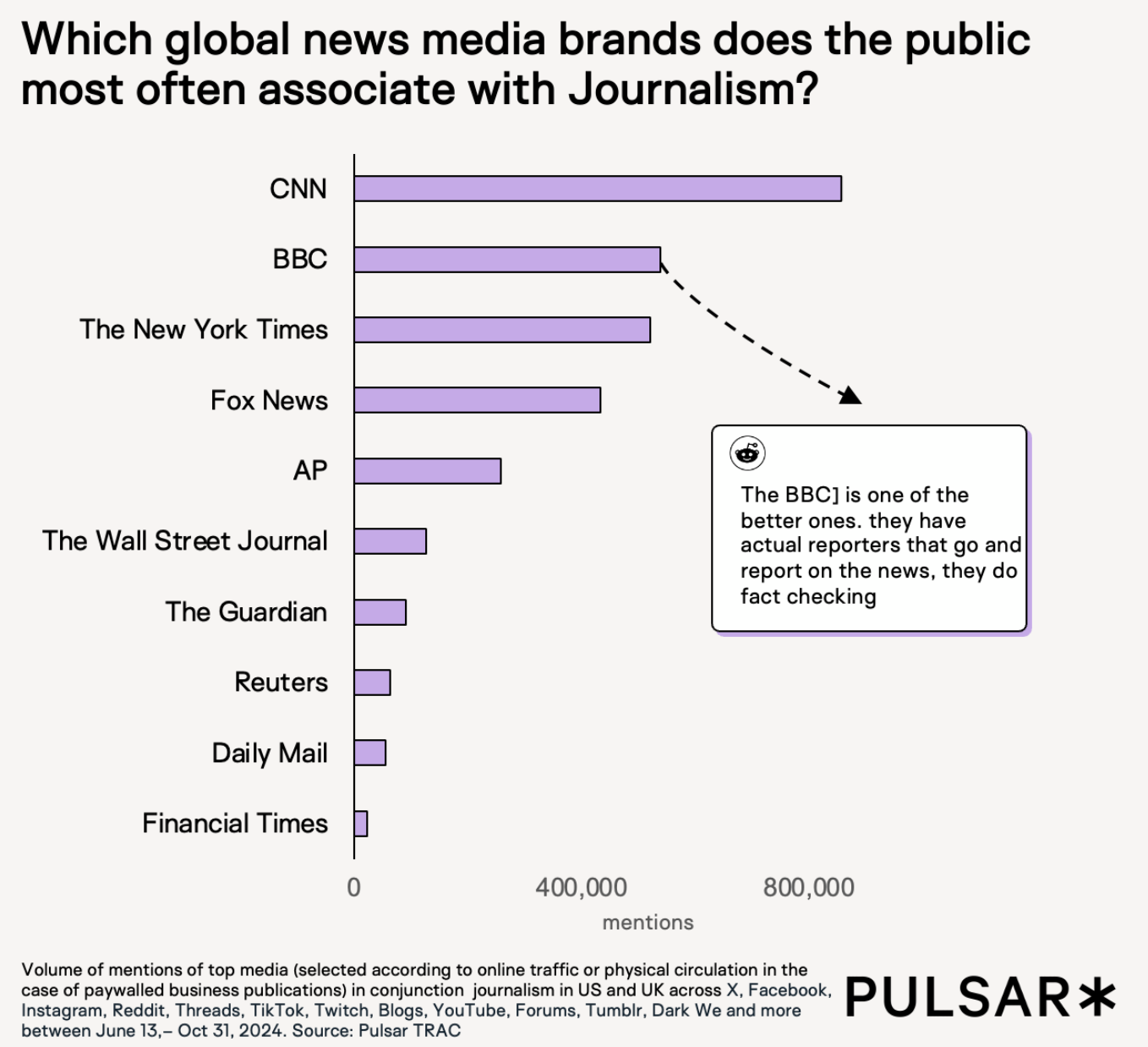
Certain outlets are more than just publishers and have become proxies for journalism itself. When people talk about journalism, the BBC, New York Times, Guardian and Washington Post lead in both news and social coverage.
These brands dominate not only through output, but through identity. They’re the ones most likely to be referenced as embodying journalism, whether being praised for their integrity or criticized for perceived bias.
This symbolic power gives them attention and cultural authority—but also scrutiny and risk. Their actions (and mistakes) are taken as signals about journalism as a whole, as well as individual brands.
How journalism gets judged
When we examine the data on journalism perception through the lens of praise versus criticism, new layers of insight emerge. A brand’s reputation doesn’t just depend on the topics it covers—it’s also shaped by how those topics themselves are received. Are they seen as impartial or partisan? Are they freely accessible or paywalled? Are they broadcast to the masses or targeted to a niche? Each of these elements plays a role in how a media brand is judged.
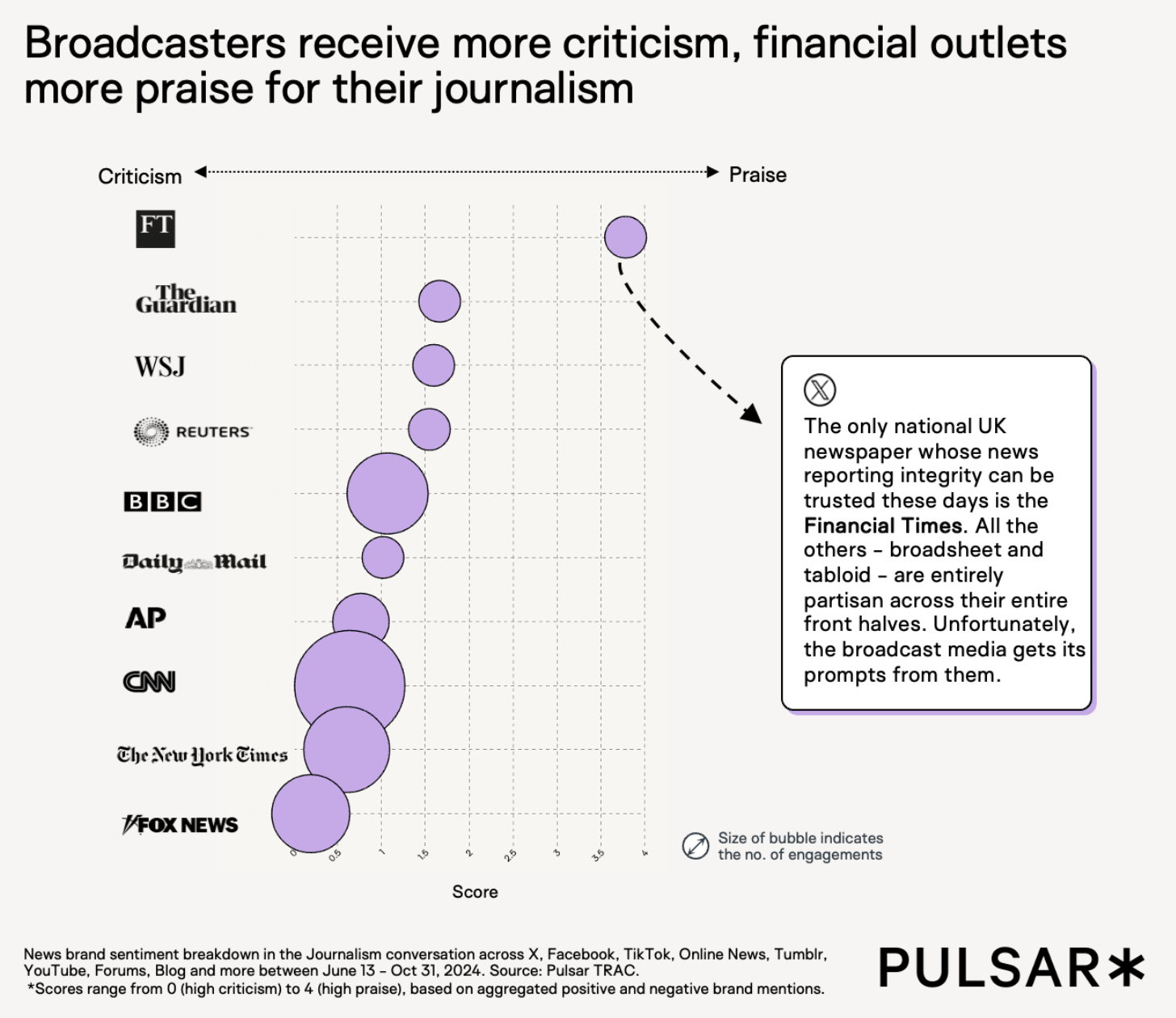
The Financial Times stands out as a rare case of consistent praise. Its journalism is widely perceived as rigorous, apolitical and tailored for a clearly defined audience. A loyal readership, devout focus, high paywall, and complex reporting style create a contained—and largely positive—narrative around the brand. This clarity of purpose helps shield the FT from the polarisation and backlash that often hit larger, more mainstream outlets. In a noisy media landscape, its editorial narrowness becomes a strategic strength. Through the lens of praise vs criticism, media brands that offer a different perspective can stand out in big ways.
Journalism as brand equity: The full report
The data reveals a media landscape in flux— legacy symbols, niche powerhouses, and viral disruptors all compete for journalistic credibility. Download the full report to understand how audiences are redrawing the lines between media and journalism, and what this means for brand trust, reputational risk and editorial strategy.
You’ll discover
- How some news brands are seen as civic pillars—and some are treated as cultural fodder
- Where audiences find rigour and where they sense bias
- How branded campaigns look to place various of these news brands as either a civic good, or a guide to decision-making
The fight for audience trust is ongoing. Brands that show up consistently, cover what matters, and act with editorial clarity won’t just weather the storm—they’ll lead the next chapter in how journalism is understood.
To download the report, simply fill in the form below.