
Social Listening & Audience Intelligence Guide for Nonprofit and Charities
Related Sources
2025 is crunch time for nonprofits. Money’s tight, staff are burned out, and community needs are booming. Just doing more with less won’t cut it anymore. It’s time to rethink everything.
Over half of nonprofit leaders say funding worries keep them up at night. Costs are rising, donors want more transparency and relevance, and competition is fierce. Meanwhile, 95% report staff burnout is out of control, and smaller teams are stretched thin trying to keep up.
Demand keeps climbing as public funds dry up, leaving many nonprofits falling behind on their core mission. These challenges feed off each other, locking organizations in crisis mode and blocking growth.
The way forward? Empathy at scale. Really knowing your donors, volunteers, and communities - their needs, values, and language - is now your biggest strategy advantage. Audience Intelligence goes way beyond social listening, giving nonprofits the sharp insights to break the cycle, act fast, and make a bigger impact.
Table of Contents
- 1. Why social listening matters for non-profits
- From Monitoring to Intelligence: A Strategic Maturity Model for Nonprofits
- Traditional Research vs. Audience Intelligence: A Strategic Shift
- Key Benefits of Social Listening for Nonprofits
- 2. The Non-Profit's Action Playbook
- Campaign Messaging & Creative Optimization
- Donor Segmentation & Persona Development: Moving Beyond Demographics
- Real-Time Trend & Sentiment Tracking
- Benchmarking Nonprofit Behaviors
- Stakeholder & Policy Mapping
- Reputation & Risk Monitoring
- 3. A Practical Guide to the Pulsar Toolkit
- Pulsar TRAC in Action: From Search Setup to Audience Segmentation
- Pulsar Narratives in Action: Uncovering Hidden Beliefs with a Simple Search
- Unifying Your Intelligence: Integrating First-Party Data
- 4. Audience Insights: building blocks for a more resilient future
1. Why social listening matters for non-profits
To navigate the complexities of the modern digital landscape, it is essential for non-profit organizations to understand the critical distinctions between three levels of maturity in using public data: social media monitoring, social listening, and audience intelligence. This evolution represents a shift from a reactive posture to a proactive and, ultimately, strategic command of the conversations that shape an organization's destiny.
From Monitoring to Intelligence: A Strategic Maturity Model for Nonprofits
| Stage | Definition | Primary Purpose | Key Question Answered | Analogy | Strategic Value |
| Social Media Monitoring
“The What” |
The reactive process of tracking brand mentions, keywords, and hashtags in near real-time across social platforms. | To manage and protect brand presence by responding to direct mentions, questions, and feedback. | What is being said about us right now? | Seeing individual trees in the forest. | Operational oversight; limited insight beyond direct interactions. |
| Social Listening
“The So What” |
An analytical approach that interprets broader sentiment, themes, and context from aggregated conversation data. | To understand emotional tone, identify trends, and diagnose narrative patterns. | Why are people saying this? | Understanding the patterns in the forest. | Offers strategic context for messaging and campaign calibration. |
| Audience Intelligence
“The Now What” |
A strategic discipline that combines conversation data with behavioral signals to map audience motivations and predict future actions. | To inform decision-making, audience segmentation, and message targeting at scale. | Now what should we do based on what we know? | Mapping the entire ecosystem—including terrain, climate, and movement. | High-value intelligence for shaping long-term strategy and forecasting cultural shifts. |
Traditional Research vs. Audience Intelligence: A Strategic Shift
Focus groups, phone surveys, and interviews have long been staples of nonprofit research. But these methods are slow, costly, and often suffer from response bias—participants know they’re being observed, which shapes their answers.
In contrast, audience intelligence provides continuous, real-time access to authentic conversations happening organically online across social media, forums, blogs, and search behavior. This data reflects genuine opinions and emotions, free from artificial influence.
The result? Organizations gain faster, more reliable insights, enabling agile decision-making and sharper strategy development.
For nonprofits, lagging behind in listening capabilities risks being drowned out in a crowded digital landscape where attention and funding are limited. Moving from reactive monitoring to proactive audience intelligence means transitioning from crisis management to strategic foresight.
| Core Non-Profit Challenge | Reactive Monitoring (What You See) | Proactive Listening (What You Analyze) | Strategic Intelligence (What You Do with Pulsar) |
| Declining Donor Retention | "Donors are not renewing their annual gifts." | "Sentiment analysis shows donor fatigue around our generic fundraising messaging." | Segment donor audiences in Pulsar TRAC to personalize appeals based on their unique motivations and affinities.16 |
| Low Volunteer Engagement | "Few people are signing up for our volunteer events." | "Conversations on community forums show that potential volunteers feel their professional skills are not being utilized." | Identify skills-based volunteer opportunities mentioned organically and create targeted recruitment drives for specific professionals.18 |
| Ineffective Advocacy Campaigns | "Our online petition isn't getting enough signatures." | "Topic analysis reveals our campaign message is confusing and not resonating with the public's primary concerns." | Use Pulsar Narratives to discover a more potent cultural narrative to frame the advocacy campaign, aligning it with existing public beliefs.20 |
| Negative Brand Perception | "We are seeing an increase in negative comments on our social media posts." | "Thematic analysis of negative comments points to a recurring issue with a specific service or program." | Use Pulsar TRAC to pinpoint the exact audience segment driving the negative sentiment and address their specific concerns directly through targeted messaging and operational improvements.6 |
Table 1: The Non-Profit Intelligence Matrix. This table maps common non-profit challenges to the escalating levels of insight, demonstrating the clear, actionable value of moving from simple monitoring to strategic audience intelligence with Pulsar.
Key Benefits of Social Listening for Nonprofits
- Target precision audiences with tailored messages
- Surface giving motivations like duty, urgency, or empowerment
- Optimize timing, content, and calls-to-action
- Identify new donor and volunteer communities
- Pre-empt and mitigate reputational risks early
2. The Non-Profit's Action Playbook
For a modern non-profit, audience intelligence is not a single-use tool but a versatile, mission-critical capability that enhances every core function. It provides the data-driven empathy needed to transform fundraising, optimize campaigns, shape policy, and protect your organization's most valuable asset: its reputation. This section provides a practical playbook, illustrated with real-world case studies and examples, on how to deploy social listening and audience intelligence to drive measurable impact across your organization.
Campaign Messaging & Creative Optimization
Why it matters:
Campaigns live or die on resonance. Social listening reveals not just what people are talking about, but how they talk about it—the words, metaphors, and emotional tones that cut through. This lets nonprofits refine CTAs, slogans, and creative assets to feel authentic across different communities or geographies.

Case Study: Shelter UK
During COVID-19, Shelter UK tapped Pulsar to analyze public discourse around homelessness. By comparing political debates, grassroots conversations, and local community narratives, the team uncovered key storytelling gaps. This insight led to localized messaging—highlighting housing insecurity as both a personal and systemic issue—which boosted advocacy traction and donor engagement.
Donor Segmentation & Persona Development: Moving Beyond Demographics
Why it matters:
Demographics alone don’t explain why someone gives—or why they stop. Behavioral and psychographic segmentation unlocks deeper patterns: shared values, language preferences, cause affinities, even meme culture signals that indicate generational engagement styles.
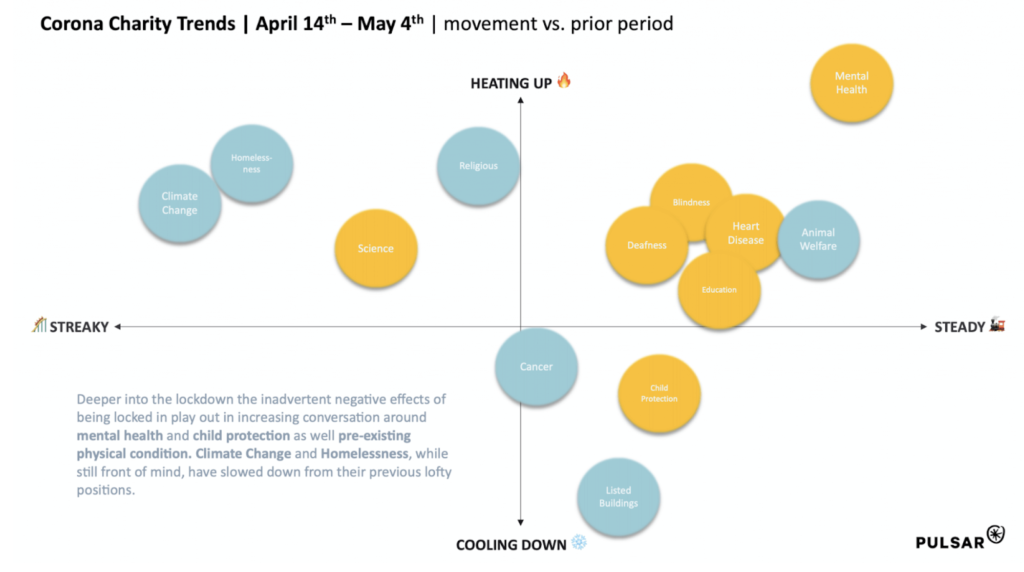
Case Study: Pulsar Nonprofit Workshop
Nonprofits like The Bible Society and The Children’s Society used Pulsar to create multidimensional donor personas. By analyzing the causes supporters follow, their online tone, and their cultural touchpoints, these orgs developed personalized supporter journeys—turning casual followers into recurring donors and even volunteers.
Real-Time Trend & Sentiment Tracking
Why it matters:
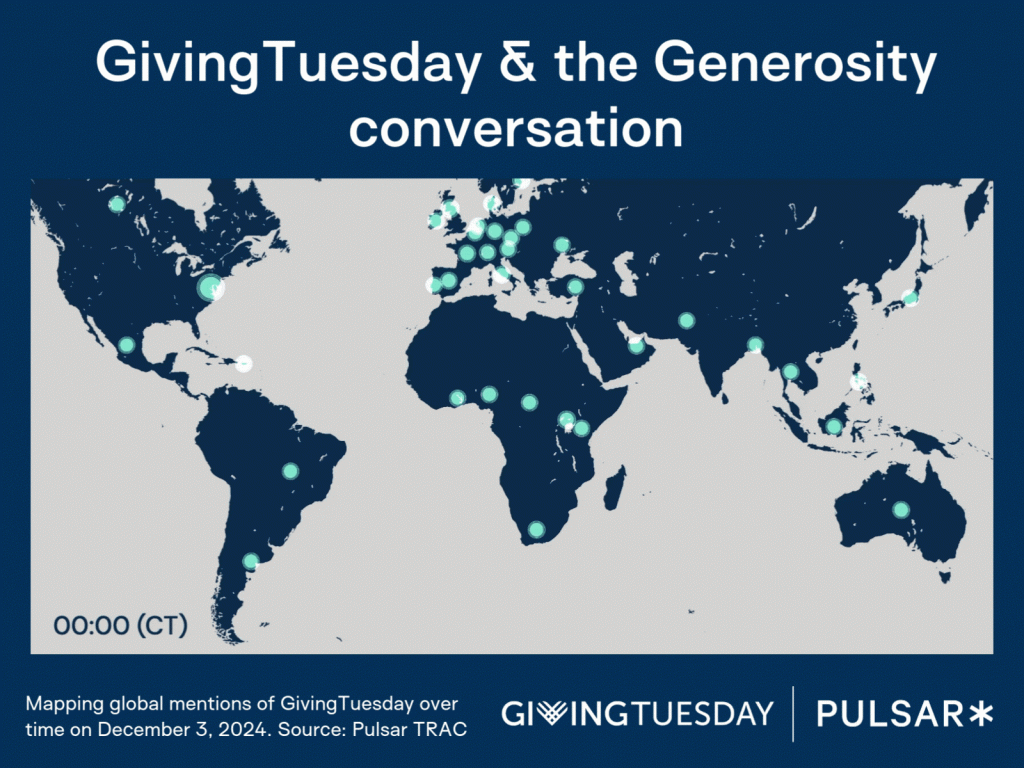
Global giving days like GivingTuesday generate billions of impressions—but attention peaks fast and fades even faster. Real-time analysis allows nonprofits to adapt messaging in the moment, ensuring campaigns ride cultural highs rather than miss them.
Case Study: GivingTuesday 2024
Partnering with GivingTuesday, Pulsar TRAC tracked worldwide conversations in real time:
- Top Cause: Health & Healthcare surged as the most-discussed giving focus.
- CTA Dynamics: Urgency (“Act now”) dominated, while Empowerment (“Your gift matters”) resonated closely; Duty appeals worked best for family and education causes.
- Non-Monetary Giving: Volunteering and everyday acts of kindness rose sharply, reflecting a radical generosity trend amid economic strain.
- Emotional Trends: Gratitude and solidarity spiked during campaign peaks, while burnout surfaced later—crucial for planning follow-up engagement.
Nonprofits using this data could pivot mid-campaign—switching CTAs, shifting content formats, or adding volunteering pathways—maximizing cultural relevance and donor response.
Benchmarking Nonprofit Behaviors
Why it matters:
You can’t compete if you don’t know the benchmark. Pulsar’s collaboration with Hootsuite produced the first Nonprofit Social Media Trends Report, analyzing thousands of campaigns to reveal what’s working (and what’s not) across platforms like TikTok, Instagram, and LinkedIn.
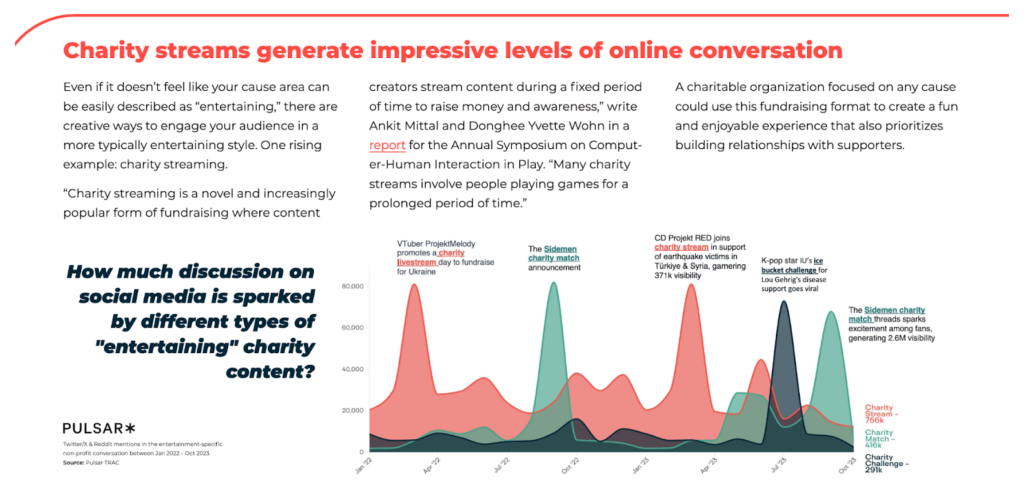
Key Insights:
- Value-Driven Branding Wins: Storytelling around community impact consistently outperforms transactional “Donate Now” asks.
- Cultural Engagement > Silence: Nonprofits addressing complex social issues authentically see stronger audience loyalty than those who avoid them.
- Quality Over Quantity: Fewer posts, better stories. Emotional alignment beats volume every time.
- CTAs That Work: “Stand with” and “Join” outperform “Donate,” especially with Gen Z and Millennials.
This data helps nonprofits prioritize content strategies that meet supporters where they are—emotionally and culturally.
Stakeholder & Policy Mapping
Why it matters:
Advocacy campaigns don’t just target donors—they influence policymakers, journalists, and coalition partners. Social listening maps issue-specific ecosystems: which influencers matter, how policies are framed, and where narratives emerge.
Case Study: Compassion International
By analyzing adjacent conversations on child development, faith-based giving, and political narratives, Compassion International identified new advocacy partners and preempted opposition talking points—informing both campaign messaging and internal alignment.
Reputation & Risk Monitoring
Why it matters:
In an era of misinformation and fast-moving backlash, nonprofits need early warning systems. Real-time sentiment monitoring lets teams spot crises before they escalate, respond transparently, and protect hard-earned trust.
Applications include:
- Setting alerts for sudden spikes in negative sentiment.
- Tracking misinformation campaigns or activist targeting.
- Surfacing “hidden” community concerns before they snowball.
3. A Practical Guide to the Pulsar Toolkit
Understanding the strategic value of audience intelligence is the first step; the next is seeing how accessible and powerful the right tools can be for a non-profit professional's daily workflow. The Pulsar platform is not an esoteric data science tool requiring a team of analysts. It is an intuitive and modular command center designed to provide actionable insights for marketers, fundraisers, and communicators.44 The suite's power lies in its two core components,
Pulsar TRAC and Pulsar Narratives AI, which work in concert to provide intelligence on both the micro and macro levels—from specific community conversations to broad cultural trends.
Pulsar TRAC in Action: From Search Setup to Audience Segmentation
Pulsar TRAC is the foundational audience intelligence and social listening platform, serving as the engine for data collection and analysis.
- Comprehensive Data Collection: Its primary strength is the sheer breadth of its data sources. TRAC provides a 360-degree view of public conversation by pulling data not only from major social platforms like X (Twitter), Facebook, Instagram, TikTok and Twitch, but also from a vast array of online news, print publications, TV and radio broadcasts, podcasts, blogs, and forums.41 This ensures that an organization avoids blind spots and captures the full context of any topic.
- Intuitive Search and Analysis: Setting up a search is straightforward, ranging from simple keyword tracking to complex boolean queries, a process that can be further simplified using Pulsar's integrated AI Boolean Generator.22 Once data is collected, it can be sliced and diced with over 50 different interactive filters, including demographics, sentiment, and keywords.16
- The Power of Audience Segmentation: TRAC's most distinctive feature is its ability to instantly segment the audience behind any conversation.16 After capturing the data on a topic, the platform's AI analyzes the participants and groups them into distinct communities based on their shared interests, behaviors, and self-descriptions. This is the mechanism that moves analysis from "what is being said" to "who is saying it".11 For a non-profit, this means it can segment the conversation around "animal welfare" to see precisely how 'Urban Pet Owners' discuss the issue differently from 'Rural Farmers' or 'Veterinary Professionals', enabling the creation of tailored messaging for each distinct group.
Pulsar Narratives in Action: Uncovering Hidden Beliefs with a Simple Search
While TRAC excels at analyzing specific conversations and the audiences within them, Pulsar Narratives AI is a revolutionary tool designed to uncover the deeper cultural currents and belief systems that shape public opinion on a macro level.30
- A Search Engine for Public Opinion: The platform's defining characteristic is its simplicity. It functions like a web search for beliefs, requiring no complex data analysis skills or knowledge of boolean logic.30 A user can type in a broad topic like "mental health" or "affordable housing" and receive an instant, comprehensive briefing on the top 100 narratives driving that conversation.
- From Topics to Beliefs: Narratives AI goes beyond topic clustering to reveal the underlying opinions, beliefs, and worldviews that constitute each narrative.21 For a non-profit, this provides a profound strategic advantage. It is the difference between knowing that people are talking about "homeless shelters" (a topic) and understanding the emerging public narrative that "providing housing first is more effective and humane than the traditional shelter system" (a belief system). This level of insight allows an organization to align its long-term strategy and communications with the direction public opinion is already heading.
Unifying Your Intelligence: Integrating First-Party Data
A unique and powerful feature of Pulsar TRAC is the ability for an organization to upload its own first-party data, such as donor lists from a CRM, volunteer databases, or email subscriber lists.22 This closes the intelligence loop, allowing a non-profit to analyze the public social media conversations of its
own known supporters. An organization can create a custom "panel" of its major donors to track their changing interests and concerns over time, or analyze the social media activity of its most engaged volunteers to better understand their motivations. This integration provides an unparalleled, 360-degree view of the people who matter most to the mission.16
The combination of TRAC and Narratives gives a non-profit a dual-capability command center. TRAC provides the tactical tools needed for the daily "war room"—tracking campaign performance, engaging with communities, and responding to immediate events. Narratives provides the strategic foresight needed for the "board room"—understanding deep cultural shifts, planning long-term advocacy, and positioning the organization for the future. This integrated capacity to operate on both tactical and strategic levels simultaneously is a rare and invaluable asset for any mission-driven organization.
| The Question You're Asking | Primary Tool | How You'd Use It |
| "Who are the most influential journalists and bloggers talking about our cause?" | Pulsar TRAC | Run a search on your core topic, apply source filters for 'News' and 'Blogs', then view the 'Top Authors' visualization to see who has the most reach and engagement.31 |
| "What are the core beliefs of people who oppose our new policy initiative?" | Pulsar Narratives | Run a search on your initiative's topic, then analyze the 'Top Themes' and read the AI-generated summaries for narratives with negative sentiment to understand the root of the opposition.21 |
| "How did our #GivingTuesday campaign perform with donors under 35?" | Pulsar TRAC | In your TRAC campaign search, apply a demographic filter for age, then analyze the sentiment, top content, and engagement metrics specifically for that audience segment.16 |
| "What is the emerging cultural narrative around 'corporate social responsibility' that we can tap into for partnerships?" | Pulsar Narratives | Use Narratives to search 'corporate social responsibility' and examine the 'Evolution Visualization' to see how the public conversation has shifted over time, for example, from 'philanthropy' to 'accountability'.30 |
| "Which of our existing donors are also talking about environmental issues online?" | Pulsar TRAC | Upload your donor list as a First-Party Data source to create a custom audience panel. Then, run a search within that panel for keywords related to environmental causes to identify overlapping interests.22 |
Table 2: Pulsar for Non-Profits: Choosing the Right Tool for the Task. This table serves as a practical guide, helping non-profit professionals match their specific business questions to the correct Pulsar tool and methodology.
4. Audience Insights: building blocks for a more resilient future
The modern non-profit operates in an environment of unprecedented complexity and constraint. The compounding pressures of financial uncertainty, workforce burnout, and rising demand for services require more than just incremental improvements; they demand a fundamental shift in strategic capability. This report has detailed how audience intelligence is not a peripheral marketing function or a technological luxury, but a core strategic imperative for any organization seeking to build a resilient and impactful future.
The journey from reactive monitoring to proactive listening, and ultimately to strategic audience intelligence, is a path to organizational maturity. By embracing this evolution, non-profits can transform their operations across every critical function.
- In Fundraising, it is the shift from generic, fatiguing appeals to personalized, empathetic conversations that resonate with donor motivations, fortifying financial stability and fostering long-term loyalty.
- In Advocacy, it is the move from measuring simple activity to shaping and dominating the public narratives that drive real policy change, proving impact with quantifiable data.
- In Volunteer Management, it is the transformation of the volunteer relationship from a transaction of time to a partnership of passion, building an engaged and committed community that feels valued and heard.
Platforms like Pulsar TRAC and Pulsar Narratives are the enabling technologies for this transformation. They provide a unified command center to understand the micro-dynamics of specific audience communities and the macro-currents of cultural belief systems. They make the power of advanced AI and data analysis accessible, allowing mission-driven leaders to move beyond guesswork and act with the confidence that comes from data-driven insight.
Ultimately, the call to action is not simply to adopt a new tool, but to embrace a new way of leading. It is a commitment to place listening and empathy at the very center of strategy. In a world of finite resources and infinite noise, the ability to truly hear, understand, and connect with the people you serve and depend upon is the most valuable asset a non-profit can possess. By activating these insights, organizations can break free from the cycle of crisis and build a more responsive, more effective, and more resilient foundation to achieve their mission for years to come. To learn more about how audience intelligence can empower your organization, explore the solutions available at pulsarplatform.com.
To stay ahead of shifting nonprofits and charities' narratives and evolving audience behaviors, subscribe to our newsletter.