Social Listening & Audience Intelligence Guide for Finance
Related Sources
Gone are the days when financial institutions quietly shaped markets behind closed doors. Today, five billion people share advice, frustrations, and opinions about money in public digital spaces—from TikTok’s #FinTok, YouTube, and Reddit’s r/personalfinance. For banks, fintechs, and insurers, social listening isn’t a luxury; it’s survival.
Growth now depends on decoding the unfiltered, always-on chatter of consumers and communities. But this openness is a double-edged sword. Viral misinformation, regulatory risks, and rapid sentiment shifts can erode trust faster than any traditional PR crisis.
This guide is your playbook. Tailored for marketing, insights, and compliance leaders in the financial sector, it walks you through upgrading from simple mention tracking to a full-fledged audience intelligence strategy. Using Pulsar as our lens, we’ll show you how to transform noisy data into a strategic asset that powers innovation, builds trust, and protects your brand in the digital square.
Table of Contents
- 1. Why Social Listening Is Critical for Financial Services
- The Great Unbundling of Financial Advice
- Navigating Compliance and Brand Reputation in Financial Social Media Listening
- Combating Financial Misinformation with Audience Intelligence Tools
- 2. The Strategic Playbook: Actionable Social Listening Use Cases for Financial Services
- Spotting Latent Demand: Product Innovation and Service Refinement
- Building Digital Trust: Proactive Reputation and Crisis Management
- Decoding the Competition: Gaining a Strategic Edge
- Navigating Global Uncertainty and Currency Skepticism: A Real-Time Narrative Insight
- 3. Implementing an Audience-First Marketing Strategy in Finance
- Building Your Social Intelligence Tech Stack
- From Insights to Action: Democratizing Data Across the Organization
- Measuring What Matters: A Framework for ROI in Financial Social Listening
- Conclusion
1. Why Social Listening Is Critical for Financial Services
The Great Unbundling of Financial Advice
Financial advice is no longer the sole domain of banks and advisors. Today’s consumers—especially Gen Z (76%) and Millennials (65%)—turn to social platforms for guidance, community, and candid opinions. Platforms like TikTok (#FinTok), YouTube, and Reddit have birthed a new class of “finfluencers,” who sway millions with jargon-free, relatable content.
This shift reveals an unmet need: accessible, transparent financial education. Topics like “how to budget” or “ETFs explained” trend because traditional institutions have failed to connect authentically.
For forward-thinking finance brands, social listening unlocks a direct line to these conversations. By monitoring emerging themes and knowledge gaps, you can create content that answers real questions—reclaiming your role as the trusted expert for tomorrow’s customers.
Navigating Compliance and Brand Reputation in Financial Social Media Listening
Regulation in finance is strict. Agencies like the FFIEC, FINRA, and SEC scrutinize every message, including social media posts. One misstep—a rogue employee tweet or an overpromising ad—can trigger fines and permanent reputational damage.
This tightrope walk often results in overly cautious messaging that fails to engage or inspire.2 Meanwhile, nimble finfluencers exploit this vacuum. Audience intelligence platforms with built-in compliance features—automated risk flagging, secure archiving—allow you to break free. They enable real-time, compliant engagement, transforming legal oversight from a bottleneck into a strategic ally.
Combating Financial Misinformation with Audience Intelligence Tools
In finance, trust is the currency of survival. Misinformation isn’t just bad PR—it’s a potential financial disaster. Fake news, fraudulent reviews, or conspiracy theories can dismantle decades of goodwill in hours.
The challenge? Not just tracking mentions but evaluating source credibility. A negative article on Bloomberg is a PR issue; the same story amplified by fake news sites is a brand safety crisis. Advanced audience intelligence platforms add a “credibility layer” to distinguish genuine criticism from malicious attacks, allowing teams to respond effectively and proactively.
2. The Strategic Playbook: Actionable Social Listening Use Cases for Financial Services
Spotting Latent Demand: Product Innovation and Service Refinement
Traditional market research is slow and often filtered through biases. Social listening captures real-time, candid consumer feedback—not only on your products but also your competitors’. This continuous pulse helps you spot market gaps and evolving trends before they hit formal reports.
Case Study: Aviva’s Savings Campaign
Aviva used Pulsar TRAC to analyze conversations around saving money. They identified three core community themes: #savingtogether (support networks), #savingsstruggles (common challenges), and #savingsheroes (aspirational success stories). These insights inspired their “#savesmarter” campaign featuring a family savings challenge and an online “Financial Personality Profiler,” creating authentic engagement rooted in real customer language.
Building Digital Trust: Proactive Reputation and Crisis Management
Trust is fragile and fleeting in a hyper-connected world. Social listening is your early warning system, detecting subtle shifts before they explode into crises.
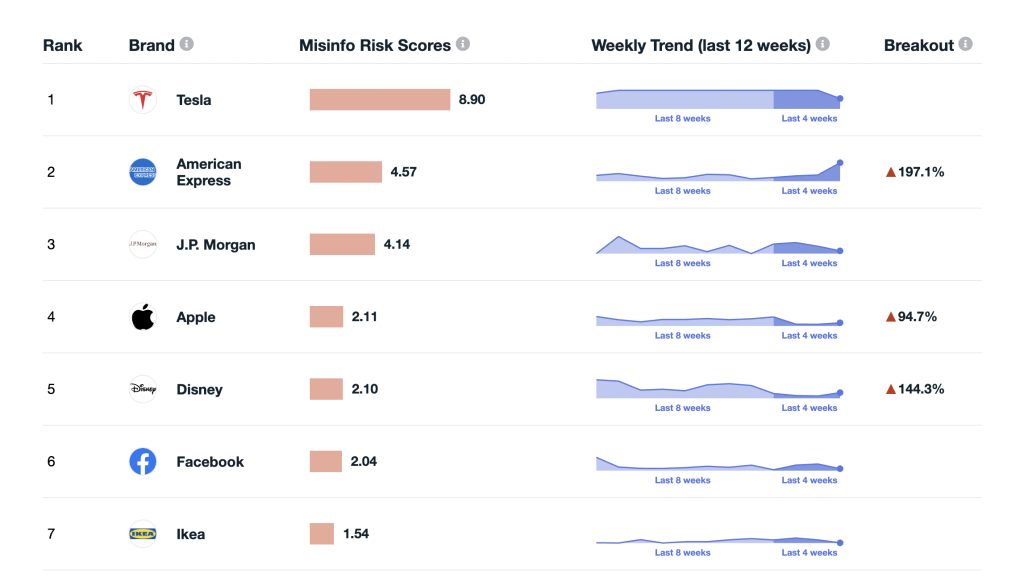
Case Study: Amex & J.P. Morgan’s Misinformation Risk
Using the Pulsar Misinformation Risk Index (built with NewsGuard), Amex tracked exposure to unreliable narratives weekly.

A spike occurred when fringe media falsely linked credit card companies to gun sales tracking, fueling civil liberties backlash. Simultaneously, the brand faced allegations of “woke racism” from politically motivated outlets. With concrete data showing a 40% exposure increase, Amex adjusted strategy dynamically.
Meanwhile, J.P. Morgan’s risk score hit a yearly low after previous spikes tied to high-profile controversies, illustrating how fast misinformation cycles shift and why quantifying risk is now table stakes.
Decoding the Competition: Gaining a Strategic Edge
The financial services battlefield is crowded with traditional banks, neobanks, fintechs, and Big Tech entrants. Social listening elevates competitive analysis from simple mention counts to deep insights on sentiment and emerging narratives.
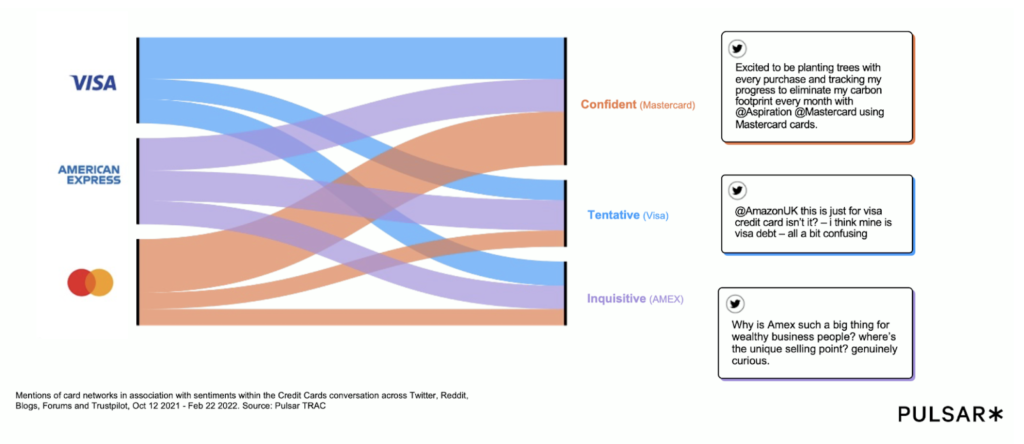
Case Study: Credit Card Market Mapping
Pulsar TRAC helps issuers benchmark brand perception vs. Visa, Mastercard, or Amex by analyzing feature resonance (airline miles vs. cashback) and tracking trends (crypto rewards, fraud anxiety, digital wallets). This intelligence enables hyper-personalized marketing and future-proof product roadmaps.
Case Study: Buy Now, Pay Later (BNPL) Market Disruption
The BNPL narrative shifted from discretionary “wants” (fashion) to essential “needs” (groceries, utilities), becoming a lifeline for many. Pulsar segmented conversations into groups like “Fintech Enthusiasts,” “Financially Vulnerable Consumers,” and “Regulatory Commentators,” each requiring distinct messaging—from tech thought leadership to empathetic financial wellness and policy advocacy. The table below shows how to operationalize this audience intelligence.
BNPL Audience Narratives: A Comparative Analysis Audience Segment
| Audience Segment (from Pulsar Report) | Core Narrative / Belief | Key Concerns | Language & Channels | Strategic Implication for a Bank |
| Fintech Enthusiasts | BNPL is a disruptive technological innovation; focus is on market share, company valuations, and technology stacks. | Scalability, regulation as a barrier to innovation, user acquisition costs, and profitability models. | Technical, business-focused language. Found on X (formerly Twitter), industry blogs, and in financial news media. | Engage with thought leadership content on the future of credit; position the bank as a potential partner or a stable, regulated alternative. |
| Financially Vulnerable Consumers | BNPL is a necessary tool for survival; a way to manage tight cash flow for essential goods and services. | Hidden late fees, the potential for negative impact on credit scores, the risk of spiraling debt, and a feeling of being exploited by lenders. | Emotional, anecdotal, and often anxious language. Found on it forums (e.g., r/personalfinance), Facebook groups, and product review sites. | Offer transparent, low-interest micro-loans or secured credit lines as a safer alternative. Market with empathy, focusing on financial wellness and responsible lending. |
| Political & Regulatory Commentators | BNPL is the "Wild West" of consumer credit that must be reined in to protect consumers from harm. | Lack of transparency, potential for predatory lending practices, and the risk of systemic financial instability. | Formal, policy-oriented, and critical language. Found in mainstream news media, political blogs, and on government websites. | Proactively engage in the regulatory conversation. Issue white papers and position the bank as the gold standard for responsible, transparent lending practices. |
| Young Media Buffs / Creatives | BNPL is a convenient and aspirational tool for affording lifestyle purchases, creative software, and equipment. | Overconsumption, the environmental impact of fast fashion fueled by easy credit, and social pressure to spend. | Aspirational, trend-focused, and sometimes conflicted language. Found on visual platforms like TikTok, Instagram, and Pinterest. | Develop and promote financial literacy content. Partner with influencers on campaigns themed around "smart spending" or "conscious consumption." |
Navigating Global Uncertainty and Currency Skepticism: A Real-Time Narrative Insight
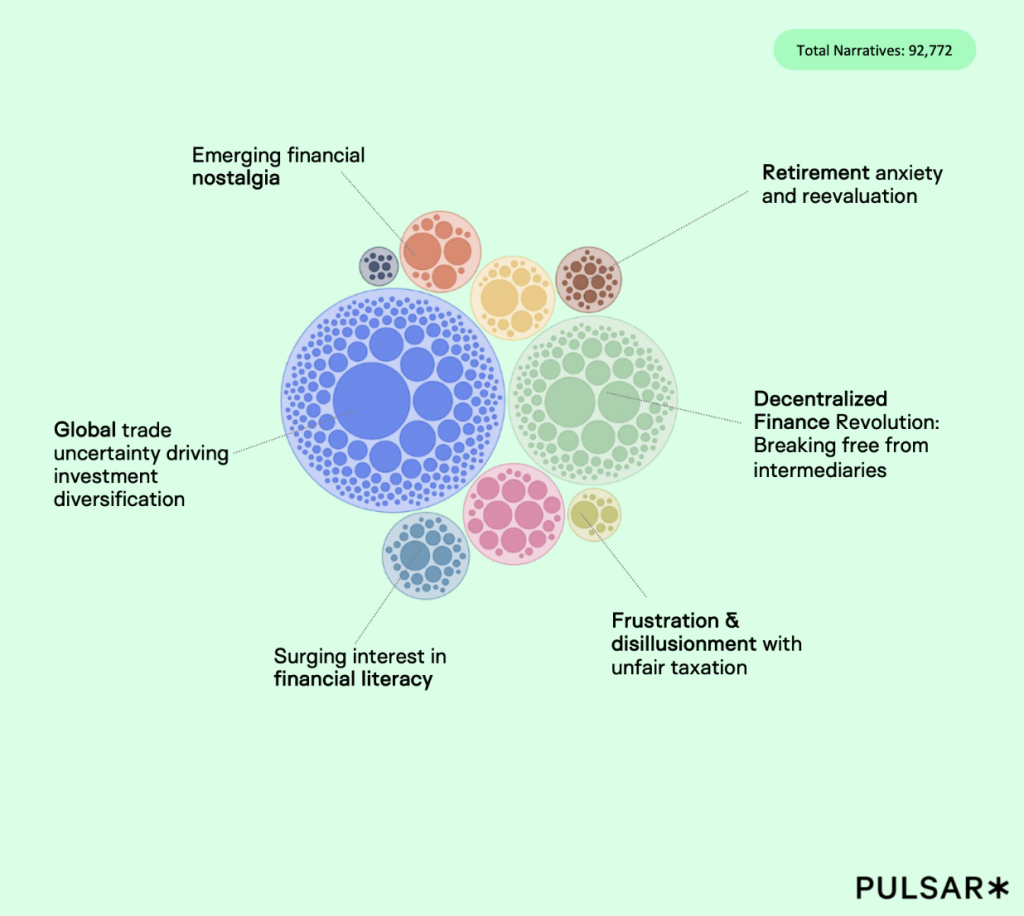
Narrative AI data reveals how tariffs and geopolitical uncertainty are reshaping financial conversations worldwide. Pulsar Narrative AI-powered report for Spring/Summer 2025 shows dominant narratives revolving around skepticism toward established financial policies, especially around the impact of President Trump's tariffs on stock markets. Phrases like “The stock market will keep tanking due to Trump’s tariffs” highlight investor anxiety about economic stability.
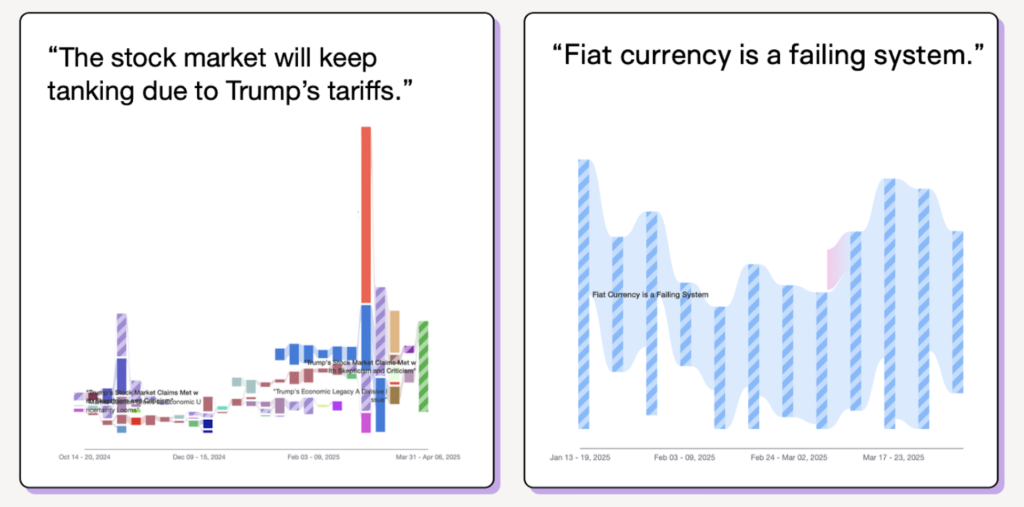
Alongside market jitters, there’s a growing distrust of fiat currency, with many social conversations calling it “a failing system.” This erosion of confidence in traditional money systems fuels interest in alternative currencies and decentralized finance (DeFi) models. Bitcoin, despite its controversies, emerges as a trusted refuge for many, prized for its fixed supply and perceived credibility over flashier alternatives like Ethereum or Memecoins.
This narrative insight offers a critical opportunity for financial brands:
- Product Innovation: Explore new offerings in DeFi or alternative investments aligned with consumer demand.
- Marketing & Education: Address consumer anxiety by demystifying financial policies and highlighting stability options.
- Risk Management: Monitor misinformation risks linked to political rhetoric and misinformation on currency stability.
3. Implementing an Audience-First Marketing Strategy in Finance
Knowing why and how to use audience intelligence is the start. The final step is building the capability to execute. This section provides a blueprint for selecting tools, structuring workflows, and measuring impact.
Building Your Social Intelligence Tech Stack
Financial services require a specialized tech stack. When selecting a platform, prioritize these finance-grade requirements:
- Compliance and Security: The platform must have robust, finance-specific features, including automated flagging of non-compliant language and secure archiving for audits (FFIEC, FINRA). Top-tier data security certifications (PCI DSS, SOC 2) are non-negotiable.
- Advanced AI and Analytics: The AI must deliver nuanced insights, including sentiment analysis that understands sarcasm and industry context, plus the audience segmentation and narrative detection capabilities essential for deep understanding.
- Comprehensive Data Sources: Your platform needs broad access to the channels where real financial conversations happen, including niche forums like Reddit, professional networks, and review sites—not just major social networks.
- Actionability and Usability: The platform must distill complex data into intuitive visualizations and actionable summaries. It should democratize insights with customizable dashboards, not deliver a "firehose of mentions" that only a data scientist can interpret.
From Insights to Action: Democratizing Data Across the Organization
The biggest failure of social listening programs is siloing them in marketing. True ROI is unlocked only when insights are shared and integrated across the business:
- Product Development: Give product managers dashboards highlighting customer complaints and feature requests. This real-world data ensures your product roadmap aligns with actual customer needs.
- Customer Service: Integrate social listening into service workflows to proactively identify and resolve issues, often before a customer even files a formal complaint. This turns negative experiences into public displays of great service.
- Legal and Compliance: Make the legal team an upstream partner. Give them access to monitor risks and collaborate on pre-approved response playbooks. This speeds up reaction times while ensuring compliance.
- Strategy and C-Suite: Use executive dashboards to provide a real-time pulse of brand health, competitive share of voice, and misinformation risk. These strategic KPIs inform top-level decision-making.
Practical Example: Mapping Pulsar Tools to Financial Goals
To move from concept to execution, financial marketers can map strategic objectives to Pulsar tools. This provides clarity on what to deploy where:
| Strategic Goal | Finance Use Case | Pulsar Tool(s) Used | How the Tool Achieves the Goal |
| Product Innovation | Understanding the BNPL market to find unmet needs and create new offerings | Pulsar TRAC | Segments the audience into distinct communities (e.g., “Financially Vulnerable Consumers”) to reveal pain points and desires, guiding product design and positioning. |
| Reputation Management | Quantifying and managing a bank’s exposure to misinformation | Pulsar TRAC + NewsGuard Integration (Misinformation Risk Index) | Tracks brand mentions on unreliable sites and generates a quantifiable risk score, allowing comms teams to address threats proactively. |
| Competitive Intelligence | Analyzing the credit card market to exploit competitor weaknesses | Pulsar TRAC | Surfaces sentiment and key themes around competitors (e.g., praise for UX, anger over hidden fees) to inform campaigns and feature prioritization. |
| Market Intelligence | Anticipating macroeconomic and political narrative shifts | Pulsar Narratives AI | Detects and summarizes emerging conversations (e.g., “distrust in fiat currency”), enabling foresight into market volatility and regulatory risk factors. |
This mapping demonstrates that audience-first marketing isn’t theoretical—it’s an actionable framework. When implemented, each department (from product to legal to executive) gains relevant, real-time intelligence tailored to their objectives, breaking silos and accelerating decision-making.
Measuring What Matters: A Framework for ROI in Financial Social Listening
Proving the ROI of audience intelligence can seem hard, but it's not impossible. It just requires a more holistic model for measuring value:
- Cost Avoidance: This is your most tangible ROI. Calculate the potential cost of regulatory fines that were avoided because the platform flagged non-compliant content. Quantify the mitigated impact of a PR crisis by showing how an early alert prevented escalation.
- Operational Efficiency: Measure the time and resources saved generating insights compared to traditional methods. Track improvements in customer service metrics like response time.
- Lead Generation and Conversion: Use social listening to spot clear buying signals (e.g., users asking "what's the best credit card for travel?"). Compare the performance of campaigns informed by social insights to those that were not.
- Enhanced Customer Lifetime Value (CLV): Integrate social data with your CRM. Determine if customers engaged on social media have higher retention rates or adopt more products over time.
Conclusion
In today's transparent and volatile financial world, listening is the ultimate strategic asset. The billions of daily online conversations form an "unseen ledger"—a living record of your company's true standing with customers and critics. Ignoring it is a profound liability.
The future belongs to firms that move from passive monitoring to proactive, AI-powered audience understanding. Platforms like Pulsar are leading this evolution, providing the tools to not only listen at scale but to understand with unprecedented nuance. The financial institutions that thrive will be those that place audience intelligence at the heart of their strategy—using public conversation to build products people need, create content that builds trust, and manage risks before they materialize.
To stay ahead of shifting financial narratives and evolving audience behaviors, subscribe to our newsletter.